By Margarete Heymann
Located in Berlin, DE
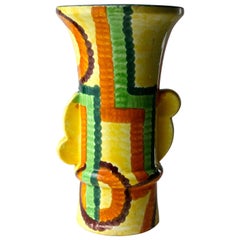
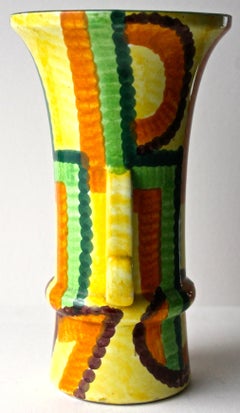
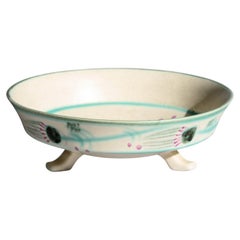
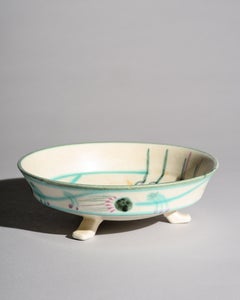
Matte-glazed earthenware bowl designed by Margarete Heymann-Löbenstein for Haël-Werkstätten, Germany, circa 1930. Raised on three small feet, the shallow circular form is hand-painted with turquoise rings, fine black lines and abstract motifs in lilac pink and soft violet.
The decoration moves freely across the pale ground and continues around the exterior. Precise circles and linear elements are balanced by looser painted forms, reflecting Heymann-Löbenstein’s distinctive combination of geometric discipline, expressive colour and playful movement. The three-footed base lifts the bowl slightly above the surface, keeping both its profile and exterior decoration visible.
Margarete Heymann-Löbenstein (1899–1990) studied at the Bauhaus in Weimar before co-founding Haël-Werkstätten with her husband Gustav Löbenstein and his brother Daniel in Marwitz in 1923. Under her artistic direction, Haël became one of the most progressive German ceramic manufacturers of the Weimar Republic, known for geometric forms, vivid glazes and freely painted abstract decoration. After the deaths of her husband and brother-in-law in 1928, she continued running the company independently.
As a Jewish entrepreneur, Heymann-Löbenstein closed Haël in 1933 amid increasing political and economic pressure and was forced to sell the business below value in 1934. The HB-Werkstätten subsequently opened on the same premises under Hedwig Bollhagen, initially retaining some Haël equipment, employees and forms before establishing its own identity. Heymann-Löbenstein emigrated to Britain in 1936 and continued her career under the name Grete Marks.
Category
1930s Art Deco Vintage German Vases and Vessels