Located in Downingtown, PA
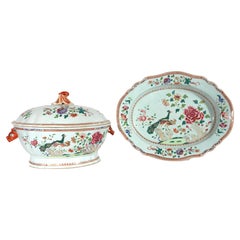
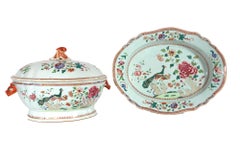
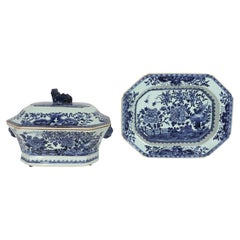
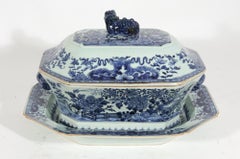
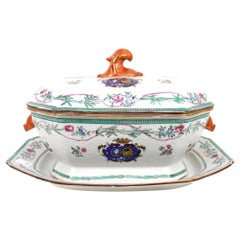
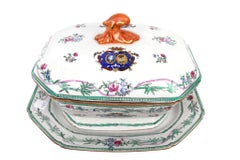
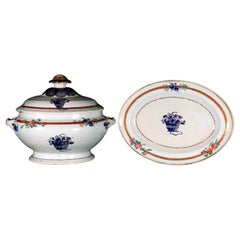
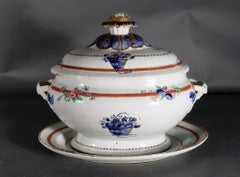
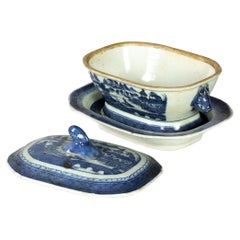
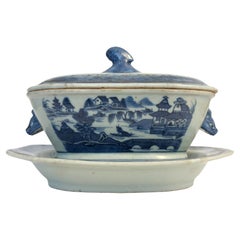
Chinese Export Porcelain Double Peacock Soup Tureen, Cover and Stand, Circa 1765
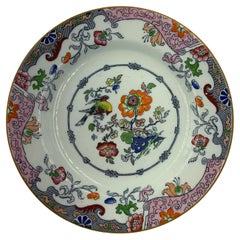
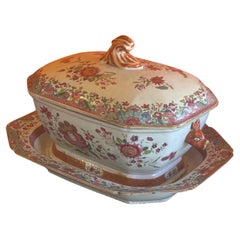
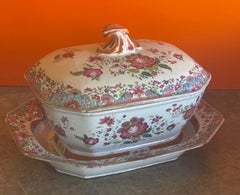
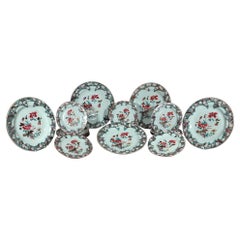
This Chinese export famille rose soup tureen, cover and stand is painted with the celebrated “Double Peacock” pattern, one of the most distinguished designs produced for the European market in the Qianlong period. The oval stand, its shaped rim scalloped in gentle lobes, and the oval tureen, its swelling bombé sides rising from a spreading molded foot, are decorated en suite with a pair of peacocks perched upon pierced garden rockwork amid flowering peonies, chrysanthemums and leafy branches. The birds are finely rendered, their plumage worked in rich tones of green, blue, ochre and iron-red, the long tail feathers sweeping across the white ground, while a profusion of blossoms in deep rose-pink, coral and soft green fills the surrounding field.
The low domed cover repeats the floral decoration and is surmounted by a boldly modeled pomegranate knop in iron-red and gilt, and the sides of the tureen are flanked by a pair of hare’s-head handles, also in iron-red with gilt spotting. A spearhead border frames the central composition of the stand and runs around the foot of the tureen, while the rims are banded with a running gilt trellis on an iron-red ground, interrupted at intervals by reserved panels of underglaze blue scrolling ornament that lend depth and vivacity to the palette.
Dimensions
Overall, assembled:
Width: 15 inches (38.1 cm)
Depth: 11¾ inches (29.8 cm)
Height: 9¾ inches (24.8 cm)
Tureen:
Width: 13¼ inches (33.7 cm)
Depth: 9¼ inches (23.5 cm)
Height: 9 inches (22.9 cm)
Stand:
Width: 15 inches (38.1 cm)
Depth: 11¾ inches (29.8 cm)
Height: 2½ inches (6.4 cm)
Provenance
Private collection.
Condition
Good antique condition throughout, the vibrant famille rose enamels, underglaze blue borders and extensive gilt highlights remaining remarkably bright, crisp and well preserved across all three components.
Historical Context
The “Double Peacock” pattern, the Serviço dos Pavões of Portuguese and Brazilian collectors, is among the most celebrated of all Chinese export famille rose designs. It was produced in great quantity for the open market, an estimated twenty thousand pieces between about 1750 and 1795, and has always been particularly prized in Portugal, Brazil and England; the Brazilian authority José de Almeida Santos, in his Manual do Colecionador Brasileiro (1950), ranked it the finest of the famille rose services made to European commission and singled out the drawing of the birds. Much of its renown rests on a royal association. The Portuguese royal house owned a service of the design, and when the French invasion of November 1807 drove the Braganza court into exile, the Prince Regent Dom João, King João VI from 1816, sailed for Brazil with his mother, Queen Maria I, and the court, carrying his Chinese porcelain services...
Category
1760s Chinese Antique Chinese Export Serveware, Ceramics, Silver and Glass