By Andre Antoine Lardin
Located in Forney, TX
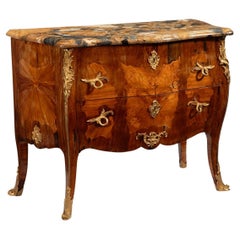
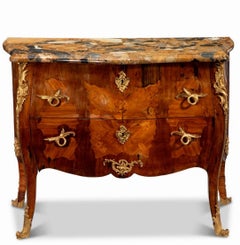
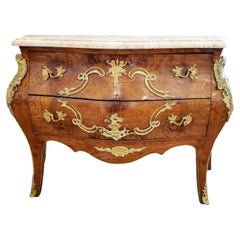
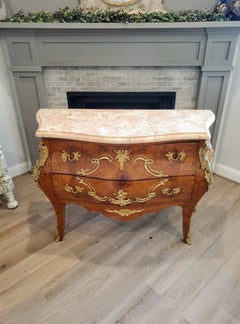
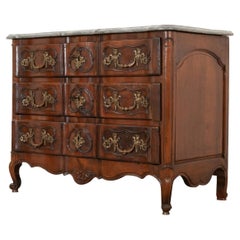
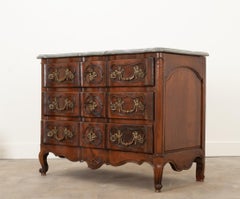
An extraordinary Louis XV period (1715-1774) French ormolu mounted tulipwood and kingwood marquetry bombé sauteuse commode by master Parisian ébéniste André-Antoine Lardin. circa late 1740s
In our 40+ years we have not came across a chest of drawers that captures our attention like this one!
Exquisitely hand-crafted in Paris in the mid-18th century, exceptionally executed in opulent and luxurious period King Louis 15th taste, featuring a curvacious serpentine-front bombe-form solid wood case fitted with two drawers, adorned with finely chased, chiseled and gilded bronze doré mounts, including rare and most distinctive sculptural fiolated scroll Rocaille handles, flanking ornate keyhole escutcheons with original key included. In absolutely stunning rare and exotic precious tulipwood and kingwood veneer work with striking warm rich highly figured grain patterns, elegant floral marquetry inlays and fascinating early sunburst panels. Topped with the original serpentine shaped Brèche de Médous marble-top with stepped molded edge. The Breccia de Médous is extracted in the towns of Médous and Asté, near Bagnères-de-Bigorre in the Hautes-Pyrénées. This dramatic breccia is composed of angular elements of contrasting colors ranging from black to yellow to gray creating a bold but subdued visual display.
Signed, retaining the original LARDIN blind stamp to top proper-right rear post underneath marble. André-Antoine Lardin (1724-1790) is a celebrated Master Cabinetmaker, earning maître in 1750, and particularly respected for his extraordinary woodworking veneer - marquetry work.
- PROVENANCE / ACQUISITION:
From the important collection of Loyd-Paxton, Dallas, Texas.
Property from the magnificent Estate of Mr. and Mrs. Robert Morris Graham Sr., El Paso, Texas, but also with homes in Dallas, Texas and Pebble Beach, California.
Acquired from the highly reputable auction house Heritage Auctions, Dallas, Texas.
2024 Furniture & Decorative Art Featuring The Collection of Mrs. Henry Ford II Signature Auction Catalog #8167
Loyd Paxton Gallery, Dallas, Texas.
With one of the finest collections in the world and prominent customers to match, including Sir Elton John, Truman Capote, Saudi Prince Faisal, and the Sultan of Brunei. Rare French antiques from Loyd-Paxton made their way into Versailles when it underwent renovations, and the Metropolitan Museum of Art in New York purchased furnishings, including a dazzling Louis XIV Boulle desk that had been owned by the Sun King himself.
Betty Jo Graham might not hold celebrity status but her remarkable life and many contributions to American history and the arts community of El Paso, Texas, make her deserving of the limelight nonetheless.
Affectionately known to her friends as BJ, led a remarkable life that intertwined a deep passion for music with significant contributions to her community and country. BJ embarked on her vocal journey at the age of 12, studying under the esteemed Mini Ferguson Owens at the University of Wichita. Her pursuit of musical excellence continued in the same institution, where she later attended college.
BJ's life was not solely dedicated to music; she also played a vital role in American history. During the tumultuous times of World War II, she contributed her skills to the Cessna AT-17 training program, a crucial effort in preparing pilots for combat. She worked as an electrical wiring diagram analyst for Boeing Engineering Development on the iconic Enola Gay project in 1956.
BJ's heart always remained with music. She continued to refine her vocal skills with notable figures such as Maude Douglas Tweedy in New York City and John Charles Thomas in Apple Valley, California. Her love story with Robert Morris Graham Sr., whom she married in 1975, was filled with shared adventures and travels across the globe, living in places from Dallas, Texas, to Pebble Beach, California, and El Paso, Texas.
As a trustee of the El Paso Symphony Orchestra and a board member of the El Paso Symphony Youth Orchestra and El Paso Pro-Musica, she played a pivotal role in nurturing the musical landscape of her community. Her support extended to various causes, including the El Paso Opera, Holocaust Museum, Museum of Art, and many more, showcasing her belief in the transformative power of art and culture.
Betty Jo Graham's journey through life reflects a profound dedication to her passions, community, and the arts. Her legacy, marked by her music, history, and philanthropy contributions, inspires and impacts many, ensuring that her melodious spirit will be remembered and cherished for future generations.
After traveling the globe and living in cities across the country, Graham and her husband, Robert Morris Graham Sr., eventually settled in El Paso, where she served as a trustee of the El Paso Symphony Orchestra and a board member of the El Paso Symphony Youth Orchestra and El Paso Pro-Musica. Though Graham had a lifelong passion for music and played a pivotal role in nurturing the musical landscape of her community, her philanthropy extended to various causes, including the El Paso Opera, El Paso Holocaust Museum and El Paso Museum of Art, showcasing her belief in the power of art and culture.
A patron of the arts, Graham was also a collector of fine jewelry, with a particular fondness for eye-catching, statement-making rings, necklaces, earrings and more, and Heritage was honored to present Property from the Estate of Mrs. Betty Jo “B.J.” Graham as part of its Spring Fine Jewelry Signature Auction.
Inscription to placard on reverse:
FROM THE COLLECTION OF LOYD-PAXTON DALLAS, TEXAS
Signatures:
Original blind stamped LARDIN to top of rear post. Bronzes not removed to inspect for foundry marks.
- DIMENSIONS: (approx)
33" High, 42" Wide, 20.75" Deep
- CONDITION REPORT:
Overall a superb example, especially considering its nearly 300 years old. Beautifully aged warm patina, antique wood glow and lustrous sheen. Strong, sturdy, stable, structurally sound. Evidence of restorations, likely by Loyd-Paxton, including high-quality bespoke upholstered drawer lining. Typical wear commensurate with age, use, handling and exposure, including minor nicks to edge, age splits scattered throughout body, expected antique character and charm. Marble top is in great shape. Accompanied by two working keys.
Overall outstanding presence, delivered cleaned, waxed, with hand rubbed polished patina, ready for immediate use and generational enjoyment!
- INTERESTING ADDITIONAL INFORMATION:
This elegant commode typifies the fashion for furniture mounted with exotic and rare woods, exquisite marquetry-work, and decadent Rococo bronzes.
Andre Antoine Lardin, also known as N.B. Lardin was born in 1724 and died on 10 August 1790. He held his master's title from 1 July 1750 and was particularly respected for the exceptional quality of his veneering / marquetry. A well known and regarded maître ébéniste, Lardin’s career is somewhat thinly documented, most likely due to the upheaval and record destruction during the Revolution, notably when the guilds in Paris and elsewhere were abolished in 1791.
Lardin worked for various marchand-mercier (furniture dealers) and probably also for a private clientele. He ran his workshop first in the Rue de Charenton and from 1770 in the Rue Saint-Nicolas. His two sons, André Antoine II and Louis François, worked with him for some time and the second-named became his successor in the Rue Saint-Nicolas.
Lardin is known to have worked for the marchands André-François Carré, this superb commode having almost most certainly been commissioned through the intervention of one of these fashionable dealers.
The marchand-mercier André-François Carré, is recorded rue Froidmanteau, "Magasin de glaces, porcelaine ébénisterie et curiosités pour les cabinets d'histoire naturelle." Carré also worked with two vernisseurs (vernis Martin): Porchon and Prévost.
All of Lardin's furniture is classic in form and decor, well crafted and mostly veneered in rosewoods or violet wood. Lardin worked in the taste of the time with geometric patterns, cartouche fields and simulated fluting. Furniture with elaborate inlays such as birds, trophies, urns, landscapes, or flowers and sunburts such as this stunning example appear more rarely.
The stamp JME stands for Jures Menuisiers Ebeniste and notes the guild affiliation of the master. The Corporation des Menuisiers-Ébénistes was a French craft guild which was concerned with the profession of woodworking. Some JME stamps are worn down from the marble slab over the years and no longer apparent, but in this case lacking the JME stamp is likely indicative of work made prior to reaching maître ébéniste (master cabinetmaker), denoting an early and exceedingly scarce example.
Eighteenth century French furniture...
Category
Mid-18th Century French Louis XV Antique Ormolu Furniture
MaterialsBreccia Marble, Bronze, Ormolu