Art by Medium: Etching

19,637 Results
to
1,903
11,863
4,207
3,838
879
430
Overall Width
to
Overall Height
to
3,810
3,292
12,193
2,036
216
331
626
573
382
674
1,361
3,305
1,457
784
3,279
5,961
3,621
2,429
1,697
1,468
401
315
199
81
73
31
23
13
3
11,157
5,930
5,752
3,631
3,365
2,913
1,833
1,087
1,042
1,008
938
862
720
609
581
496
480
423
422
386
13,390
7,613

Use search to find more

608
514
430
317
201

Use search to find more

Medium: Etching
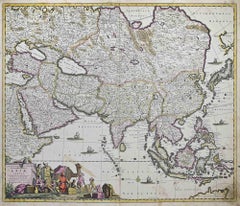
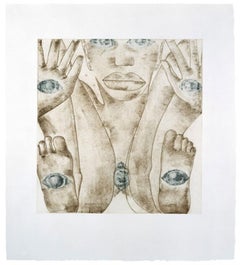
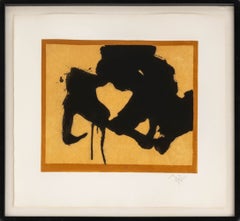
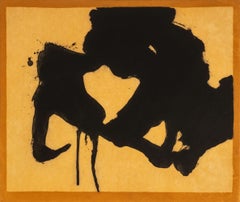
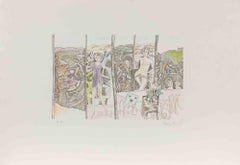
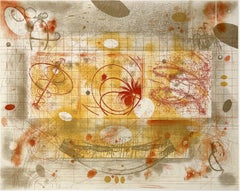
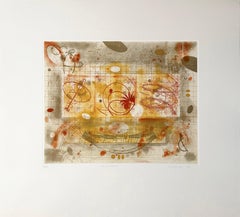
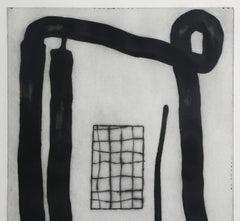
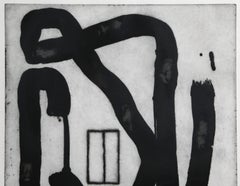
Francesco Clemente, Geography East

Francesco Clemente, Geography East

By Francesco Clemente

Located in New York, NY

GEOGRAPHY, EAST Year: 1992 Medium: 2-color, soft ground etching Paper Size: 28 x 25 inches (71 x 64 cm) Plate Size: 19 x 18 inches (48 x 46 cm) Edition: 60 Price: $6,000 Suite of f...

Category

1990s Contemporary Art by Medium: Etching

Materials

Etching

Runner, Pop Art Print with Marker Drawing by Peter Max

Runner, Pop Art Print with Marker Drawing by Peter Max

By Peter Max

Located in Long Island City, NY

Peter Max, German/American (1937 - ) - Runner, Year: 1974, Medium: Print with Marker Drawing, signed and dated, Size: 24.5 in. x 21.5 in. (62.23 cm x 54.61 cm)

Category

1970s Pop Art Art by Medium: Etching

Materials

Etching

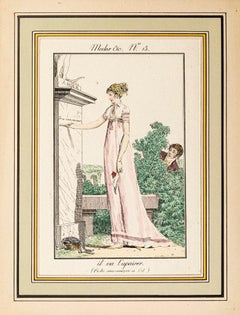
Il va l'Apaiser - Original Etching by Philibert-Louis Debucourt - 19th century

Il va l'Apaiser - Original Etching by Philibert-Louis Debucourt - 19th century

By Philibert-Louis Debucourt

Located in Roma, IT

Il va l'apaiser is an original watercolored etching realized in the first quarter of the 19th century by the French artist Philibert-Louis Debucourt (1755 – 1832). The artwork is...

Category

19th Century Modern Art by Medium: Etching

Materials

Watercolor, Etching

The Whipper In- Etching by Henry Alken - 1822

The Whipper In- Etching by Henry Alken - 1822

By Henry Alken

Located in Roma, IT

Etching and aquatint realized by Henry Alken in 1822. Table from "The Sporting Repository", first edition. Very good condition. Henry Alken (1765-1851) was en english painter and e...

Category

Mid-19th Century Modern Art by Medium: Etching

Materials

Etching

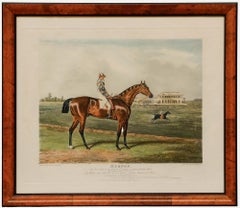
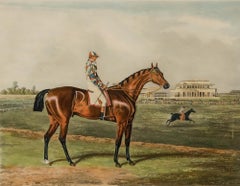
Sutherland after Herring - Aquatint, Memnon, Winner of the Great St. Leger

Sutherland after Herring - Aquatint, Memnon, Winner of the Great St. Leger

Located in Corsham, GB

A vibrant aquatint by Thomas Sutherland (1785-1838) after John Frederick Herring Snr. (1795-1865) depicting Memnon, a racehorse who won the 1825 Great St. Leger at Doncaster. An insc...

Category

19th Century Art by Medium: Etching

Materials

Aquatint

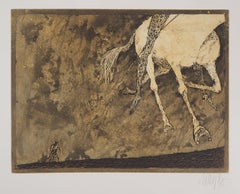
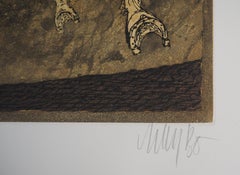
The Departure of The Horserider, 1975 - Original Handsigned Etching

The Departure of The Horserider, 1975 - Original Handsigned Etching

By Lars Bo

Located in Paris, IDF

Lars BO The Departure of The Horserider (Le Rêve de Jean Valjean 1/8), 1975 Original etching Handsigned in pencil On vellum, 35,5 x 45 cm (c. 13,9 x 17,7 inch) Edition limited to 10...

Category

1970s Surrealist Art by Medium: Etching

Materials

Etching

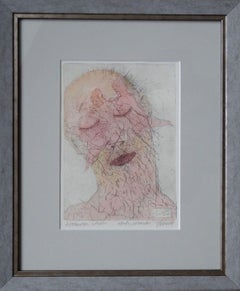
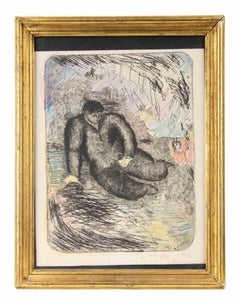
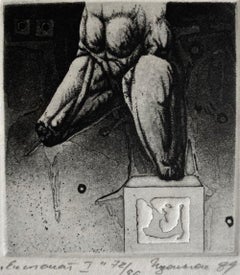
Sleeping man. Paper, etching, watercolor, 19x13 cm

Sleeping man. Paper, etching, watercolor, 19x13 cm

By Juris Putrams

Located in Riga, LV

Sleeping man. Paper, etching, watercolor, 19x13 cm Juris Putrāms graphics artists, works in book and advertising graphics, poster art, creates installations, organizes campaigns, de...

Category

1990s Surrealist Art by Medium: Etching

Materials

Paper, Etching, Watercolor

Spanish Artist signed limited edition original art print numbered lithograph n15

Spanish Artist signed limited edition original art print numbered lithograph n15

By Antoni Tàpies

Located in Miami, FL

Antoni Tapies (Spain, 1923-2012) 'Grille de papier colle', 1976 aquatint, collage, lithograph on paper Velin Arches 250 g. 24.9 x 35.5 in. (63 x 90 cm.) Edition of 50 Unframed ID: TA...

Category

1970s Abstract Art by Medium: Etching

Materials

Paper, Lithograph, Etching

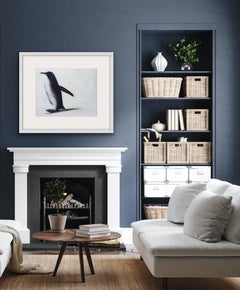
Forwards!, Penguin Art, Contemporary Mononchrome Animal Art, Black and White Art

Forwards!, Penguin Art, Contemporary Mononchrome Animal Art, Black and White Art

Located in Deddington, GB

Original Print, hand made and hand printed by the artist. A penguin on a mission, a gentoo penguin striding along in the indomitable way a penguin does. Helen Fay is available online and in our gallery at Wychwood Art. Animals have always been at the heart of my work. I find the form, movement and behaviour of the creatures I draw a source of limitless fascination. I love the idea of them watching me, watching them as I draw. I hope my appreciation of the sentience and character of the animals I draw comes across in my work. Over my career I have drawn everything from primates to penguins, dogs, ostriches and even an echidna. These days dogs are my main focus, mostly because I adore dogs but also because they are such an integral part of life. I am delighted by the theory that humans and dogs co evolved, we wouldn’t be what we are without them and vice versa. I try to pare my images down to a balanced simplicity that directs attention to the subject of the picture. I try to balance the subject and the space it occupies, giving each equal importance. Light is hugely important to my work, I imagine my subject in three dimensions as I draw and the light describes the musculature and texture that gives the drawing it’s presence and grounds it in the picture. I aim to capture a pause, a moment where whatever I draw looks like it could wander off or leap up any minute. My influences include Japanese prints, Chinese and Japanese brush drawing and the European artists who were influenced by Japan. I am really excited by composition, by artists like Bonnard and Leon Spilliaert. I have long been a fan of Munch for his direct markmaking, colour and intensity and at the other end of the spectrum, Hammershoi for his limited palette, sense of space and calm. I am interested in black and white photography and film and have recently discovered and been amazed by the films of Yasujiro Ozu. The photographs of Andrei Tarkovsky are favourites too. Lastly, I would like to namecheck a great influence in natural history illustration...

Category

21st Century and Contemporary Contemporary Art by Medium: Etching

Materials

Paper, Etching

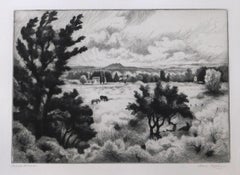
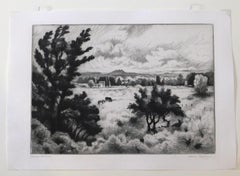
Taos Artist Gene Kloss Original Etching. Indian Summer

Taos Artist Gene Kloss Original Etching. Indian Summer

By Gene Kloss

Located in Phoenix, AZ

Original Etching by famous Taos Artist Gene Kloss (1903-1996). Full Margins. Edition of 75. Titled: Indian Summer. Image measures: 7 3/4" H x 11 1/8" W. Unframed. Archivally matted. ...

Category

Mid-20th Century Art by Medium: Etching

Materials

Paper, Etching

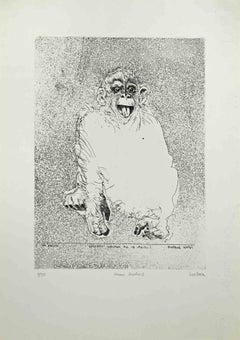
Homo Ludens - Etching by Sergio Barletta - 1960s

Homo Ludens - Etching by Sergio Barletta - 1960s

By Sergio Barletta

Located in Roma, IT

Etching, realized by Sergio Barletta in 1960s. Hand-signed in the lower right. Edition of 50. Excellent condition. Sergio Barletta (1934) is an Italian cartoonist and illustrator...

Category

1960s Contemporary Art by Medium: Etching

Materials

Etching

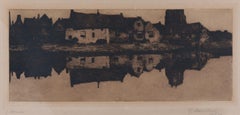
Evening - The depth of the visible -

Evening - The depth of the visible -

Located in Berlin, DE

Max Clarenbach (1880 Neuss - Cologne 1952), Evening. Etching, 18 x 41 cm (platemark), 33.5 x 57 cm (frame), inscribed "Abend" in pencil at lower left, signed and dated "M. Clarenbach. 28.III.[19]09". Framed and mounted under glass. - Somewhat browned and slightly foxed. About the artwork The horizontally elongated etching depicts the panoramic view of a small town as seen from the other side of the river. There are gabled houses on the left and a mighty church spire on the right. The bourgeois houses and the large religious building indicate the urban character. These buildings are rendered in dark tones to emphasise the lighter row of houses in the centre of the picture, closer to the water. The chiaroscuro contrast creates two parallel planes that open up a space for the imagination of what the city could be. The imagination is stimulated by the almost entirely dark, barely recognisable buildings, while the arm of the river leading into the city further stimulates the imagination. However, as the silhouette of the city as a whole is reflected in the water, the parallel planes are perceived as a band of houses that stretches across the entire horizontality of the etching and seems to continue beyond the borders of the picture. The reflection has almost the same intensity as the houses themselves, so that the band of buildings merges with their reflection to form the dominant formal unit of the picture. Only the parallel horizontal hatching creates the convincing impression of seeing water, demonstrating Max Clarenbach's mastery of the etching needle. The water is completely motionless, the reflection unclouded by the slightest movement of the waves, creating a symmetry within the formal unity of the cityscape and its reflection that goes beyond the motif of a mere cityscape. A pictorial order is established that integrates everything in the picture and has a metaphysical character as a structure of order that transcends the individual things. This pictorial order is not only relevant in the pictorial world, but the picture itself reveals the order of the reality it depicts. Revealing the metaphysical order of reality in the structures of its visibility is what drives Clarenbach as an artist and motivates him to return to the same circle of motifs. The symmetry described is at the same time inherent an asymmetry that is a reflection on art: While the real cityscape is cut off at the top of the picture, two chimneys and above all the church tower are not visible, the reflection illustrates reality in its entirety. The reflection occupies a much larger space in the picture than reality itself. Since antiquity, art has been understood primarily as a reflection of reality, but here Clarenbach makes it clear that art is not a mere appearance, which can at best be a reflection of reality, but that art has the potential to reveal reality itself. The revealed structure of order is by no means purely formalistic; it appears at the same time as the mood of the landscape. The picture is filled with an almost sacred silence. Nothing in the picture evokes a sound, and there is complete stillness. There are no people in Clarenbach's landscape paintings to bring action into the picture. Not even we ourselves are assigned a viewing position in the picture, so that we do not become thematic subjects of action. Clarenbach also refrains from depicting technical achievements. The absence of man and technology creates an atmosphere of timelessness. Even if the specific date proves that Clarenbach is depicting something that happened before his eyes, without the date we would not be able to say which decade, or even which century, we are in. The motionless stillness, then, does not result in time being frozen in the picture, but rather in a timeless eternity that is nevertheless, as the title "Abend" (evening), added by Clarenbach himself, makes clear, a phenomenon of transition. The landscape of the stalls is about to be completely plunged into darkness, the buildings behind it only faintly discernible. The slightly darkened state of the sheet is in keeping with this transitional quality, which also lends the scene a sepia quality that underlines its timelessness. And yet the depiction is tied to a very specific time. Clarenbach dates the picture to the evening of 28 March 1909, which does not refer to the making of the etching, but to the capture of the landscape's essence in the landscape itself. If the real landscape is thus in a state of transition, and therefore something ephemeral, art reveals its true nature in that reality, subject to the flow of phenomena, is transferred to an eternal moment, subject to a supra-temporal structure of order - revealed by art. Despite this supratemporality, the picture also shows the harbingers of night as the coming darkening of the world, which gives the picture a deeply melancholy quality, enhanced by the browning of the leaf. It is the philosophical content and the lyrical-melancholic effect of the graphic that give it its enchanting power. Once we are immersed in the image, it literally takes a jerk to disengage from it. This etching, so characteristic of Max Clarenbach's art, is - not least because of its dimensions - a major work in his graphic oeuvre. About the artist Born into poverty and orphaned at an early age, the artistically gifted young Max Clarenbach was discovered by Andreas Achenbach and admitted to the Düsseldorf Art Academy at the age of 13. "Completely penniless, I worked for an uncle in a cardboard factory in the evenings to pay for my studies.” - Max Clarenbach At the academy he studied under Arthur Kampf, among others, and in 1897 was accepted into Eugen Dücker...

Category

Early 1900s Realist Art by Medium: Etching
Materials

Etching

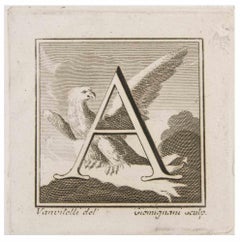
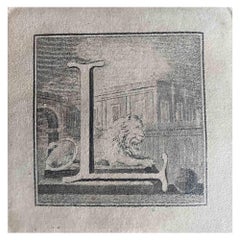
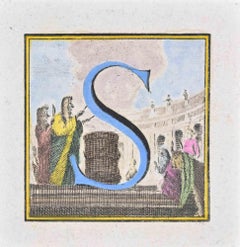
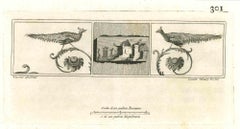
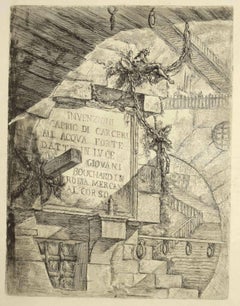
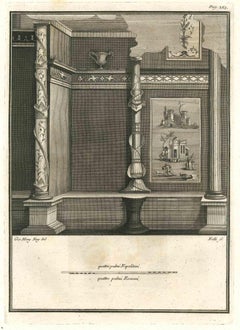
Antiquities of Herculaneum -  Letter L - Etching  - 18th Century

Antiquities of Herculaneum - Letter L - Etching - 18th Century

Located in Roma, IT

Antiquities of Herculaneum - Letter of the Alphabet L, from the series "Antiquities of Herculaneum", is an original etching on paper realized in the 18th century. Good conditions ...

Category

Late 18th Century Old Masters Art by Medium: Etching

Materials

Etching

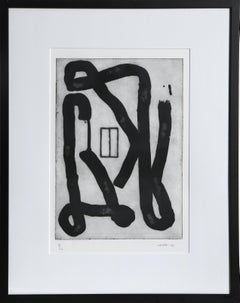
Untitled (Hands)

Untitled (Hands)

By Louisa Chase

Located in Long Island City, NY

Artist: Louisa Chase, American (1951 - 2016) Title: Hands (Black and White) Year: 1984 Medium: Etching, Signed and Numbered in Pencil Edition: 25 Paper Size: 12 x 12 Inches (30.48 x ...

Category

1980s Abstract Expressionist Art by Medium: Etching

Materials

Etching

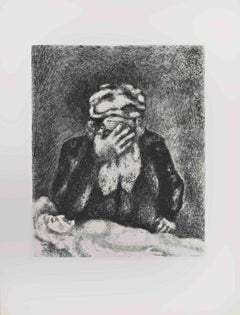
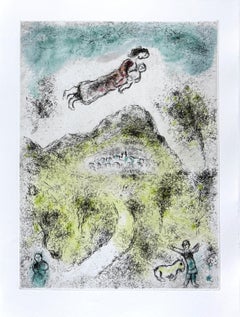
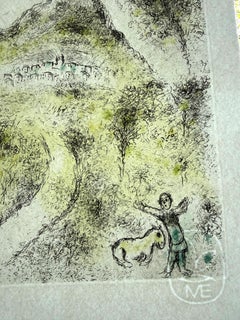
Celui qui dit les choses sans rien dire, Planche XIX

Celui qui dit les choses sans rien dire, Planche XIX

By Marc Chagall

Located in OPOLE, PL

Marc Chagall (1887-1985) - Celui qui dit les choses sans rien dire, Planche XIX Etching and aquatint from 1976. The edition of 225. Dimensions of sheet: 47 x 35 cm Dimensions in ...

Category

1970s Modern Art by Medium: Etching

Materials

Etching, Aquatint

Composition - Etching on Cardboard by Leo Guida - 1971

Composition - Etching on Cardboard by Leo Guida - 1971

By Leo Guida

Located in Roma, IT

Composition is an original colored etching artwork on cardboard realized by Leo Guida in 1971. Hand-signed in pencil and dated on the lower left, titled on the lower right. The sta...

Category

1970s Art by Medium: Etching

Materials

Etching

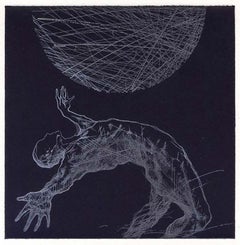
Ornithology N36 Etching, Contemporary Figurative Print, 2010-

Ornithology N36 Etching, Contemporary Figurative Print, 2010-

By Veta Gorner

Located in Palm Springs, CA

A dramatic and highly expressive composition by Veta Gorner, this work showcases the artist’s remarkable command of line, tension, and atmosphere. Against a velvety black field, a lo...

Category

2010s Contemporary Art by Medium: Etching

Materials

Etching

Correlations, by Rosalyn Richards

Correlations, by Rosalyn Richards

By Rosalyn Richards

Located in Palm Springs, CA

Signed, titled and numbered, edition of 10. Rosalyn Richards has been a member of the Bucknell University art faculty since 1982. Images from particle physics, satellite photograph...

Category

Early 2000s Abstract Art by Medium: Etching

Materials

Etching, Aquatint

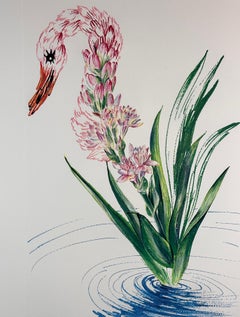
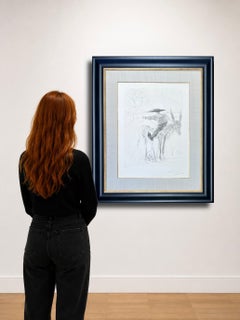
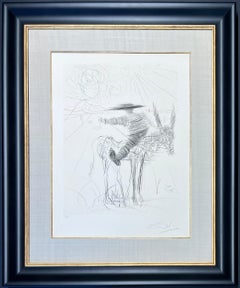
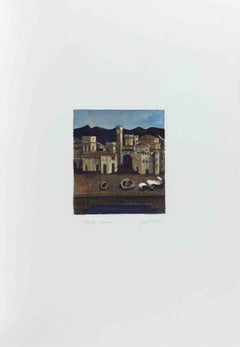
Salvador Dalí (1904-1989) - Sancho Pança - Drypoint etching on Lana paper - 1970

Salvador Dalí (1904-1989) - Sancho Pança - Drypoint etching on Lana paper - 1970

By Salvador Dalí­

Located in Varese, IT

Drypoint etching on Lana paper, edited in 1970. Limited edition of 175 copies, numbered as 150/175 in lower left corner. Hand-signed by artist in pencil in the lower right corner. Plate size: 52 x 39 cm Paper size: 76 x 56 cm Framed size: 94,5 x 78 cm Very good conditions. Publisher: Editions de Francony (Paris) Printer: Ateliers Rigal (Fontenay-aux-Roses) Bibliography: Dalì - Catalogue Raisonnè of Etchings and Mixed-Media Prints, 1924-1980 p. 190 Ref. 452 A regular certificate of authenticity and publication will be included. Also placed on the back is the original certificate hand-signed by Salvador Dali...

Category

1970s Surrealist Art by Medium: Etching
Materials

Paper, Etching

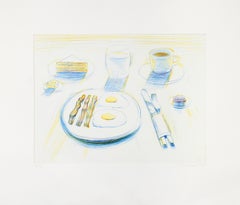
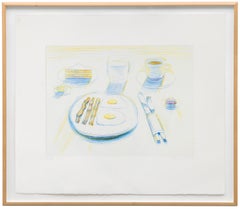
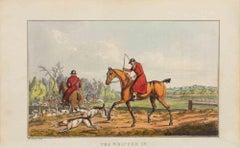
Breakfast - Pop Art, Post War, Color Etching, 1995

Breakfast - Pop Art, Post War, Color Etching, 1995

By Wayne Thiebaud

Located in Palm Desert, CA

“Breakfast” is a colored etching and drypoint by American artist, Wayne Thiebaud from 1995. The work is edition 22/50 and is signed lower right, "Thiebaud 1995” Wayne Thiebaud's Bre...

Category

Late 20th Century Pop Art Art by Medium: Etching
Materials

Paper, Drypoint, Etching

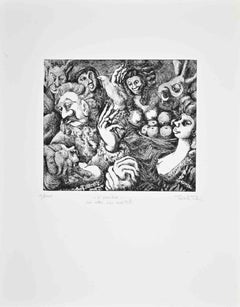
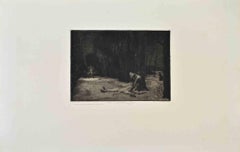
The Sybil - Original Etching by Leo Guida  - 1970s

The Sybil - Original Etching by Leo Guida - 1970s

By Leo Guida

Located in Roma, IT

The Sibyl is an original Contemporary artwork realized in the 1970s by the italian artist Leo Guida. Original B/W Etching on paper. Image Dimensions: 24.5 x 0.1 x 20 cm. Mint cond...

Category

1970s Contemporary Art by Medium: Etching
Materials

Etching

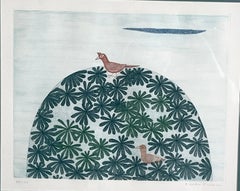
DEUX OISEAUX SUR L'ARBRE (TWO BIRDS ON A TREE)

DEUX OISEAUX SUR L'ARBRE (TWO BIRDS ON A TREE)

By Keiko Minami

Located in Portland, ME

Minami, Keiko (Japanese, 1911-2004) DEUX OISEAUX SUR L'ARBRE. Etching and aquatint in colors, 1979. Signed and Numbered 98/100. 11 1/8 x 14 3/8 inches (plate),c. 14 x17 inches (shee...

Category

1970s Art by Medium: Etching

Materials

Etching, Aquatint

Etching art for sale on 1stDibs.

Find a wide variety of authentic Etching art available on 1stDibs. While artists have worked in this medium across a range of time periods, art made with this material during the 20th Century is especially popular. If you’re looking to add art created with this material to introduce a provocative pop of color and texture to an otherwise neutral space in your home, the works available on 1stDibs include elements of yellow, orange, green and other colors. There are many well-known artists whose body of work includes ceramic sculptures. Popular artists on 1stDibs associated with pieces like this include Leo Guida, Salvador Dalí, Thomas Holloway, and Pablo Picasso. Frequently made by artists working in the Contemporary, Modern, all of these pieces for sale are unique and many will draw the attention of guests in your home. Not every interior allows for large Etching art, so small editions measuring 2.96 inches across are also available Prices for art made by famous or emerging artists can differ depending on medium, time period and other attributes. On 1stDibs, the price for these items starts at $55 and tops out at $3,119, while the average work can sell for $330.