1850s Art

to
67
968
124
47
31
28
Overall Width
to
Overall Height
to
7,473
21,298
163,838
233,384
2,025
2,268
4,939
6,521
5,792
15,018
20,763
25,787
18,704
14,195
5,308
812
17
7
4
2
2
1
669
492
24
663
359
306
268
220
165
146
110
77
73
69
67
61
53
47
46
45
44
35
35
833
317
170
130
72
119
87
63
48
14
171
640
408
167
Period: 1850s
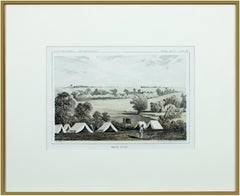
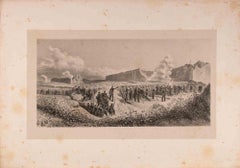
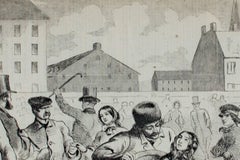
'Distribution of Goods to the Assiniboines' original John Mix Stanley lithograph

'Distribution of Goods to the Assiniboines' original John Mix Stanley lithograph

By John Mix Stanley

Located in Milwaukee, WI

In the mid-nineteenth century, the United States government set out to survey and document its newly acquired lands and territories west of the Mississippi. The goals of these surveys were manifold: to produce topographical maps, to document flora and fauna, and to document natural resources to build the emerging US economy. These surveys, and the images from them, also functioned to build the new sense of American identity with the landscape, condensing vistas into the 'picturesque' tradition of European image making. Thus, the entire span of US territory could be seen as a single, cohesive whole. This lithograph comes from one of six surveys commissioned by the Army's Topographic Bureau in 1853, which sought to find the best route to construct a transcontinental railroad. The result was a thirteen-volume report including maps, lithographs, and technical data entitled 'Explorations and Surveys to ascertain the most practicable and economical route for a Railroad from the Mississippi river to the Pacific Ocean.' When it came to depicting the Assiniboine people, as seen in the present print, Stanley chose to juxtapose their encampment, marked by tipis in the distance, with the encampment of the Isaac Stevens survey party. In the foreground, commemorating this moment, Isaac Stevens can be seen presenting trade goods, which are known to include thirty two dressed skins and two robes. The survey leader Isaac Stevens noted being grateful for the generosity of the Assiniboine, commenting: "I felt very grateful indeed to those Indians, for their kindness to my men, their proffer of kind feeling and hospitality to myself and the survey." This description and this image, however, are arguably depicted through rose-colored glasses: to the Assiniboine people, this meeting may well have included stressful diplomatic relationships and have indicated a threat to the sovereignty over the territories agreed to be theirs by the 1851 Treaty of Fort Laramie. 5.75 x 8.75 inches, image 6.5 x 9.25 inches, stone 17 x 19.75 inches, frame Artist 'Stanley Del.' lower left Entitled 'Distribution of Goods to the Assiniboines' lower center margin Publisher 'Sarony, Major & Knapp. Lith.s 449 Broadway N.Y.' lower right Inscribed 'U.S.P.R.R. EXP. & SURVEYS — 47th & 49th PARALLELS' upper left Inscribed 'GENERAL REPORT — PLATE XIV' upper right Framed to conservation standards using 100 percent rag matting with French accents; glazed with UV5 Plexiglas to inhibit fading; housed in a gold reverse ogee moulding. Print in overall good condition; some localized foxing and discoloration; frame in excellent condition. John Mix Stanley...

Category

Romantic 1850s Art
Materials

Lithograph

Nasiterna Bruijni
Nasiterna Bruijni

Nasiterna Bruijni

By John Gould

Located in Missouri, MO

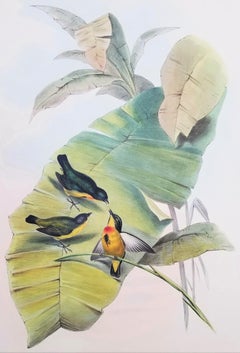
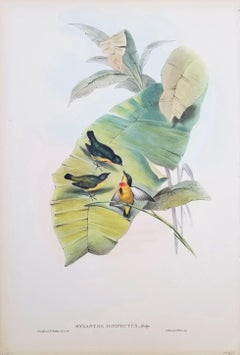
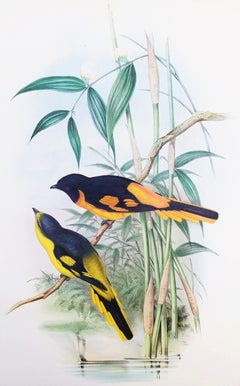
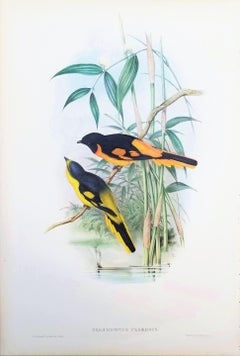
John Gould (British, 1804-1881) Nasiterna Bruijni c. 1849-1861 Hand Colored Lithograph Image Size: approx 19.5 x 13.5 inches Framed Size: 27 3/8 x 21 1/2 inches John Gould was an English ornithologist and bird artist. The Gould League in Australia was named after him. His identification of the birds now nicknamed "Darwin's finches" played a role in the inception of Darwin's theory of evolution by natural selection. Gould's work is referenced in Charles Darwin's book, On the Origin of Species. Gould was born in Lyme Regis, Dorset, the son of a gardener, and the boy probably had a scanty education. Shortly afterwards his father obtained a position on an estate near Guildford, Surrey, and then in 1818 became foreman in the Royal Gardens of Windsor. He was for some time under the care of J T Aiton, of the Royal Gardens of Windsor. The young Gould started training as a gardener, being employed under his father at Windsor from 1818 to 1824, and he was subsequently a gardener at Ripley Castle in Yorkshire. He became an expert in the art of taxidermy, and in 1824 he set himself up in business in London as a taxidermist, and his skill led to him becoming the first Curator and Preserver at the museum of the Zoological Society of London in 1827. Gould's position brought him into contact with the country's leading naturalists, and also meant that he was often the first to see new collections of birds given to the Society. In 1830 a collection of birds arrived from the Himalayas, many not previously described. Gould published these birds in A Century of Birds from the Himalaya Mountains (1830-1832). The text was by Nicholas Aylward Vigors, and the illustrations were lithographed by Gould's wife Elizabeth, daughter of Nicholas Coxen of Kent. This work was followed by four more in the next seven years including Birds of Europe in five volumes - completed in 1837, with the text written by Gould himself, edited by his clerk Edwin Prince. Some of the illustrations were made by Edward Lear as part of his Illustrations of the Family of Psittacidae in 1832. Lear however was in financial difficulty, and he sold the entire set of lithographs to Gould. The books were published in a very large size, imperial folio, with magnificent coloured plates. Eventually 41 of these volumes were published with about 3000 plates. They appeared in parts at £3 3s. a number, subscribed for in advance, and in spite of the heavy expense of preparing the plates, Gould succeeded in making his ventures pay and in realizing a fortune. In 1838 he and his wife moved to Australia to work on the Birds of Australia and shortly after his return to England, his wife died in 1841. When Charles Darwin presented his mammal and bird specimens collected during the second voyage of HMS Beagle to the Geological Society of London at their meeting on 4 January 1837, the bird specimens were given to Gould for identification. He set aside his paying work and at the next meeting on 10 January reported that birds from the Galápagos Islands, which Darwin had thought were blackbirds, "gross-bills" and finches were in fact "a series of ground Finches which are so peculiar" as to form "an entirely new group, containing 12 species." This story made the newspapers. In March, Darwin met Gould again, learning that his Galápagos "wren" was another species of finch and the mockingbirds he had labeled by island were separate species rather than just varieties, with relatives on the South American mainland. Subsequently Gould advised that the smaller southern Rhea specimen that had been rescued from a Christmas dinner...

Category

Naturalistic 1850s Art

Materials

Lithograph

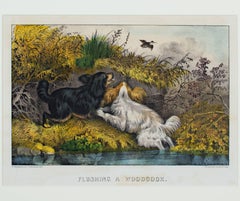
19th century color lithograph dogs bird nature grass pastoral animals

19th century color lithograph dogs bird nature grass pastoral animals

By Currier & Ives

Located in Milwaukee, WI

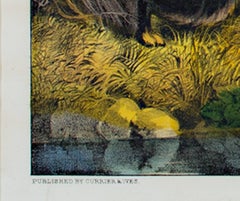
"Flushing a Woodcock" is an original hand-colored lithograph published by Currier & Ives. It depicts two dogs at the edge of a pond going after a bird that has just flown into the air. 8" x 12 1/2" art 18 1/2" x 22 1/4" frame Currier & Ives produced their prints in a building at 33 Spruce Street where they occupied the third, fourth and fifth floors. The third floor was devoted to the hand operated printing presses that were built by Nat's cousin, Cyrus Currier, at his shop Cyrus Currier & Sons in Newark, NJ. The fourth floor found the artists, lithographers and the stone grinders...

Category

1850s Art

Materials

Lithograph

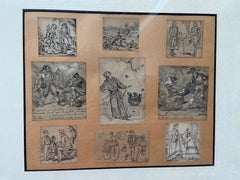
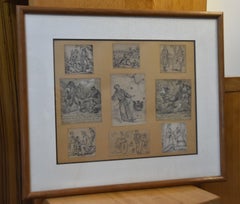
The Leaflet of the Italian Risorgimento - Lithograph - 1850s

The Leaflet of the Italian Risorgimento - Lithograph - 1850s

Located in Roma, IT

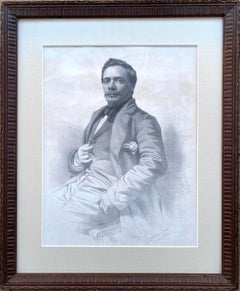
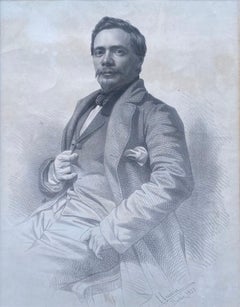
The Leaflet of the Italian Risorgimento is an original Propaganda leaflet realized in the 1850s. Good conditions with slight foxing.

Category

Modern 1850s Art

Materials

Lithograph

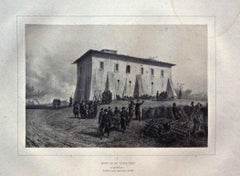
Battle of Pozzolo - Lithograph after Louis Martinet - 1850s

Battle of Pozzolo - Lithograph after Louis Martinet - 1850s

Located in Roma, IT

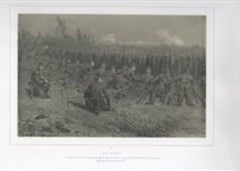
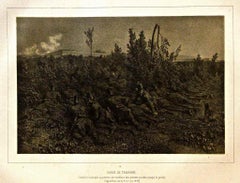
Pozzolo Battle is a lithograph print on paper realized After Louis Martinet in the 1850s. Titled, signed on the plate. The artwork is in good conditions with aged margins and diffu...

Category

Modern 1850s Art

Materials

Lithograph

Le Maria, La Femme, et le Voleur - Lithograph - 1850s

Le Maria, La Femme, et le Voleur - Lithograph - 1850s

Located in Roma, IT

Le Maria, La Femme, et le Voleur is a Lithograph print on paper realized in the late 19th Century. Three narratives in three frames are represented with the title in French on the l...

Category

Modern 1850s Art

Materials

Lithograph

Architectural - Maison Donne - Etching - 1850s

Architectural - Maison Donne - Etching - 1850s

Located in Roma, IT

Architectural- Maison Donne is an etching print on paper realized in the late 19th Century. Titled on the plate and signed. Good conditions.

Category

Modern 1850s Art

Materials

Etching

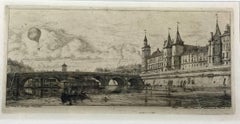
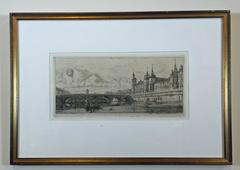
LE PONT AU CHANGE
LE PONT AU CHANGE

LE PONT AU CHANGE

By Charles Meryon

Located in Portland, ME

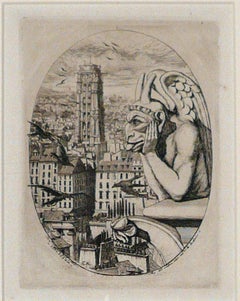
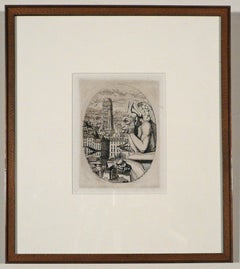
Meryon, Charles. LE PONT AU CHANGE. S.40(v), DW.34. Etching with drypoint, 1854. Fifth State of twelve, with the inscriptions in cursive, "C. Meryon del. sculp. mdcccliiii," lower l...

Category

Realist 1850s Art

Materials

Drypoint, Etching

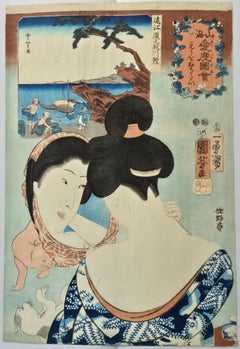
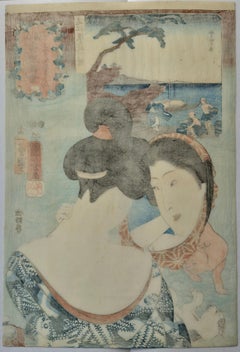
Utagawa Kuniyoshi -- No. 38 Totomi 遠江

Utagawa Kuniyoshi -- No. 38 Totomi 遠江

By Utagawa Kuniyoshi

Located in BRUCE, ACT

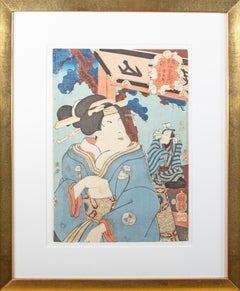
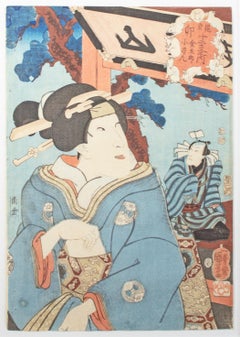
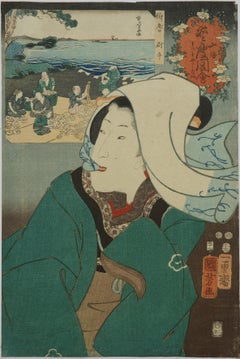
Utagawa Kuniyoshi No. 38 Totomi 遠江, 1852 From Series: Sankai medetai zue 山海目出度図絵 (Celebrated Treasures of Mountains and Seas) Woodblock print Oban Woodblock print, oban tate-e. Woma...

Category

1850s Art

Materials

Woodcut

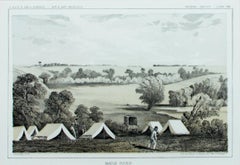
'Kettle Falls, Columbia River' original color lithograph by John Mix Stanley

'Kettle Falls, Columbia River' original color lithograph by John Mix Stanley

By John Mix Stanley

Located in Milwaukee, WI

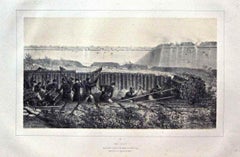
In the mid-nineteenth century, the United States government set out to survey and document its newly acquired lands and territories west of the Mississippi. The goals of these surveys were manifold: to produce topographical maps, to document flora and fauna, and to document natural resources to build the emerging US economy. These surveys, and the images from them, also functioned to build the new sense of American identity with the landscape, condensing vistas into the 'picturesque' tradition of European image making. Thus, the entire span of US territory could be seen as a single, cohesive whole. This lithograph comes from one of six surveys commissioned by the Army's Topographic Bureau in 1853, which sought to find the best route to construct a transcontinental railroad. The result was a thirteen-volume report including maps, lithographs, and technical data entitled 'Explorations and Surveys to ascertain the most practicable and economical route for a Railroad from the Mississippi river to the Pacific Ocean.' When it came to depicting the Columbia River, as seen in the present print, Stanley chose to depict the river's characteristic rock formations and choppy waters. The figures in the image give the viewer a sense of the vase scale of the imposing landscape. Other explorers that reached the site years before the Pacific Railroad Survey, such as Lewis and Clark, observed this scene with wonder and awe – and it is clear Stanley felt the same way. 5.75 x 8.75 inches, image 6.5 x 9.25 inches, stone 13.25 x 16.25 inches, frame Artist 'Stanley Del.' lower left Entitled 'Kettle Falls, Columbia River' lower center margin Publisher 'Sarony, Major & Knapp. Lith.s 449 Broadway N.Y.' lower right Inscribed 'U.S.P.R.R. EXP. & SURVEYS — 47th & 49th PARALLELS' upper left Inscribed 'GENERAL REPORT — PLATE XLVII' upper right Framed to conservation standards using 100 percent rag matting and Museum Glass to inhibit fading; housed in a brass-surface aluminium moulding. Print in overall good condition; wrinkles in upper margin and upper right corner; frame in excellent condition. John Mix Stanley...

Category

Romantic 1850s Art
Materials

Lithograph

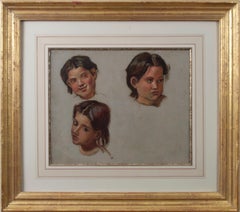
Quirky Dogsled Scene featuring Downtown Detroit in 1853

Quirky Dogsled Scene featuring Downtown Detroit in 1853

Located in Philadelphia, PA

Frederick E. Cohen (American, born England, c. 1818-1858) Boy in a Dog Sled, 1853 Oil on canvas, 25 x 30 inches Framed: 35 x 40 inches (approx.) Signed and inscribed: (on side of sle...

Category

Realist 1850s Art
Materials

Oil, Canvas

The Mouse - Lithograph by Paul Gervais - 1854

The Mouse - Lithograph by Paul Gervais - 1854

By Paul Gervais

Located in Roma, IT

The Mouse is a lithograph on ivory-colored paper, realized by Paul Gervais (1816-1879). The artwork is from The Series of "Les Trois Règnes de la Nature", and was published in 1854. ...

Category

Modern 1850s Art
Materials

Lithograph

The Lion - Lithograph by Paul Gervais - 1854

The Lion - Lithograph by Paul Gervais - 1854

By Paul Gervais

Located in Roma, IT

The Lion is a lithograph on ivory-colored paper, realized by Paul Gervais (1816-1879). The artwork is from The Series of "Les Trois Règnes de la Nature", and was published in 1854. ...

Category

Modern 1850s Art
Materials

Lithograph

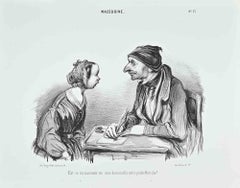
Une Partegeuse à Londres - Lithograph by Paul Gavarni - 1850s

Une Partegeuse à Londres - Lithograph by Paul Gavarni - 1850s

By Paul Gavarni

Located in Roma, IT

Une partegeuse a Londres is a lithograph on ivory-colored paper, realized by the French draftsman Paul Gavarni (alias Guillaume Sulpice Chevalier Gavarni, 1804-1866) in the mid-19th Century. From series of "Masques et Visages". Titled on the lower. Good conditions except for some foxings. Paul Gavarni (Paris, 1804 – 1866). Gavarni's father, Sulpice Chevalier, was from a family line of coopers from Burgundy. Paul began work as mechanical work in a machine factory but he saw that to make any progress in his profession, he had to be able to draw; accordingly, in his spare time in the evenings, he took classes in drawing. He devoted his special attention to architectural and mechanical drawing and worked at land surveying...

Category

Modern 1850s Art
Materials

Lithograph

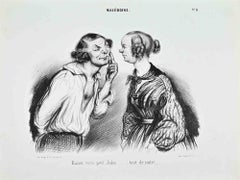
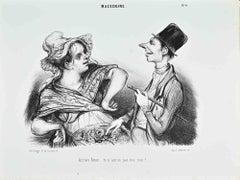
Les Partageuses - Lithograph by Paul Gavarni - 1850s

Les Partageuses - Lithograph by Paul Gavarni - 1850s

By Paul Gavarni

Located in Roma, IT

Les Partageuses is a lithograph on ivory-colored paper, realized by the French draftsman Paul Gavarni (alias Guillaume Sulpice Chevalier Gavarni, 1804-1866) in the mid-19th Century. From series of "Masques et Visages". Titled on the lower. Good conditions except for some foxings. Paul Gavarni (Paris, 1804 – 1866). Gavarni's father, Sulpice Chevalier, was from a family line of coopers from Burgundy. Paul began work as mechanical work in a machine factory but he saw that to make any progress in his profession, he had to be able to draw; accordingly, in his spare time in the evenings, he took classes in drawing. He devoted his special attention to architectural and mechanical drawing and worked at land...

Category

Modern 1850s Art
Materials

Lithograph

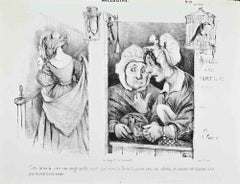
Les Partageuses - Lithograph by Paul Gavarni - 1850s

Les Partageuses - Lithograph by Paul Gavarni - 1850s

By Paul Gavarni

Located in Roma, IT

Les Partageuses is a lithograph on ivory-colored paper, realized by the French draftsman Paul Gavarni (alias Guillaume Sulpice Chevalier Gavarni, 1804-1866) in the mid-19th Century. From series of "Masques et Visages". Titled on the lower. Good conditions except for some foxings. Paul Gavarni (Paris, 1804 – 1866). Gavarni's father, Sulpice Chevalier, was from a family line of coopers from Burgundy. Paul began work as mechanical work in a machine factory but he saw that to make any progress in his profession, he had to be able to draw; accordingly, in his spare time in the evenings, he took classes in drawing. He devoted his special attention to architectural and mechanical drawing and worked at land...

Category

Modern 1850s Art
Materials

Lithograph

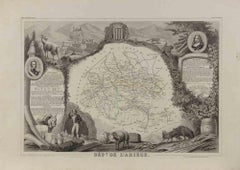
Les Partageuses - Original Lithograph by Paul Gavarni - 1850s

Les Partageuses - Original Lithograph by Paul Gavarni - 1850s

By Paul Gavarni

Located in Roma, IT

Les Partageuses is a lithograph on ivory-colored paper, realized by the French draftsman Paul Gavarni (alias Guillaume Sulpice Chevalier Gavarni, 1804-1866) in the mid-19th Century. From series of "Masques et Visages". Titled on the lower. Good conditions except for some foxings. Paul Gavarni (Paris, 1804 – 1866). Gavarni's father, Sulpice Chevalier, was from a family line of coopers from Burgundy. Paul began work as mechanical work in a machine factory but he saw that to make any progress in his profession, he had to be able to draw; accordingly, in his spare time in the evenings, he took classes in drawing. He devoted his special attention to architectural and mechanical drawing and worked at land...

Category

Modern 1850s Art
Materials

Lithograph

Military - Original Lithograph by  Auguste Raffet - 1857

Military - Original Lithograph by Auguste Raffet - 1857

Located in Roma, IT

Military is an Original Lithograph realized by Auguste Raffet in 1857. Hand-Signed and dated by the artist on the lower left corner. Good conditions on a cream colored cardboard. ...

Category

Modern 1850s Art
Materials

Lithograph

Études D'Androgynes  - Original Lithograph by Paul Gavarni - 1850s

Études D'Androgynes - Original Lithograph by Paul Gavarni - 1850s

By Paul Gavarni

Located in Roma, IT

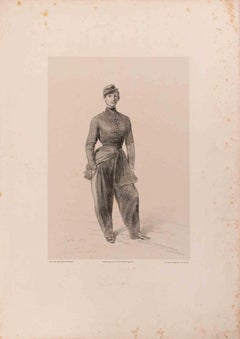
Études D'Androgynes is a lithograph on ivory-colored paper, realized by the French draftsman Paul Gavarni (alias Guillaume Sulpice Chevalier Gavarni, 1804-1866) in the mid-19th Century. From series of "Masques et Visages". Titled on the lower. Good conditions. Paul Gavarni (Paris, 1804 – 1866). Gavarni's father, Sulpice Chevalier, was from a family line of coopers from Burgundy. Paul began work as mechanical work in a machine factory but he saw that to make any progress in his profession, he had to be able to draw; accordingly, in his spare time in the evenings, he took classes in drawing. He devoted his special attention to architectural and mechanical drawing...

Category

Modern 1850s Art
Materials

Lithograph