1850s Art

to
67
970
124
47
32
26
Overall Width
to
Overall Height
to
7,453
21,381
163,661
232,343
2,021
2,274
4,928
6,488
5,801
15,002
20,716
25,763
18,679
14,127
5,306
816
16
7
4
2
2
1
668
494
24
659
360
306
266
219
167
146
109
77
73
69
67
60
53
47
47
45
44
36
35
837
317
169
129
73
119
87
63
48
14
171
644
404
168
Period: 1850s
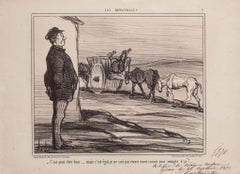
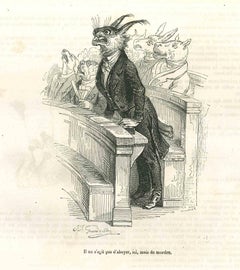
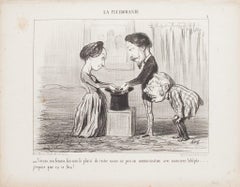
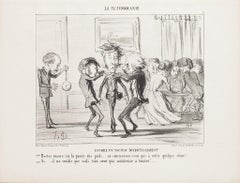
Le Retour à Paris - Lithograph by H. Daumier - 1852

Le Retour à Paris - Lithograph by H. Daumier - 1852

By Honoré Daumier

Located in Roma, IT

Le Retour à Paris is the b/w lithographes plate (n.15) from the satirical print series “Les Trains de Plaisir”, composed of caricatures “de mœurs” (of behaviours), realized by Honoré Daumier (France, 1808-1879). Published by the Maison Martinet, Paris, this plate appeared on the French periodical, Le Charivari, on September 28th, 1852. Printed by the lithographer Charles Trinocq. Reference: H. Delteil, Catalogue Raisonnée, 2339. Inscriptions: Monogrammed on stone, h.D, 441.. Complete Caption: LE RETOUR A PARIS –Deux nuits sans fermer l’oeil! ... un lumbago et un rhume de cerveau…plus souvent qu’on me rattrapera encore à prendre un train de plaisir! Superb print, full margins, depicting an amusing scene of a sitting couple...

Category

Modern 1850s Art

Materials

Lithograph

Portrait - Original Mixed-Media on Cardboard - 1850s

Portrait - Original Mixed-Media on Cardboard - 1850s

Located in Roma, IT

Portrait is an original photo of a print on cardboard realized in 1850 ca. by an Anonymous artist. Good conditions, except for some foxings of original print. The artwork represent...

Category

1850s Art

Materials

Cardboard, Mixed Media

Superb Neoclassical White Marble Bust of Flora France 1850 '

Superb Neoclassical White Marble Bust of Flora France 1850 '

Located in Rome, IT

Superbly carved white statuary Carrara marble bust of Flora, the goddess of flowers. Flora was often associated with the coming of spring and the fertility of the land. She also sy...

Category

1850s Art

Materials

Marble

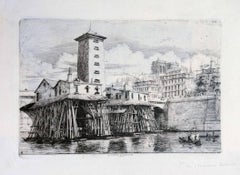
La Tour de L’Horloge (The Clock Tower, Paris)

La Tour de L’Horloge (The Clock Tower, Paris)

By Charles Meryon

Located in New York, NY

Charles Meryon (1821-1868), La Tour de L’Horloge (The Clock Tower, Paris), 1852, etching with engraving. Reference: Schneiderman 23, Delteil 28. Third state (of 10). On very thin Jap...

Category

Realist 1850s Art

Materials

Engraving, Etching

Little Sandpiper

Little Sandpiper

By John James Audubon

Located in Columbia, MO

John James Audubon was born in Haiti in 1785. Most of his childhood was spent in France, where he first took interest in birds and drawing. He came to the U.S. at age 18, and made ma...

Category

Naturalistic 1850s Art

Materials

Lithograph

Watercolor 19th French school flowers hollyhocks large Academic

Watercolor 19th French school flowers hollyhocks large Academic

Located in PARIS, FR

French school of the mid-19th century Watercolor 51 x 37 cm (69 x 55 cm with frame) Signed and dated at the bottom “M. C. / 1857” The hollyhock comes from China, passing through Sy...

Category

1850s Art

Materials

Watercolor

Set of Six Hand-Colored Lithograph Ornithological Prints from "The Ibis" Birds

Set of Six Hand-Colored Lithograph Ornithological Prints from "The Ibis" Birds

Located in Saint Augustine, FL

Artist: Philip Lutley Sclater (English, 1829-1913) Titles: "Crossoptilon Harmani (Tibetan eared Pheasant)", "Hypotaenidia Sulcirostris (Barred Rail)", "Craspedophora Duivenbodei (Dui...

Category

Victorian 1850s Art

Materials

Watercolor, Lithograph

'Camp Red River Hunters' original lithograph by John Mix Stanley

'Camp Red River Hunters' original lithograph by John Mix Stanley

By John Mix Stanley

Located in Milwaukee, WI

In the mid-nineteenth century, the United States government set out to survey and document its newly acquired lands and territories west of the Mississippi. The goals of these surveys were manifold: to produce topographical maps, to document flora and fauna, and to document natural resources to build the emerging US economy. These surveys, and the images from them, also functioned to build the new sense of American identity with the landscape, condensing vistas into the 'picturesque' tradition of European image making. Thus, the entire span of US territory could be seen as a single, cohesive whole. This lithograph comes from one of six surveys commissioned by the Army's Topographic Bureau in 1853, which sought to find the best route to construct a transcontinental railroad. The result was a thirteen-volume report including maps, lithographs, and technical data entitled 'Explorations and Surveys to ascertain the most practicable and economical route for a Railroad from the Mississippi river to the Pacific Ocean.' In particular, the print comes from the northern survey, commanded by Isaac Stevens, which explored the regions between the 47th and 49th parallels. In this image, Stanley shows an encampment of the people known as the Red River of the North hunters. They were generations of European and mixed-race trappers who lived on the frontier and had Indian wives and mixed-race children. They had come to the area for bison hunting, as the herds were still vast on the prairies. In the image, the figures and their encampment are dwarfed by the vast landscape around them, indicating the sublimity of these new American territories. 5.75 x 8.75 inches, image 6.5 x 9.25 inches, stone 17 x 20 inches, frame Artist 'Stanley Del.' lower left Entitled 'Camp Red River Hunters' lower center margin Publisher 'Sarony, Major & Knapp. Lith.s 449 Broadway N.Y.' lower right Inscribed 'U.S.P.R.R. EXP. & SURVEYS — 47th & 49th PARALLELS' upper left Inscribed 'GENERAL REPORT — PLATE XII' upper right Framed to conservation standards using 100 percent rag matting with French accents; glazed with UV5 Plexiglas to inhibit fading; housed in a gold reverse ogee moulding. Print in overall good condition; some localized foxing and discoloration; minor surface abrasions to frame. John Mix Stanley...

Category

Romantic 1850s Art

Materials

Lithograph

Animal Teeth - Lithograph by Paul Gervais - 1854

Animal Teeth - Lithograph by Paul Gervais - 1854

By Paul Gervais

Located in Roma, IT

Lithograph on ivory-colored paper, realized by Paul Gervais (1816-1879). The artwork is from The Series of "Les Trois Règnes de la Nature", and was published in 1854. Good condition...

Category

Modern 1850s Art

Materials

Lithograph

Circa 1850 original chromolithograph - vitraux (stained glass)

Circa 1850 original chromolithograph - vitraux (stained glass)

Located in PARIS, FR

"Vitraux Pl. 88" is a circa 1850 original chromolithograph, a stunning example of mid-19th-century decorative arts printing. This plate comes from an important series devoted to vitr...

Category

1850s Art

Materials

Paper, Lithograph

Vigilant Fox - The psyche of the fox -

Vigilant Fox - The psyche of the fox -

Located in Berlin, DE

Carl Friedrich Deiker (1838 Wetzlar - 1892 Düsseldorf). Vigilant fox. Pencil drawing on brown paper, 18 × 29.5 cm (inside measurement), 31.5 x 43.5 cm (mount), signed and dated "Deiker [18]54" at lower right. - a little bit stained, with a light water stain at lower right About the artwork Carl Friedrich Deiker's consummate ability to depict animals is already evident in this early work. He brought a whole new psychological dimension to animal painting, so that one could literally speak of animal portraits. The naturalistic appearance of the fox alone makes it seem alive. Every strand of muscle, even every hair, is captured, which requires an intensive artistic study of animal anatomy and physiology. But the fox's real liveliness comes not from its natural appearance, but from its internal movement: Stretched out, it has been brought out of rest. It turns around and, with its ears pricked up, looks intently in the direction from which it has seen something. His mouth is slightly open and his pointed teeth are bared, as if he were growling. Tension gradually takes hold of his whole body. While the hind legs were still in a relaxed position, closely observed by Deiker, one front leg was already raised, ready to begin a rising movement. The fox seems so alarmed with all its senses that one gets the impression that, at any moment, its tail will move jerkily and the animal will jump up. While wild animals have traditionally been portrayed as beasts or anthropomorphised, often for caricatural purposes, Deiker explores their inherent nature by attempting to capture their psychic impulses. The wild animal is neither bestial nor human, but a creature in its own right, valued by Deiker for its own sake. In this way, he brought the dignity of the animal into representation and raised animal painting to a whole new artistic level. About the artist Carl Friedrich Deiker was the son of the drawing teacher Christian Friedrich Deiker and the younger brother of the animal painter Johannes Deiker. In addition to the family art lessons, Christian Friedrich shared a studio with his brother Johannes at Braunfels Castle, Deiker attended the drawing academy in Hanau, and from 1858 he was a student at the Karlsruhe Art Academy, where he studied under the landscape painter Johann Wilhelm Schirmer. Carl Friedrich Deiker was already in demand as an artist during his first year: Grand Duke Frederick I of Baden, Margrave Max of Baden and Grand Duke Michael of Russia bought hunting scenes by him. In 1859 he went on a study trip to the Reinhardswald. Just as the Barbizon School had rediscovered the landscape, Deiker opened up the forest for animal painting. From 1861-64 Deiker had his own studio in Karlsruhe, then moved to Düsseldorf, where his brother Johannes followed four years later. Deiker married a daughter of the landscape painter Karl Hilger and remained in Düsseldorf until his death. In 1868 he finally achieved international fame with his painting 'Pursued Noble Deer' and was regarded as a virtuoso new founder of animal painting. "Deiker brought for the first time a truly great artistic quality to animal painting [...]". - Hans Vollmer From 1870 he participated in the academic art exhibitions in Berlin, Dresden, Munich and Hanover. He was also very busy as an illustrator. He drew for the Gartenlaube, the Salon, the Universum, and produced many of the finely illustrated hunting and animal books of the period. He also worked as a printmaker, while his oil paintings circulated as reprints by Franz Dinger. From 1865 to 1892 Deiker was a member of the artists' association Malkasten. Carl Friedrich Deiker's life's work was honoured with a large posthumous memorial exhibition at the Düsseldorf Kunsthalle in 1892. His son Carl Deiker, born in 1879, also became a painter. Selection of art museums that own works by Carl Friedrich Deiker: Hamburger Kunsthalle / Kunsthalle Karlsruhe / Kunstmuseum Düsseldorf / Wallraff Richartz Cologne. Selected Bibliography H. Schmidt: Johannes and...

Category

Naturalistic 1850s Art

Materials

Pencil

Paul Gavarni (1804-1866) La Soubrette (The handmaid), watercolor

Paul Gavarni (1804-1866) La Soubrette (The handmaid), watercolor

Paul Gavarni (1804-1866) La Soubrette (The handmaid), pencil, watercolor and heightenings of gouache on paper Signed lower right (faded) 20 x 15 cm In quite good condition, lightly sunstroke and yellowed Framed 28.5 x 23 cm Paul Gavarni was the nom de plume of Sulpice Guillaume Chevalier (13 January 1804 – 24 November 1866), a French illustrator, born in Paris. The story is told that he took his name from Gavarnie in Luz-Saint-Sauveur where he had taken a journey into the Pyrenees. He was a very famous illustrator, friend of Felix Nadar...

Category

1850s Art
Materials

Watercolor

Pericrocotus Flammeus (Orange Minivet) /// John Gould Ornithology Animal Bird

Pericrocotus Flammeus (Orange Minivet) /// John Gould Ornithology Animal Bird

By John Gould

Located in Saint Augustine, FL

Artist: John Gould (English, 1804-1881) Title: "Pericrocotus Flammeus (Orange Minivet)" (Vol. 2, Plate 8) Portfolio: The Birds of Asia Year: 1850-1883 Medium: Original Hand-Colored Lithograph on wove paper Limited edition: approx. 235 Printer: Hullmandel & Walton, T. Walter or Walter & Cohn, London, UK Publisher: Taylor and Francis, John Gould, London, UK Sheet size: 21.38" x 14.57" Image size: 16.25" x 10" Reference: Anker No. 178; Nissen No. IVB 368; Sauer No. 17, Zimmer page 258; Wood page 365; Sitwell page 102 Condition: Faint UV stain to sheet and light toning at edges. Remnants of mounting tape from previous framing at top edge on verso. Has been professionally stored away for decades. In excellent condition with strong colors Very rare Notes: Provenance: private collection - Aspen, CO. Lithography and hand-coloring by John Gould and English artist Henry Constantine Richter (1821-1902). Comes from Gould's seven volume "The Birds of Asia", (1850-1883) (First edition), which consists of 530 hand-colored lithographs. Other contributing lithographers were German artist Joseph Wolf (1820-1899) and Irish artist William Hart (1830-1908). "The Birds of Asia" was Gould's last work before his death. Gold gilded edges as issued. The orange minivet is a brightly colored bird in the cuckooshrike family, Campephagidae. It is found all along the Western Ghats and west coast of India and Sri Lanka. Biography: John Gould FRS (14 September 1804 – 3 February 1881) was an English ornithologist and bird artist. He published a number of monographs on birds, illustrated by plates that he produced with the assistance of his wife, Elizabeth Gould, and several other artists including Edward Lear, Henry Constantine Richter, Joseph Wolf and William Matthew Hart. He has been considered the father of bird study in Australia and the Gould League in Australia is named after him. His identification of the birds now nicknamed "Darwin's finches" played a role in the inception of Darwin's theory of evolution by natural selection. Gould's work is referenced in Charles Darwin's book, "On the Origin of Species".

Category

Victorian 1850s Art

Materials

Watercolor, Lithograph

Limehouse

Limehouse

By James Abbott McNeill Whistler

Located in New York, NY

James McNeill Whistler (1834-1903), Limehouse, etching, 1859. References: Glasgow 48, fifth state (of 6), Kennedy 40, third state (of 3), signed with the butterfly in pencil in the lower margin. [Also signed and dated in the plate.]With margins, 5 x 7 7/8 inches, the sheet 6 1/2 x 9 1/2 inches. Published as no. 12 in A Series of Sixteen Etchings of Scenes on the Thames and Other Subjects, otherwise known as the Thames Set. In good condition apart from a soft diagonal fold in the sky. A very fine impression, in black ink on a thin Japan paper. Provenance: Dr. John W. Randall (cf. Lugt 2130), without his mark, annotated on the mat. Limehouse, the entrance to the West Indies Docks, lies opposite the Surrey Commercial Docks in Rotherhithe, along the lower Thames. It’s unusual to find the signed butterfly (or any pencil signature) on the early London etchings, but it is known that Whistler signed...

Category

Realist 1850s Art

Materials

Etching

Say's Marmot Squirrel /// John James Audubon Quadruped Natural History Animal

Say's Marmot Squirrel /// John James Audubon Quadruped Natural History Animal

By John James Audubon

Located in Saint Augustine, FL

Artist: John James Audubon (American, 1785-1851) Title: "Say's Marmot Squirrel" (Plate CXIV - 114, No. 23) Portfolio: The Viviparous Quadrupeds of North America, Royal Octavo Edition Year: 1849-1870 Medium: Original Hand-Colored Lithograph on wove paper Limited edition: approx. 8,000 Printer: John T. Bowen, Philadelphia, PA Publisher: John Woodhouse Audubon...

Category

Victorian 1850s Art

Materials

Watercolor, Lithograph

original poster of the Parisian public transportation system before 1854

original poster of the Parisian public transportation system before 1854

Located in PARIS, FR

This remarkable original poster offers a snapshot of the Parisian public transportation system before 1854, capturing the intricate network of horse-drawn omnibuses that circulated t...

Category

1850s Art
Materials

Linen, Paper, Lithograph

Three Head Portraits of a Young Girl

Three Head Portraits of a Young Girl

Located in Fairlawn, OH

Hippolyte Roques (active 1838-1864) Three Head Portraits of a Young Girl Oil on grey wove paper, c. 1850 Unsigned Provenance: Estate of the artist Shepherd Galle...

Category

Romantic 1850s Art

Materials

Oil

19th century color lithograph seascape boat ship waves maritime landscape

19th century color lithograph seascape boat ship waves maritime landscape

By Currier & Ives

Located in Milwaukee, WI

"Iron Steam Ship Great Britain" is an original hand-colored lithographed published by Currier & Ives. It depicts a large British steam ship on the water. The caption below says "3500 Tons. Engine 1000 Horse power. Weight of Iron used in the Ship and Engine is 1500 Tons. THE LARGEST IN THE WORLD. Length from Figurehead to Tafrail 322 Fe3et. Main breadth 50' 6" ... Depth 32' 6" Lieut. Jaf. Hosken R.N. Commander." 8" x 12 3/4" art 17 1/8" x 21 1/2" frame Currier & Ives produced their prints in a building at 33 Spruce Street where they occupied the third, fourth and fifth floors. The third floor was devoted to the hand operated printing presses that were built by Nat's cousin, Cyrus Currier, at his shop Cyrus Currier & Sons in Newark, NJ. The fourth floor found the artists, lithographers and the stone...

Category

1850s Art
Materials

Lithograph

Manuel Barrón, Vista de Sevilla

Manuel Barrón, Vista de Sevilla

Located in Madrid, ES

MANUEL BARRÓN Spanish, 1814 - 1844 VISTA DE SEVILLA signed, located and dated "Manuel Barrón / Sevilla. 1854" (lower right) oil on canvas 30-1/8 x 49 inches (76.5 x 124.5 cm.) framed...

Category

1850s Art
Materials

Oil, Canvas

c.1850 'Ritualistic Priest' Caricature Anglo-Catholic Oxford Movement John Keble

c.1850 'Ritualistic Priest' Caricature Anglo-Catholic Oxford Movement John Keble

Located in London, GB

To see our other works of Oxford and Cambridge, particularly suitable for wedding and graduation presents, scroll down to "More from this Seller" and below it click on "See all from this Seller" - or send us a message if you cannot find the view you want. Anonymous, c. 1850 Anglo Catholic...

Category

Modern 1850s Art

Materials

Ink, Watercolor, Pen

Denis Auguste Raffet (1804-1860) Studies of characters, drawing and watercolor

Denis Auguste Raffet (1804-1860) Studies of characters, drawing and watercolor

By Denis Auguste Marie Raffet

Located in Paris, FR

Denis Auguste Raffet (1804-1860) Studies of characters Black pencil and watercolor on paper 18.5 x 25.5 cm Stamp of the Raffet Estate Sale (1911) on the lower right In good condition, foxings on the original mount Framed 34 x 40 cm Denis Auguste Marie Raffet (2 March 1804 – 16 February 1860) was a French illustrator and lithographer. He was a student of Nicolas Toussaint Charlet, and was a retrospective painter of the Empire. At an early age he was apprenticed to a wood turner, but took up the study of art at evening classes. At the age of 18 he entered the workshop of Cabanel, where he applied his skill to the decoration of china, and where he met Rudor, from whom he received instruction in lithography, in the practice of which he was to rise to fame. He then entered the École des Beaux-Arts, but returned to lithography in 1830 when he produced on stone his famous designs of Lützen, Waterloo, Le bal, La revue, and Les adieux de la garrison, by which his reputation became immediately established.[ Raffet's chief works were his lithographs of the Napoleonic campaigns, from Egypt to Waterloo, vigorous designs inspired by ardent patriotic enthusiasm. In this endeavor he was a contemporary of other French artist-lithographers of Napoleon and the French army including Hippolyte Bellangé, Horace Vernet, and Nicolas Toussaint Charlet. As an illustrator his activity was prodigious, the list of works illustrated by his crayon amounting to about forty-five, among which are Béranger's poems, the History of the Revolution by Adolphe Thiers, the History of Napoleon by de Norvins, the great Walter Scott by Auguste Defauconpret, the French Plutarch and Frédéric Bérat's Songs. He went to Rome in 1849, and was present at the siege of Rome, which he made the subject of some lithographs, and followed the Italian campaign of 1859, of which he left a record in his Episodes de la campagne d'Italie de 1859. His portraits in pencil...

Category

Romantic 1850s Art

Materials

Ink, Watercolor

French School 19th century, Set of nine humoristic drawings, pencil on paper

French School 19th century, Set of nine humoristic drawings, pencil on paper

Located in Paris, FR

France, 19th century Set of nine humoristic drawings, various subjects in the same mount Black pencil, for some of them with highlights of white gouache various dimensions : 6 x 5.5 ...

Category

Romantic 1850s Art

Materials

Carbon Pencil

Monogrammist DC, France 19th Century, Different types of Workers, drawing

Monogrammist DC, France 19th Century, Different types of Workers, drawing

Located in Paris, FR

Monogrammist DC, France circa 1850 Different types of workers, Studies monogrammed DC on the lower right Lead mine on paper 13 x 19.5 On its 19th century original mount (no frame) : 26 x 33 cm Very original and lively depiction of different types of workers. Perfect illustration of the realist french School close to Barbizon painters.

Category

Realist 1850s Art

Materials

Carbon Pencil

'Distribution of Goods to the Assiniboines' original John Mix Stanley lithograph

'Distribution of Goods to the Assiniboines' original John Mix Stanley lithograph

By John Mix Stanley

Located in Milwaukee, WI

In the mid-nineteenth century, the United States government set out to survey and document its newly acquired lands and territories west of the Mississippi. The goals of these surveys were manifold: to produce topographical maps, to document flora and fauna, and to document natural resources to build the emerging US economy. These surveys, and the images from them, also functioned to build the new sense of American identity with the landscape, condensing vistas into the 'picturesque' tradition of European image making. Thus, the entire span of US territory could be seen as a single, cohesive whole. This lithograph comes from one of six surveys commissioned by the Army's Topographic Bureau in 1853, which sought to find the best route to construct a transcontinental railroad. The result was a thirteen-volume report including maps, lithographs, and technical data entitled 'Explorations and Surveys to ascertain the most practicable and economical route for a Railroad from the Mississippi river to the Pacific Ocean.' When it came to depicting the Assiniboine people, as seen in the present print, Stanley chose to juxtapose their encampment, marked by tipis in the distance, with the encampment of the Isaac Stevens survey party. In the foreground, commemorating this moment, Isaac Stevens can be seen presenting trade goods, which are known to include thirty two dressed skins and two robes. The survey leader Isaac Stevens noted being grateful for the generosity of the Assiniboine, commenting: "I felt very grateful indeed to those Indians, for their kindness to my men, their proffer of kind feeling and hospitality to myself and the survey." This description and this image, however, are arguably depicted through rose-colored glasses: to the Assiniboine people, this meeting may well have included stressful diplomatic relationships and have indicated a threat to the sovereignty over the territories agreed to be theirs by the 1851 Treaty of Fort Laramie. 5.75 x 8.75 inches, image 6.5 x 9.25 inches, stone 17 x 19.75 inches, frame Artist 'Stanley Del.' lower left Entitled 'Distribution of Goods to the Assiniboines' lower center margin Publisher 'Sarony, Major & Knapp. Lith.s 449 Broadway N.Y.' lower right Inscribed 'U.S.P.R.R. EXP. & SURVEYS — 47th & 49th PARALLELS' upper left Inscribed 'GENERAL REPORT — PLATE XIV' upper right Framed to conservation standards using 100 percent rag matting with French accents; glazed with UV5 Plexiglas to inhibit fading; housed in a gold reverse ogee moulding. Print in overall good condition; some localized foxing and discoloration; frame in excellent condition. John Mix Stanley...

Category

Romantic 1850s Art

Materials

Lithograph

Venice  1857
Venice  1857

Venice 1857

Located in Douglas, Isle of Man

James Herve d'Egville c1810 - 1880, d'Egville was an British born watercolourist the exact date of his birth is currently under research by our authoritative colleagues and further i...

Category

1850s Art
Materials

Paper, Watercolor