1850s Art

1,224 Results
to
65
1,001
126
44
30
27
Overall Width
to
Overall Height
to
7,655
21,605
166,562
236,334
2,156
2,351
4,727
6,523
6,013
15,882
21,332
26,672
19,339
14,130
5,471
824
18
7
4
2
2
1
675
517
24
686
352
315
286
231
161
153
116
87
72
68
66
65
51
49
46
44
40
40
38
843
327
180
128
68
117
87
63
59
15
181
660
1,041
176
Period: 1850s
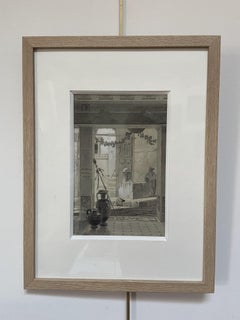
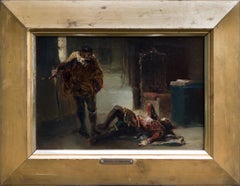
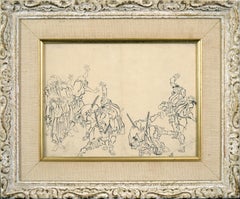
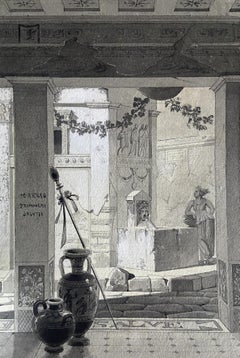
French Romantic School, View of a roman atrium, drawing

French Romantic School, View of a roman atrium, drawing

Located in Paris, FR

French Romantic school circa 1850 An antique Roman Atrium signed lower right (illegible) Ink, Ink wash and white gouache heightenings 20 x 13 cm Framed : 35.5 x 27 cm The signatu...

Category

Romantic 1850s Art

Materials

Ink

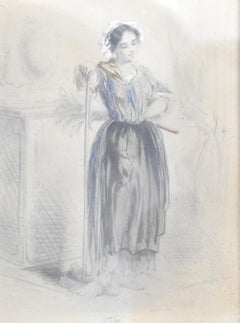
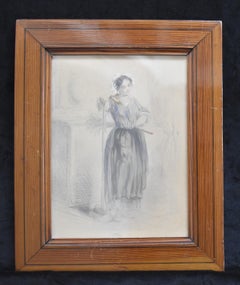
Paul Gavarni (1804-1866) La Soubrette (The handmaid), watercolor

Paul Gavarni (1804-1866) La Soubrette (The handmaid), watercolor

Paul Gavarni (1804-1866) La Soubrette (The handmaid), pencil, watercolor and heightenings of gouache on paper Signed lower right (faded) 20 x 15 cm In quite good condition, lightly sunstroke and yellowed Framed 28.5 x 23 cm Paul Gavarni was the nom de plume of Sulpice Guillaume Chevalier (13 January 1804 – 24 November 1866), a French illustrator, born in Paris. The story is told that he took his name from Gavarnie in Luz-Saint-Sauveur where he had taken a journey into the Pyrenees. He was a very famous illustrator, friend of Felix Nadar...

Category

1850s Art

Materials

Watercolor

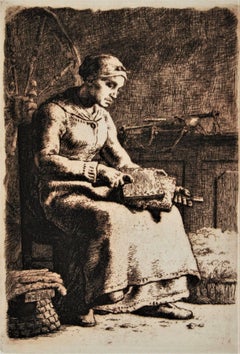
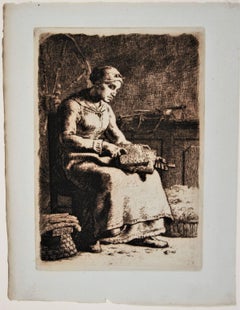
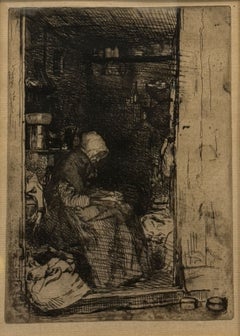
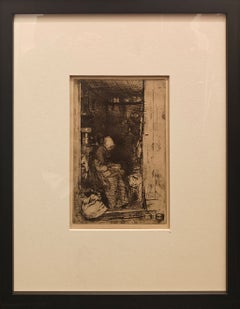
"La Vieille aux Loques" James Abbott McNeill Whistler, Rhineland, Woman Working

"La Vieille aux Loques" James Abbott McNeill Whistler, Rhineland, Woman Working

By James Abbott McNeill Whistler

Located in New York, NY

James Abbott McNeill Whistler La Vielle aux Loques, 1858 Signed in plate Etching and drypoint, printed in black ink on gray chine on off-white wove paper Plate 8 3/16 x 5 13/16 inche...

Category

Academic 1850s Art

Materials

Drypoint, Etching, Wove Paper

19th-Century Antique Animal Oil Painting, Attributed to Alfred de Dreux, Framed

19th-Century Antique Animal Oil Painting, Attributed to Alfred de Dreux, Framed

By Alfred de Dreux

Located in Gavere, BE

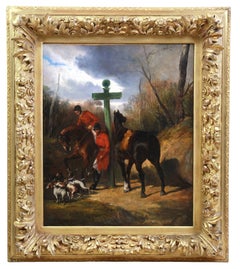
Halte de chasseurs (The Hunters’ Rest) is a 19th-century French animal and sporting oil painting attributed to Alfred de Dreux (1810–1860). Two huntsmen in red coats pause with their horses and hounds beside a green signpost in a wooded landscape. One rider remains mounted while his companion stands beside a dark saddled horse. The dogs gather at the lower left, drawing the eye into the scene. Red coats, warm earth tones and dark foliage contrast with a luminous opening in the clouded sky. The vertical composition combines the intimacy of a hunting group with the atmosphere of a woodland landscape. Alfred de Dreux was a French painter known for equestrian and animal subjects; works by him are held in the Louvre. The gallery offers this unsigned painting as attributed to the artist; it was previously catalogued by Artcurial as French School, after de Dreux. Oil on canvas. Canvas: approximately H 46 × W 38 cm (18.11 × 14.96 in). Overall with frame: H 62 × W 54 × D 7 cm (24.41 × 21.26 × 2.76 in). Cleaned and restored, and described by the gallery as being in very good condition. The painting is presented in the ornate gilt frame illustrated, with floral and scrolling ornament that complements the warm palette. Provenance: anonymous sale, Christie’s, Paris, 12 October 2012, lot 317; private collection, Paris. Illustrated in the sale catalogue on page 90. Artcurial identifies the composition’s source as a lithograph by de Dreux from 1838–1844, reproduced in M.-Chr. Renauld’s Alfred de Dreux (2008), p. 104. A decorative focal point for a study, library or country-house interior, with particular appeal to collectors of antique animal paintings...

Category

French School 1850s Art

Materials

Gold Leaf

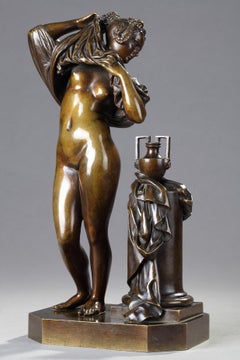
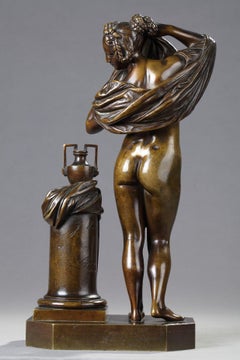
Woman taking off her shirt

Woman taking off her shirt

By James Pradier

Located in PARIS, FR

Woman taking off her shirt by James PRADIER (1790-1852) Bronze with a nuanced brown patina cast by SOYER and INGE France circa 1850 height 28,5 cm Biography : Jean-Jacques Pradier...

Category

French School 1850s Art

Materials

Bronze

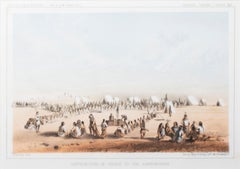
'Distribution of Goods to the Assiniboines' original John Mix Stanley lithograph

'Distribution of Goods to the Assiniboines' original John Mix Stanley lithograph

By John Mix Stanley

Located in Milwaukee, WI

In the mid-nineteenth century, the United States government set out to survey and document its newly acquired lands and territories west of the Mississippi. The goals of these surveys were manifold: to produce topographical maps, to document flora and fauna, and to document natural resources to build the emerging US economy. These surveys, and the images from them, also functioned to build the new sense of American identity with the landscape, condensing vistas into the 'picturesque' tradition of European image making. Thus, the entire span of US territory could be seen as a single, cohesive whole. This lithograph comes from one of six surveys commissioned by the Army's Topographic Bureau in 1853, which sought to find the best route to construct a transcontinental railroad. The result was a thirteen-volume report including maps, lithographs, and technical data entitled 'Explorations and Surveys to ascertain the most practicable and economical route for a Railroad from the Mississippi river to the Pacific Ocean.' When it came to depicting the Assiniboine people, as seen in the present print, Stanley chose to juxtapose their encampment, marked by tipis in the distance, with the encampment of the Isaac Stevens survey party. In the foreground, commemorating this moment, Isaac Stevens can be seen presenting trade goods, which are known to include thirty two dressed skins and two robes. The survey leader Isaac Stevens noted being grateful for the generosity of the Assiniboine, commenting: "I felt very grateful indeed to those Indians, for their kindness to my men, their proffer of kind feeling and hospitality to myself and the survey." This description and this image, however, are arguably depicted through rose-colored glasses: to the Assiniboine people, this meeting may well have included stressful diplomatic relationships and have indicated a threat to the sovereignty over the territories agreed to be theirs by the 1851 Treaty of Fort Laramie. 5.75 x 8.75 inches, image 6.5 x 9.25 inches, stone 17 x 19.75 inches, frame Artist 'Stanley Del.' lower left Entitled 'Distribution of Goods to the Assiniboines' lower center margin Publisher 'Sarony, Major & Knapp. Lith.s 449 Broadway N.Y.' lower right Inscribed 'U.S.P.R.R. EXP. & SURVEYS — 47th & 49th PARALLELS' upper left Inscribed 'GENERAL REPORT — PLATE XIV' upper right Framed to conservation standards using 100 percent rag matting with French accents; glazed with UV5 Plexiglas to inhibit fading; housed in a gold reverse ogee moulding. Print in overall good condition; some localized foxing and discoloration; frame in excellent condition. John Mix Stanley...

Category

Romantic 1850s Art

Materials

Lithograph

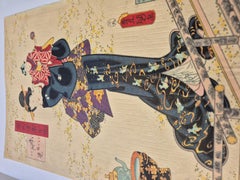
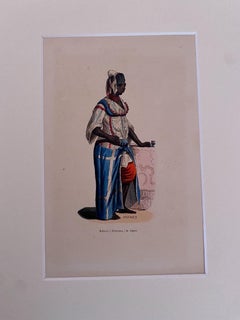
Algerian Woman - Original Lithograph - 1851

Algerian Woman - Original Lithograph - 1851

Located in Roma, IT

Algerian Woman is an original watercolored lithograph on paper realized in 1850 ca. by Anonymous Artist of 19th Century. In very good conditions. Imag...

Category

Modern 1850s Art

Materials

Lithograph

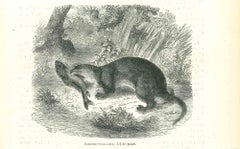
Catching Fish -  Lithograph by Paul Gervais - 1854

Catching Fish - Lithograph by Paul Gervais - 1854

By Paul Gervais

Located in Roma, IT

Catching Fish is an original lithograph on ivory-colored paper, realized by Paul Gervais (1816-1879). The artwork is from The Series of "Les Trois Règnes de la Nature", and was publ...

Category

Modern 1850s Art

Materials

Paper, Lithograph

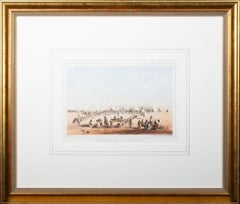
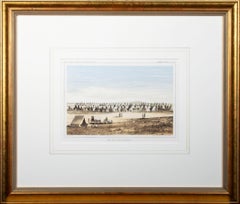
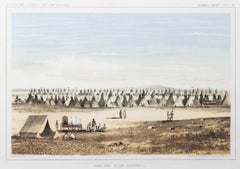
'Camp Red River Hunters' original lithograph by John Mix Stanley

'Camp Red River Hunters' original lithograph by John Mix Stanley

By John Mix Stanley

Located in Milwaukee, WI

In the mid-nineteenth century, the United States government set out to survey and document its newly acquired lands and territories west of the Mississippi. The goals of these surveys were manifold: to produce topographical maps, to document flora and fauna, and to document natural resources to build the emerging US economy. These surveys, and the images from them, also functioned to build the new sense of American identity with the landscape, condensing vistas into the 'picturesque' tradition of European image making. Thus, the entire span of US territory could be seen as a single, cohesive whole. This lithograph comes from one of six surveys commissioned by the Army's Topographic Bureau in 1853, which sought to find the best route to construct a transcontinental railroad. The result was a thirteen-volume report including maps, lithographs, and technical data entitled 'Explorations and Surveys to ascertain the most practicable and economical route for a Railroad from the Mississippi river to the Pacific Ocean.' In particular, the print comes from the northern survey, commanded by Isaac Stevens, which explored the regions between the 47th and 49th parallels. In this image, Stanley shows an encampment of the people known as the Red River of the North hunters. They were generations of European and mixed-race trappers who lived on the frontier and had Indian wives and mixed-race children. They had come to the area for bison hunting, as the herds were still vast on the prairies. In the image, the figures and their encampment are dwarfed by the vast landscape around them, indicating the sublimity of these new American territories. 5.75 x 8.75 inches, image 6.5 x 9.25 inches, stone 17 x 20 inches, frame Artist 'Stanley Del.' lower left Entitled 'Camp Red River Hunters' lower center margin Publisher 'Sarony, Major & Knapp. Lith.s 449 Broadway N.Y.' lower right Inscribed 'U.S.P.R.R. EXP. & SURVEYS — 47th & 49th PARALLELS' upper left Inscribed 'GENERAL REPORT — PLATE XII' upper right Framed to conservation standards using 100 percent rag matting with French accents; glazed with UV5 Plexiglas to inhibit fading; housed in a gold reverse ogee moulding. Print in overall good condition; some localized foxing and discoloration; minor surface abrasions to frame. John Mix Stanley...

Category

Romantic 1850s Art

Materials

Lithograph

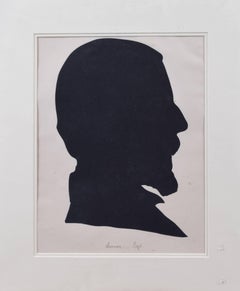
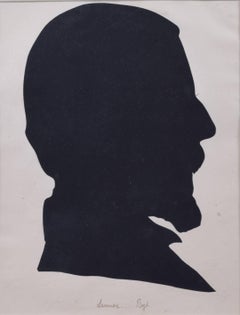
Nineteenth century silhouette of a gentleman: Lennox

Nineteenth century silhouette of a gentleman: Lennox

Located in London, GB

To see more, scroll down to "More from this Seller" and below it click on "See all from this Seller." Silhouette (circa 1870) Lennox Gouache, pen, and ink 52 x 44 cm Prior to phot...

Category

1850s Art

Materials

Ink, Gouache, Pen

Mount Washington,  New Hampshire

Mount Washington, New Hampshire

By Edmund Darch Lewis

Located in Saratoga Springs, NY

Edmund Darch Lewis (1835-1910) Mount Washington, New Hampshire 50 x 58 inches, signed & dated 1859 Description The area near Mount Washington in New Hampshire was visited by m...

Category

Hudson River School 1850s Art

Materials

Canvas, Oil

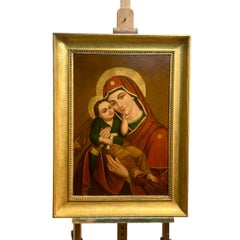
Oil on canvas, "Madonna and Child" 1850, Eastern Europe

Oil on canvas, "Madonna and Child" 1850, Eastern Europe

Located in Vicenza, VI

A painting that refers to Our Lady Eleusa, also known as the "Mother of God of Tenderness," which shows an undeniable feeling of affection and tenderness between mother and child. Th...

Category

Other Art Style 1850s Art

Materials

Canvas, Oil

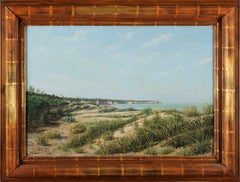
Beach landscape on Atlantic French coast

Beach landscape on Atlantic French coast

Located in BELEYMAS, FR

Jean-Georges PASQUET (Périgueux 1851 - 1936) Pointe de Suzac at Saint Georges de Didonne Oil on canvas H. 59 cm; W. 85 cm Signed and dated 1885 lower left Provenance: Private collec...

Category

French School 1850s Art

Materials

Oil, Canvas

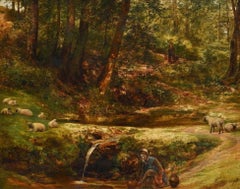
The Sylvan Spring
The Sylvan Spring

The Sylvan Spring

Located in London, GB

Richard Redgrave The Sylvan Spring 1804-1888 Oil on canvas, signed and dated '1855', inscribed verso Image size: 32 1/2 x 26 1/3 inches (82.5 x 67 cm) Original ornate gilt frame Ins...

Category

1850s Art

Materials

Canvas, Oil

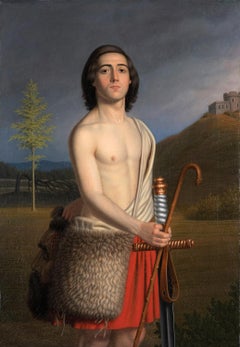
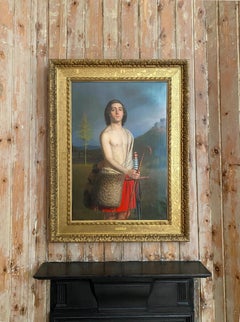
David with the Head of Goliath, 19th Century Victorian Oil

David with the Head of Goliath, 19th Century Victorian Oil

By John Rogers Herbert

Located in London, GB

John Rogers Herbert RA 1810- 1890 Oil on canvas, dated '1850' lower right on sword strap Image size: 33 ½ x 23 ½ inches Gilt Watts frame This striking painting, depicts David as a y...

Category

Victorian 1850s Art

Materials

Oil

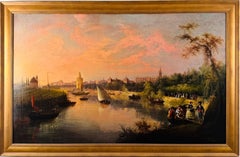
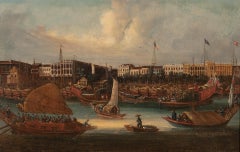
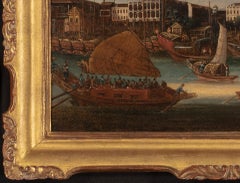
Manuel Barrón, Vista de Sevilla

Manuel Barrón, Vista de Sevilla

Located in Madrid, ES

MANUEL BARRÓN Spanish, 1814 - 1844 VISTA DE SEVILLA signed, located and dated "Manuel Barrón / Sevilla. 1854" (lower right) oil on canvas 30-1/8 x 49 inches (76.5 x 124.5 cm.) framed...

Category

1850s Art

Materials

Canvas, Oil

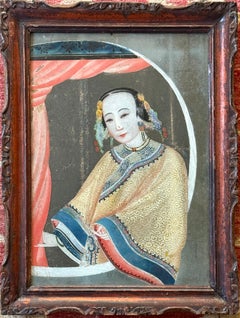
Chinese Qing Dynasty Reverse Painted Glass Painting 19th C.

Chinese Qing Dynasty Reverse Painted Glass Painting 19th C.

Located in Dallas, TX

19th Century Chinese Glass reverse Painted Figure Of A Dignifies Woman dressed in a decorated gold silk robe with ornate colorful jewelry. Circa 1825 Chinese export Signed on verso. ...

Category

Qing 1850s Art

Materials

Glass, Oil

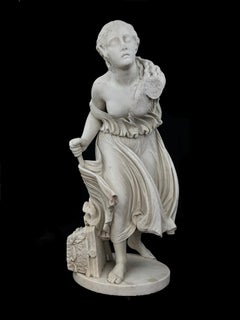
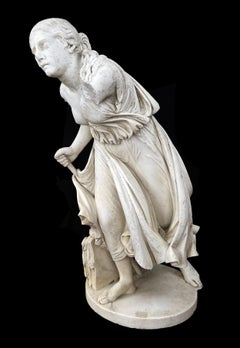
NYDIA, THE BLIND FLOWER GIRL OF POMPEII Marble Sculpture 1856-1870

NYDIA, THE BLIND FLOWER GIRL OF POMPEII Marble Sculpture 1856-1870

Located in Soquel, CA

Randolph John Rogers (American, 1825 - 1892) Randolph Rogers' Nydia, the Blind Flower Girl of Pompeii debuted in 1856 to critical and public acclaim, solidifying Rogers’ position as a pre-eminent American sculptor and it remains one of the artist’s most celebrated works today. The subject of Nydia is drawn from Edward Bulwer-Lytton's The Last Days of Pompeii 1834. After touring the ruins of the ancient city in 1833, and inspired by the stories of blinding volcanic ash, he composed the tale of Nydia, a slave who led her master, Glaucus, to safety. Rogers depicts Nydia at the moment that she and Glaucus have become separated in their perilous journey through the rubble and Nydia seeks familiarity in the surrounding chaos, her distress evident in her pained expression. The grace of the sculpture is at odds with the turmoil portrayed; a toppled Corinthian capital lies at her feet and obstructs her next step, indicated by the tilt of her back foot and grip on her walking stick. Examples of this model can be found in major American collections, including The Metropolitan Museum of Art, the Art Institute of Chicago, the Detroit Institute of Arts, the Los Angeles County Museum of Art, and the Museum of Fine Arts, Boston. Literature, Millard F Rogers, Jr. Randolph Rogers, American Sculptor in Rome. University of Massachusetts Press, 1971, American Figurative Sculpture in the Museum of Fine Arts Boston. Museum of Fine Arts, Boston, 1986. Joyce K Schiller. "Nydia, A Forgotten Icon of the Nineteenth Century." Bulletin of the Detroit Institute of Arts, Born in Waterloo, New York, Randolph John Rogers became an expatriate* sculptor of idealized figures, portraits, and commemorative works in Neo-Classical* and Realist* styles. He worked in clay, plaster, marble and bronze, and lived both in Italy and the United States. He made 167 examples of Nydia in two sizes (varies depending on base height) 36" and 54'. Rogers was raised in Ann Arbor, Michigan, and as a young man did woodcuts* for the local newspaper, The Michigan Argus, and also worked as a baker's assistant and a dry goods clerk. In 1847, he moved to New York City, where he hoped to find work as an engraver*, but failing to do so, worked in a dry goods store owned by John Steward...

Category

Italian School 1850s Art
Materials

Marble

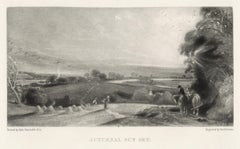
(after) John Constable mezzotint "Autumnal Sun Set"

(after) John Constable mezzotint "Autumnal Sun Set"

By David Lucas

Located in Henderson, NV

Medium: mezzotint (engraved by David Lucas after the John Constable painting). Printed in 1855 on cream wove paper for the "English Landscape Scenery" portfolio, published in London ...

Category

1850s Art
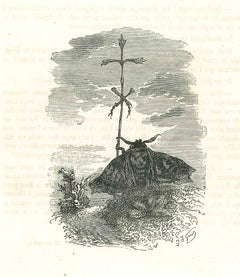
Materials

Mezzotint

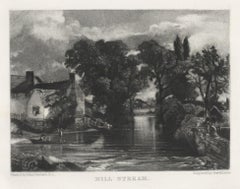
(after) John Constable mezzotint "Mill Stream"

(after) John Constable mezzotint "Mill Stream"

By David Lucas

Located in Henderson, NV

Medium: mezzotint (engraved by David Lucas after the John Constable painting). Printed in 1855 on cream wove paper for the "English Landscape Scenery" portfolio, published in London ...

Category

1850s Art
Materials

Mezzotint

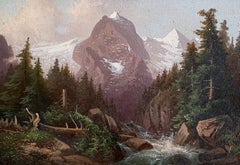
“View of Switzerland”

“View of Switzerland”

By John William Casilear

Located in Southampton, NY

Beautiful oil on fiberboard painting of a view of Switzerland done by the American artist, John William Casilear. Signed with monogram lower left. Condition is excellent. Circa 1857/1858. The painting is housed in a contemporary frame. Overall framed measurements are 6 5/8 by 8 5/8 inches. lProvenance: Long Island, New York collector. Biography John William Casilear was born in New York City on June 25, 1811. Like his fellow Hudson River School landscapists Asher B. Durand and John F. Kensett, he worked as an engraver before turning to painting. In 1826 Casilear was apprenticed to the engraver Peter Maverick (1780-1831), and at first he primarily executed bank notes. Durand encouraged him to attempt other subjects, however, and during the 1830s he madeengravings after some of the most prominent paintings of the day, including Daniel Huntington's The Sybil (New-York Historical Society). In 1832 he began submitting engravings to the National Academy of Design exhibition and he first showed paintings there in 1836. In 1833 Casilear was elected an Associate of the Academy; he was elevated to full Academician status in 1851. In 1840 Casilear accompanied Durand, Kensett, and another painter, Thomas P. Rossiter (1818-1871), on a trip to Europe. There the artists studied and copied paintings...

Category

Academic 1850s Art
Materials

Oil, Fiberboard

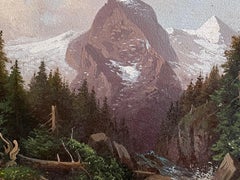
“Matterhorn”
“Matterhorn”

“Matterhorn”

Located in Southampton, NY

Here for your consideration is a wonderfully detailed miniature painting of the Matterhorn. Signed and titled verso. Attributed to the artist William Archibald Wall. Dated 6/50 verso...

Category

Academic 1850s Art
Materials

Oil, Fiberboard

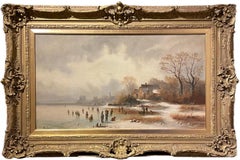
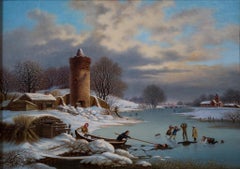
Winter Scene with Figures on Ice, 1859

Winter Scene with Figures on Ice, 1859

Located in Stockholm, SE

This signed and dated winter scene from 1859 constitutes an important and revealing example of the artistic practice of Gustaf Adolf Schuknecht, a Swedish painter whose work survives...

Category

Realist 1850s Art
Materials

Canvas, Oil

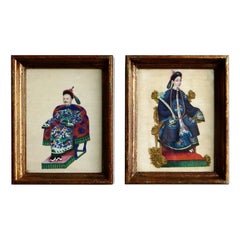
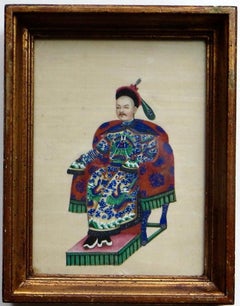
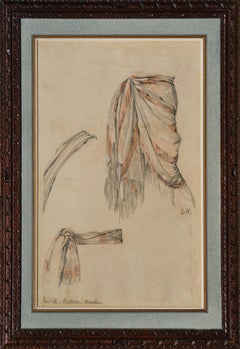
19thC Chinese Pair of Pith Paintings "Emperor Xianfeng & Consort Qing" C.1855

19thC Chinese Pair of Pith Paintings "Emperor Xianfeng & Consort Qing" C.1855

Located in Incline Village, NV

Fabulous pair of mid 19th century Qing Dynasty hand painted watercolor Chinese Pith paintings; subjects attributed to Emperor Xianfeng and Consort Qing. Emperor Xianfeng was the 8th ...

Category

Qing 1850s Art
Materials

Watercolor, Rice Paper

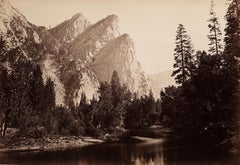
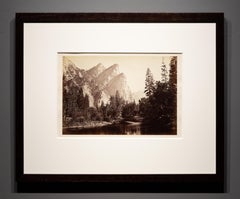
The Three Brothers, Yosemite

The Three Brothers, Yosemite

By Carleton Watkins

Located in Pacific Grove, CA

This early albumen silver print is titled in ink on the front of the mount. Printed before 1876, when Watkins lost his negatives to a creditor, who sold them to his competitor, Isaia...

Category

1850s Art
Materials

Silver

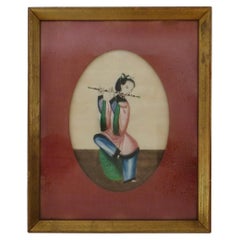
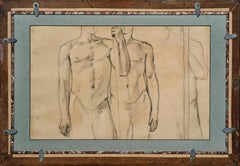
Mid 19thC. Chinese Pith Painting of A Female Flautist Framed; Oval Matte C. 1850

Mid 19thC. Chinese Pith Painting of A Female Flautist Framed; Oval Matte C. 1850

Located in Incline Village, NV

A female flautist is proudly on display in this circa 1850 Chinese watercolor pith painting; as the subject portrays an element of Chinese culture wanting to be expressed and shown t...

Category

Qing 1850s Art
Materials

Watercolor, Rice Paper