1850s Art

to
99
1,020
107
48
31
26
Overall Width
to
Overall Height
to
7,703
21,711
163,762
226,669
2,003
2,280
4,944
6,495
5,861
15,033
20,544
25,710
18,610
14,068
5,502
841
16
7
4
2
2
1
680
518
22
675
369
319
275
232
177
153
113
86
76
70
69
67
55
51
48
46
45
38
36
850
331
166
126
73
119
87
64
58
16
168
668
399
169
Period: 1850s
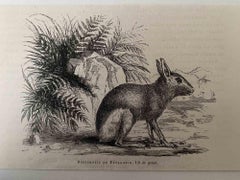
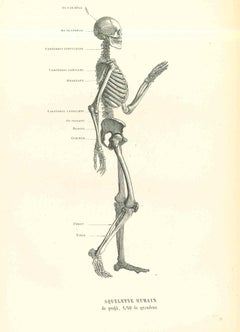
Animal Teeth - Lithograph by Paul Gervais - 1854

Animal Teeth - Lithograph by Paul Gervais - 1854

By Paul Gervais

Located in Roma, IT

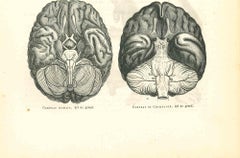
Lithograph on ivory-colored paper, realized by Paul Gervais (1816-1879). The artwork is from The Series of "Les Trois Règnes de la Nature", and was published in 1854. Good condition...

Category

Modern 1850s Art

Materials

Lithograph
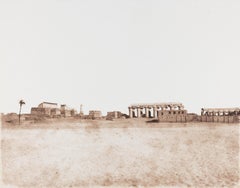
Kardacy, Egypt

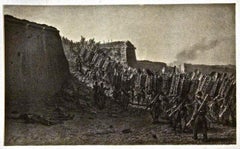
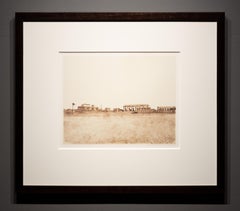
Felix TeynardKardacy, Egypt, 1851-52

$10,000Sale Price|20% Off

Kardacy, Egypt

By Felix Teynard

Located in Pacific Grove, CA

This vintage salt print is titled, attributed and annotated in lithographic ink on the front of the mount. Printed 1850s.

Category

1850s Art

Materials

Silver

Korean - Original Hand-watercolored Lithograph - 1854

Korean - Original Hand-watercolored Lithograph - 1854

Located in Roma, IT

"Coreano" (Asia) is an original hand-watercolored lithograph on ivory paper by Anonymous Artist of XIX Century, in 1854s. In excellent conditions. Not signed. Titled on the lower ...

Category

1850s Art

Materials

Watercolor, Lithograph

Untitled - Etching by Kees van Dongen - 1850

Untitled - Etching by Kees van Dongen - 1850

Located in Roma, IT

Untitled is an original Modern artwork realized by Cornelis Theodorus Maria 'Kees' van Dongen (26 January 1877 – 28 May 1968). Hand signed and numbered by artist with pencil, with d...

Category

Modern 1850s Art

Materials

Etching

Annual Events for Young Murasaki (July) - Tales of Genji - Japanese Woodblock

Annual Events for Young Murasaki (July) - Tales of Genji - Japanese Woodblock

By Utagawa Kunisada (Toyokuni III)

Located in Soquel, CA

Annual Events for Young Murasaki (July) - Tales of Genji - Japanese Woodblock Rightmost panel a triptych, depicting monthly events for Wakamurasaki (Young Murasaki). This is the month of July. There appears to be a lesson taking place, possibly for writing or poetry. Artist: Toyokuni III/Kunisada (1786 - 1864) Publisher: Ebisu-ya Shoshichist Presented in a new blue mat. Mat size: 19"H x 13"W Paper size: 14.5"H x 10"W Commentary on the triptych: In the Edo period, Tanabata was designated as one of the five seasonal festivals, and became an annual event for the imperial court, aristocrats, and samurai families, and gradually came to be celebrated by the general public. Its origins are said to be a combination of the Kikoden festival, which originated from the Chinese legend of Altair and the Weaver Girl, and Japan's ancient Tanabata women's faith. Ink is ground with dew that has accumulated on potato leaves, poems and wishes are written on five colored strips of paper, which are then hung on bamboo branches to celebrate the two stars that meet once a year. Although the illustration is a Genji painting...

Category

Realist 1850s Art

Materials

Printer's Ink, Rice Paper, Woodcut

Kabukie - Woodcut by Utagawa Kunisada - 1850s

Kabukie - Woodcut by Utagawa Kunisada - 1850s

Located in Roma, IT

Kabukie is an original artwork realized in the 1850s by Utagawa Kunisada (1786-1865). Oban from a triptych. An actor in the role of Otokodate Abe no Homei stands ready at night in...

Category

Modern 1850s Art

Materials

Woodcut

Henry Murger - Original Lithograph by Paul Gavarni - 1850s

Henry Murger - Original Lithograph by Paul Gavarni - 1850s

By Paul Gavarni

Located in Roma, IT

Henry Murger is a lithograph on ivory-colored paper, realized by the French draftsman Paul Gavarni (alias Guillaume Sulpice Chevalier Gavarni, 1804-1866) in the mid-19th Century. From series of "Masques et Visages". Titled on the lower. Good conditions. Paul Gavarni (Paris, 1804 – 1866). Gavarni's father, Sulpice Chevalier, was from a family line of coopers from Burgundy. Paul began work as mechanical work in a machine factory but he saw that to make any progress in his profession, he had to be able to draw; accordingly, in his spare time in the evenings, he took classes in drawing. He devoted his special attention to architectural and mechanical drawing...

Category

Modern 1850s Art

Materials

Lithograph
"Building the Allegheny Railroad, Pennsylvania" Alfred Wall, Scalp Level School

"Building the Allegheny Railroad, Pennsylvania" Alfred Wall, Scalp Level School

Located in New York, NY

Alfred S. Wall (American, 1825-1896) Untitled (Building the Railroad), 1859 Oil on canvas 14 1/2 x 18 1/2 inches Signed and dated lower left For Christmas, 2008, the Pittsburgh Post-Gazette featured Alfred Wall's painting, Old Saw Mill from the collection of the Westmoreland Museum of American Art in Greensburg, PA. It was painted in 1851 in the town of Lilly, Pennsylvania in the Allegheny Mountains. The newspaper description stated that "though the saw mill is long gone, it still conveys all the warmth and coziness of this time of year. The article, written by Patricia Lowry, continued: At first glance, Alfred S. Wall's painting of a saw mill in snowy woods triggers nostalgia for the coziness of a log cabin, the smell of a wood-burning fire and the warming of chilled hands and feet beside it. But as sentimental as it seems on the surface, Mr. Wall's painting has a deeper and unexpected context. This is more than a painting about sled-riding children and early industry planted in the middle of virgin forest. Intended or not, this is a painting about conquering the great divide of the Allegheny Mountains. For the third consecutive year, the Post-Gazette features a winter-scene painting on the cover of the Christmas Day newspaper. This year's painting, Old Saw Mill, was selected by co-publisher and editor-in-chief John Robinson Block and executive editor David Shribman during a visit to the Westmoreland Museum of American Art in Greensburg. Mr. Wall, listed as a portrait painter in the 1850 census, was about 26 when he painted Old Saw Mill in 1851. The self-taught artist was born in Mount Pleasant, Westmoreland County, to William and Lucy Wall, who'd emigrated from England around 1820. An artistic sensibility ran in the family: William was a sculptor who carved ornate tombstones here; Alfred's children, A. Bryan and Bessie, were landscape painters, as was Alfred's older brother, William Coventry Wall. For more than a century the Walls formed a prominent art dynasty in Pittsburgh, and Alfred, eventually a partner in the city's most prestigious art gallery, was well known as a painter, dealer and restorer. In Old Saw Mill, two wood cutters, each holding an axe, meet outside the mill; one points in the direction of the forest. On the other side of the stream, one child pulls another down the hillside on a sled. Just behind the hill's slope, the roof of a building appears, perhaps the home of the sawyer. The luminous, late afternoon light comes from the northwest, casting lengthening shadows on the snow under a darkening sky. The saw mill in "Old Saw Mill" likely would have been impossible to track down had Mr. Wall, presumably, not written on the back of the painting: "old saw mill near Jct. 4, Portage RR, Pa." "There was no Junction 4," said Mike Garcia, park ranger at the Allegheny Portage Railroad National Historic Site, about 90 miles east of Pittsburgh near Gallitzen, Cambria County. "But there was an Inclined Plane No. 4 at Lilly, and there was a saw mill there." In fact, there were at least six saw mills at Lilly over the years, said longtime resident Jim Salony, president of the Lilly-Washington Historical Society. But when he saw an image of the painting, Mr. Salony had no trouble coming up with a location. While there are no known photographs of the saw mill, he believes it stood near the intersection of Portage and Washington streets, next to Bear Rock Run. Mr. Salony, retired academic dean at Mount Aloysius College, didn't know exactly when the mill was torn down, but it's been gone since at least the late 1800s. He was pleased to learn of the painting, even though that knowledge came too late for inclusion in a new book about Lilly, The Spirit of a Community, for which he served as primary author and editor. It runs to more than 700 pages. For a little town -- population 869 last year -- Lilly has a lot of history. Nestled in a bowl on the western slope of the Allegheny Mountains about 3 miles south of Cresson, Lilly was first settled in 1806 by Joseph Meyer and his family, who named their 332-acre land patent Dundee. Although the Meyers had left by 1811, other settlers followed, but the community didn't flourish until the 1830s, when the Allegheny Portage Railroad began its 23-year-run through the town. For 200 years the Alleghenies had stood as an impediment to trade and travel between Pittsburgh and the east. A canal from Philadelphia to Pittsburgh would change that and compete with New York's Erie Canal. But a portage railroad would have to be built, on which teams of horses would lead the canal boats over the mountains. Engineer Sylvester Welch began his surveying from the small settlement at Lilly. The railroad would require 10 inclined planes, some quite steep, between Hollidaysburg and Johnstown. To build it, trees had to be cut along a 120-foot-wide right-of-way for 36 miles, along which track and engine houses had to be built. William Brown, who owned the saw mill on Bear Rock Run, built at least one of the engine houses at Inclined Plane No. 4; an 1834 contract also included fencing the dwelling lots at the head and foot of the plane. Lilly is located at what was the foot of Inclined Plane No. 4., giving the community one of its early informal names, Foot of Four. Named in 1883 for Richard Lilly, who'd completed the grist mill there, Lilly had another early name: Hemlock, so dubbed by a Portage Railroad traveler who smelled the bark stripped from the trees at the saw mill. Because there isn't another Allegheny Portage Railroad location like it, where a cut in the mountains opens into a bowl, Mr. Salony thinks it was Lilly that Charles Dickens wrote about following his trip from Harrisburg to Pittsburgh on the Pennsylvania Canal in late March 1842, describing what he saw after emerging from "the bottom of the cut": "It was very pretty while traveling, to look down into a valley full of light and softness, catching glimpses through the tree-tops of scattered cabins; children running to the doors; dogs bursting out to bark, who we could see without hearing; terrified pigs scampering homeward; families sitting out in their rude gardens; cows gazing upward with a stupid indifference; men in their shirt-sleeves looking on at their unfinished houses, planning out to-morrow's work; and we riding onward, high above them, like a whirlwind." To get to Lilly, Mr. Wall may have taken the Pennsylvania Canal from his home in Allegheny City, now the North Side. He'd married young, at 21, to Sarah Carr in 1846, the same year he began his career as an artist. By 1880 they were living in a brick townhouse at 104 (later 814) Arch St., now demolished. Across the river in Pittsburgh he shared a studio at 67 Fourth Ave. with his brother William; they later moved to Burke's Building, today the city's oldest office building at 209-211 Fourth. But often they worked outdoors, sometimes as part of the colony of artists that grew up around painter George Hetzel beginning in the late 1860s at Scalp Level...

Category

Hudson River School 1850s Art

Materials

Canvas, Oil

Portrait de Frederique Regamey - Oil Paint by Alphonse Legros - 1859

Portrait de Frederique Regamey - Oil Paint by Alphonse Legros - 1859

By Alphonse Legros

Located in Roma, IT

Portrait d'Homme is an artwork realized by the french artist Alphonse Legros (1837-1911) in 1859. Oil on Canvas. Good conditions except some rips on the edges. Broche du nº 23 du catalogue Malassis-Thibaudeau "Portrait de Frederique Regamey". Collection Thibaudeau. Alphonse Legros was born on May 8, 1837 in Dijon, France. While young, Legros visited the farms of his relatives, and the peasants and landscapes of that part of France are the subjects of many of his works. He was sent to the art school at Dijon with a view to qualifying for a trade, and was apprenticed to an interior decorator. In 1851, Legros left for Paris, but passing through Lyon he worked for six months as journeyman muralist for painter/art restorer Jean-Baptiste Beuchot, who was painting the chapel of Cardinal Bonald in the cathedral.In Paris, Legros studied with theater scene painter Charles-Antoine. He attended also the drawing-school of Lecoq de Boisbaudran (the "Petite école") where he found made friends with Jules Dalou and Auguste Rodin. In 1855, he attended the evening classes of the École des Beaux Arts.Legros sent two portraits to the Paris Salon of 1857: one was rejected, and formed part of the exhibition of protest organized by Francois Bonvin in his studio; the other, which was accepted, was a profile portrait of his father. Art critic Champfleury saw the work in the Salon, and sought out the artist to enlist him in the "Realists," a group anchored by Gustave Courbet.Legros picked up the art of etching by watching a colleague in Paris who worked as a commercial engraver, and taught himself both etching and medallion making. He considered the traditional journey to Italy an important part of artistic training, and in later years, gave part of his salary to augment the income available for a travelling internship.He moved to England in 1863 and in 1864 married Frances Rosetta Hodgson. In his early career, he lived from the sales of his etchings and teaching. He began teaching etching at the South Kensington School of Art and in 1876 became a Slade Professor at University College, London, succeeding Edward Poynter...

Category

Contemporary 1850s Art

Materials

Canvas, Oil

The Fairy Library - Rare Book Illustrated by George Cruikshank - 1850

The Fairy Library - Rare Book Illustrated by George Cruikshank - 1850

By George Cruikshank

Located in Roma, IT

The Fairy Library is a set of original modern rare books written by various authors and illustrated by George Cruikshank (London, 1792 - London, 1878) between 1853-1854. Published by David Bogue, London. Original First Edition. Format: in 8°. The book includes Four Volumes (they includes 30, 32, 31 and 40 pages with illustrated wrappers and 24 full page Etchings; there is also an extra suite of Twentyfour hand colored etchings). Mint conditions. George Cruikshank (London, 1792 - London, 1878) was a British caricaturist and book illustrator, praised as the "modern Hogarth" during his life. His book illustrations for his friend di lui Charles Dickens, and many other authors, reached an international audience. For Charles Dickens, Cruikshank illustrated Sketches by Boz...

Category

Modern 1850s Art

Materials

Paper, Etching

Tourelle de la Rue de la Tixeranderie - Etching by C. Meryon - 1852

Tourelle de la Rue de la Tixeranderie - Etching by C. Meryon - 1852

By Charles Meryon

Located in Roma, IT

Tourelle de la rue de la Tixeranderie is an original Modern Artwork realized in the half of the 19th Century by Charles Meryon (sometimes Méryon, 23 November 1821 – 14 February 1868). Original Etching. Fine impression printed by the artist. II/III state on V. Total dimensions: 24 x 12 cm. Passepartout is included. Excellent conditions of sheet. Reference: Salimbeni no.163; Schneiderman n. 24; Delteil n. 29. Charles Meryon (sometimes Méryon, 23 November 1821 – 14 February 1868). He was a French artist who worked almost entirely in etching, as he suffered from color blindness. Although now little-known in the English-speaking world, he is generally recognized as the most significant etcher of 19th century France. His most famous works by him are a series of views powerfully conveying his distinctive Gothic vision of Paris. He also suffered from mental illness, dying in an asylum. Meryon had sketched in Athens, Algiers and other exotic places he had visited, and by late 1840 decided to take lessons in drawing from the Toulon...

Category

Modern 1850s Art

Materials

Etching

Landscape with Herd
Landscape with Herd

Landscape with Herd

Located in ROUEN, FR

19th-century French School oil on canvas by Auguste-François Lièvre, titled “Landscape with Herd” (Paysage au troupeau). Signed and dated 1854.

Category

French School 1850s Art

Materials

Oil

“View of Switzerland”

“View of Switzerland”

By John William Casilear

Located in Southampton, NY

Beautiful oil on fiberboard painting of a view of Switzerland done by the American artist, John William Casilear. Signed with monogram lower left. Condition is excellent. Circa 1857/1858. The painting is housed in a contemporary frame. Overall framed measurements are 6 5/8 by 8 5/8 inches. lProvenance: Long Island, New York collector. Biography John William Casilear was born in New York City on June 25, 1811. Like his fellow Hudson River School landscapists Asher B. Durand and John F. Kensett, he worked as an engraver before turning to painting. In 1826 Casilear was apprenticed to the engraver Peter Maverick (1780-1831), and at first he primarily executed bank notes. Durand encouraged him to attempt other subjects, however, and during the 1830s he madeengravings after some of the most prominent paintings of the day, including Daniel Huntington's The Sybil (New-York Historical Society). In 1832 he began submitting engravings to the National Academy of Design exhibition and he first showed paintings there in 1836. In 1833 Casilear was elected an Associate of the Academy; he was elevated to full Academician status in 1851. In 1840 Casilear accompanied Durand, Kensett, and another painter, Thomas P. Rossiter (1818-1871), on a trip to Europe. There the artists studied and copied paintings...

Category

Academic 1850s Art

Materials

Fiberboard, Oil

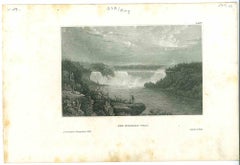
Ancient View of Niagara Waterfalls - Original Lithograph - 1850s

Ancient View of Niagara Waterfalls - Original Lithograph - 1850s

Located in Roma, IT

Ancient View of Niagara Waterfalls is an original modern artwork realized in Italy in the first half of the 19th Century. Original Lithograph on Ivory Paper. Inscripted in capital...

Category

Modern 1850s Art

Materials

Lithograph
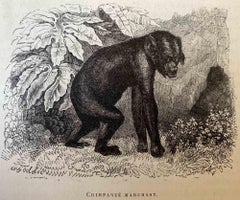
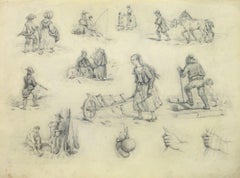
French Drawing - Figure Study

French Drawing - Figure Study

Located in Houston, TX

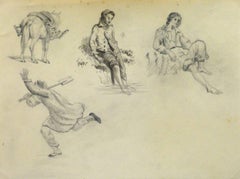
Lovely one-of-a-kind pencil and watercolor sketch of various figures and a work horse, circa 1850. Original artwork on paper displayed on a white mat with a gold border. Archival pl...

Category

1850s Art

Materials

Paper, Watercolor, Pencil

original poster of the Parisian public transportation system before 1854

original poster of the Parisian public transportation system before 1854

Located in PARIS, FR

This remarkable original poster offers a snapshot of the Parisian public transportation system before 1854, capturing the intricate network of horse-drawn omnibuses that circulated t...

Category

1850s Art

Materials

Linen, Paper, Lithograph

La Pompe Notre Dame

La Pompe Notre Dame

By Charles Meryon

Located in Roma, IT

This original etching is titled and dated on plate. Monogram of the artist "MC" on higher right margin. Edition of 30 prints, 9 State. Very good conditions. Charles Méryon was a Fre...

Category

Old Masters 1850s Art

Materials

Etching

French Drawing - Everyday Life

French Drawing - Everyday Life

Located in Houston, TX

Playful one-of-a-kind pencil sketch of various 18th century figures going about their daily activities, circa 1850. Original artwork on paper displayed on a white mat with a gold bo...

Category

1850s Art

Materials

Paper, Pencil

The Departure - Etching by Bartolomeo Pinelli - 1850

The Departure - Etching by Bartolomeo Pinelli - 1850

By Bartolomeo Pinelli

Located in Roma, IT

Th Departure - (Original Title: In Partenza - Il General Radet Fa Partire) is an original hand-colored etching realized by the Italian artist Bartolomeo Pinelli in 1850. With the description of artwork on the lower in Italian. Very good conditions. Engaging Italian artwork...

Category

Modern 1850s Art

Materials

Etching

Limehouse

Limehouse

By James Abbott McNeill Whistler

Located in New York, NY

James McNeill Whistler (1834-1903), Limehouse, etching, 1859. References: Glasgow 48, fifth state (of 6), Kennedy 40, third state (of 3), signed with the butterfly in pencil in the lower margin. [Also signed and dated in the plate.]With margins, 5 x 7 7/8 inches, the sheet 6 1/2 x 9 1/2 inches. Published as no. 12 in A Series of Sixteen Etchings of Scenes on the Thames and Other Subjects, otherwise known as the Thames Set. In good condition apart from a soft diagonal fold in the sky. A very fine impression, in black ink on a thin Japan paper. Provenance: Dr. John W. Randall (cf. Lugt 2130), without his mark, annotated on the mat. Limehouse, the entrance to the West Indies Docks, lies opposite the Surrey Commercial Docks in Rotherhithe, along the lower Thames. It’s unusual to find the signed butterfly (or any pencil signature) on the early London etchings, but it is known that Whistler signed...

Category

Realist 1850s Art

Materials

Etching

Ancient View of Moscow - Original Lithograph on paper - 1850s

Ancient View of Moscow - Original Lithograph on paper - 1850s

Located in Roma, IT

Ancient View of Moscow is an original modern artwork realized in France in the first half of the 19th Century. Original B/W Lithograph on Ivory Paper. Inscripted on the lower marg...

Category

Modern 1850s Art

Materials

Lithograph
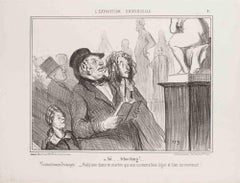
"Sun Saburo Matsugaya" - Mid 19th Century Figurative Japanese Woodblock Print

"Sun Saburo Matsugaya" - Mid 19th Century Figurative Japanese Woodblock Print

By Utagawa Kunisada (Toyokuni III)
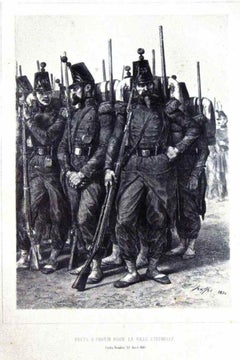
Located in Soquel, CA

"Sun Saburo Matsugaya" - Mid 19th Century Figurative Japanese Woodblock Print Beautiful mid 19th century figural Japanese woodblock print of a seated man with lilies in the background by Utagawa Toyokuni III (Kunisada) (Japanese, 1786-1864/5). Artist's chop is in the lower right corner of the piece. The actor is Magosaburo Matsugaya from the play "Katakiuchi Rumors" Presented in a new grey-blue mat with foamcore backing. Mat size: 21"H x 16"W Paper size: 14"H x 9.75"W During his lifetime Kunisada Utagawa...

Category

Edo 1850s Art

Materials

Paper, Ink, Woodcut

Mother - Original Lithograph by J.J Grandville - 1852

Mother - Original Lithograph by J.J Grandville - 1852

By J. J. Grandville

Located in Roma, IT

Mother is an original lithographs by J.J. Grandville from "Scènes de la vie privée et publique des animaux, 1852. Published by Manesq & Harvard, Paris. Good Conditions but aged. The artwork is depicted through strong strokes with perfect hatching. Jean Ignace Isidore Gérard...

Category

Modern 1850s Art

Materials

Paper, Lithograph

“Le Crepuscule”
“Le Crepuscule”

“Le Crepuscule”

By Jean Louis Hamon

Located in Southampton, NY

Original photogravure of a young woman in the garden. Original painting was done by Jean Louis Harmon in 1857. Condition is very good. Le Crepuscule is the French word for twilig...

Category

Academic 1850s Art

Materials

Archival Paper, Photogravure

Antique American Sunset Seascape Giltwood Framed New England Harbor Oil Painting

Antique American Sunset Seascape Giltwood Framed New England Harbor Oil Painting

Located in Buffalo, NY

Antique American sunset seascape oil painting. Oil on board. Signed. Framed. Measuring: 18 by 24 inches overall, and 12.25 by 18 painting alone.. In excellent original condition. Ha...

Category

Hudson River School 1850s Art

Materials

Oil, Board

NYDIA, THE BLIND FLOWER GIRL OF POMPEII Marble Sculpture 1856-1870

NYDIA, THE BLIND FLOWER GIRL OF POMPEII Marble Sculpture 1856-1870

Located in Soquel, CA

Randolph John Rogers (American, 1825 - 1892) Randolph Rogers' Nydia, the Blind Flower Girl of Pompeii debuted in 1856 to critical and public acclaim, solidifying Rogers’ position as a pre-eminent American sculptor and it remains one of the artist’s most celebrated works today. The subject of Nydia is drawn from Edward Bulwer-Lytton's The Last Days of Pompeii 1834. After touring the ruins of the ancient city in 1833, and inspired by the stories of blinding volcanic ash, he composed the tale of Nydia, a slave who led her master, Glaucus, to safety. Rogers depicts Nydia at the moment that she and Glaucus have become separated in their perilous journey through the rubble and Nydia seeks familiarity in the surrounding chaos, her distress evident in her pained expression. The grace of the sculpture is at odds with the turmoil portrayed; a toppled Corinthian capital lies at her feet and obstructs her next step, indicated by the tilt of her back foot and grip on her walking stick. Examples of this model can be found in major American collections, including The Metropolitan Museum of Art, the Art Institute of Chicago, the Detroit Institute of Arts, the Los Angeles County Museum of Art, and the Museum of Fine Arts, Boston. Literature, Millard F Rogers, Jr. Randolph Rogers, American Sculptor in Rome. University of Massachusetts Press, 1971, American Figurative Sculpture in the Museum of Fine Arts Boston. Museum of Fine Arts, Boston, 1986. Joyce K Schiller. "Nydia, A Forgotten Icon of the Nineteenth Century." Bulletin of the Detroit Institute of Arts, Born in Waterloo, New York, Randolph John Rogers became an expatriate* sculptor of idealized figures, portraits, and commemorative works in Neo-Classical* and Realist* styles. He worked in clay, plaster, marble and bronze, and lived both in Italy and the United States. He made 167 examples of Nydia in two sizes (varies depending on base height) 36" and 54'. Rogers was raised in Ann Arbor, Michigan, and as a young man did woodcuts* for the local newspaper, The Michigan Argus, and also worked as a baker's assistant and a dry goods clerk. In 1847, he moved to New York City, where he hoped to find work as an engraver*, but failing to do so, worked in a dry goods store owned by John Steward...

Category

Italian School 1850s Art

Materials

Marble