1870s Art

1,617 Results
to
97
1,196
291
95
40
49
Overall Width
to
Overall Height
to
7,652
21,601
166,591
236,406
2,157
2,351
4,728
6,525
6,007
15,885
21,339
26,678
19,347
14,136
5,470
971
122
61
3
1
1
1
999
621
5
690
350
340
334
324
309
272
177
177
173
143
91
87
69
64
61
60
52
50
50
490
428
317
309
225
37
18
12
11
9
296
1,109
1,268
408
Period: 1870s
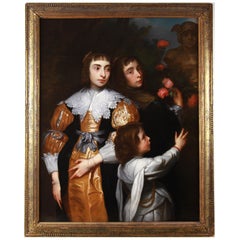
Oil On Canvas Family Portrait After Sir Anthony Van Dyck ca 1870

Oil On Canvas Family Portrait After Sir Anthony Van Dyck ca 1870

By Anthony van Dyck

Located in Gavere, BE

"Oil On Canvas Family Portrait After Sir Anthony Van Dyck" After Sir Anthony van Dyck (Flemish painter, 1599-1641), Group of three young girls with a bust of Mercury Oil on canvas (doubled), probably end 19th century, with French wax seal...

Category

Baroque 1870s Art

Materials

Gold Leaf

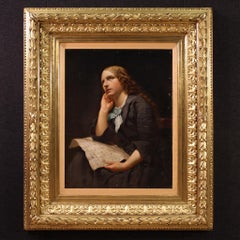
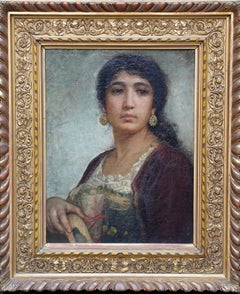
19th Century Oil on Canvas Italian Lady Portrait Painting, 1870

19th Century Oil on Canvas Italian Lady Portrait Painting, 1870

Located in Vicoforte, IT

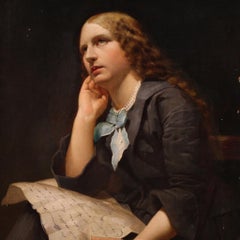
A magnificent 19th-century Italian painting. Oil on canvas, first canvas, painting depicting a young woman absorbed in thought, of extraordinary pictorial quality. The girl with long...

Category

1870s Art

Materials

Canvas, Oil

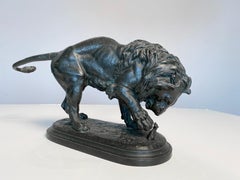
Lion & Mouse
Lion & Mouse

Lion & Mouse

By Isidore Jules Bonheur

Located in New York, NY

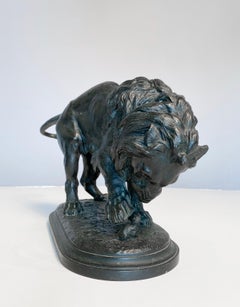
Isadore stands as one of the greatest animaliers of all time and this is a playful and endearing example of his work! Especially going forward, these bronzes make a distinctive and...

Category

Academic 1870s Art

Materials

Bronze

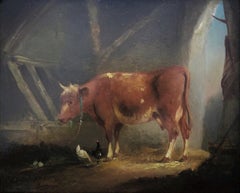
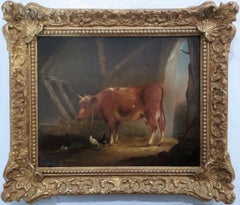
Cow and Chickens in Stable /// Thomas Sidney Cooper British Farm Animal Painting

Cow and Chickens in Stable /// Thomas Sidney Cooper British Farm Animal Painting

By Thomas Sidney Cooper

Located in Saint Augustine, FL

Artist: Thomas Sidney Cooper (English, 1803-1902) Title: "Cow and Chickens in Stable" *Signed and dated by Cooper lower left Year: 1871 Medium: Original Oil Painting on Wood Panel Fr...

Category

Victorian 1870s Art

Materials

Paint, Oil, Panel, Wood Panel, Board, Wood

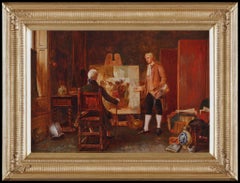
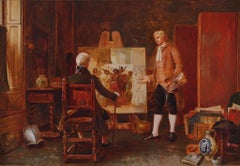
The Painter. 19th Century, framed oil on canvas by Edwin Hughes

The Painter. 19th Century, framed oil on canvas by Edwin Hughes

By Edwin Hughes

Located in St. Albans, GB

Edwin Hughes Signed and dated 1875 Framed oil on canvas Picture Size: 14 x 20" (36 x 51) Framed Size: 20 x 26" (51 x 66cm) Exhibited 1875 – 1895 Figure and portrait painter Edwin H...

Category

Victorian 1870s Art

Materials

Canvas, Oil

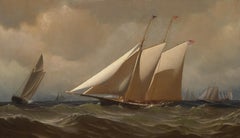
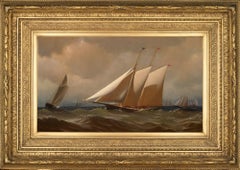
Racing Yacht Comet Off New York, Oil on Canvas, Framed, 1879

Racing Yacht Comet Off New York, Oil on Canvas, Framed, 1879

Located in Bryn Mawr, PA

Racing Yacht "Comet" Off New York, 1879 Oil on canvas 14 x 24 inches (35.6 x 61 cm) Framed dimensions: 24 1/2 x 34 1/2 inches Signed lower left: A. Cary Smith 79 Provenance Private...

Category

Hudson River School 1870s Art

Materials

Canvas, Oil

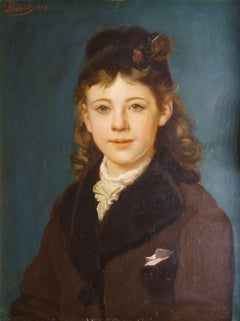
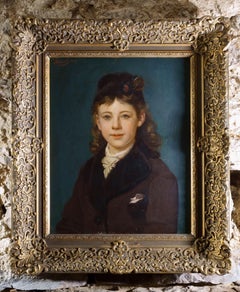
Portrait of Elegant Child in Gilded Frame Napoleon III Era Signed

Portrait of Elegant Child in Gilded Frame Napoleon III Era Signed

Located in Pistoia, IT

"Portrait of elegant little girl" , extraordinary oil painting on wood panel signed and dated at upper left "A. Robert 1879" for Alexandre Robert. A Belgian painter of great talent...

Category

French School 1870s Art

Materials

Oil, Wood Panel

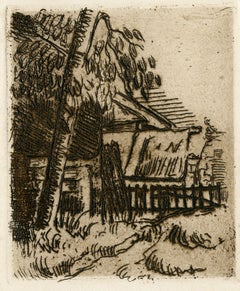
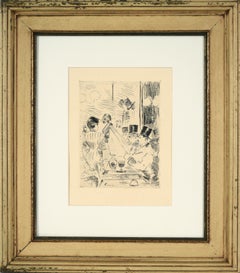
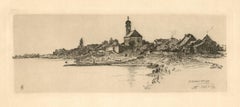
"Schwabelweiss" original etching

"Schwabelweiss" original etching

By Otto Bacher

Located in Henderson, NV

Medium: original etching. Executed in 1879, this is one of the "Danube Set" of Otto Bacher's German compositions from his travels in Bavaria. Printed on laid paper and published in B...

Category

1870s Art

Materials

Etching

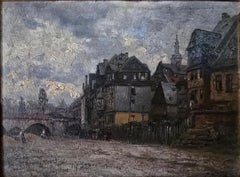
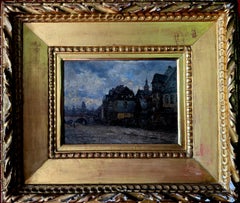
Grey Day in Town
Grey Day in Town

Grey Day in Town

Located in North Clarendon, VT

Moody Paul Andorff painting of a town, stormy skies and foreboding! Housed in a period European frame circa 1875. Pairs very well with the other Paul Andorff painting that we have l...

Category

Barbizon School 1870s Art

Materials

Oil

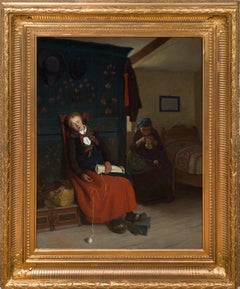
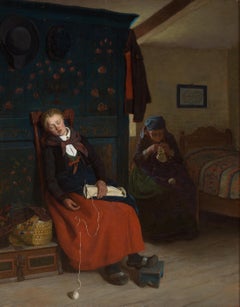
An Old 19th Century Genre Interior Depicting An Afternoon Nap, 1877

An Old 19th Century Genre Interior Depicting An Afternoon Nap, 1877

Located in Stockholm, SE

Jakob Kulle (1838–1898) Sweden An Afternoon Nap, 1877 signed and dated oil on canvas unframed 61 × 48 cm (24 × 18.9 in) framed 79 × 67 cm (31.1 × 26.4 in) Provenance: Purchased di...

Category

Realist 1870s Art

Materials

Canvas, Oil

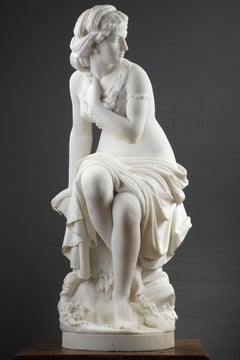
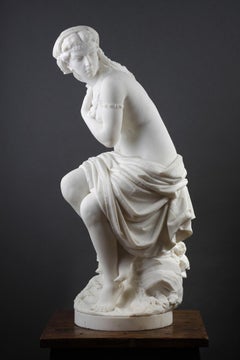
Susanna surprised at her bath

Susanna surprised at her bath

Located in PARIS, FR

"Susanna surprised at her bath" by Giovanni Battista LOMBARDI (1822-1880) Sculpture made in white Carrara marble Signed and dated "GB. Lombardi, Roma 1873" Italy 1873 height 91 cm...

Category

Italian School 1870s Art

Materials

Marble

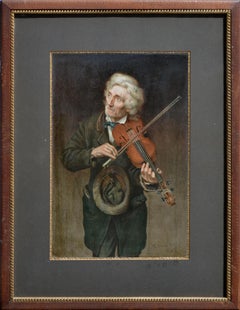
Old Violinist - Late 19th Century Figurative Lithograph

Old Violinist - Late 19th Century Figurative Lithograph

By John George Brown

Located in Soquel, CA

Finely detailed late 19th century chromo-lithograph portrait of a violinist street musician by John George Brown (British, 1831-1913). Many of Brown’s paintings were reproduced in lithography (Chromo-lithograpy), as is the case with the one offered here. Presented in a rustic antique Oak wood frame with giltwood fillet. Image, 15.63"H x 10.63"W. John George Brown was a British citizen and an American painter born in Durham, England. His parents apprenticed him to the career of glass worker at the age of fourteen, in an attempt to dissuade him from pursuing painting. He studied nights at the School of Design in Newcastle-on-Tyne while working as a glass cutter there between 1849 and 1852, and evenings at the Trustees Academy in Edinburgh while working at the Holyrood Glass Works between 1852 ad 1853. After moving to New York City in 1853, he studied with Thomas Seir Cummings at the National Academy of Design where he was elected a National Academician in 1861. Brown was the Academy’s vice-president from 1899 to 1904. Around 1855, he worked for the owner of the Brooklyn Glass Company, and later he married the daughter of his employer. His father-in-law encouraged his artistic abilities, supporting him financially, letting Brown pursue painting full-time. In 1866, he became one of the charter members of the Water-Color Society, of which he was president from 1887 to 1904. Brown became famous for his depictions of street urchins found of the streets of New York (bootblacks, street musicians, posy sellers, newsboys, etc.). Brown’s art is best characterized as British genre painting...

Category

Realist 1870s Art

Materials

Paper, Lithograph

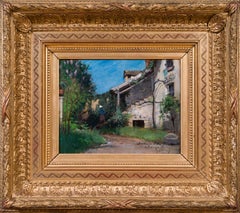
A French Barbizon Garden by Swedish Artist Carl Skånberg

A French Barbizon Garden by Swedish Artist Carl Skånberg

By Carl Skånberg

Located in Stockholm, SE

Carl Skånberg (1850-1883) Sweden A Barbizon Garden (1879) oil on wood panel signed C. Skånberg, dated 1879 (lower front) unframed: 19 × 24 cm (7.5 × 9.4 inches) framed: 40 × 45 cm ...

Category

Post-Impressionist 1870s Art

Materials

Oil, Wood Panel

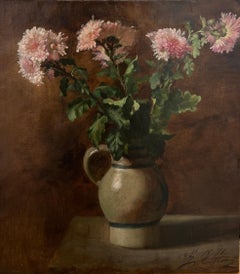
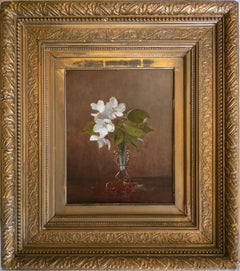
Apple Blossom in a Vase

Apple Blossom in a Vase

By Walter Blackman

Located in Saratoga Springs, NY

Walter Blackman (1847–1928) Apple Blossom in a Vase Signed lower left Oil on canvas applied to board 10 × 8 inches Walter Blackman was born in New York in 1847 and pursued formal s...

Category

Hudson River School 1870s Art

Materials

Oil, Board

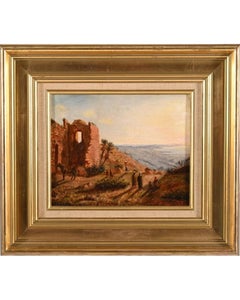
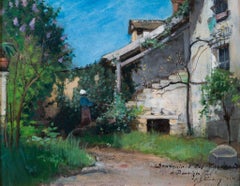
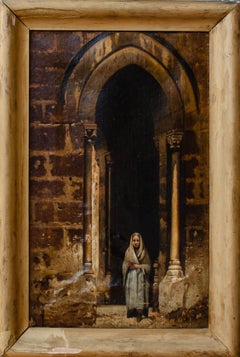
Medieval Architecture Painting with Female Figure by Mystery Artist

Medieval Architecture Painting with Female Figure by Mystery Artist

Located in New York, NY

Mystery Artist, likely French Untitled, c. 1876 Oil on canvas 18 1/2 x 11 1/4 in. Framed: 22 x 14 3/4 x 1 in. Signed and dated lower right

Category

Barbizon School 1870s Art

Materials

Canvas, Oil

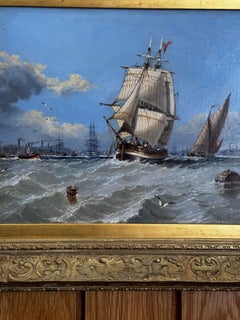
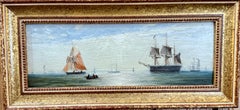
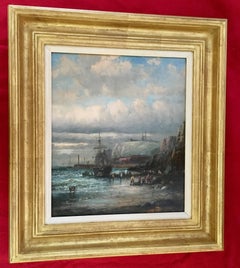
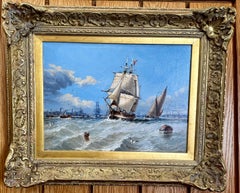
English 19thC Victorian Shipping scene with fishing boats in the English Channel

English 19thC Victorian Shipping scene with fishing boats in the English Channel

By William Anslow Thornley

Located in Woodbury, CT

William Thornley was a painter of coastal scenes whose work is very similar to Hubert and Charles Thornley, who may have been members of the same family. He painted scenes of genre, architecture and landscapes as well. A number of the landscapes were of Belgium, Holland, Italy and Norway. However, it is for his seascapes that he is best remembered. Thornley’s works are beautifully detailed and show a masterful understanding of the moods of both weather and sea. They are often small in size and put together with fine detail and great artistic merit. Thornley’s fishing scenes are spirited and similar in style to those of “Jock” Wilson, and are often painted in pairs. Thornley’s works have always been popular when they appear on the art market. He was believed to have first exhibited marines at the Royal Academy in 1859 from an address in Paddington, London and also at the British Institution from 1861 until it closed in 1867. He continued to exhibit at the Royal Academy until 1898. Thornley also exhibited at the Paris Salon and the Salon of French Artists, receiving an honourable mention in 1881 and a third place medal in 1888. William Thornley also went by the names Georges William and William...

Category

Victorian 1870s Art

Materials

Oil, Canvas

Self Portrait Of The Artist Munich 1875 Bavarian Münchner Schule Oil Painting

Self Portrait Of The Artist Munich 1875 Bavarian Münchner Schule Oil Painting

Located in Sutton Poyntz, Dorset

Albin Mattenheimer. German ( b.1823 - d.1875 ). Self Portrait, Munich 1875. Oil On Canvas. Signed & Dated Lower Left. Image size 34.1 inches x 26.6 inches ( 86.5cm x 67.5cm ). Frame size 42.5 inches x 34.8 inches ( 108cm x 88.5cm ). Available for sale; this original oil painting is by the German artist Albin Mattenheimer and is dated 1875. The painting is presented and supplied in its original period frame (which is shown in these photographs). The frame has benefitted from cleaning, restoration and reinforcement, which was performed on our instruction, supervision and approval. The canvas and the painted surface have been professionally restored whilst in previous ownership, probably within the last 20 years. This includes a couple of repairs to perforations in the canvas which are of good material integrity. This antique painting is in good condition. It wants for nothing and is supplied ready to hang and display. The painting is signed and dated 1875 lower left. Albin Mattenheimer (1823–1875) was a German painter associated with the artistic traditions of Bavaria during the nineteenth century. Born in Bamberg in 1823, he belonged to the distinguished Mattenheimer family of artists, several generations of whom worked as painters, restorers, and teachers in southern Germany. The family had established a notable artistic reputation from the eighteenth century onwards, particularly through Andreas Theodor Mattenheimer and his descendants, who were active in Bamberg, Munich, and other Bavarian cultural centres. Mattenheimer studied at the Academy of Fine Arts in Munich, one of the most important artistic institutions in Germany during the nineteenth century. He subsequently worked in Munich and is generally regarded as a landscape painter. His surviving recorded works include views of Nuremberg and other Bavarian subjects, reflecting the enduring popularity of topographical and landscape painting in the period. He is often associated with the circle of painters known as the Chiemseemaler, artists inspired by the scenery of the Chiemsee region of Upper Bavaria. Like many German painters of his generation, Mattenheimer worked during a period when Romanticism was gradually giving way to a more naturalistic approach to landscape and genre painting. His works demonstrate an appreciation of atmosphere, place, and the character of the Bavarian countryside. Although comparatively little is known about his career today, Mattenheimer’s paintings occasionally appear on the art market and are represented in specialist reference works on nineteenth-century German art. His relative obscurity has meant that much of his oeuvre remains under-researched, and works by the artist are consequently of particular interest to collectors of German and Central European painting. Albin Mattenheimer died in 1875, leaving behind a small but intriguing body of work that forms part of the rich tradition of nineteenth-century Bavarian painting...

Category

Naturalistic 1870s Art

Materials

Canvas, Oil

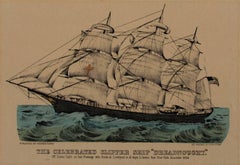
19th century color lithograph seascape boat ship waves maritime landscape

19th century color lithograph seascape boat ship waves maritime landscape

By Currier & Ives

Located in Milwaukee, WI

"The Celebrated Clipper Ship Dreadnought" is an original hand-colored lithograph by Currier & Ives. It depicts a sailing ship. 13 1/4" x 17 1/2" art 19" x 23 1/2" frame Nathaniel Currier was a tall introspective man with a melancholy nature. He could captivate people with his piercing stare or charm them with his sparkling blue eyes. Nathaniel was born in Roxbury, Massachusetts on March 27th, 1813, the second of four children. His parents, Nathaniel and Hannah Currier, were distant cousins who lived a humble yet spartan life. When Nathaniel was eight years old, tragedy struck. Nathaniel’s father unexpectedly passed away leaving Nathaniel and his eleven-year-old brother Lorenzo to provide for the family. In addition to their mother, Nathaniel and Lorenzo had to care for six-year-old sister Elizabeth and two-year-old brother Charles. Nathaniel worked a series of odd jobs to support the family, and at fifteen, he started what would become a life-long career when he apprenticed in the Boston lithography shop of William and John Pendleton. A Bavarian gentleman named Alois Senefelder invented lithography just 30 years prior to young Nat Currier’s apprenticeship. While under the employ of the brothers Pendleton, Nat was taught the art of lithography by the firm’s chief printer, a French national named Dubois, who brought the lithography trade to America. Lithography involves grinding a piece of limestone flat and smooth then drawing in mirror image on the stone with a special grease pencil. After the image is completed, the stone is etched with a solution of aqua fortis leaving the greased areas in slight relief. Water is then used to wet the stone and greased-ink is rolled onto the raised areas. Since grease and water do not mix, the greased-ink is repelled by the moisture on the stone and clings to the original grease pencil lines. The stone is then placed in a press and used as a printing block to impart black on white images to paper. In 1833, now twenty-years old and an accomplished lithographer, Nat Currier left Boston and moved to Philadelphia to do contract work for M.E.D. Brown, a noted engraver and printer. With the promise of good money, Currier hired on to help Brown prepare lithographic stones of scientific images for the American Journal of Sciences and Arts. When Nat completed the contract work in 1834, he traveled to New York City to work once again for his mentor John Pendleton, who was now operating his own shop located at 137 Broadway. Soon after the reunion, Pendleton expressed an interest in returning to Boston and offered to sell his print shop to Currier. Young Nat did not have the financial resources to buy the shop, but being the resourceful type he found another local printer by the name of Stodart. Together they bought Pendleton’s business. The firm ‘Currier & Stodart’ specialized in "job" printing. They produced many different types of printed items, most notably music manuscripts for local publishers. By 1835, Stodart was frustrated that the business was not making enough money and he ended the partnership, taking his investment with him. With little more than some lithographic stones, and a talent for his trade, twenty-two year old Nat Currier set up shop in a temporary office at 1 Wall Street in New York City. He named his new enterprise ‘N. Currier, Lithographer’ Nathaniel continued as a job printer and duplicated everything from music sheets to architectural plans. He experimented with portraits, disaster scenes and memorial prints, and any thing that he could sell to the public from tables in front of his shop. During 1835 he produced a disaster print Ruins of the Planter's Hotel, New Orleans, which fell at two O’clock on the Morning of the 15th of May 1835, burying 50 persons, 40 of whom Escaped with their Lives. The public had a thirst for newsworthy events, and newspapers of the day did not include pictures. By producing this print, Nat gave the public a new way to “see” the news. The print sold reasonably well, an important fact that was not lost on Currier. Nat met and married Eliza Farnsworth in 1840. He also produced a print that same year titled Awful Conflagration of the Steamboat Lexington in Long Island Sound on Monday Evening, January 18, 1840, by which melancholy occurrence over One Hundred Persons Perished. This print sold out very quickly, and Currier was approached by an enterprising publication who contracted him to print a single sheet addition of their paper, the New York Sun. This single page paper is presumed to be the first illustrated newspaper ever published. The success of the Lexington print launched his career nationally and put him in a position to finally lift his family up. In 1841, Nat and Eliza had their first child, a son they named Edward West Currier. That same year Nat hired his twenty-one year old brother Charles and taught him the lithography trade, he also hired his artistically inclined brother Lorenzo to travel out west and make sketches of the new frontier as material for future prints. Charles worked for the firm on and off over the years, and invented a new type of lithographic crayon which he patented and named the Crayola. Lorenzo continued selling sketches to Nat for the next few years. In 1843, Nat and Eliza had a daughter, Eliza West Currier, but tragedy struck in early 1847 when their young daughter died from a prolonged illness. Nat and Eliza were grief stricken, and Eliza, driven by despair, gave up on life and passed away just four months after her daughter’s death. The subject of Nat Currier’s artwork changed following the death of his wife and daughter, and he produced many memorial prints and sentimental prints during the late 1840s. The memorial prints generally depicted grief stricken families posed by gravestones (the stones were left blank so the purchasers could fill in the names of the dearly departed). The sentimental prints usually depicted idealized portraits of women and children, titled with popular Christian names of the day. Late in 1847, Nat Currier married Lura Ormsbee, a friend of the family. Lura was a self-sufficient woman, and she immediately set out to help Nat raise six-year-old Edward and get their house in order. In 1849, Lura delivered a son, Walter Black Currier, but fate dealt them a blow when young Walter died one year later. While Nat and Lura were grieving the loss of their new son, word came from San Francisco that Nat’s brother Lorenzo had also passed away from a brief illness. Nat sank deeper into his natural quiet melancholy. Friends stopped by to console the couple, and Lura began to set an extra place at their table for these unexpected guests. She continued this tradition throughout their lives. In 1852, Charles introduced a friend, James Merritt Ives, to Nat and suggested he hire him as a bookkeeper. Jim Ives was a native New Yorker born in 1824 and raised on the grounds of Bellevue Hospital where his father was employed as superintendent. Jim was a self-trained artist and professional bookkeeper. He was also a plump and jovial man, presenting the exact opposite image of his new boss. Jim Ives met Charles Currier through Caroline Clark, the object of Jim’s affection. Caroline’s sister Elizabeth was married to Charles, and Caroline was a close friend of the Currier family. Jim eventually proposed marriage to Caroline and solicited an introduction to Nat Currier, through Charles, in hopes of securing a more stable income to support his future wife. Ives quickly set out to improve and modernize his new employer’s bookkeeping methods. He reorganized the firm’s sizable inventory, and used his artistic skills to streamline the firm’s production methods. By 1857, Nathaniel had become so dependent on Jims’ skills and initiative that he offered him a full partnership in the firm and appointed him general manager. The two men chose the name ‘Currier & Ives’ for the new partnership, and became close friends. Currier & Ives produced their prints in a building at 33 Spruce Street where they occupied the third, fourth and fifth floors. The third floor was devoted to the hand operated printing presses that were built by Nat's cousin, Cyrus Currier, at his shop Cyrus Currier & Sons in Newark, NJ. The fourth floor found the artists, lithographers and the stone grinders at work. The fifth floor housed the coloring department, and was one of the earliest production lines in the country. The colorists were generally immigrant girls, mostly German, who came to America with some formal artistic training. Each colorist was responsible for adding a single color to a print. As a colorist finished applying their color, the print was passed down the line to the next colorist to add their color. The colorists worked from a master print displayed above their table, which showed where the proper colors were to be placed. At the end of the table was a touch up artist who checked the prints for quality, touching-in areas that may have been missed as it passed down the line. During the Civil War, demand for prints became so great that coloring stencils were developed to speed up production. Although most Currier & Ives prints were colored in house, some were sent out to contract artists. The rate Currier & Ives paid these artists for coloring work was one dollar per one hundred small folios (a penny a print) and one dollar per one dozen large folios. Currier & Ives also offered uncolored prints to dealers, with instructions (included on the price list) on how to 'prepare the prints for coloring.' In addition, schools could order uncolored prints from the firm’s catalogue to use in their painting classes. Nathaniel Currier and James Merritt Ives attracted a wide circle of friends during their years in business. Some of their more famous acquaintances included Horace Greeley, Phineas T. Barnum, and the outspoken abolitionists Rev. Henry Ward, and John Greenleaf Whittier (the latter being a cousin of Mr. Currier). Nat Currier and Jim Ives described their business as "Publishers of Cheap and Popular Pictures" and produced many categories of prints. These included Disaster Scenes, Sentimental Images, Sports, Humor, Hunting Scenes, Politics, Religion, City and Rural Scenes, Trains, Ships, Fire Fighters, Famous Race Horses, Historical Portraits, and just about any other topic that satisfied the general public's taste. In all, the firm produced in excess of 7500 different titles, totaling over one million prints produced from 1835 to 1907. Nat Currier retired in 1880, and signed over his share of the firm to his son Edward. Nat died eight years later at his summer home 'Lion’s Gate' in Amesbury, Massachusetts. Jim Ives remained active in the firm until his death in 1895, when his share of the firm passed to his eldest son, Chauncey. In 1902, faced will failing health from the ravages of Tuberculosis, Edward Currier sold his share of the firm to Chauncey Ives...

Category

Other Art Style 1870s Art
Materials

Lithograph

A Young Woman With Her Dog by Victor Ravet

A Young Woman With Her Dog by Victor Ravet

Located in Stockholm, SE

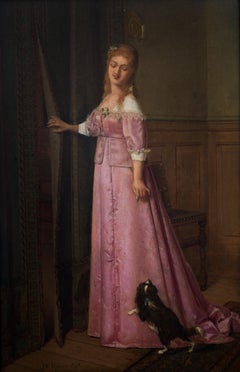
In this exquisite painting by Victor Ravet, we are transported to an elegant interior setting reminiscent of the grandeur of high-class homes. The focal point is a woman adorned in a shimmering pink gown, radiating grace and sophistication. Bathed in gentle light, her dress catches the glimmer, accentuating her beauty. She holds a treat for a dog in her hand, enticing the furry companion who stands on its hind legs in eager anticipation. The canine's eyes fixated on the delicious morsel, capturing a moment of playful interaction between the woman and her loyal companion. The scene takes on a narrative quality as the young woman's other hand delicately lifts a curtain, hinting at another room beyond. This subtle gesture adds depth to the composition, suggesting a world of hidden secrets and intriguing possibilities within the opulent surroundings. Victor Ravet took inspiration from the Dutch Golden Age painters of the 17th century, such as Vermeer, Jacob Ochtervelt, and Gerrit Dou. This homage to their style and subject matter pays tribute to the timeless allure of domestic scenes, capturing a slice of life in a bygone era. With meticulous attention to detail, Ravet masterfully recreates the textures and fabrics, immersing the viewer in the sumptuousness of the period. The soft play...

Category

Realist 1870s Art
Materials

Oil, Panel