1870s Art

to
103
1,102
293
102
39
48
Overall Width
to
Overall Height
to
7,547
21,370
164,603
237,144
2,094
2,312
4,637
6,409
5,837
15,289
20,918
26,272
19,152
14,157
5,363
876
123
63
3
1
1
1
979
556
6
685
349
315
307
268
259
236
175
173
172
143
92
83
69
63
63
62
54
52
46
502
427
312
226
223
37
14
11
11
9
307
1,016
1,178
411
Period: 1870s
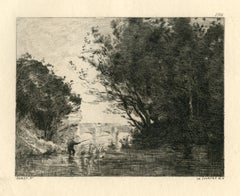
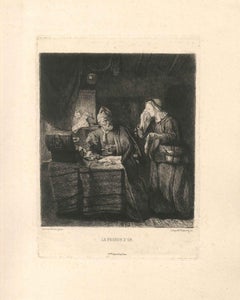
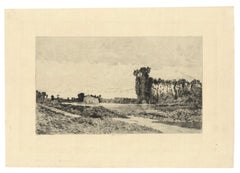
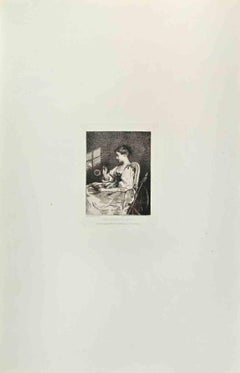
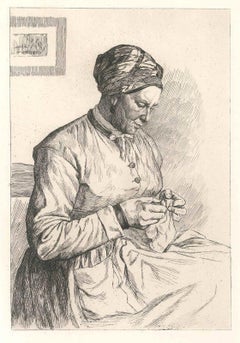
Intériueur de Ferme - Etching by Léon Jacque - 1870s

Intériueur de Ferme - Etching by Léon Jacque - 1870s

Located in Roma, IT

Intérieur de Ferme is an artwork realized by Léon Jacque in the 1870s. Etching. Image size:16x22 Good conditions. Realized for the "Société des Aquafortistes. Born on the initi...

Category

Modern 1870s Art
Materials

Etching

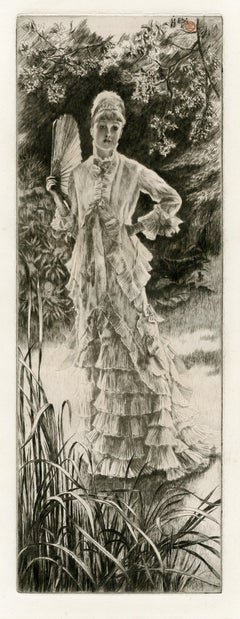
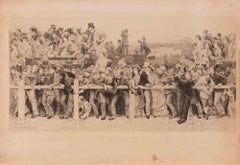
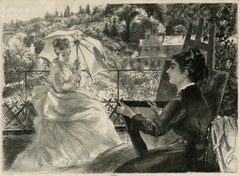
"Le Printemps de 1872" original etching

"Le Printemps de 1872" original etching

Located in Henderson, NV

Medium: original etching. François Nicolas Augustin Feyen was known as Auguste Feyen-Perrin. This impression on laid paper was printed in 1872 by A. Salmon and published in Paris by ...

Category

Realist 1870s Art
Materials

Etching

Amadee, Heliogravure by Marcantonio Raimondi

Amadee, Heliogravure by Marcantonio Raimondi

By Marcantonio Raimondi

Located in Long Island City, NY

Marcantonio Raimondi, After by Amand Durand, Italian (1480 - 1534) - Amadee, Year: 1875, Medium: Heliogravure, Size: 4.5 x 4.5 in. (11.43 x 11.43 cm), Printer: Amand Durand, Descr...

Category

Old Masters 1870s Art
Materials

Etching

"Skating on Ladies' Pond Central Park": Winslow Homer 19th C. Woodcut Engraving

"Skating on Ladies' Pond Central Park": Winslow Homer 19th C. Woodcut Engraving

By Winslow Homer

Located in Alamo, CA

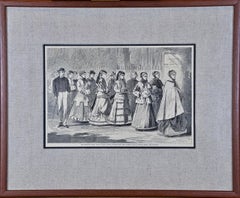
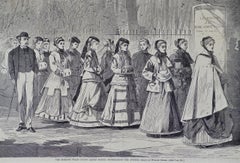
This Winslow Homer woodcut engraving entitled "Skating on the Ladies' Skating-Pond in Central Park, New York", was published in Harper's Weekly in the January 28, 1860 edition. It depicts a large number of men, women and children skating on a recently opened pond in Central Park. At the time of publication of this engraving, Central Park was in the early stages of construction. This engraving documents the very early appearance of Frederick Law Olmstead and Calvert Vaux's masterpiece of landscape design. According to Olmsted, the park was "of great importance as the first real Park made in this century – a democratic development of the highest significance". The people of New York were very proud of the plans for their park. It was stated at the time: "Our Park, which is progressing very satisfactorily under the management of the Commissioners, will undoubtedly be, one of these days, one of the finest place of the kind in the world...Those who saw the Park before the engineers went to work on it are amazed at the beautiful sites which have been contrived with such unpromising materials; all fair persons believe that the enterprise is managed with honesty and good taste." Skating was rapidly rising in national popularity in part due to the opening of Central Park’s lake to skaters on a Sunday in December 1858 with 300 participants. The following Sunday it attracted ten thousand skaters. By Christmas Day, a reported 50,000 people came to the park, most of them to skate. There were rules governing who could use the skating pond. “The Ladies’ Pond...

Category

American Impressionist 1870s Art
Materials

Engraving, Woodcut

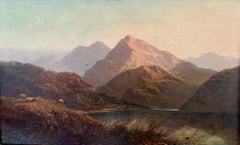
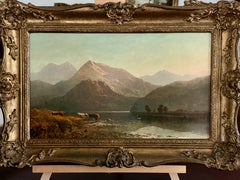
'River Landscape with Rider', English School, Barbizon

'River Landscape with Rider', English School, Barbizon

Located in Santa Cruz, CA

An unsigned, English school landscape painted circa 1860 painted by a skilled but unidentified hand, perhaps a follower of George Augustus Williams (English, 1814-1901). A particula...

Category

1870s Art
Materials

Canvas, Masonite, Oil

Rue Du Canal à Figeac - Etching by Étienne Mazas - 1870s

Rue Du Canal à Figeac - Etching by Étienne Mazas - 1870s

Located in Roma, IT

Rue Du Canal à Figeac is an artwork realized by E.Mazas in the 1870s. Etching. Good conditions. Realized for the "Société des Aquafortistes. Born on the initiative of the publis...

Category

Modern 1870s Art
Materials

Etching

Keying Up - The Court Jester

Keying Up - The Court Jester

By William Merritt Chase

Located in Fairlawn, OH

Keying Up - The Court Jester Etching with drypoint, 1879 Signed in the plate lower left corner (see photos) Proof before engraved title and engraved names Printed on thin light golden Japanese tissue paper In the final state, with engraved titled and typeface engraved artist’s signature below the image Condition: excellent Plate size: 6-5/8 x 4-1/4" According to Pisano, this image was very popular during Chase’s life. It is based on his famous painting, Keying Up-The Court Jester, in the collection of the Pennsylvania Academy of Fine Arts. The painting was created in Munich during the artist’s studies there. It was exhibited in the 1876 Centennial Exhibition in Philadelphia where it won a Medal of Honor and helped establish the artist’s reputation as a leading American painter. Chase, always conscious of self promotion, created the etching and had numerous impressions printed. He sold them for a modest price to increase his fame. The etching was later published in Sylvester R. Koehler, American Art Review, September 1878. It was for this American Art Review printing that the engraved titled and type face signature below the image were added to the plate. This example was part of a group of impressions that came down in the Chase family via his daughter Dorothy Bremond Chase, his third daughter. They were acquired at auction in a single auction lot, housed in a paper board folder. The consignor was Associated American Artist’s as they were liquidating their stock prior to closing the gallery. Dorothy was the subject of Chase’s painting, My Little Daughter Dorothy. C. 1894, in the collection of the Detroit Institute of Arts as well as numerous other portraits of her. Reference: Pisano/Bake, Volume 1, Pr. 3, illustrates the rare 1st state, this being a 2nd state before any other the engraved title and Chase's name in the bottom margin which are found in the third state. Artist bio in file (Chase) In 1883 Chase was involved in the organization of an exhibition to help raise funds for a pedestal for the Statute of Liberty. The exhibition featured loans of three works by Manet and urban scenes by the Italian Impressionist Giuseppe de Nittis. Both artists influenced Chase's Impressionistic style that gave rise to a series of New York park scenes. It is also thought that he was influenced by John Singer Sargent's In the Luxembourg Gardens (1879) which was exhibited in New York at this time. Indeed, Chase had met Sargent in Europe in 1881, the two men becoming lifelong friends with Sargent painting Chase's portrait in 1902. On another European trip in 1885, Chase met James McNeill Whistler in London. While Whistler had a reputation for being difficult, the two artists got along famously and agreed to paint one another's portrait. Eventually, however, Whistler's moods began to grate with Chase who wrote home stating "I really begin to feel that I never will get away from here". For his part, Whistler criticized Chase's finished portrait and, according to Hirshler, "complained about Chase for the rest of his life". While no record exists of Whistler's portrait of Chase; Chase's portrait of Whistler remains a well-known piece in his oeuvre. In 1887 Chase married Alice Gerson, the daughter of the manager of a lithography company. Though some fifteen years his junior (Chase was 37), he had known Alice for some time through her family's devotion to the arts. The pair, who would enjoy a happy marriage with Alice in full support of her husband's career, settled initially in Brooklyn where their first child was born. The couple would parent six daughters and two sons and it was only his family that could rival his devotion to his art. Indeed, Chase often combined his two loves by painting several portraits of his wife and children in Brooklyn parks before the couple relocated to Manhattan. Later Period Between 1891 and 1902, Chase and his family spent their summers at a purpose-built home and studio in Shinnecock Hills, a close suburb of the upmarket town of Southampton on the south shore of Long Island (roughly 100 miles east of New York). Chase set up, and taught two days a week, at the nearby Shinnecock Hills Summer School of Art which benefitted from the financial backing of local art collectors. It was at Shinnecock that Chase, taken in by the region's striking natural surroundings, painted several Impressionistic landscapes. As Bettis put it, "There, among the dunes, in the bright sunlight and sea air his painterly impulse was given free sway, and he produced some of his freest and loveliest work". His passion for the area was so felt he even gave his daughter Hazel the middle name of Neamaug, in honor of the rich Native American history of Shinnecock. Chase was equally focused on the students that came to the School and who he encouraged to paint in the modern plein air style favored by the French Impressionists. Although Chase was making a name for himself as an Impressionist, he never abandoned his commitment to the sombre tones and academic tropes he had learned in Munich, though these he reserved for his portraits, and for his series of striking still lifes featuring dead fish. Chase was in fact a successful society portraitist - he painted fashionable women for a fee of $2,000 - and would paint his students as "samples" which he then donated to leading art institutions (such as Lady in Black (1888) which he donated to the Metropolitan Museum in 1891). In 1896, facing financial difficulties, Chase flirted with the idea of giving up his teaching in New York and traveled with his family to Madrid where he developed a passion for bullfighting. Chase returned however to Shinnecock in June to teach his yearly summer art class, and in the fall of that year, established his own art school in Manhattan: the Chase School which was modelled on the Académie Julian in Paris. Chase lacked business savvy, however, and the Chase School lasted only two years before it was placed under new management. It continued as the New York School of Art (changed to Parsons School of Design starting 1941) with Chase as head the School for eleven more years. Chase also taught during this period at the Pennsylvania Academy of Fine Arts. In 1902, following the premature death of his friend John Twachtman, Chase was invited to join the Ten American Painters group (who included amongst its members, Frank Weston Benson, Thomas Wilmer Dewing...
Category

American Impressionist 1870s Art
Materials

Etching

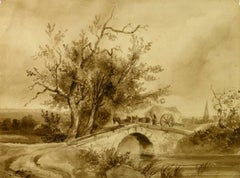
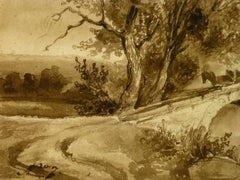
Stone Bridge Ink Wash

Stone Bridge Ink Wash

Located in Houston, TX

Sepia nineteenth century French ink wash, circa 1870. Signed lower left. Original artwork on paper displayed on a white mat with a gold border. Mat fits a ...

Category

1870s Art

Materials

Ink

“Seaside Cliffs, California”

“Seaside Cliffs, California”

By George Douglas Brewerton

Located in Southampton, NY

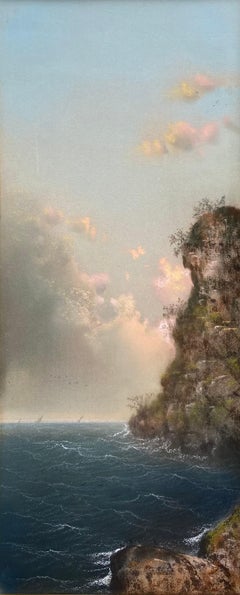
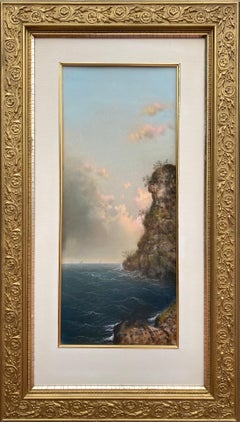
Beautiful original pastel on archival card stock from Paris of the craggy seaside cliffs of California by the well known Hudson River artist, George Douglas Bremerton. Signed lower left. Circa 1880. Condition is excellent. Under glass. The artwork is housed in its original ornate scroll designed frame. Overall framed measurements are 33 by 19 inches. Provenance: A East Coast Florida estate. George Douglas Brewerton received lessons in art from Prof. Robert W. Weir at West Point where his father was Superintendent. In 1874, he was detailed to San Francisco as an officer in the Stevenson Regiment. In 1848, he underwent many adventures in Western deserts and mountains with Kit Carson, who crossed the country with news of the California Gold Rush. After serving as an aide to Gen. Rufus Saxton during the Civil War, Brewerton called himself “Colonel,” although he never received an army commission...

Category

Hudson River School 1870s Art

Materials

Pastel, Archival Paper

La piece dite des cinq Saints, Heliogravure by Marcantonio Raimondi

La piece dite des cinq Saints, Heliogravure by Marcantonio Raimondi

By Marcantonio Raimondi

Located in Long Island City, NY

Marcantonio Raimondi, After by Amand Durand, Italian (1480 - 1534) - La piece dite des cinq Saints, Year: 1875, Medium: Heliogravure, Size: 17.5 x 11.75 in. (44.45 x 29.85 cm), Pr...

Category

Old Masters 1870s Art

Materials

Etching

RENIE Barbizon Hunter Hound Hunt French Impressionnist 19th

RENIE Barbizon Hunter Hound Hunt French Impressionnist 19th

By Nicolas Renie

Located in PARIS, FR

Nicolas RENIE (Active 1840s to 1870s) Oil on wood 33 x 24 cm (44.5 x 34 cm with frame) Signed and dated lower left 'NRenié / 1879" Nicolas Renié is part of the family of the Barbizo...

Category

Impressionist 1870s Art

Materials

Oil

Portrait of Victor Hugo -  b/w Postcard - 1870s

Portrait of Victor Hugo - b/w Postcard - 1870s

Located in Roma, IT

Portrait of Victor Hugo is a photografic albumen print in CDV size. The print was made around 1870 by J.M. Lopez in Paris, for the publisher Hautecoeur. Photographer's logo on fron...

Category

Modern 1870s Art

Materials

Paper, Photographic Paper

La dormeuse
La dormeuse

La dormeuse

By James Jacques Joseph Tissot

Located in New York, NY

Drypoint, 1876. Signed by the artist in the plate, lower right. From edition of approximately 100. Sheet size: 8.25 x 12.63 inches, with full margins. Catalogue raisonné referenc...

Category

Realist 1870s Art

Materials

Drypoint