1980s Art

to
2,698
5,458
3,365
4,838
2,688
2,376
Overall Width
to
Overall Height
to
7,569
21,482
164,234
234,748
2,051
2,299
4,968
6,480
5,731
15,206
20,886
26,002
18,789
14,129
5,382
4,438
3,063
2,387
1,745
642
524
264
201
187
157
66
47
39
1
9,267
7,931
928
7,803
3,922
3,008
2,527
1,928
1,568
1,279
1,261
1,235
1,085
1,002
965
821
783
520
448
442
425
408
404
3,925
3,831
3,545
1,897
1,858
1,359
285
207
201
173
3,248
7,553
11,749
6,449
Period: 1980s
“Down da Road”
“Down da Road”

“Down da Road”

Located in Southampton, NY

Original acrylic on wooden panel by the well known American folk art artist, Black Joe Jackson. Circa 1985. Condition is excellent. Titled along the right side and titled along the...

Category

Folk Art 1980s Art

Materials

Board, Acrylic

"St. George and the Dragon" - Large Late 20th Century Framed Painting

"St. George and the Dragon" - Large Late 20th Century Framed Painting

Located in New Orleans, LA

You don't have to be a Catholic, or a medievalist, or a Catholic medievalist (Tolkien?) to appreciate this striking image of St. George taking on the dragon. In style it falls somewhere between Cubism and Guernica, to my eye. The limited color palette, with the bold red, gives it the energy of early 20th-century Russian poster...

Category

Cubist 1980s Art

Materials

Oil

DEUX ARBRES (TWO TREES)

DEUX ARBRES (TWO TREES)

By Keiko Minami

Located in Portland, ME

Minami, Keiko (Japanese, 1911-2004) DEUX ARBRES. Etching and aquatint in colors, 1981. Signed and Numbered 98/100. (plate), framed to 14 X 14 inches . In excellent condfition.

Category

1980s Art

Materials

Etching, Aquatint

Tàpies, Composition, Derrière le miroir (after)

Tàpies, Composition, Derrière le miroir (after)

By Antoni Tàpies

Located in Southampton, NY

Lithograph on vélin paper. Inscription: Unsigned and unnumbered, as issued. Good condition, with centerfold, as issued. Notes: From Derrière le miroir, N° 253, 1982. Published by Aim...

Category

Post-War 1980s Art

Materials

Lithograph

Girls in a Taxi - Naïve art, comical, colourful, Folk art, everyday life

Girls in a Taxi - Naïve art, comical, colourful, Folk art, everyday life

Located in London, GB

Printer's Proof /5 Beryl Cook's appeal was classless and she rapidly became Britain’s most popular artist. She was a ‘heart and soul’ painter, compelled to paint with a passion. He...

Category

Contemporary 1980s Art

Materials

Archival Paper, Screen

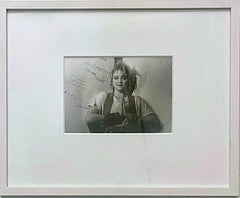
Cicciolina Puppet - Vintage Photograph - 1980s

Cicciolina Puppet - Vintage Photograph - 1980s

Located in Roma, IT

Cicciolina Puppet - Vintage Photograph is a black and white photograph realized in the 1980s. Good conditions with slight foxing.

Category

Contemporary 1980s Art

Materials

Photographic Paper

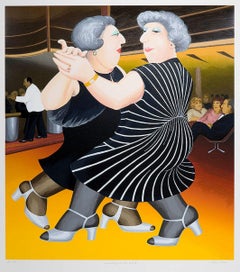
Ladies Night - Naïve art, comical, colourful, Folk art, everyday life

Ladies Night - Naïve art, comical, colourful, Folk art, everyday life

Located in London, GB

Printer's Proof /5 Beryl Cook's appeal was classless and she rapidly became Britain’s most popular artist. She was a ‘heart and soul’ painter, compelled to paint with a passion. Her...

Category

Contemporary 1980s Art

Materials

Archival Paper, Screen

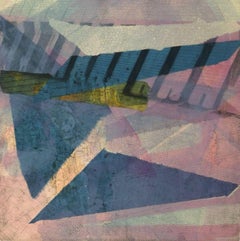
Untitled

Untitled

By Sam Francis

Located in New York, NY

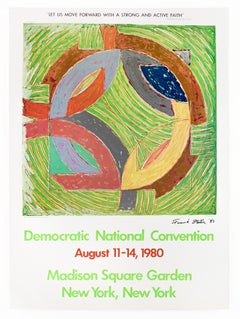
Dynamic and bold color lithograph on Rives BFK. One of 20 numbered Hors Commerce impressions, aside from the edition of 176. This stunning print is signed and inscribed "H.C. 10/20" ...

Category

Abstract 1980s Art

Materials

Color, Lithograph

"Sanity Hearing" Satirical Etching

"Sanity Hearing" Satirical Etching

By Charles Bragg

Located in Soquel, CA

"Sanity Hearing" Satirical Etching Satirical etching by Charles Bragg (American, 1931-2017). This scene depicts a chaotic courtroom, ostensibly the location of this "Sanity Hearing." A man wearing a suit of armor sits with his hand raised taking an oath of honesty on top of three books labeled "Bible," "Holy Bible," and "Cookbook." The judge sits behind him, holding a fly swatter with a glass tankard of beer in front of him. A man in the bottom right corner reads the Bill of Rights but he holds it upside down. Other guests of the courtroom include multiple kittens, a man gnawing on the bench, and a toucan on a leash. Numbered as "104/300" in bottom left corner. Titled "Sanity Hearing" in center edge. Signed "Charles Bragg" in bottom right corner. Frame size: 20.32" H x 22.63" W Image size: 10.27" H x 12.75" W Charles Bragg (American, 1931-2017) was a painter, sculptor, and illustrator of commentary on human behavior, based out of Los Angeles, California. Bragg often injected his sense of humor and appreciation of satire into his subjects, many of which are cartoonish and seem half human and half animal. He also depicted serious subjects, ones that become poignant commentaries on the human condition. Bragg was born in St. Louis Missouri in 1931. His parents were vaudeville performers, and he spent most of his young life traveling on tour with them. During his teenage years, he went to New York's High School of Music & Art in Harlem. At 18, he ran away with his high school sweetheart, fellow artist Jennie Tomao...

Category

Other Art Style 1980s Art

Materials

Paper, Ink, Etching

Mermaid with Sailboat, c. 1989

Mermaid with Sailboat, c. 1989

By Peter Max

Located in Philadelphia, PA

(Unique) 1/1 edition Max, Peter Mermaid with Sailboat, c. 1989 Mixed media with watercolor and serigraphy on paper 15 x 11 in.

Category

Neo-Expressionist 1980s Art

Materials

Watercolor, Screen

Andy Warhol's original poster for the 1982 film "Querelle" - Erotic - Cinema

Andy Warhol's original poster for the 1982 film "Querelle" - Erotic - Cinema

By Andy Warhol

Located in PARIS, FR

Andy Warhol's original poster for the 1982 film "Querelle" is a fascinating fusion of two artistic worlds: cinema and pop culture art. Directed by German filmmaker Rainer Werner Fassbinder, the film is based on Jean Genet's novel of the same name, exploring themes of desire, sexuality and mystery. Warhol, a celebrated figure of the Pop Art movement, brought his unique style to this iconic poster. Using vivid colors and striking contrasts, the poster highlights key elements of the film, including the unsettling sensuality of the main character, Querelle, played by Brad Davis. Warhol's association with the film gave a new artistic dimension to film promotion...

Category

Pop Art 1980s Art

Materials

Paper

Impressionist Oversized Lilli Pond Landscape Oil Painting

Impressionist Oversized Lilli Pond Landscape Oil Painting

Located in Douglas Manor, NY

6175 Oversized Impressionist oil painting of a lillie pand landscape Gilt wood frame Signed Image size 47x35"

Category

1980s Art

Materials

Oil

Basquiat Gray 1980
Basquiat Gray 1980

Basquiat Gray 1980

By Jean-Michel Basquiat

Located in NEW YORK, NY

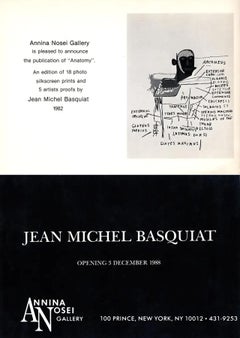
Jean-Michel Basquiat (untitled) Gray 1980: Basquiat illustrated & printed this exceptionally rare flyer for his band Gray in 1980. Executed similarly in the manner of his well-documented Anti-Product Cards of the period - Basquiat draws over a found image, then employs his famous William Burroughs style 'cut-up' technique; completing the piece by abstractly scrawling the word, 'Gray' above. Few known to have survived. Not to be passed upon. Literature: Jean-Michel Basquiat 1981: The Studio of the Street', (Deitch, Cortez, Vassell); Seeing Loud: Basquiat and Music (Buchhart, Bessières, Desmarais). Exhibited: Jean-Michel Basquiat 1981: The Studio of the Street: Jeffrey Deitch Gallery, New York, 2006; New York, New Music 1980-86: Museum of the City of New York (2021); Montreal Museum of Fine Arts: Seeing Loud: Basquiat and Music (2022); Basquiat Soundtracks: The Philharmonie de Paris, 2023 (The Paris Philharmonic). Further background as follows: Medium: Color Xerox on paper. 1980. Dimensions: 8.5 x 11 inches. Condition: Good overall vintage condition; scattered soiling marks; minor signs of handling & aging; typewriting on the reverse; minor corner bending in one or more places. Unsigned from an edition of unknown; few known to have survived. Provenance: Obtained directly from a prominent Basquiat Gray...

Category

Pop Art 1980s Art

Materials

Offset, Lithograph

"Ravanna's Palace Burning, " Woodcut Landscape signed by Carol Summers

"Ravanna's Palace Burning, " Woodcut Landscape signed by Carol Summers

By Carol Summers

Located in Milwaukee, WI

"Ravanna's Palace Burning" is a woodcut signed by Carol Summers. The image combines landscape and architecture, which is typical of the works Summers produced during the 1980s and '90s. In the image, a dark building stands burning, bright red flames licking from the windows and rooftop. It stands beside an orange field framed in pink, probably representing a plaza. Beyond the plaza are multicolored trees, their branches reaching upward like the flames on the building. The playfulness of the image is enhanced by Summers' signature printmaking technique, which allows the ink from the woodblock to seep through the paper, blurring the edges of each form. Art: 24.5 x 37.25 in Frame: 30 x 42.75 in Numbered 53 of the edition of 125 Carol Summers (1925-2016) has worked as an artist throughout the second half of the 20th century and into the first years of the next, outliving most of his mid-century modernist peers. Initially trained as a painter, Summers was drawn to color woodcuts around 1950 and it became his specialty thereafter. Over the years he has developed a process and style that is both innovative and readily recognizable. His art is known for it’s large scale, saturated fields of bold color, semi-abstract treatment of landscapes from around the world and a luminescent quality achieved through a printmaking process he invented. In a career that has extended over half a century, Summers has hand-pulled approximately 245 woodcuts in editions that have typically run from 25 to 100 in number. His talent was both inherited and learned. Born in 1925 in Kingston, a small town in upstate New York, Summers was raised in nearby Woodstock with his older sister, Mary. His parents were both artists who had met in art school in St. Louis. During the Great Depression, when Carol was growing up, his father supported the family as a medical illustrator until he could return to painting. His mother was a watercolorist and also quite knowledgeable about the different kinds of papers used for various kinds of painting. Many years later, Summers would paint or print on thinly textured paper originally collected by his mother. From 1948 to 1951, Carol Summers trained in the classical fine and studio arts at Bard College and at the Art Students League of New York. He studied painting with Steven Hirsh and printmaking with Louis Schanker. He admired the shapes and colors favored by early modernists Paul Klee (Sw: 1879-1940) and Matt Phillips (Am: b.1927- ). After graduating, Summers quit working as a part-time carpenter and cabinetmaker (which had supported his schooling and living expenses) to focus fulltime on art. That same year, an early abstract, Bridge No. 1 was selected for a Purchase Prize in a competition sponsored by the Brooklyn Museum. In 1952, his work (Cathedral, Construction and Icarus) was shown the first time at the Museum of Modern Art in New York City in an exhibition of American woodcuts. In 1954, Summers received a grant from the Italian government to study for a year in Italy. Woodcuts completed soon after his arrival there were almost all editions of only 8 to 25 prints, small in size, architectural in content and black and white in color. The most well-known are Siennese Landscape and Little Landscape, which depicted the area near where he resided. Summers extended this trip three more years, a decision which would have significant impact on choices of subject matter and color in the coming decade. After returning from Europe, Summers’ images continued to feature historical landmarks and events from Italy as well as from France, Spain and Greece. However, as evidenced in Aetna’s Dream, Worldwind and Arch of Triumph, a new look prevailed. These woodcuts were larger in size and in color. Some incorporated metal leaf in the creation of a collage and Summers even experimented with silkscreening. Editions were now between 20 and 50 prints in number. Most importantly, Summers employed his rubbing technique for the first time in the creation of Fantastic Garden in late 1957. Dark Vision of Xerxes, a benchmark for Summers, was the first woodcut where Summers experimented using mineral spirits as part of his printmaking process. A Fulbright Grant as well as Fellowships from the Louis Comfort Tiffany Foundation and the Guggenheim Foundation followed soon thereafter, as did faculty positions at colleges and universities primarily in New York and Pennsylvania. During this period he married a dancer named Elaine Smithers with whom he had one son, Kyle. Around this same time, along with fellow artist Leonard Baskin, Summers pioneered what is now referred to as the “monumental” woodcut. This term was coined in the early 1960s to denote woodcuts that were dramatically bigger than those previously created in earlier years, ones that were limited in size mostly by the size of small hand-presses. While Baskin chose figurative subject matter, serious in nature and rendered with thick, striated lines, Summers rendered much less somber images preferring to emphasize shape and color; his subject matter approached abstraction but was always firmly rooted in the landscape. In addition to working in this new, larger scale, Summers simultaneously refined a printmaking process which would eventually be called the “Carol Summers Method” or the “ Carol Summers Technique”. Summers produces his woodcuts by hand, usually from one or more blocks of quarter-inch pine, using oil-based printing inks and porous mulberry papers. His woodcuts reveal a sensitivity to wood especially its absorptive qualities and the subtleties of the grain. In several of his woodcuts throughout his career he has used the undulating, grainy patterns of a large wood plank to portray a flowing river or tumbling waterfall. The best examples of this are Dream, done in 1965 and the later Flash Flood Escalante, in 2003. In the majority of his woodcuts, Summers makes the blocks slightly larger than the paper so the image and color will bleed off the edge. Before printing, he centers a dry sheet of paper over the top of the cut wood block or blocks, securing it with giant clips. Then he rolls the ink directly on the front of the sheet of paper and pressing down onto the dry wood block or reassembled group of blocks. Summers is technically very proficient; the inks are thoroughly saturated onto the surface of the paper but they do not run into each other. The precision of the color inking in Constantine’s Dream in 1969 and Rainbow Glacier in 1970 has been referred to in various studio handbooks. Summers refers to his own printing technique as “rubbing”. In traditional woodcut printing, including the Japanese method, the ink is applied directly onto the block. However, by following his own method, Summers has avoided the mirror-reversed image of a conventional print and it has given him the control over the precise amount of ink that he wants on the paper. After the ink is applied to the front of the paper, Summers sprays it with mineral spirits, which act as a thinning agent. The absorptive fibers of the paper draw the thinned ink away from the surface softening the shapes and diffusing and muting the colors. This produces a unique glow that is a hallmark of the Summers printmaking technique. Unlike the works of other color field artists or modernists of the time, this new technique made Summers’ extreme simplification and flat color areas anything but hard-edged or coldly impersonal. By the 1960s, Summers had developed a personal way of coloring and printing and was not afraid of hard work, doing the cutting, inking and pulling himself. In 1964, at the age of 38, Summers’ work was exhibited for a second time at the Museum of Modern Art. This time his work was featured in a one-man show and then as one of MOMA’s two-year traveling exhibitions which toured throughout the United States. In subsequent years, Summers’ works would be exhibited and acquired for the permanent collections of multiple museums throughout the United States, Europe and Asia. Summers’ familiarity with landscapes throughout the world is firsthand. As a navigator-bombardier in the Marines in World War II, he toured the South Pacific and Asia. Following college, travel in Europe and subsequent teaching positions, in 1972, after 47 years on the East Coast, Carol Summers moved permanently to Bonny Doon in the Santa Cruz Mountains in Northern California. There met his second wife, Joan Ward Toth, a textile artist who died in 1998; and it was here his second son, Ethan was born. During the years that followed this relocation, Summers’ choice of subject matter became more diverse although it retained the positive, mostly life-affirming quality that had existed from the beginning. Images now included moons, comets, both sunny and starry skies, hearts and flowers, all of which, in one way or another, remained tied to the landscape. In the 1980s, from his home and studio in the Santa Cruz mountains, Summers continued to work as an artist supplementing his income by conducting classes and workshops at universities in California and Oregon as well as throughout the Mid and Southwest. He also traveled extensively during this period hiking and camping, often for weeks at a time, throughout the western United States and Canada. Throughout the decade it was not unusual for Summers to backpack alone or with a fellow artist into mountains or back country for six weeks or more at a time. Not surprisingly, the artwork created during this period rarely departed from images of the land, sea and sky. Summers rendered these landscapes in a more representational style than before, however he always kept them somewhat abstract by mixing geometric shapes with organic shapes, irregular in outline. Some of his most critically acknowledged work was created during this period including First Rain, 1985 and The Rolling Sea, 1989. Summers received an honorary doctorate from his alma mater, Bard College in 1979 and was selected by the United States Information Agency to spend a year conducting painting and printmaking workshops at universities throughout India. Since that original sabbatical, he has returned every year, spending four to eight weeks traveling throughout that country. In the 1990s, interspersed with these journeys to India have been additional treks to the back roads and high country areas of Mexico, Central America, Nepal, China and Japan. Travel to these exotic and faraway places had a profound influence on Summers’ art. Subject matter became more worldly and nonwestern as with From Humla to Dolpo, 1991 or A Former Life of Budha, 1996, for example. Architectural images, such as The Pillars of Hercules, 1990 or The Raja’s Aviary, 1992 became more common. Still life images made a reappearance with Jungle Bouquet in 1997. This was also a period when Summers began using odd-sized paper to further the impact of an image. The 1996 Night, a view of the earth and horizon as it might be seen by an astronaut, is over six feet long and only slightly more than a foot-and-a-half high. From 1999, Revuelta A Vida (Spanish for “Return to Life”) is pie-shaped and covers nearly 18 cubic feet. It was also at this juncture that Summers began to experiment with a somewhat different palette although he retained his love of saturated colors. The 2003 Far Side of Time is a superb example of the new direction taken by this colorist. At the turn of the millennium in 1999, “Carol Summers Woodcuts...

Category

Contemporary 1980s Art

Materials

Woodcut

Abstract Painted Ceramic Tile Pop Art Painting Italian Neo Figurative Painting

Abstract Painted Ceramic Tile Pop Art Painting Italian Neo Figurative Painting

By Italo Scanga

Located in Surfside, FL

This painted ceramic tile by Italo Scanga, epitomizes the characteristics of his oeuvre. Polychrome and vibrant art from the Memphis Milano era. This is signed with his initials. This is reminiscent of the mid century work of Jean Lurcat and Jean Picart le Doux. Italo Scanga (June 6, 1932 - July 7, 2001), an Italian-born American artist, was known for his sculptures, prints and, paintings, mostly created from found objects. In his youth in Calabria, Italy he worked as a cabinetmaker's apprentice and studies sculpture with a man who carved statues of saints. Italo Scanga was an innovative neo Dada, neo-Expressionist, and neo-Cubist multimedia artist who made assemblage, collage, sculptures of ordinary objects and created prints, glass, and ceramic works. Modern Italian abstract geometric folk art. Scanga's materials included natural objects like branches and seashells, as well as kitsch figurines, castoff musical instruments and decorative trinkets salvaged from flea markets and thrift shops. He combined these ingredients into free-standing assemblages, which he then painted. Although visually ebullient, the results sometimes referred to gruesome episodes from Greek mythology or the lives and deaths of martyred saints. He considered his artistic influences to be sweepingly pan-cultural, from African sculpture to Giorgio de Chirico. He often collaborated with the sculptor Dale Chihuly, who was a close friend. Constructed of wood and glass, found objects or fabric, his ensembles reflect a trio of activities—working, eating, and praying. These activities dominate the lives of those who live close to the land, but they are also activities that are idealized by many who contemplate, romantically, a simpler, bucolic life. Italo graduated from Michigan State University where he befriended fellow artists Richard Merkin and David Pease. He studied under Lindsey Decker who introduces him to welding and sculpture after his initial interest in photography. Also studies with Charles Pollock, the brother of Abstract Expressionist Jackson Pollock. His first teaching job was at University of Wisconsin (through 1964). where he met Harvey Littleton, a fellow instructor. He later moves to Providence, Rhode Island,I to teach at Rhode Island School of Design (RISD). Is colleagues with artists Richard Merkin and Hardu Keck. Starts a correspondence with HC Westermann. Spends summers teaching at Brown University; colleague of Hugh Townley. Moves to State College, PA, and teaches at Pennsylvania State University for one year. Meets artists Juris Ubans, Harry Anderson, Richard Frankel, and Richard Calabro, who remain friends throughout his career. 1967: David Pease helps him get a tenure track position at Tyler School of Art in Philadelphia, PA, . Artists he works closely with include Ernest Silva, Lee Jaffe, Donald Gill, and William Schwedler. Meets graduate student Dale Chihuly while lecturing at RISD and develops a lifelong friendship. 1969: One person exhibition, Baylor Art Gallery, Baylor University, Waco, TX. Works very closely with students Larry Becker and Heidi Nivling (who later run a gallery in Philadelphia, PA), and Harry Anderson. Welcomes many artists into his home including Donald Judd, Dan Flavin, Bruce Nauman (a former student), Vito Acconci, Ree Morton and Rafael Ferrer. 1973: "Saints Glass" at 112 Greene Street Gallery, NYC. Installation at the Institute of Contemporary Art at University of Pennsylvania, Philadelphia, PA. Meets Gordon Matta Clark and contributes to an artist cookbook. Goes to Pilchuck Glass School, Stanwood, WA, founded by Dale Chihuly, as a visiting artist. He continues to work there annually through 2001. Works over the years with Pilchuck artists Richard Royal, Seaver Leslie, Jamie Carpenter, Joey Kirkpatrick, Flora Mace, Robbie Miller, Billy Morris, Buster Simpson...

Category

Neo-Expressionist 1980s Art

Materials

Enamel

20th Century French Impressionist Signed Oil River Seine Paris Skyline

20th Century French Impressionist Signed Oil River Seine Paris Skyline

By Claude Marin

Located in Cirencester, Gloucestershire

Paris by Claude Marin (French 1914-2001) signed oil on canvas, unframed canvas: 24 x 28.5 inches Provenance: private collection, Paris, France Condition: very good condition Origina...

Category

Impressionist 1980s Art

Materials

Oil

Leonor Fini, Untitled, from Fruits of Passion, 1980 (after)

Leonor Fini, Untitled, from Fruits of Passion, 1980 (after)

By Leonor Fini

Located in Southampton, NY

This exquisite heliogravure, titled Sans titre (Untitled), after Leonor Fini, from the album Fruits de la passion, trente-deux variations sur un theme de Leonor Fini (Fruits of Passi...

Category

Surrealist 1980s Art

Materials

Lithograph

Keith Haring 'Untitled (1987)' 1989- Pop Art Vintage

Keith Haring 'Untitled (1987)' 1989- Pop Art Vintage

By Keith Haring

Located in Brooklyn, NY

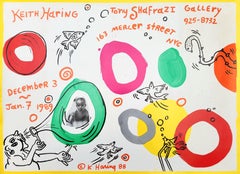
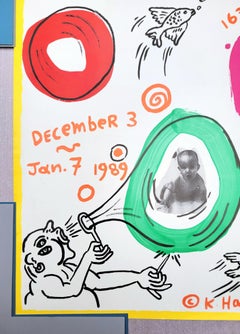
Keith Haring's art vibrantly portrays themes of love, unity, and movement. This reproduction features three iconic images that encapsulate these themes: Two Men in Love: Depicts two...

Category

Pop Art 1980s Art

Materials

Offset

1986 Soviet Poster – Gagarin April 12, 1961 Space Tribute

1986 Soviet Poster – Gagarin April 12, 1961 Space Tribute

Located in PARIS, FR

This powerful 1986 Soviet poster commemorates one of the most defining moments of the 20th century: April 12, 1961, the day Yuri Gagarin became the first human to journey into space....

Category

1980s Art

Materials

Paper, Lithograph

Signed Lithograph Coloring Book by Keith Haring

Signed Lithograph Coloring Book by Keith Haring

By Keith Haring

Located in Long Island City, NY

A blank coloring book designed and printed by American Pop artist Keith Haring. This copy is signed and dated in pen by the artist and features several illustrations in the artist’s ...

Category

1980s Art

Materials

Lithograph

Signed limited edition Figurative photo, Black white man, Homoerotic - Mathew 2

Signed limited edition Figurative photo, Black white man, Homoerotic - Mathew 2

By Ian Sanderson

Located in Sant Cugat del Vallès, Barcelona

An original signed archival pigment print on Hahnemühle Photo Rag® Baryta 315 gsm paper by Scottish artist Ian Sanderson (1951- 2020) titled ‘ Mathew 2 ‘ who was captured on film in...

Category

Modern 1980s Art
Materials

Photographic Film, Archival Paper, Black and White, Giclée, Pigment, Arc...

"Three Ribbon Heads", Art Deco Hand Colored Lithograph by John Luke Eastman 1984

"Three Ribbon Heads", Art Deco Hand Colored Lithograph by John Luke Eastman 1984

Located in Soquel, CA

"Three Ribbon Heads", Art Deco Female Figurative by John Luke Eastman. 1984 Beautiful mid-1980's hand colored Art Deco style lithograph by Southern California artist John Luke Eastman (American, b.1929). In this 1984 version of Eastman's "Three Ribbon Heads", a delicate flowing line drawing of three consecutive women's faces in profile are framed by ribbons in a circular composition. As in many of the artist's works, Eastman captions the piece with the following phrase: " In this life we have three lasting qualities...faith, hope, and love. But the greatest of them is love." Hand signed and dated in pencil lower right, "John L. Eastman 84" artists proof. Displayed in a light grey mat and new art deco-style giltwood frame. Paper size: 20"H x 16"W. Framed size: 19.5"H x 23.25"W x 1"D. John Luke Eastman is a Southern California artist with a unique style. A graduate of UCLA with a degree in graphic arts, he was successful fashion illustrator and art director for prestigious department store in L. A. before turning his full attention to fine art. Over the part decade he has created and mastered the unique style that is currently found in his limited edition silk-screen graphics. A versatile artist, who has illustrated many record and book covers he refers to his style as "the 5th dimension" or "beautiful distortion". The qualities he seeks to impart through his works are fluidity of movement, a feeling of spatiality, weightlessness and beautiful color. His artworks have been in a lot of shows across the country. He recently had show at Celux (Louis Vuitton membership...

Category

Art Deco 1980s Art
Materials

Paper, Mixed Media, Watercolor, Lithograph

Rare Judaica Jewish Folk Art Sukkot Papercut Jerusalem Mizrach Archie Granot

Rare Judaica Jewish Folk Art Sukkot Papercut Jerusalem Mizrach Archie Granot

By Archie Granot

Located in Surfside, FL

Jewish paper cutting is a traditional form of Jewish folk art made by cutting figures and sentences in paper or parchment. It is connected with various customs and ceremonies, and associated with holidays and family life. Paper cuts often decorated ketubbot (marriage contracts), Mizrahs, and ornaments for festive occasions. Paper cutting was practiced by Jewish communities in both Eastern Europe and North Africa and the Middle East for centuries and has seen a revival in modern times in Israel and elsewhere. Born in London, England in 1946, Archie Granot moved to Israel in 1967. Prior to settling in Jerusalem in 1978, he was a member of an agricultural community where he milked cows and grew melons. He has a M.Phil in Russian Studies from the University of Glasgow, Scotland and a B.A. in Political Science and Russian Studies from the Hebrew University, Jerusalem. Archie Granot is a paper cut artist based in Israel. He works in traditional Jewish art, including ketubahs (ketubot), mizrachs, mezuzahs, haggadah and blessings for the Jewish life cycle, etc. Granot uses a scalpel to produce his papercut works, rather than the scissors which are more common with other artists. Granot's use of Hebrew inscriptions, handcut in calligraphic letters in his Jewish papercuts...

Category

Folk Art 1980s Art
Materials

Mixed Media