Naturalistic Art

to
165
1,153
358
237
198
287
Overall Width
to
Overall Height
to
231
808
402
794
37
20
14
29
19
26
13
20
28
10
219
116,946
64,128
56,282
28,401
14,651
9,596
6,705
6,022
4,191
3,156
2,487
2,377
2,149
604
1,083
860
137
516
404
367
289
254
219
216
194
154
133
120
105
100
85
79
73
71
68
61
61
590
416
391
375
354
136
83
69
40
36
524
379
966
635
Style: Naturalistic
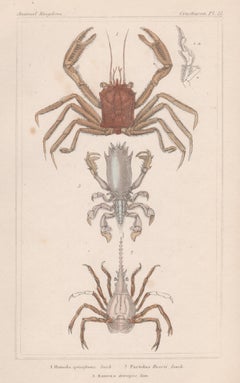
Crustaceans - Coconut and hermit crabs, natural history engraving print, 1837

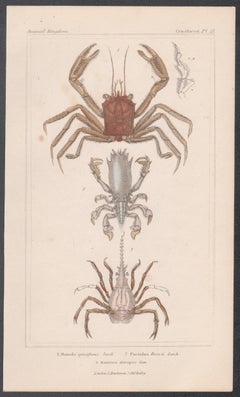
Crustaceans - Coconut and hermit crabs, natural history engraving print, 1837

Located in Melbourne, Victoria

'Crustacea' Copper-line engraving with original hand-colouring. From Baron Georges Cuvier's (1769-1832) 'Animal Kingdom', published in London in 1837. 210mm by 130mm (sheet)

Category

Mid-19th Century Naturalistic Art

Materials

Engraving

Red Geranium: An 18th Century Hand-colored Botanical Engraving by J. Weinmann

Red Geranium: An 18th Century Hand-colored Botanical Engraving by J. Weinmann

By Johann Wilhelm Weinmann

Located in Alamo, CA

This is an original antique colored botanical mezzotint and line engraving of flowering Red Geraniums which is finished with hand-coloring. It is entitled "Geranium Anemones folio Af...

Category

Mid-18th Century Naturalistic Art

Materials

Engraving, Mezzotint

Birds of Europe by John and Elisabeth Goult, 1832

Birds of Europe by John and Elisabeth Goult, 1832

By John Gould and Elizabeth Gould

Located in Paris, FR

Rare Set of 6 beautiful Naturalistic hand-colored lithograph prints by John Gould from his work Birds of Europe, embelished with gum arabic in vibrant colors. Published 1832 - 1837 by Hullmandel, Walter and Walton. Presented in gold leaf wood frames. Very charming . The price includes the set of 6 framed ones. John Gould (1804–1881) is the most prolific publisher of ornithological subjects of all time. In 19th-century Europe, his name was as well known as Audubon’s was in North America. Unlike Audubon, whose life’s work focused on one region, Gould traveled widely and employed other artists to help create his lavish, hand-colored lithographic folios. John Gould’s love of natural history was fostered in the gardens of King George III where his father was chief gardener at Windsor Castle. Although trained as a gardener, Gould’s interests quickly evolved, and at the age of 20, he was appointed taxidermist to the Zoological Society of London. After three years, he progressed to the position of curator of birds and chief taxidermist. In 1830, newly married, Gould and his artist wife, Elizabeth Gould...

Category

1830s Naturalistic Art

Materials

Lithograph

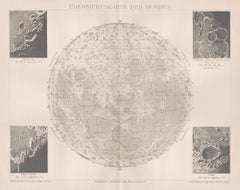
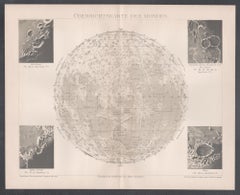
Ubersichtskarte Des Mondes (Overview Map of the Moon), antique astronomy print

Ubersichtskarte Des Mondes (Overview Map of the Moon), antique astronomy print

Located in Melbourne, Victoria

'Ubersichtskarte Des Mondes' (Overview Map of the Moon) German chromolithograph, circa 1895. 245mm by 305mm (sheet). Central vertical fold as issued.

Category

Late 19th Century Naturalistic Art

Materials

Lithograph

Blue Lining

Blue Lining

By Jean- Michel Lenoir

Located in New York, NY

Elevation 41 x 59" Ed. of 10, Unframed We can frame it in a white wood shadow box for a price of $400. Other sizes are available within the limited Edition of 30 all sized included...

Category

2010s Naturalistic Art

Materials

Archival Ink, Archival Paper, Photographic Paper, Archival Pigment

Norwegian Pine Grove - The inner glow of the trees -

Norwegian Pine Grove - The inner glow of the trees -

Located in Berlin, DE

Themistokles von Eckenbrecher (1842 Athens - 1921 Goslar), Norwegian pine grove, 1901. Watercolor on blue-green paper, 30 x 22 cm. Signed, dated and inscribed in his own hand "TvE. Fagermes [i.e. Fagermes]. 26.6.[19]01." - Slight crease throughout at left margin, otherwise in good condition. About the artwork Themistokles von Eckenbrecher often traveled to Norway to study the nature that fascinated him there. On June 26, 1901, near the southern Norwegian town of Fagernes, in the summer evening sun, he saw a small pine grove, which he immediately captured in a watercolor. He exposed the trees growing on a small hill in front of the background, so that the pines completely define the picture and combine to form a tense motif. The tension comes from the contrast of form and color. The trunks, growing upward, form a vertical structure that is horizontally penetrated by the spreading branches and the pine needles, which are rendered as a plane. This structural tension is further intensified by the color contrast between the brown-reddish iridescent trunks and branches and the green-toned needlework. Themistokles von Eckenbrecher, however, does not use the observed natural scene as an inspiring model for a dance of color and form that detaches itself from the motif and thus treads the path of abstracting modernism. Its inner vitality is to be brought to light and made aesthetically accessible through the work of art. It is precisely in order to depict the inner vitality of nature that von Eckenbrecher chooses the technique of watercolor, in which the individual details, such as the needles, are not meticulously worked out, but rather a flowing movement is created that unites the contrasts. The trees seem to have formed the twisted trunks out of their own inner strength as they grew, creatingthose tense lineations that the artist has put into the picture. The inner strength continues in the branches and twigs, culminating in the upward growth of the needles. At the same time, the trunks, illuminated by the setting sun, seem to glow from within, adding an almost dramatic dimension to the growing movement. Through the artwork, nature itself is revealed as art. In order to make nature visible as art in the work, von Eckenbrecher exposes the group of trees so that they are bounded from the outside by an all-encompassing contour line and merge into an areal unity that enters into a figure-ground relationship with the blue-greenish watercolor paper. The figure-ground relationship emphasizes the ornamental quality of the natural work of art, which further enforces the artwork character of the group of trees. With the presentation of Themistokles von Eckenbrecher's artistic idea and its realization, it has become clear that the present watercolor is not a study of nature in the sense of a visual note by the artist, which might then be integrated into a larger work context, but a completely independent work of art. This is why von Eckenbrecher signed the watercolor. In addition, it is marked with a place and a date, which confirms that this work of nature presented itself to him in exactly this way at this place at this time. At the same time, the date and place make it clear that the natural work of art has been transferred into the sphere of art and thus removed from the time of the place of nature. About the artist Themistocles' parents instilled a life of travel in their son, who is said to have spoken eleven languages. His father, who was interested in ancient and oriental culture, was a doctor and had married Francesca Magdalena Danelon, an Italian, daughter of the British consul in Trieste. During a stay in Athens - Gustav von Eckenbrecher was a friend of Heinrich von Schliemann and is said to have given him crucial clues as to the location of Troy - Themistokles saw the light of day in 1842. After an interlude in Berlin, where Themistokles was educated at the English-American School, the journey began again. From 1850 to 1857 the family lived in Constantinople, after which the father opened a practice in Potsdam, where Themistokles, who wanted to become a painter, was taught by the court painter Carl Gustav Wegener. In 1861 the von Eckenbrechers left Potsdam and settled in Düsseldorf. There Themistokles received two years of private tuition from Oswald Aschenbach, who greatly admired the talented young artist. After his artistic training, he undertook extensive travels, often accompanied by Prince Peter zu Sayn-Wittgenstein, which took him to northern and eastern Europe, but above all to the Middle East and even to South America. The paintings that resulted from these journeys established his artistic reputation and led to his participation in large panoramas such as the 118 x 15 metre Entry of the Mecca Caravan into Cairo, painted for the City of Hamburg in 1882. 1882 was also the start of a total of 21 study trips to Scandinavia, most of them to Norway, and the unique Norwegian landscape with its rugged fjords became a central motif in his work. Along with Anders Askevold and Adelsteen Normann...

Category

Early 1900s Naturalistic Art

Materials

Watercolor

Tah-Chee, Cherokee Chief: 19th C. Folio Hand-colored McKenney & Hall Lithograph

Tah-Chee, Cherokee Chief: 19th C. Folio Hand-colored McKenney & Hall Lithograph

By McKenney & Hall

Located in Alamo, CA

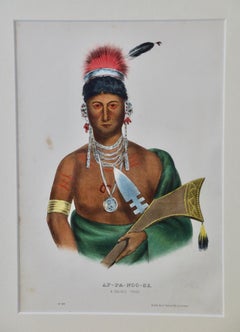
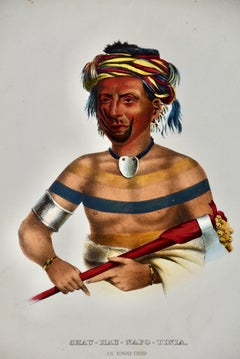
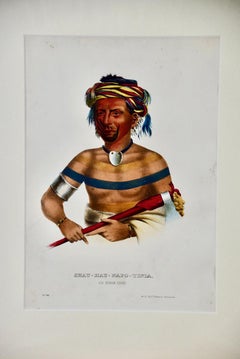
This is an original 19th century hand-colored folio-sized lithographic portrait of a Native American entitled "Tah-Chee, A Cherokee Chief", from McKenney and Hall's 'History of the Indian Tribes of North America'. It was lithographed by J. T. Bowen after a painting by Charles Bird King and published by E. C. Biddle in Philadelphia in 1838. Tahchee's name translates to Dutch in Cherokee, and he became known as William Dutch. He was born in 1790 in the Cherokee Nation, which is now in a portion of Alabama. Tahchee became known as a skilled warrior and leader among his people, and he was eventually appointed as a chief of the Cherokee Nation "Old Settlers". During his time as chief, Tahchee was a rival of the Osage people and he worked to protect the Cherokee people and their land from encroachment by white settlers. He was a strong advocate for maintaining Cherokee sovereignty and cultural traditions, even as pressure mounted from the United States government to remove the Cherokee from their ancestral lands. In 1838, Tahchee and many other Cherokee people were forcibly removed from their homes in what is known as the Trail of Tears...

Category

Mid-19th Century Naturalistic Art

Materials

Lithograph

Gloxinia, English antique flower botanical chromolithograph, 1895

Gloxinia, English antique flower botanical chromolithograph, 1895

By Frederick William Hulme

Located in Melbourne, Victoria

'Gloxinia' Process print from Frederick William Hulme’s ‘Familiar Wild Flowers’, circa 1890. Hulme was known as a teacher and an amateur botanist. He was the Professor of Freehand ...

Category

Late 19th Century Naturalistic Art

Materials

Lithograph

Crustaceans - lobsters, antique English natural history engraving print, 1837

Crustaceans - lobsters, antique English natural history engraving print, 1837

Located in Melbourne, Victoria

'Crustacea' Copper-line engraving with original hand-colouring. From Baron Georges Cuvier's (1769-1832) 'Animal Kingdom', published in London in 1837. 210mm by 130mm (sheet)

Category

Mid-19th Century Naturalistic Art

Materials

Engraving

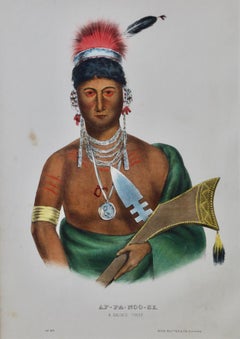
Qua-Ta-Wa-Pea, A Shawnee: 19th C. Folio Hand-colored McKenney & Hall Lithograph

Qua-Ta-Wa-Pea, A Shawnee: 19th C. Folio Hand-colored McKenney & Hall Lithograph

By McKenney & Hall

Located in Alamo, CA

This is an original 19th century hand-colored folio-sized lithographic portrait of a Native American entitled "Qua-Ta-Wa-Pea, A Shawanoe Chief", from McKenney and Hall's 'History of the Indian Tribes of North America'. It was lithographed by J. T. Bowen after a painting by Charles Bird King and published by E. C. Biddle in Philadelphia in 1836. Quatawapea wears a maroon head covering, a white ruffled shirt and blue shawl with gray trim. His presidential peace medal is attached to a maroon fabric...

Category

Mid-19th Century Naturalistic Art

Materials

Lithograph

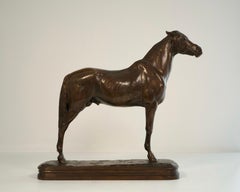
Cheval arabe - Bronze d'Emmanuel Frémiet

Cheval arabe - Bronze d'Emmanuel Frémiet

Located in Ixelles, BE

Cette très belle sculpture d’Emmanuel Frémiet porte en plus de la signature « E. FRÉMIET », les initiales de l’artiste sous la terrasse, ainsi qu’un numéro, probablement le « 2 », s...

Category

Late 19th Century Naturalistic Art

Materials

Bronze

Fish, engraving with original hand-colouring, circa 1815

Fish, engraving with original hand-colouring, circa 1815

Located in Melbourne, Victoria

Fish, engraving with original hand-colouring, circa 1815. From Bilderbuch Zum Nutzen und Vergnugen Der Jugend by Friedrich Justin Bertuch (1747-1822), an encyclopaedic collection of...

Category

Early 19th Century Naturalistic Art

Materials

Engraving

Strahlinge (Protozoa - Radiolarians or Radioza) German antique lithograph print

Strahlinge (Protozoa - Radiolarians or Radioza) German antique lithograph print

Located in Melbourne, Victoria

'Strahlinge' (Protozoa - Radiolarians or Radioza) German lithograph, circa 1895. Key to protozoa in German below the image. 250mm by 305mm (sheet). Central vertical fold as iss...

Category

Late 19th Century Naturalistic Art

Materials

Lithograph

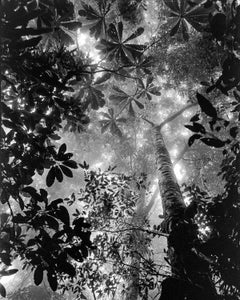
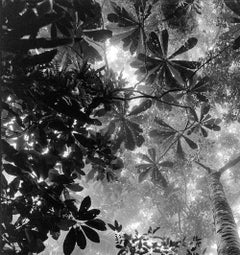
Bosque Alto Andino Chingaza. Pigment Print

Bosque Alto Andino Chingaza. Pigment Print

By Miguel Winograd

Located in Miami Beach, FL

The artist looks for a path between tangled branches. Reconfiguring a personal archive of diverse Colombian landscapes, experimenting with a variety of printing materials to reconstr...

Category

21st Century and Contemporary Naturalistic Art

Materials

Black and White, Pigment

Indigenous People, Stage Coach, Mexico, America, mid 19th century lithograph.

Indigenous People, Stage Coach, Mexico, America, mid 19th century lithograph.

Located in Melbourne, Victoria

'Indiani in viaggio' / 'Diligenza Messicana' Italian lithograph, c1841. Originally from 'Galleria universale di tutti i popoli del mondo' by Giuseppe Antonelli, published in Venice,...

Category

Mid-19th Century Naturalistic Art

Materials

Lithograph

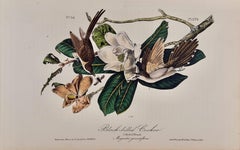
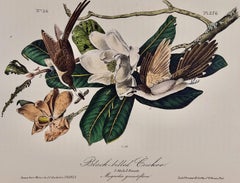
Black-billed Cuckoo: An Original 1st Ed. Audubon Hand-colored Bird Lithograph

Black-billed Cuckoo: An Original 1st Ed. Audubon Hand-colored Bird Lithograph

By John James Audubon

Located in Alamo, CA

This is an original 1st octavo edition John James Audubon hand-colored lithograph entitled "Black-billed Cuckoo, 1. Male, 2, Female, Magnolia Grandiflora", No. 56, Plate 276 from Audubon's "Birds of America, lithographed, printed and colored by J. T. Bowen and published in Philadelphia between 1840-1844. It depicts a female black-billed cuckoo perched on a branch of a magnolia tree reaching for a flying insect. The male appears to be in flight in front of magnolia leaves on the right, perhaps after the same insect. Magnolia flowers are depicted, as well. This original 1st octavo edition hand-colored Audubon Black-billed Cuckoo lithograph is in excellent condition, other than a few tiny spots in the upper margin and a tiny faint spot in the lower inscription area. The sheet measures 6.5" high by 10.13" wide. The original text pages, 300-302, from Audubon's 19th century publication are included with the lithograph. John James Audubon (1785-1851) was a naturalist and artist. He was initially unsuccessful financially prior to the publication of his famous work “The Birds of America”, spending time in debtor’s prison, once stabbing a disgruntled investor in self-defense. However, his obsession with birds and art motivated him to persist in his goal of documenting every bird in America via his watercolor paintings and publishing his works for all to enjoy. Audubon's first illustrations were published in a large elephant folio size. Due to their expense they were purchased in rather small numbers by the wealthy. To reach a larger audience, Audubon, with the help of his sons and J. T. Bowen, published a smaller octavo sized lithograph version, which were much more affordable. With the success of his bird projects, Audubon then turned his attention to four-legged animals. He explored the Missouri River in 1843 sketching the four-legged animals he encountered in their natural setting. His expedition covered some of the same regions recently explored by Lewis and Clark, traveling from present day Alaska to Mexico. Audubon realized that this was an opportunity to document these animals in the still relatively pristine American wilderness, before man encroached on their environment. Between 1845 and 1848, Audubon and his sons John Woodhouse Audubon and Victor Gifford Audubon produced a set of elephant folio sized lithographs that were primarily engraved and hand colored by J. T. Bowen in Philadelphia. The publication, which included text descriptions of the animals was published 3 years before Audubon died. As with the birds, this was followed by a three-volume set of 155 octavo-sized plates entitled “The Quadrupeds of North America” completed and published by Audubon’s sons, John, Jr. and Victor. Audubon prints continue to be popular and a wise investment. The double elephant folio set...

Category

Mid-19th Century Naturalistic Art
Materials

Lithograph

'Scarlet Dreams'. Contemporary painting poppies red white blue floral nature

'Scarlet Dreams'. Contemporary painting poppies red white blue floral nature

By Sophia Milligan

Located in Penzance, GB

'Scarlet Dreams'. Original Artwork. Framed ready to hang _________________ Exploring the flux and balance in the nature of all things, 'Scarlet Dreams' captures an essence of the equ...

Category

2010s Naturalistic Art

Materials

Chalk, Conté, Ink, Mixed Media, Acrylic, Watercolor, Pencil, Carbon Penc...

Portrait of a Lady - French 19th century art Realist drawing woman covered head

Portrait of a Lady - French 19th century art Realist drawing woman covered head

Located in Hagley, England

This is a fine detailed French Naturalistic portrait. Executed on November 2nd 1889 and signed PHL. In good condition. Signed and dated middle right. Provenance. Private collection. ...

Category

19th Century Naturalistic Art

Materials

Charcoal, Pencil

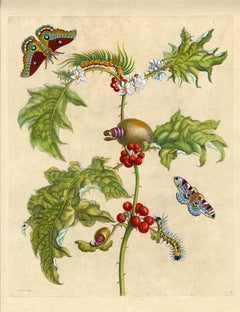
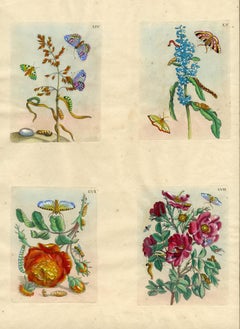
4 plates from The Wondrous Transformation of Caterpillars & their Strange Diet..

4 plates from The Wondrous Transformation of Caterpillars & their Strange Diet..

By Maria Sibylla Merian

Located in Middletown, NY

Four plates from The Wondrous Transformation of Caterpillars and their Strange Diet of Flowers. “Wolfsmelk Rupsen;" “Wolfsmilch, Raupe und Schmetterling" Amsterdam: J F Bernard, 1730. Each an engraving with hand coloring in watercolor and gouache printed on one sheet of watermarked Honig cream laid paper, each measures 6 1/4 x 5 inches (157 x 121 mm), sheet measures 20 5/8 x 14 inches (522 x 355 mm), full margins. With handling creases in the lower right sheet quadrant, as well as minor, loose cockling, otherwise in very good condition. The colors are superb with exceptionally fresh and bright saturation. Engraved between 1679 and 1683, printed 1730. Plates included: LIV, LV, LVI, & LVII. MARIA SIBYLLA MERIAN was one of the most highly respected entomologists of the 17th century, and remains today one of the field's most significant figures. A German-born naturalist and scientific illustrator, she reared herself on the study of caterpillars, and made tremendous contributions to the knowledge of the life cycles of numerous species. Until her detailed and careful study of the process of metamorphosis it was thought that insects were "born of mud," through spontaneous generation. Trained as a miniature painter by her stepfather, she published her first book of illustrations in 1675, at the age of 28. In 1679, Merian published the first volume of the two-volume series on caterpillars, The Wondrous Transformation of Caterpillars and their Strange Diet of Flowers; the second volume followed in 1683. Each volume contained 50 plates that she engraved and etched. In 1699, Merian traveled to Dutch Guiana...

Category

Early 18th Century Naturalistic Art

Materials

Watercolor, Engraving

Still Life with Peaches

Still Life with Peaches

By Otto Eichinger

Located in Sheffield, MA

Otto Eichinger Austrian, 1922 – 2004 Still Life with Peaches Oil on panel 10 ¼ by 12 ¾ in, w/ frame 17 ¼ by 19 ¾ in Signed lower right Otto Eichinger was born in 1922 in Vienna, Au...

Category

Late 20th Century Naturalistic Art

Materials

Oil

German Realist painter - 19th century children playing with a trained dog

German Realist painter - 19th century children playing with a trained dog

Located in Varmo, IT

German Realist painter (19th century) - Two children training a dog. 56.5 x 46.5 cm (without frame) - 69 x 59 cm (with frame). Oil on canvas, in a gilt wood frame. Signed indistin...

Category

Late 19th Century Naturalistic Art

Materials

Canvas, Oil

Crustaceans, antique English natural history engraving print, 1837

Crustaceans, antique English natural history engraving print, 1837

Located in Melbourne, Victoria

'Crustacea' Copper-line engraving with original hand-colouring. From Baron Georges Cuvier's (1769-1832) 'Animal Kingdom', published in London in 1837. 210mm by 130mm (sheet)

Category

Mid-19th Century Naturalistic Art
Materials

Engraving

Indigenous Peoples of Prince William Sound, America, 19th century lithograph.

Indigenous Peoples of Prince William Sound, America, 19th century lithograph.

Located in Melbourne, Victoria

'Mausoleo del Vakosci' / 'Tschigaschi' Italian lithograph, c1841. Originally from 'Galleria universale di tutti i popoli del mondo' by Giuseppe Antonelli, published in Venice, Italy...

Category

Mid-19th Century Naturalistic Art
Materials

Lithograph

30: Collier

30: Collier

Located in Columbia, MO

Edward William Cooke was born in Pentonville. His father, George Cooke, and uncle William Bernard Cooke were also well-known line engravers. Growing up in an environment of artists,...

Category

1820s Naturalistic Art

Materials

Etching

Oak and fern - black and white landscape photography Limited edition of 10

Oak and fern - black and white landscape photography Limited edition of 10

By Ugne Pouwell

Located in London, GB

Oak and fern London, United Kingdom 2024. It is a still life black and white film photograph, made with a large format 4x5 Linhof camera. The photograph is signed front and back a...

Category

21st Century and Contemporary Naturalistic Art
Materials

Film, Photographic Film, Giclée

Naturalistic art for sale on 1stDibs.
Find a wide variety of authentic Naturalistic art available for sale on 1stDibs. Works in this style were very popular during the 21st Century and Contemporary, but contemporary artists have continued to produce works inspired by this movement. If you’re looking to add art created in this style to introduce contrast in an otherwise neutral space in your home, the works available on 1stDibs include elements of blue, orange, green, red and other colors. Many Pop art paintings were created by popular artists on 1stDibs, including Miguel Winograd , John James Audubon, McKenney & Hall, and William Curtis. Frequently made by artists working with Paint, and Engraving and other materials, all of these pieces for sale are unique and have attracted attention over the years. Not every interior allows for large Naturalistic art, so small editions measuring 0.5 inches across are also available. Prices for art made by famous or emerging artists can differ depending on medium, time period and other attributes. On 1stDibs, the price for these items starts at $38 and tops out at $191,816, while the average work sells for $863.