Andy Warhol

American, 1928-1987

The name of American artist Andy Warhol is all but synonymous with Pop art, the movement he helped shape in the 1960s. He was phenomenally prolific, and the archive of original photography, prints, drawings, paintings and other art that he left behind is beyond vast.

Andy Warhol is known for his clever appropriation of motifs and images from popular advertising and commercials, which he integrated into graphic, vibrant works that utilized mass-production technologies such as printmaking, photography and silkscreening. Later in his career, Warhol expanded his oeuvre to include other forms of media, founding Interview magazine and producing fashion shoots and films on-site at the Factory, his world-famous studio in New York.

Born and educated in in Pittsburgh, Warhol moved to New York City in 1949 and built a successful career as a commercial illustrator. Although he made whimsical drawings as a hobby during these years, his career as a fine artist began in the mid-1950s with ink-blot drawings and hand-drawn silkscreens. The 1955 lithograph You Can Lead a Shoe to Water illustrates how he incorporated in his artwork advertising styles and techniques, in this case shoe commercials.

As a child, Warhol was often sick and spent much of his time in bed, where he would make sketches and put together collections of movie-star photographs. He described this period as formative in terms of his skills and interests. Indeed, Warhol remained obsessed with celebrities throughout his career, often producing series devoted to a famous face or an object from the popular culture, such as Chairman Mao or Campbell’s tomato soup. The 1967 silkscreen Marilyn 25 embodies his love of bright color and famous subjects.

Warhol was a prominent cultural figure in New York during the 1960s, ’70s and ’80s. The Factory was a gathering place for the era’s celebrities, writers, drag queens and fellow artists, and collaboration was common. To this day, Warhol remains one of the most important artists of the 20th century and continues to exert influence on contemporary creators.

Find a collection of original Andy Warhol art on 1stDibs.

Original Bank by Andy Warhol pop art Gaudy savings vintage poster 1968
By Andy Warhol
Located in Spokane, WA
Original Andy Warhol 1968 Vintage Poster "Gaudy Savings by RCA Color Scanner" Authentic Pop Art Collectible First Edition Print. Archival linen-backed in excellent condition, Grad...
Category

1960s Pop Art Andy Warhol

Materials

Offset

Exposures (Deluxe Edition) Monograph Hand Signed, Numbered #1 by Andy Warhol COA
By Andy Warhol
Located in New York, NY
Andy Warhol Deluxe Collectors' Edition of Exposures (Hand Signed and Numbered), 1979 Hardcover Monograph in leather with gilt edge and stamped in gilt. Hand signed by Andy Warhol on...
Category

1970s Pop Art Andy Warhol

Materials

Mixed Media, Graphite, Lithograph, Offset

Unique portrait of Roy Lichtenstein, Authenticated by the Andy Warhol Foundation
By Andy Warhol
Located in New York, NY
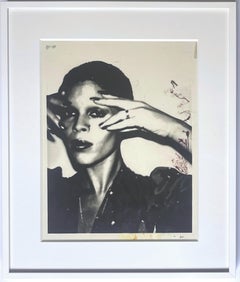
Andy Warhol Portrait of Roy Lichtenstein, 1975 Polaroid dye-diffusion print Authenticated by the Andy Warhol Foundation for the Visual Arts, bears the Foundation stamp verso Frame included: Framed in white wood frame with UV plexiglass; with die-cut window in the back to show official Warhol Foundation authentication stamp and text Measurements: 9 9/16 x 8 9/16 x 9/16 inches (frame) 3 1/2 x 2 3/4 inches (window) 4.16 x 3.15 inches (Artwork) Authenticated and stamped by the Estate of Andy Warhol/Warhol Foundation for the Visual Arts An impressive piece of Pop Art history! A must-have for fans and collectors of both Andy Warhol and Roy Lichtenstein: This is a unique, authenticated color Polaroid taken by one Pop Art legend, Andy Warhol, of his most formidable contemporary and, in many respects, rival, Roy Lichtenstein. One of only a few portraits Andy Warhol took of Roy Lichtenstein, during one tense photo shoot. Both iconic artists, colleagues and, perhaps lesser known to the public, rivals, would be represented at the time by the renowned Leo Castelli Gallery. The truth is - they were really more rivals than friends. (the rivalry intensified when Warhol, who was working with Walt Disney, discovered that Lichtenstein painted Mickey Mouse before he did!!) Leo Castelli was committed to Roy Lichtenstein, and, it's easy to forget today, wasn't that interested in Warhol as he considered Lichtenstein the greater talent and he could relate better with Roy on a personal level. However, Ivan Karp, who worked at Castelli, was very interested in Warhol, as were some powerful European dealers, as well as many wealthy and influential American and European collectors. That was the start of Warhol's bypassing the traditional gallery model - so that dealers like Castelli could re-discover him after everybody else had. Warhol is known to have taken hundreds of self-portrait polaroid photographs - shoe boxes full - and he took many dozens of images of celebrities like Blondie and Farrah Fawcett. But only a small number of photographic portraits of fellow Pop Art legend Roy Lichtenstein -- each unique,- are known to have appeared on the market over the past half a century - all from the same photo session. This is one of them. There is another Polaroid - from this same (and only) sitting, in the permanent collection of the Getty Museum in California. There really weren't any other collaborations between these two titans, making the resulting portrait from this photo session extraordinary. It is fascinating to study Roy Lichtenstein's face and demeanor in this photograph, in the context of the great sense of competition, but perhaps even greater, albeit uneasy respect, these two larger than life Pop art titans had for each other: Like Leo Castelli, Roy Lichtenstein was Jewish of European descent; whereas Warhol was Catholic and quintessentially American, though also of European (Polish) descent. They were never going to be good friends, but this portrait, perhaps even arranged by Leo Castelli, represents an uneasy acknowledgement there would be room at the top for both of them. Floated, framed with die cut back revealing authentication details, and ready to hang. Measurements: 9 9/16 x 8 9/16 x 9/16 inches (frame) 3 1/2 x 2 3/4 inches (window) 4.16 x 3.15 inches (sheet) Authenticated by the Estate of Andy Warhol/The Andy Warhol Foundation for the Visual Arts. Estate Stamped: Stamped with the Andy Warhol Estate, Warhol Foundation for the Visual Arts stamp, numbered "B 512536P", with the Estate of Andy Warhol stamp and inscribed UP on the reverse. Bears the Warhol Foundation unique inventory number. Roy Lichtenstein Biography Roy Lichtenstein was one of the most influential and innovative artists of the second half of the twentieth century. He is preeminently identified with Pop Art, a movement he helped originate, and his first fully achieved paintings were based on imagery from comic strips and advertisements and rendered in a style mimicking the crude printing processes of newspaper reproduction. These paintings reinvigorated the American art scene and altered the history of modern art. Lichtenstein’s success was matched by his focus and energy, and after his initial triumph in the early 1960s, he went on to create an oeuvre of more than 5,000 paintings, prints, drawings, sculptures, murals and other objects celebrated for their wit and invention. Roy Fox Lichtenstein was born on October 27, 1923, in New York City, the first of two children born to Milton and Beatrice Werner Lichtenstein. Milton Lichtenstein (1893–1946) was a successful real estate broker, and Beatrice Lichtenstein (1896–1991), a homemaker, had trained as a pianist, and she exposed Roy and his sister Rénee to museums, concerts and other aspects of New York culture. Roy showed artistic and musical ability early on: he drew, painted and sculpted as a teenager, and spent many hours in the American Museum of Natural History and the Museum of Modern Art. He played piano and clarinet, and developed an enduring love of jazz, frequenting the nightspots in Midtown to hear it. Lichtenstein attended the Franklin School for Boys, a private junior high and high school, and was graduated in 1940. That summer he studied painting and drawing from the model at the Art Students League of New York with Reginald Marsh. In September he entered Ohio State University (OSU) in Columbus in the College of Education. His early artistic idols were Rembrandt, Daumier and Picasso, and he often said that Guernica (1937; Museo Reina Sofía, Madrid), then on long-term loan to the Museum of Modern Art, was his favorite painting. Even as an undergraduate, Lichtenstein objected to the notion that one set of lines (one person’s drawings) “was considered brilliant, and somebody’s else’s, that may have looked better to you, was considered nothing by almost everyone.”i Lichtenstein’s questioning of accepted canons of taste was encouraged by Hoyt L. Sherman, a teacher whom he maintained was the person who showed him how to see and whose perception-based approach to art shaped his own. In February 1943, Lichtenstein was drafted, and he was sent to Europe in 1945. As part of the infantry, he saw action in France, Belgium and Germany. He made sketches throughout his time in Europe and, after peace was declared there, he intended to study at the Sorbonne. Lichtenstein arrived in Paris in October 1945 and enrolled in classes in French language and civilization, but soon learned that his father was gravely ill. He returned to New York in January 1946, a few weeks before Milton Lichtenstein died. In the spring of that year, Lichtenstein went back to OSU to complete his BFA and in the fall he was invited to join the faculty as an instructor. In June 1949, he married Isabel Wilson Sarisky (1921–80), who worked in a cooperative art gallery in Cleveland where Lichtenstein had exhibited his work. While he was teaching, Lichtenstein worked on his master’s degree, which he received in 1949. During his second stint at OSU, Lichtenstein became closer to Sherman, and began teaching his method on how to organize and unify a composition. Lichtenstein remained appreciative of Sherman’s impact on him. He gave his first son the middle name of “Hoyt,” and in 1994 he donated funds to endow the Hoyt L. Sherman Studio Art Center at OSU. In the late 1940s and early 1950s, Lichtenstein began working in series and his iconography was drawn from printed images. His first sustained theme, intimate paintings and prints in the vein of Paul Klee that poked lyrical fun at medieval knights, castles and maidens, may well have been inspired by a book about the Bayeux Tapestry. Lichtenstein then took an ironic look at nineteenth-century American genre paintings he saw in history books, creating Cubist interpretations of cowboys and Indians spiked with a faux-primitive whimsy. As with his most celebrated Pop paintings of the 1960s, Lichtenstein gravitated toward what he would characterize as the “dumbest” or “worst” visual item he could find and then went on to alter or improve it. In the 1960s, commercial art was considered beneath contempt by the art world; in the early 1950s, with the rise of Abstract Expressionism, nineteenth-century American narrative and genre paintings were at the nadir of their reputation among critics and collectors. Paraphrasing, particularly the paraphrasing of despised images, became a paramount feature of Lichtenstein’s art. Well before finding his signature mode of expression in 1961, Lichtenstein called attention to the artifice of conventions and taste that permeated art and society. What others dismissed as trivial fascinated him as classic and idealized—in his words, “a purely American mythological subject matter.”ii Lichtenstein’s teaching contract at OSU was not renewed for the 1951–52 academic year, and in the autumn of 1951 he and Isabel moved to Cleveland. Isabel Lichtenstein became an interior decorator specializing in modern design, with a clientele drawn from wealthy Cleveland families. Whereas her career blossomed, Lichtenstein did not continue to teach at the university level. He had a series of part-time jobs, including industrial draftsman, furniture designer, window dresser and rendering mechanical dials for an electrical instrument company. In response to these experiences, he introduced quirkily rendered motors, valves and other mechanical elements into his paintings and prints. In 1954, the Lichtensteins’ first son, David, was born; two years later, their second child, Mitchell, followed. Despite the relative lack of interest in his work in Cleveland, Lichtenstein did place his work with New York dealers, which always mattered immensely to him. He had his first solo show at the Carlebach Gallery in New York in 1951, followed by representation with the John Heller Gallery from 1952 to 1957. To reclaim his academic career and get closer to New York, Lichtenstein accepted a position as an assistant professor at the State University of New York at Oswego, in the northern reaches of the state. He was hired to teach industrial design, beginning in September 1957. Oswego turned out to be more geographically and aesthetically isolated than Cleveland ever was, but the move was propitious, for both his art and his career. Lichtenstein broke away from representation to a fully abstract style, applying broad swaths of pigment to the canvas by dragging the paint across its surface with a rag wrapped around his arm. At the same time, Lichtenstein was embedding comic-book characters figures such as Mickey Mouse and Donald Duck in brushy, expressionistic backgrounds. None of the proto-cartoon paintings from this period survive, but several pencil and pastel studies from that time, which he kept, document his intentions. Finally, when he was in Oswego, Lichtenstein met Reginald Neal, the new head of the art department at Douglass College, the women’s college of Rutgers University, in New Brunswick, New Jersey. The school was strengthening and expanding its studio art program, and when Neal needed to add a faculty member to his department, Lichtenstein was invited to apply for the job. Lichtenstein was offered the position of assistant professor, and he began teaching at Douglass in September 1960. At Douglass, Lichtenstein was thrown into a maelstrom of artistic ferment. With New York museums and galleries an hour away, and colleagues Geoffrey Hendricks and Robert Watts at Douglass and Allan Kaprow and George Segal at Rutgers, the environment could not help but galvanize him. In June 1961, Lichtenstein returned to the idea he had fooled around with in Oswego, which was to combine cartoon characters from comic books with abstract backgrounds. But, as Lichtenstein said, “[I]t occurred to me to do it by mimicking the cartoon style without the paint texture, calligraphic line, modulation—all the things involved in expressionism.”iii Most famously, Lichtenstein appropriated the Benday dots, the minute mechanical patterning used in commercial engraving, to convey texture and gradations of color—a stylistic language synonymous with his subject matter. The dots became a trademark device forever identified with Lichtenstein and Pop Art. Lichtenstein may not have calibrated the depth of his breakthrough immediately but he did realize that the flat affect and deadpan presentation of the comic-strip panel blown up and reorganized in the Sherman-inflected way “was just so much more compelling”iv than the gestural abstraction he had been practicing. Among the first extant paintings in this new mode—based on comic strips and illustrations from advertisements—were Popeye and Look Mickey, which were swiftly followed by The Engagement Ring, Girl with Ball and Step-on Can with Leg. Kaprow recognized the energy and radicalism of these canvases and arranged for Lichtenstein to show them to Ivan Karp, director of the Leo Castelli Gallery. Castelli was New York’s leading dealer in contemporary art, and he had staged landmark exhibitions of Jasper Johns and Robert Rauschenberg in 1958 and Frank Stella in 1960. Karp was immediately attracted to Lichtenstein’s paintings, but Castelli was slower to make a decision, partly on account of the paintings’ plebeian roots in commercial art, but also because, unknown to Lichtenstein, two other artists had recently come to his attention—Andy Warhol and James Rosenquist—and Castelli was only ready for one of them. After some deliberation, Castelli chose to represent Lichtenstein, and the first exhibition of the comic-book paintings was held at the gallery from February 10 to March 3, 1962. The show sold out and made Lichtenstein notorious. By the time of Lichtenstein’s second solo exhibition at Castelli in September 1963, his work had been showcased in museums and galleries around the country. He was usually grouped with Johns, Rauschenberg, Warhol, Rosenquist, Segal, Jim Dine, Claes Oldenburg, Robert Indiana and Tom Wesselmann. Taken together, their work was viewed as a slap in the face to Abstract Expressionism and, indeed, the Pop artists shifted attention away from many members of the New York School. With the advent of critical and commercial success, Lichtenstein made significant changes in his life and continued to investigate new possibilities in his art. After separating from his wife, he moved from New Jersey to Manhattan in 1963; in 1964, he resigned from his teaching position at Douglass to concentrate exclusively on his work. The artist also ventured beyond comic book subjects, essaying paintings based on oils by Cézanne, Mondrian and Picasso, as well as still lifes and landscapes. Lichtenstein became a prolific printmaker and expanded into sculpture, which he had not attempted since the mid-1950s, and in both two- and three-dimensional pieces, he employed a host of industrial or “non-art” materials, and designed mass-produced editioned objects that were less expensive than traditional paintings and sculpture. Participating in one such project—the American Supermarket show in 1964 at the Paul Bianchini Gallery, for which he designed a shopping bag—Lichtenstein met Dorothy Herzka (b. 1939), a gallery employee, whom he married in 1968. The late 1960s also saw Lichtenstein’s first museum surveys: in 1967 the Pasadena Art Museum initiated a traveling retrospective, in 1968 the Stedelijk Musem in Amsterdam presented his first European retrospective, and in 1969 he had his first New York retrospective, at the Solomon R. Guggenheim Museum. Wanting to grow, Lichtenstein turned away from the comic book subjects that had brought him prominence. In the late 1960s his work became less narrative and more abstract, as he continued to meditate on the nature of the art enterprise itself. He began to explore and deconstruct the notion of brushstrokes—the building blocks of Western painting. Brushstrokes are conventionally conceived as vehicles of expression, but Lichtenstein made them into a subject. Modern artists have typically maintained that the subject of a painting is painting itself. Lichtenstein took this idea one imaginative step further: a compositional element could serve as the subject matter of a work and make that bromide ring true. The search for new forms and sources was even more emphatic after 1970, when Roy and Dorothy Lichtenstein bought property in Southampton, New York, and made it their primary residence. During the fertile decade of the 1970s, Lichtenstein probed an aspect of perception that had steadily preoccupied him: how easily the unreal is validated as the real because viewers have accepted so many visual conceptions that they don’t analyze what they see. In the Mirror series, he dealt with light and shadow upon glass, and in the Entablature series, he considered the same phenomena by abstracting such Beaux-Art architectural elements as cornices, dentils, capitals and columns. Similarly, Lichtenstein created pioneering painted bronze sculpture that subverted the medium’s conventional three-dimensionality and permanence. The bronze forms were as flat and thin as possible, more related to line than volume, and they portrayed the most fugitive sensations—curls of steam, rays of light and reflections on glass. The steam, the reflections and the shadow were signs for themselves that would immediately be recognized as such by any viewer. Another entire panoply of works produced during the 1970s were complex encounters with Cubism, Futurism, Purism, Surrealism and Expressionism. Lichtenstein expanded his palette beyond red, blue, yellow, black, white and green, and invented and combined forms. He was not merely isolating found images, but juxtaposing, overlapping, fragmenting and recomposing them. In the words of art historian Jack Cowart, Lichtenstein’s virtuosic compositions were “a rich dialogue of forms—all intuitively modified and released from their nominal sources.”v In the early 1980s, which coincided with re-establishing a studio in New York City, Lichtenstein was also at the apex of a busy mural career. In the 1960s and 1970s, he had completed four murals; between 1983 and 1990, he created five. He also completed major commissions for public sculptures in Miami Beach, Columbus, Minneapolis, Paris, Barcelona and Singapore. Lichtenstein created three major series in the 1990s, each emblematic of his ongoing interest in solving pictorial problems. The Interiors, mural-sized canvases inspired by a miniscule advertisement in an Italian telephone...
Category

1970s Pop Art Andy Warhol

Materials

Polaroid

To Earl and Camilla Love Andy Warhol unique heart drawing in monograph Signed 2x
By Andy Warhol
Located in New York, NY
Andy Warhol To Earl and Camilla, Love Andy Warhol, 1979 Original Heart Drawing held in book with unique dedication to Earl and Camilla McGrath (Signed Twice by Andy Warhol) This uniq...
Category

1970s Pop Art Andy Warhol

Materials

Mixed Media, Permanent Marker, Lithograph, Offset

Flowers #71
By Andy Warhol
Located in New York, NY
From the iconic Flowers portfolio of ten individual floral prints created by Andy Warhol in 1970, Flowers #71 is an original color screenprint, hand-signed in ballpoint pen, and numb...
Category

20th Century Pop Art Andy Warhol

Materials

Screen

Flowers #71
$125,000
H 36 in W 36 in
Ads: Life Savers (Blue) By Andy Warhol
By Andy Warhol
Located in Dubai, Dubai
Ads: Life Savers (Blue) By Andy Warhol 2004 Medium: Offset Lithograph Paper Size: 34 x 34 inches ( 86 x 86 cm ) Image Size: 26 x 26 inches ( 66 x 66 cm ) Edition Size: Unknown
Category

Early 2000s Contemporary Andy Warhol

Materials

Lithograph, Offset

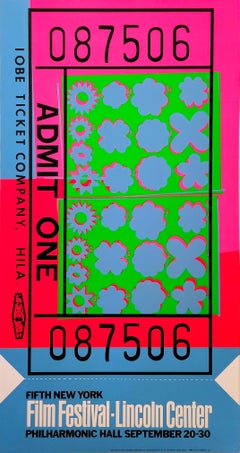
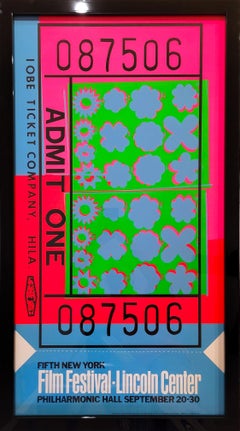
Deluxe Signed Edition of Film Festival Lincoln Center (Feldman & Schellmann, II)
By Andy Warhol
Located in New York, NY
Andy Warhol Deluxe Signed Edition of Film Festival Lincoln Center (Feldman & Schellmann, II.19), 1967 Silkscreen, die-cut on opaque acrylic Edition 2/200 (Signed and numbered on the back with engraving pen) Hand-signed by artist, As this work was done on acrylic, Warhol signed and numbered it by hand on verso with an engraving needle. Printed date with copyright Frame included: Elegantly framed in a museum quality wood frame with UV plexiglass. A die-cut window has been created in the back of the frame to reveal Warhol's incised signature and edition Publisher: Leo Castelli, New York Printer: Chiron Press, New York Catalogue Raisonne: Feldman & Schellmann, II.19 This work is often hung and displayed both vertically and horizontally - see photos for inspiration This work is one of only 200 done on opaque acrylic rather than wove paper, signed and numbered on the opaque acrylic by Andy Warhol with an engraving pen. (Separately, there was an unsigned edition of 500 on wove paper). What distinguishes this rare, extremely desirable signed edition of 200, other than that it is signed and numbered by hand by Andy Warhol, is that the black graphic text FIFTH NEW YORK is placed directly over the text Film Festival of Lincoln Center; whereas in the edition of 500, the text black text FIFTH NEW YORK is placed on top of the white text. An innovative feature that appears in this special edition is a perforated line running across the surface of the print, at its triangular cut out sides, mimicking the tear line present in real commercial movie admissions tickets. Chiron Press commissioned by Lincoln Center, devised a special process expressly to imprint the edition with this perforation using a die cut stamp. This work is quintessential early Warhol, with characteristic bright neon colors, featuring text, along with the artist's very recognizable flower motif. The Lincoln Center ticket...
Category

1960s Pop Art Andy Warhol

Materials

Plastic, Mixed Media, Screen

“Andy Warhol Tate Gallery Exhibition Poster 1971”
By Andy Warhol
Located in Southampton, NY
This is a vintage exhibition poster for an Andy Warhol exhibition held at The Tate Gallery in London from February 17 to March 28, 1971. The poster features Andy Warhol's iconic ima...
Category

1970s Pop Art Andy Warhol

Materials

Archival Paper, Lithograph, Board

“Andy Warhol Tate Gallery Exhibition Poster 1971”
$575 Sale Price
23% Off
H 29 in W 19.75 in D 2.25 in
Browse all Art from Andy Warhol
Shop Now

Andy Warhol Sale Prices

Sold DateSold PriceCategoryMediumCreation Year
2025$575More ArtOffset Print1964
2025$749Still-life Prints, Figurative PrintsOffset Print1983
2025$1,260More ArtPaper, Offset Print1978
2025$895Figurative Prints, More PrintsOffset Print1985
2025$749Figurative Prints, Still-life PrintsOffset Print1983
2025$110Decorative ArtOther1986
2025$129More ArtLithograph, Offset Print1986
2025$140PrintsPaper1980s
2025$250Prints and MultiplesOffset Print1992
2025$55Prints and MultiplesOffset Print1989
2025$125Mixed Media, Prints and MultiplesOffset Print, Lithograph1986
2025$1,585Portrait PrintsLithograph1975
2025$426Porcelain, Serving PiecesPorcelain1980
2025$145Prints and MultiplesOffset Print1992
2025$295Porcelain, Serving PiecesPorcelain1980
2025$180Prints and MultiplesOffset Print1983
2025$500Figurative PrintsScreen Print1986
2025$650More PrintsArchival Paper, Lithograph1984
2025$636Figurative Prints, Still-life PrintsOffset Print1983
2025$200Prints and MultiplesOffset Print1993
$1,701
Average sold price of items in the past 12 months
$40-$55,000
Sold price range of items in the past 12 months

Artists Similar to Andy Warhol

Andy Warhol art for sale on 1stDibs.

Find a wide variety of authentic Andy Warhol art available for sale on 1stDibs. If you’re browsing the collection of art to introduce a pop of color in a neutral corner of your living room or bedroom, you can find work that includes elements of orange, blue, purple and other colors. You can also browse by medium to find art by Andy Warhol in silver gelatin print, polaroid, screen print and more. Much of the original work by this artist or collective was created during the 20th century and is mostly associated with the Pop Art style. Not every interior allows for large Andy Warhol art, so small editions measuring 1 inch across are available. Customers who are interested in this artist might also find the work of Jack Mitchell, Christopher Makos, and Andrew Unangst. Andy Warhol art prices can differ depending upon medium, time period and other attributes. On 1stDibs, the price for these items starts at $153 and tops out at $2,500,000, while the average work can sell for $20,000.
Questions About Andy Warhol
  • 1stDibs ExpertOctober 30, 2024
    How much Andy Warhol's most famous painting is worth depends on which painting you believe is his best-known work. The name of the American artist is all but synonymous with Pop art, the movement he helped shape in the 1960s. He was phenomenally prolific, working in photography, prints, drawings, paintings and other art. A few of his pieces may be worthy of the title of “most famous.” In 2022, his acrylic and silk screen Shot Sage Blue Marilyn sold for $195.4 million at auction, and Silver Car Crash (Double Disaster) fetched $105.1 million in 2013. Pieces from his well-known “Elvis” series have sold for $80 to $100 million at auction. On 1stDibs, find a diverse assortment of Andy Warhol art.
  • 1stDibs ExpertFebruary 22, 2021
    Andy Warhol was a leading visual artist in the Pop art movement. He is known for his bright and colorful silkscreens, photography and more. Find a sprawling collection of Andy Warhol art on 1stDibs.
  • 1stDibs ExpertFebruary 1, 2024
    Andy Warhol is known for helping to shape the Pop art movement during the 1960s. He is famous for his clever appropriation of motifs and images from popular culture, advertising and commercials, which he integrated into graphic, vibrant works that utilized mass-production technologies such as printmaking, photography and silkscreening. Later in his career, Warhol expanded his oeuvre to include other forms of media, founding Interview magazine and producing fashion shoots and films on-site at the Factory, his world-famous studio in New York. On 1stDibs, find a variety of Andy Warhol art.
  • 1stDibs ExpertMay 30, 2024
    Andy Warhol is so famous due to the impact that he had on the art world by contributing to the development of Pop art. In fact, his name is all but synonymous with the movement that he helped shape in the 1960s. Warhol was phenomenally prolific, and the archive of original photography, prints, drawings, paintings and other art that he left behind is vast. He is best known for his clever appropriation of motifs and images from popular culture, advertising and commercials, which he integrated into graphic, vibrant works that utilized mass-production technologies such as printmaking, photography and silkscreening. Later in his career, Warhol expanded his oeuvre to include other forms of media, founding Interview magazine and producing fashion shoots and films on-site at the Factory, his world-famous studio in New York. On 1stDibs, shop a range of Andy Warhol art.
  • 1stDibs ExpertMay 3, 2024
    Here are some facts about Andy Warhol. He was born in Pittsburgh, Pennsylvania, on August 6, 1928, and he attended Carnegie Mellon University in his hometown. He moved to New York City in 1949 and built a successful career as a commercial illustrator. Although he made whimsical drawings as a hobby during these years, his career as a fine artist began in the mid-1950s with ink-blot drawings and hand-drawn silkscreens. As a child, Warhol was often sick and spent much of his time in bed, where he would make sketches and put together collections of movie-star photographs. He described this period as formative in terms of his skills and interests. Indeed, Warhol remained obsessed with celebrities throughout his career, often producing series devoted to a famous face or an object from popular culture, such as Chairman Mao or Campbell's tomato soup. The 1962 silkscreen Marilyn Diptych embodies his love of bright color and famous subjects. Warhol was a prominent cultural figure in New York during the 1960s, '70s and '80s. His studio, the Factory, was a gathering place for the era's celebrities, writers, drag queens and fellow artists, and collaboration was common. Find an assortment of Andy Warhol art on 1stDibs.
  • 1stDibs ExpertFebruary 27, 2024
    There are more than 9,000 Andy Warhol paintings. The American Pop artist also produced more than 12,000 drawings and more than 19,000 prints. The largest collection of Warhol's work is at the Andy Warhol Museum, located in the artist's hometown, Pittsburgh, Pennsylvania. Shop a selection of Andy Warhol art on 1stDibs.
  • 1stDibs ExpertApril 5, 2022
    Yes, Andy Warhol is one of the most famous artists to work with screen printing, so much so that the technique is frequently associated with him. He first began working with it in 1962, and used it to create his photographic screen prints. Shop an array of Andy Warhol art on 1stDibs.
  • 1stDibs ExpertApril 5, 2022
    Yes, Andy Warhol did paint cats. Before reaching the height of his success, he lived in a New York apartment with his mother and 25 cats. He would paint his cats in his spare time. Find a collection of expertly vetted Andy Warhol pieces from some of the world’s top reputable sellers on 1stDibs.
  • 1stDibs ExpertApril 5, 2022
    Andy Warhol's Electric Chair is in the collection of the Tate Museum in London, UK. The artist produced the work in 1964 by applying screen printing techniques and acrylic paint to canvas. Shop a range of Andy Warhol art on 1stDibs.
  • 1stDibs ExpertApril 5, 2022
    Andy Warhol painted his beloved Cow Wallpaper in 1966. He used a screen printing technique over wallpaper to create the pop art design. Shop a selection of Andy Warhol pieces from some of the world’s top art dealers on 1stDibs.
  • 1stDibs ExpertMarch 22, 2022
    Andy Warhol painted Moonwalk in 1987. However, it is more accurate to say he screened it then, as the work is a silkscreen on museum board, not a painting. Warhol used a photograph of Buzz Aldrin taken by Neil Armstrong during the moon landing as the basis for his design. Shop a variety of Andy Warhol art on 1stDibs.
  • 1stDibs ExpertFebruary 15, 2024
    Who owns individual Andy Warhol paintings will vary over time owing to auctions or sales conducted outside of auction houses. With respect to public collections, the American artist’s paintings, prints and other works are held in some of the most prominent museums and institutions in the world. The largest collection of original Andy Warhol art is held at the Andy Warhol Museum in Pittsburgh, Pennsylvania. Other museums in the United States that feature Warhol in their collections are the Metropolitan Museum of Art, the Whitney Museum of American Art and the Broad in Los Angeles, California. Portland, Oregon native Jordan D. Schnitzer has amassed one of the largest private collections of the Pop master’s multiples and works on paper. It includes nearly 1,500 prints, drawings and photographs. Elsewhere, there are reportedly between 800 and 1,000 Warhol works in the collection of the New York-based Mugrabi family. Shop an assortment of Andy Warhol prints on 1stDibs.
  • 1stDibs ExpertFebruary 7, 2024
    The most famous picture by Andy Warhol is open to debate. During his career, the Pennsylvania-born Pop artist produced more than 20,000 works, including paintings, sculptures and drawings. Some of his best known works include Campbell's Soup Cans, Marilyn Diptych, Banana, Mao and Self Portrait (Fright Wig). Shop a selection of Andy Warhol art on 1stDibs.
  • 1stDibs ExpertApril 5, 2022
    Andy Warhol is known for his influence on Pop art in modern culture and 20th-century art and many pieces of his work are considered famous. Some of his most notable works include Campbell’s Soup Cans, Marilyn Diptych, Banana and Eight Elvises. Shop a selection of Andy Warhol’s pieces from some of the world’s top art dealers on 1stDibs.
  • 1stDibs ExpertApril 22, 2024
    Andy Warhol used a variety of media over the course of his career. He produced paintings, prints and sculptures. In addition, he worked in photography and filmmaking, designed fashion and wrote music. On 1stDibs, find a wide range of Andy Warhol art from some of the world's top galleries and dealers.
  • 1stDibs ExpertApril 5, 2022
    Andy Warhol used a wide array of symbols in his art, as well as symbolizing famous figures, pop culture references, brands and more. This use of symbolism was used to evoke feelings in an observer. Browse a range of authentic Andy Warhol pieces on 1stDibs.
  • 1stDibs ExpertSeptember 25, 2019

    Andy Warhol was a Pop artist.

  • 1stDibs ExpertSeptember 9, 2024
    How much an Andy Warhol painting is worth depends on its size, subject matter, condition and other factors. In 2022, his Shot Sage Blue Marilyn sold for $195 million at auction, establishing a new record for the American artist. Warhol is all but synonymous with Pop art, the movement he helped shape in the 1960s. He was phenomenally prolific, and the archive of original photography, prints, drawings, paintings and other art he left behind is vast. If you're in possession of a Warhol, consult a certified appraiser or experienced art dealer to learn about its value. Explore a selection of Andy Warhol art on 1stDibs.
  • 1stDibs ExpertAugust 26, 2024
    The difference between Andy Warhol and Roy Lichtenstein is what inspired their art. While both artists were leading figures in the Pop art movement, they produced different types of work. Lichtenstein is famous for drawing inspiration from comic books and appropriating techniques of commercial printing in his paintings. Andy Warhol tended to produce paintings and prints depicting celebrities, such as Marilyn Monroe, and everyday objects like Campbell's soup cans. On 1stDibs, shop a variety of Pop art.
  • 1stDibs ExpertApril 5, 2022
    What the meaning of Andy Warhol's artwork Soup Cans is largely comes down to personal interpretation. When asked about his work, Warhol said he painted the cans because he liked soup. Some art critics believe they represent consumerism because Campbell's is a popular soup brand. You'll find a collection of Andy Warhol art on 1stDibs.
  • 1stDibs ExpertMarch 22, 2022
    Which of Andy Warhol's art pieces is his most famous is largely a matter of personal opinion. Some of his most well-known works include Marilyn Diptych, Campbell's Soup Cans, the “Cow” series, Mao, Dollar Signs and the “Flower” series. On 1stDibs, shop a range of Andy Warhol artwork.
  • 1stDibs ExpertApril 5, 2022
    Andy Warhol painted Mick Jagger because he received a commission to create the cover for The Rolling Stones' album Sticky Fingers, which was released in 1971. By that time, he was well known for his Pop art portraits of celebrities. Shop a range of Andy Warhol art on 1stDibs.
Still Thinking About These?

All Recently Viewed