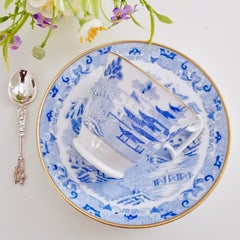
Broseley Porcelain

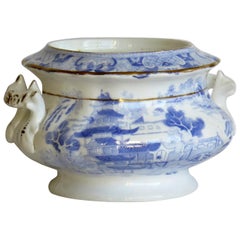
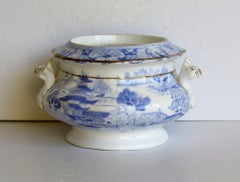
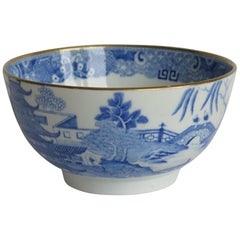
Miles Mason Porcelain Sucrier Blue and White Broseley Willow Pattern, circa 1810

Miles Mason Porcelain Sucrier Blue and White Broseley Willow Pattern, circa 1810

By Miles Mason Porcelain

Located in Lincoln, Lincolnshire

This is a porcelain blue and white, hand gilded Sucrier (Sugar Bowl) in the Broseley printed pattern made by Miles Mason (Mason's), Staffordshire Potteries, in the early 19th century...

Category

Antique Early 19th Century English Chinoiserie Ceramics

Materials

Porcelain

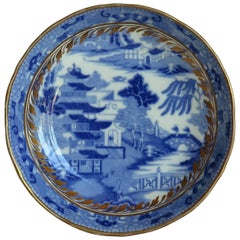
Miles Mason Porcelain Saucer Dish Blue and White Gilded Broseley Pattern Ca 1805

Miles Mason Porcelain Saucer Dish Blue and White Gilded Broseley Pattern Ca 1805

By Miles Mason Porcelain

Located in Lincoln, Lincolnshire

It is decorated in the under-glaze blue printed Pagoda or Broseley, chinoiserie Willow pattern, ( sometimes called Boy at the Door pattern).

Category

Antique Early 19th Century English Chinoiserie Ceramics

Materials

Porcelain

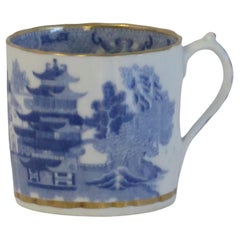
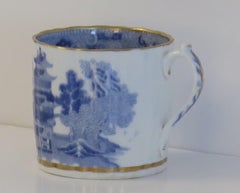
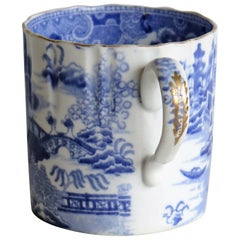
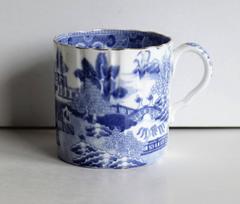
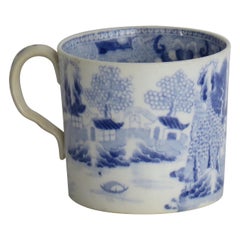
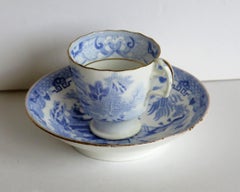
Miles Mason Porcelain Coffee Can Blue & White Broseley Gilded Ptn 50, circa 1808

Miles Mason Porcelain Coffee Can Blue & White Broseley Gilded Ptn 50, circa 1808

By Miles Mason Porcelain

Located in Lincoln, Lincolnshire

This is a porcelain blue and white, gilded Coffee Can made by Miles Mason (Mason's), Staffordshire Potteries, in the early 19th century George 111rd period, circa 1805-1810.

Category

Antique Early 19th Century English Chinoiserie Ceramics

Materials

Porcelain

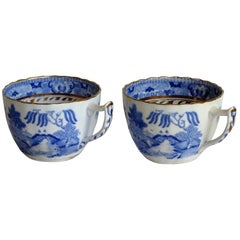
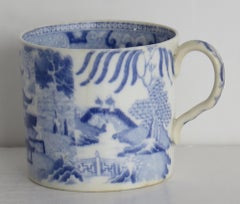
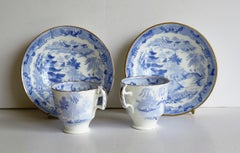
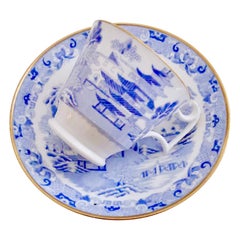
Miles Mason Porcelain PAIR of Tea Cups Broseley Blue and White Pattern, Ca. 1805

Miles Mason Porcelain PAIR of Tea Cups Broseley Blue and White Pattern, Ca. 1805

By Miles Mason Porcelain

Located in Lincoln, Lincolnshire

These are pair of porcelain blue and white, hand gilded tea cups made by Miles Mason (Mason's), Staffordshire Potteries, England around the turn of the 18th century, circa 1805.

Category

Antique Early 19th Century English Chinoiserie Ceramics

Materials

Porcelain

Recent Sales

Early Spode Porcelain Coffee Can Fluted Broseley Pattern, circa 1810

Early Spode Porcelain Coffee Can Fluted Broseley Pattern, circa 1810

By Spode

Located in Lincoln, Lincolnshire

This is a very good Spode coffee can from the factory of Josiah Spode, Stoke on Trent, Staffordshire, England, made very early in the 19th century, George 111 period. The coffee can...

Category

Antique Early 19th Century English Chinoiserie Porcelain

Materials

Porcelain

Early S & J Rathbone Porcelain Coffee Can Broseley Pattern, circa 1805

Early S & J Rathbone Porcelain Coffee Can Broseley Pattern, circa 1805

By Rathbone

Located in Lincoln, Lincolnshire

This is a good porcelain coffee can from the factory of S & J Rathbone, with a transfer printed Blue & White Broseley pattern, made very early in the 19th century, George 111 period,...

Category

Antique Early 19th Century English Chinoiserie Porcelain

Materials

Porcelain

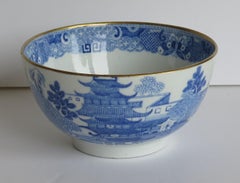
Miles Mason Porcelain Bowl Blue and White Broseley Pattern, English, circa 1805

Miles Mason Porcelain Bowl Blue and White Broseley Pattern, English, circa 1805

By Miles Mason Porcelain

Located in Lincoln, Lincolnshire

This is a porcelain bowl made by Miles Mason (Mason's), Staffordshire Potteries, England around the turn of the 18th century, circa 1805.

Category

Antique Early 19th Century English Chinoiserie Ceramics

Materials

Porcelain

Miles Mason Porcelain Cup and Saucer Blue Broseley Willow Pattern, circa 1815

Miles Mason Porcelain Cup and Saucer Blue Broseley Willow Pattern, circa 1815

By Miles Mason Porcelain

Located in Lincoln, Lincolnshire

This is a porcelain blue and white, hand gilded coffee cup and saucer made by Miles Mason (Mason's), Staffordshire Potteries, in the early 19th century, circa 1812-1820.

Category

Antique Early 19th Century English Chinoiserie Ceramics

Materials

Porcelain

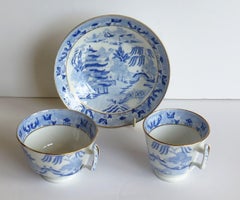
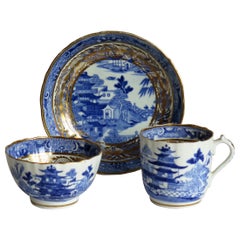
Miles Mason Porcelain Trio Blue and White Broseley Willow Pattern, circa 1815

Miles Mason Porcelain Trio Blue and White Broseley Willow Pattern, circa 1815

By Miles Mason Porcelain

Located in Lincoln, Lincolnshire

All pieces are decorated in the under-glaze blue printed Pagoda or Broseley, chinoiserie Willow pattern, ( sometimes called Boy at the Door pattern).

Category

Antique Early 19th Century English Chinoiserie Ceramics

Materials

Porcelain

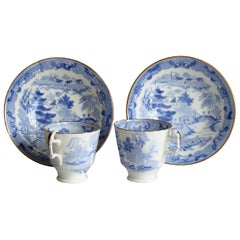
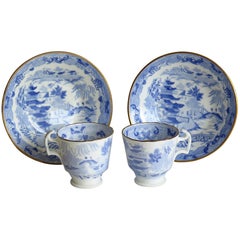
Miles Mason Porcelain Pair of Cups & Saucers Blue Broseley Willow Ptn circa 1815

Miles Mason Porcelain Pair of Cups & Saucers Blue Broseley Willow Ptn circa 1815

By Miles Mason Porcelain

Located in Lincoln, Lincolnshire

This is a porcelain blue and white, hand gilded pair of coffee cups and saucers made by Miles Mason (Mason's), Staffordshire Potteries, in the early 19th century, circa 1812-1820.

Category

Antique Early 19th Century English Chinoiserie Ceramics

Materials

Porcelain

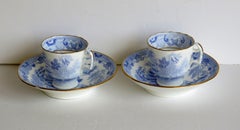
Miles Mason Porcelain Pair of Cups & Saucers Blue Broseley Willow Ptn circa 1815

Miles Mason Porcelain Pair of Cups & Saucers Blue Broseley Willow Ptn circa 1815

By Miles Mason Porcelain

Located in Lincoln, Lincolnshire

This is a porcelain blue and white, hand gilded pair of coffee cups and saucers made by Miles Mason (Mason's), Staffordshire Potteries, in the early 19th century, circa 1812-1820.

Category

Antique Early 19th Century English Chinoiserie Ceramics

Materials

Porcelain

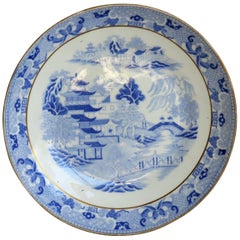
Miles Mason Porcelain Plate or Dish Blue & White Gilded Broseley Ptn, circa 1810

Miles Mason Porcelain Plate or Dish Blue & White Gilded Broseley Ptn, circa 1810

By Miles Mason Porcelain

Located in Lincoln, Lincolnshire

This is a porcelain blue and white, hand gilded plate or dish made by Miles Mason (Mason's), Staffordshire Potteries, England, dating to circa 1810.

Category

Antique Early 19th Century English Chinoiserie Ceramics

Materials

Porcelain

Miles Mason Porcelain Saucer Dish Blue and White Gilded Broseley Pattern Ca 1805

Miles Mason Porcelain Saucer Dish Blue and White Gilded Broseley Pattern Ca 1805

By Miles Mason Porcelain

Located in Lincoln, Lincolnshire

It is decorated in the under-glaze blue printed Pagoda or Broseley, chinoiserie Willow pattern, ( sometimes called Boy at the Door pattern).

Category

Antique Early 19th Century English Chinoiserie Ceramics

Materials

Porcelain

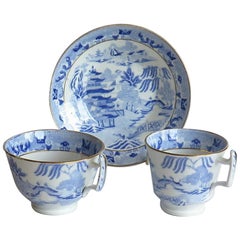
Miles Mason Porcelain Trio Blue and White Broseley Gilded Willow Ptn 50, Ca 1808

Miles Mason Porcelain Trio Blue and White Broseley Gilded Willow Ptn 50, Ca 1808

By Miles Mason Porcelain

Located in Lincoln, Lincolnshire

All pieces are decorated in the under-glaze blue printed Pagoda or Broseley, chinoiserie Willow pattern, (sometimes called Boy at the Door pattern).

Category

Antique Early 19th Century English Chinoiserie Ceramics

Materials

Porcelain

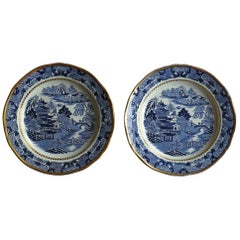
Early Pair of Davenport Ironstone Plates Blue and White Broseley Ptn, circa 1815

Early Pair of Davenport Ironstone Plates Blue and White Broseley Ptn, circa 1815

By Davenport Porcelain

Located in Lincoln, Lincolnshire

Both plates are decorated in the cobalt blue transfer printed Broseley Willow pattern with a Fitzhugh border and additional hand gilded highlighting to the outer and inner rim.

Category

Antique Early 19th Century English Georgian Ceramics

Materials

Ironstone

Spode Coffee Cup, Broseley Pattern Pagoda, 1818-1825

Spode Coffee Cup, Broseley Pattern Pagoda, 1818-1825

By Spode

Located in London, GB

The decoration on the cup is a delicate transfer print in light ultramarine blue with the "Broseley" pattern, a famous version of the widely used Pagoda or Temple pattern.

Category

Antique 1820s English Regency Tea Sets

Materials

Porcelain

Get Updated with New Arrivals
Save "Broseley Porcelain", and we’ll notify you when there are new listings in this category.

A Close Look at Chinoiserie Furniture

Emerging in the 17th century, chinoiserie appropriated the aesthetics and imagery of popular East Asian design for European-made versions. Reflecting the exoticization of China, Japan and other countries in this era, the word directly translates from French to “Chinese-esque,” which reveals its shortcomings as a style of furniture and decor that often stereotypically and reductively mimics Asian culture rather than showcasing and paying tribute to its artistic traditions.

The enthusiastically decorative chinoiserie style was propelled by influential tastemakers including French King Louis XIV, whose Trianon de Porcelaine in 1670 was inspired by Chinese architecture. Expanded trade between the East and West led to a demand for porcelain, lacquer objects, silk and other goods, which further informed the fanciful furniture being crafted in Europe.

Artisans working in the chinoiserie style used materials and elements like pagoda shapes, bamboo, lacquer surfaces, bird and flower motifs and other interpretations of Asian design on pieces that were frequently set against vibrant wallcoverings. This whimsical approach yielded chinoiserie furniture that boasted dramatic flourishes drawing on the natural world and reflected the dominance of Rococo during the 18th century.

As chinoiserie was shaped by approximations of Asian design by European creators, it had regional variations, such as Chinese Chippendale in England where cabinets, chairs and tea tables had wooden fretwork designs and “japanned” surfaces intended to resemble lacquer work that was created in East Asia. In North America, furniture makers in Boston and New York integrated chinoiserie-painted scenes into Queen Anne furniture.

Antique chinoiserie furniture has continued to be fashionable, from its popularity with decorators of the Hollywood Regency era — James Mont, Tommi Parzinger, William Haines and Samuel Marx favored the style — to contemporary interior designers, although it brings with it a complex history.

Find a collection of chinoiserie bedroom furniture, cabinets, decorative objects and more on 1stDibs.

Finding the Right Ceramics for You

Whether you’re adding an eye-catching mid-century modern glazed stoneware bowl to your dining table or grouping a collection of decorative plates by color for the shelving in your living room, decorating and entertaining with antique and vintage ceramics is a great way to introduce provocative pops of colors and textures to a space or family meals.

Ceramics, which includes pottery such as earthenware and stoneware, has had meaningful functional value in civilizations all over the world for thousands of years. When people began to populate permanent settlements during the Neolithic era, which saw the rapid growth of agriculture and farming, clay-based ceramics were fired in underground kilns and played a greater role as important containers for dry goods, water, art objects and more.

Today, if an Art Deco floor vase, adorned in bright polychrome glazed colors with flowers and geometric patterns, isn’t your speed, maybe minimalist ceramics can help you design a room that’s both timeless and of the moment. Mixing and matching can invite conversation and bring spirited contrasts to your outdoor dining area. The natural-world details enameled on an Art Nouveau vase might pair well with the sleek simplicity of a modern serving bowl, for example.

In your kitchen, your cabinets are likely filled with ceramic dinner plates. You’re probably serving daily meals on stoneware dishes or durable sets of porcelain or bone china, while decorative ceramic dishes may be on display in your dining room. Perhaps you’ve anchored a group of smaller pottery pieces on your mantelpiece with some taller vases and vessels, or a console table in your living room is home to an earthenware bowl with a decorative seasonal collection of leaves, greenery and acorns.

Regardless of your tastes, however, it’s possible that ceramics are already in use all over your home and outdoor space. If not, why? Whatever your needs may be, find a wide range of antique and vintage ceramics on 1stDibs.