Gustavo Montoya for sale on 1stDibs
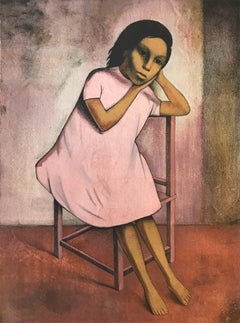
Gustavo Montoya was born in Mexico City on July 9, 1905. At the age of 13 he studied painting at the Academia de San Carlos. Some of his teachers were: German Gedovius, Roberto Montenegro, Leandro Izaguirre, Francisco de la Torre, Mateo Herrera and Juan de Mata Pacheco, among others. He stated that the school had only taught him the technique of art, but not the spirit of it and therefore he considered himself a self-taught artist.
He married his first wife, Luz Saavedra. In 1929 he traveled to Los Angeles, California, where he worked illustrating posters at the West Coast Theaters Co. The couple had a daughter, Rosa Elena Montoya Saavedra. The marriage did not last long, and Gustavo Montoya returned to Mexico in 1933. In 1936 he entered the Escuela Nacional de Artes Plásticas (National School of Visual Arts) as teacher of the color class.
He married a second time to the painter Cordelia Urueta, with whom he moved to Paris in 1938 to study European avant-garde art. He visited museums, galleries, and painters' studios. He toured Switzerland, Italy and England. In 1939, due to the Second World War, Montoya and his wife were forced to leave for New York where they remained for several years. Exhibited at the Alma Reed Gallery.
When they returned to Mexico in 1942, Gustavo Montoya joined the Mexican neo-realist school movement. In 1953 he entered again as a teacher at the Escuela Nacional de Artes Plásticas.
In 1965 Gustavo Montoya and Cordelia Urueta divorced after 26 years of marriage. He was lonely and did not engage in artistic circles. He was a founding member of the League of Revolutionary Writers and Artists along with Cordelia Urueta and others. Also, he was a founding member of the Salón de la Plástica Mexicana.
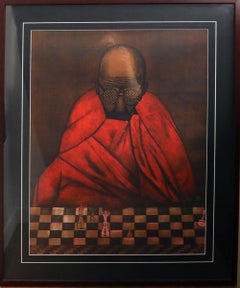
He spent most of his professional career depicting the streets of Mexico and its inhabitants. He painted still lifes, street scenes, churches, children, women, and markets in Mexico. Montoya preferred to paint the poor and working class, considering them the most authentic class in Mexico City. He liked to do his work in series around one main idea. Some of his series were: The streets of Mexico, Mexican still lifes, Mexican children, Dreams, Walls, Chess, Allegory of transformation, among others.
Gustavo Montoya died on July 12, 2003 in Mexico City, at the age of 98 years.
A Close Look at Contemporary Art
Used to refer to a time rather than an aesthetic, Contemporary art generally describes pieces created after 1970 or being made by living artists anywhere in the world. This immediacy means it encompasses art responding to the present moment through diverse subjects, media and themes. Contemporary painting, sculpture, photography, performance, digital art, video and more frequently includes work that is attempting to reshape current ideas about what art can be, from Felix Gonzalez-Torres’s use of candy to memorialize a lover he lost to AIDS-related complications to Jenny Holzer’s ongoing “Truisms,” a Conceptual series that sees provocative messages printed on billboards, T-shirts, benches and other public places that exist outside of formal exhibitions and the conventional “white cube” of galleries.
Contemporary art has been pushing the boundaries of creative expression for years. Its disruption of the traditional concepts of art are often aiming to engage viewers in complex questions about identity, society and culture. In the latter part of the 20th century, contemporary movements included Land art, in which artists like Robert Smithson and Michael Heizer create large-scale, site-specific sculptures, installations and other works in soil and bodies of water; Sound art, with artists such as Christian Marclay and Susan Philipsz centering art on sonic experiences; and New Media art, in which mass media and digital culture inform the work of artists such as Nam June Paik and Rafaël Rozendaal.
The first decades of the 21st century have seen the growth of Contemporary African art, the revival of figurative painting, the emergence of street art and the rise of NFTs, unique digital artworks that are powered by blockchain technology.
Major Contemporary artists practicing now include Ai Weiwei, Cecily Brown, David Hockney, Yayoi Kusama, Jeff Koons, Takashi Murakami and Kara Walker.
Find a collection of Contemporary prints, photography, paintings, sculptures and other art on 1stDibs.
Finding the Right Figurative-prints-works-on-paper for You
Bring energy and an array of welcome colors and textures into your space by decorating with figurative fine-art prints and works on paper.
Figurative art stands in contrast to abstract art, which is more expressive than representational. The oldest-known work of figurative art is a figurative painting — specifically, a rock painting of an animal made over 40,000 years ago in Borneo. This remnant of a remote past has long faded, but its depiction of a cattle-like creature in elegant ocher markings endures.
Since then, figurative art has evolved significantly as it continues to represent the world, including a breadth of works on paper, including printmaking. This includes woodcuts, which are a type of relief print with perennial popularity among collectors. The artist carves into a block and applies ink to the raised surface, which is then pressed onto paper. There are also planographic prints, which use metal plates, stones or other flat surfaces as their base. The artist will often draw on the surface with grease crayon and then apply ink to those markings. Lithographs are a common version of planographic prints.
Figurative art printmaking was especially popular during the height of the Pop art movement, and this kind of work can be seen in artist Andy Warhol’s extensive use of photographic silkscreen printing. Everyday objects, logos and scenes were given a unique twist, whether in the style of a comic strip or in the use of neon colors.
Explore an impressive collection of figurative art prints for sale on 1stDibs and read about how to arrange your wall art.