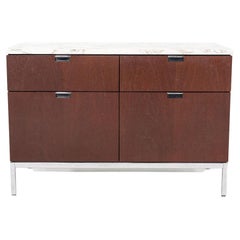
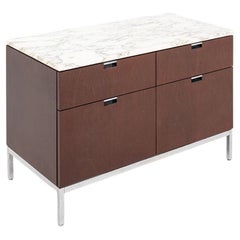
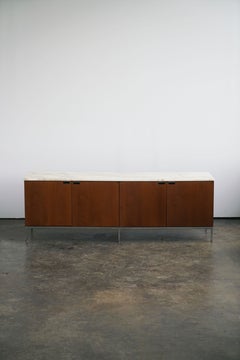
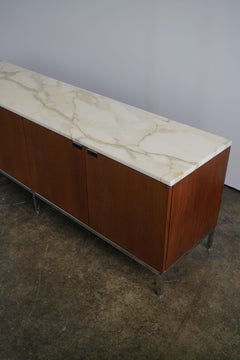
Architect, furniture designer, interior designer, entrepreneur — Florence Knoll had a subtle but profound influence on the course of mid-century American modernism. Dedicated to functionality and organization, and never flamboyant, Knoll shaped the ethos of the postwar business world with her skillfully realized office plans and polished, efficient designs for sofas, credenzas, desks and other furnishings.
Knoll had perhaps the most thorough design education of any of her peers. Florence Schust was orphaned at age 12, and her guardian sent her to Kingswood, a girl’s boarding school that is part of the Cranbrook Educational Community in suburban Detroit. Her interest in design brought her to the attention of Eliel Saarinen, the Finnish architect and head of the Cranbrook Academy of Art.
Saarinen and his wife took the talented child under their wing, and she became close to their son, the future architect Eero Saarinen. While a student at the academy, Florence befriended artist-designer Harry Bertoia and Charles and Ray Eames. Later, she studied under three of the Bauhaus masters who emigrated to the United States. She worked as an apprentice in the Boston architectural offices of Walter Gropius and Marcel Breuer; Ludwig Mies van der Rohe taught her at the Illinois Institute of Technology.
In 1941, she met Hans Knoll, whose eponymous furniture company was just getting off the ground. They married in 1946, and her design sense and his business skills soon made Knoll Inc. a leading firm in its field. Florence signed up the younger Saarinen as a designer, and would develop pieces by Bertoia, Mies and the artist Isamu Noguchi.
Florence Knoll's main work came as head of the Knoll Planning Group, designing custom office interiors for clients such as IBM and CBS. The furniture she created for these spaces reflects her Bauhaus training: the pieces are pure functional design, exactingly built; their only ornament from the materials, such as wood and marble. Her innovations — the oval conference table, for example, conceived as a way to ensure clear sightlines among all seated at a meeting — were always in the service of practicality.
Since her retirement in 1965, Knoll received the National Medal of Arts, among other awards; in 2004 the Philadelphia Museum of Art mounted the exhibition “Florence Knoll: Defining Modern” — well deserved accolades for a strong, successful design and business pioneer. As demonstrated on these pages, the simplicity of Knoll’s furniture is her work’s great virtue: they fit into any interior design scheme.
Find vintage Florence Knoll sofas, benches, armchairs and other furniture on 1stDibs.
Mid-century modern credenzas descend from the Renaissance-era sideboard, once used to serve and store food and dishware. The clean-lined, low-profile version prized today emerged from Italian and Scandinavian design in the mid-20th century, defined by tapered legs and warm walnut or teak veneers.
Styles to Know
Mid-century modern credenzas are one of the most searched storage silhouettes on 1stDibs. Sliding-door and open-shelf configurations serve different needs: books and displayed objects suit open shelving, while electronics and linens are better behind doors. A matching mid-century modern dresser extends the look to the bedroom, or an apothecary cabinet offers more drawer storage in a smaller footprint.
How to Choose the Right Vintage Credenza
Hardware and veneer condition vary considerably from piece to piece, so listing photographs deserve a close look; our guide to case pieces covers what else to look for in construction. Every credenza comes from a vetted 1stDibs seller, with era, designer and condition on record, and the 1stDibs Promise stands behind every purchase.