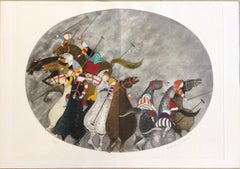
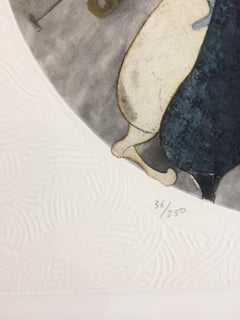
Polo I
By Graciela Rodo Boulanger
Located in Boston, MA
animals, G. Rodo Boulanger is in some of the best Museum collections worldwide. A master of etching
Category
2010s Contemporary Animal Prints
Materials
Etching, Aquatint
Polo I
By Graciela Rodo Boulanger
Located in Boston, MA
animals, G. Rodo Boulanger is in some of the best Museum collections worldwide. A master of etching
Etching, Aquatint
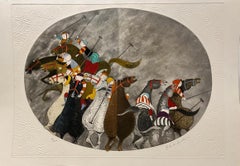
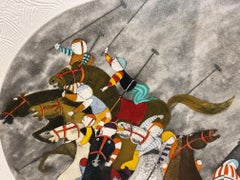
Polo I
By Graciela Rodo Boulanger
Located in Boston, MA
1961. There are few intaglios remaining. So this Polo 1 is a rare find. G. Rodo Boulanger’s work has
Etching, Intaglio
Graciela Rodo Boulanger was born in 1935 in La Paz, Bolivia. From an early age, she was surrounded by art and music due in part to her mother being a concert pianist and her father an art connoisseur. By the age of 17, she had studied both in Chile and Vienna and had exhibited paintings and given piano recitals in over five countries. At 22 she made the difficult decision to abandon her musical studies in order to devote all of her time and energy to painting and making prints.
In 1960, Boulanger held an exhibition in Argentina where she became one of the winners of the First Latin American Xylography Competition. (Xylography is a form of woodblock printmaking.) After viewing an etching by Johnny Friedlaender, she moved to Paris in 1961 where she studied under the renowned artist. During this time, she was able to improve upon her style and technique as well as gain worldwide recognition for her oil paintings, etchings and lithographs.
In 1966, Boulanger first exhibited in the United States and began to publish editions of her engravings. Within two short years, she had established her own etching studio.
In 1979, Boulanger was designated by UNICEF as the official artist for the "International Year of the Child" poster. The Metropolitan Opera of New York commissioned Boulanger's poster for their performance of Mozart's The Magic Flute in 1986. The World Federation of the UN Associations chose one of Boulanger’s paintings in 1993 to use on a stamp and as a limited-edition print. The proceeds benefitted the preservation of endangered species.
In 2005, Boulanger left Paris and moved back to her home in La Paz, Bolivia, where her daughter Sandra and her grandchildren have been a constant source of inspiration for her art.
Today Boulanger’s work, which is known worldwide for the artist’s stylized treatment of the continuous theme of children, can be seen in museums such as La Bibliotheque Nationale in Paris, the Modern Art Center in Zurich and the Museum of Modern Art of Latin America. Boulanger has participated in more than 150 exhibitions on all five continents.
Find original Graciela Rodo Boulanger prints and other art for sale on 1stDibs.
(Biography provided by R Alexander Fine Art)
Decorating with fine art prints — whether they’re figurative prints, abstract prints or another variety — has always been a practical way of bringing a space to life as well as bringing works by an artist you love into your home.
Pursued in the 1960s and ’70s, largely by Pop artists drawn to its associations with mass production, advertising, packaging and seriality, as well as those challenging the primacy of the Abstract Expressionist brushstroke, printmaking was embraced in the 1980s by painters and conceptual artists ranging from David Salle and Elizabeth Murray to Adrian Piper and Sherrie Levine.
Printmaking is the transfer of an image from one surface to another. An artist takes a material like stone, metal, wood or wax, carves, incises, draws or otherwise marks it with an image, inks or paints it and then transfers the image to a piece of paper or other material.
Fine art prints are frequently confused with their more commercial counterparts. After all, our closest connection to the printed image is through mass-produced newspapers, magazines and books, and many people don’t realize that even though prints are editions, they start with an original image created by an artist with the intent of reproducing it in a small batch. Fine art prints are created in strictly limited editions — 20 or 30 or maybe 50 — and are always based on an image created specifically to be made into an edition.
Many people think of revered Dutch artist Rembrandt as a painter but may not know that he was a printmaker as well. His prints have been preserved in time along with the work of other celebrated printmakers such as Pablo Picasso, Salvador Dalí and Andy Warhol. These fine art prints are still highly sought after by collectors.
“It’s another tool in the artist’s toolbox, just like painting or sculpture or anything else that an artist uses in the service of mark making or expressing him- or herself,” says International Fine Print Dealers Association (IFPDA) vice president Betsy Senior, of New York’s Betsy Senior Fine Art, Inc.
Because artist’s editions tend to be more affordable and available than his or her unique works, they’re more accessible and can be a great opportunity to bring a variety of colors, textures and shapes into a space.
For tight corners, select small fine art prints as opposed to the oversized bold piece you’ll hang as a focal point in the dining area. But be careful not to choose something that is too big for your space. And feel free to lean into it if need be — not every work needs picture-hanging hooks. Leaning a larger fine art print against the wall behind a bookcase can add a stylish installation-type dynamic to your living room. (Read more about how to arrange wall art here.)
Find fine art prints for sale on 1stDibs today.