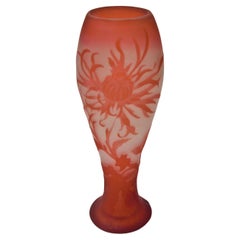
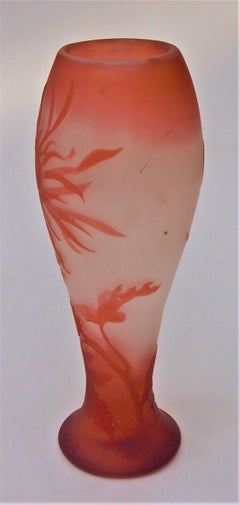
Galle Vase Iris

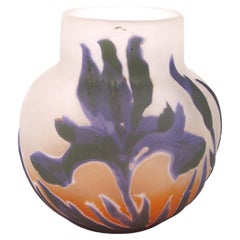
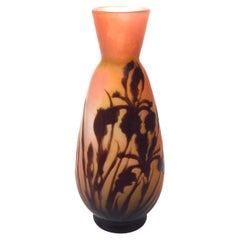
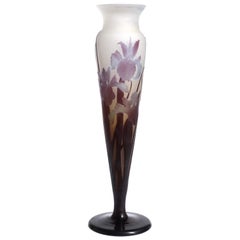
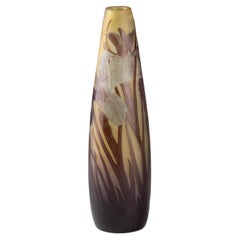
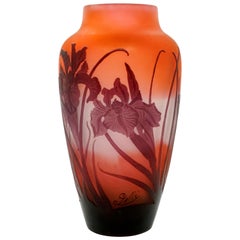
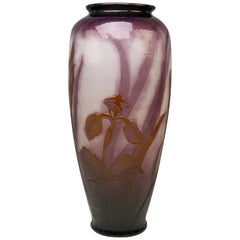
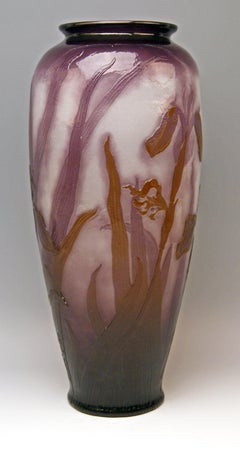
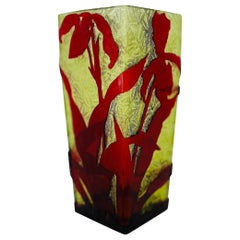
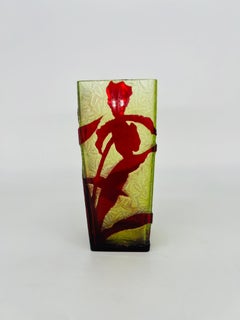
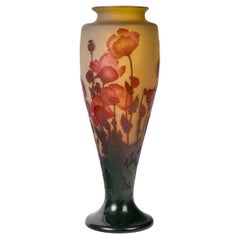
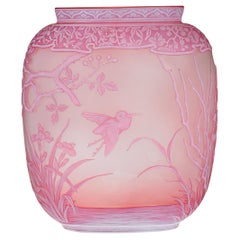
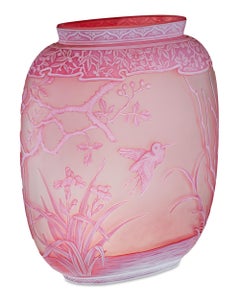
ÉMILE GALLÉ 'Iris' Vase, circa 1900 overlaid cameo and fire polished glass
By Émile Gallé
Located in Tel Aviv - Jaffa, IL
ÉMILE GALLÉ (1846-1904) Rare and important 'Iris' Vase, circa 1900 Overlaid cameo and fire polished
Category

Early 20th Century French Art Nouveau Vases

Materials

Art Glass, Blown Glass, Cut Glass

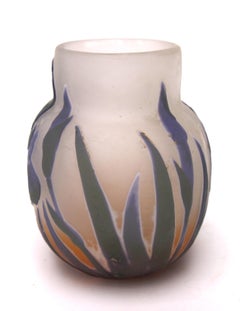
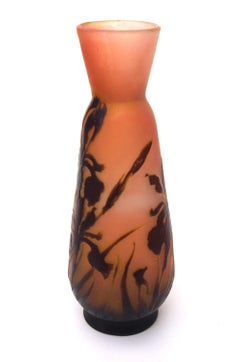
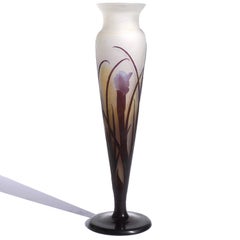
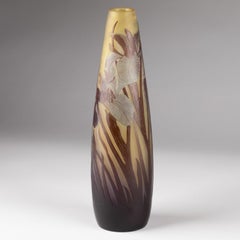
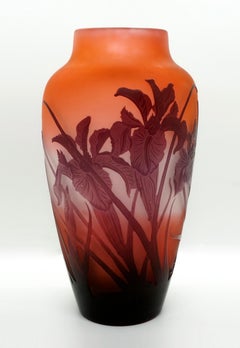
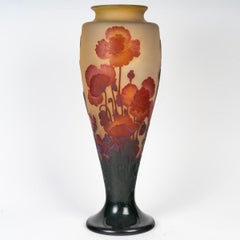
Rare French Art Nouveau 4 colour Emile Galle Cameo Glass Vase -With Irises c1908
By Émile Gallé
Located in Worcester Park, GB
Rare four colour Emile Galle cameo vase in green, purple and opaque white over bright orange
Category

Antique Early 1900s French Art Nouveau Glass

Materials

Art Glass

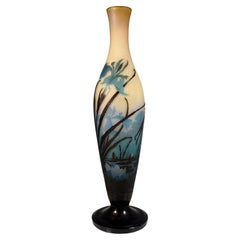
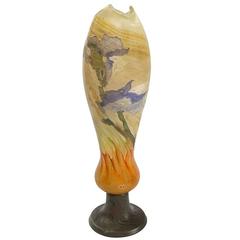
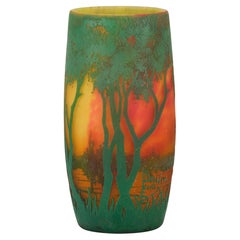
Large Émile Gallé Art Nouveau Cameo Vase, Iris And Lily Pond, France, ca. 1906
By Émile Gallé
Located in Vienna, AT
Slender baluster-shaped vase body on a separate base, widening conically towards the top and then
Category

Antique Early 1900s French Art Nouveau Glass

Materials

Glass

French Art Nouveau Brown & Pink Signed Emile Gallé Iris Cameo Glass Vase c1910
By Paul Nicolas, Émile Gallé
Located in Worcester Park, GB
French Art Nouveau Emile Gallé tall cameo vase depicting blooming Irises in brown and green over
Category

Vintage 1910s French Art Nouveau Glass

Materials

Art Glass

Recent Sales

Emile Galle Tall Blue Iris Vase
By Émile Gallé
Located in Dallas, TX
Emile Gallé Iris a double overlay cameo glass vase, circa 1900 overlaid and acid-etched with
Category

Antique Early 1900s French Art Nouveau Vases

Materials

Art Glass

Emile Galle Cameo Art Nouveau Iris Vase
By Émile Gallé
Located in Dallas, TX
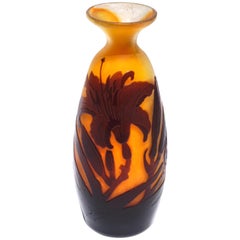
A wonderful Emile Galle cabinet vase in orange, yellows and purple wheel carved and acid etched
Category

Antique Early 1900s French Art Nouveau Vases

Materials

Art Glass

Iris Vases by Emile Gallé, Art Nouveau, Early 20th Century.
By Émile Gallé
Located in Saint-Ouen, FR
Iris vases by Emile Gallé, Art Nouveau, early 20th century. Vases by Emile Gallé, iris decoration
Category

Early 20th Century French Art Nouveau Vases

Materials

Glass

French Art Nouveau “Iris” Cameo Glass Vase by Emile Gallé
By Émile Gallé
Located in New York, NY
A French Art Nouveau “Flambé d’Eau” glass marquetry vase by Emile Gallé. This extremely rare vase
Category

Antique 1890s French Art Nouveau Vases

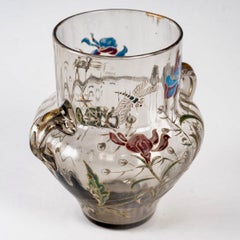
1880 Emile Gallé Cristallerie, Handled Enamel Grey Glass Vase, Irises Dragonfly
By Émile Gallé
Located in Boulogne Billancourt, FR
Vase Cristallerie "Iris" made in grey glass with enamel. Application of two handles. Design of
Category

Antique 1880s French Art Nouveau Vases

Materials

Enamel

Émile Gallé Art Nouveau Vase with Iris Decor, France, 1920-1925
By Émile Gallé
Located in Vienna, AT
decor with irises in burgundy against a milky red-white-red background. Cameo signature 'Gallé' near
Category

Early 20th Century French Art Nouveau Glass

Materials

Glass

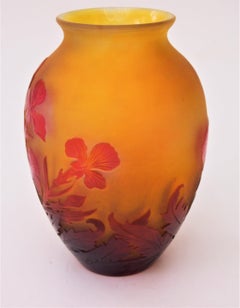
French Art Nouveau Red on Yellow Signed Emile Gallé Iris Cameo Glass Vase c1920
By Émile Gallé
Located in Worcester Park, GB
French Art Nouveau Emile Gallé ball shaped cameo vase depicting Irises in reds over orange with a
Category

Vintage 1920s French Art Nouveau Glass

Materials

Art Glass

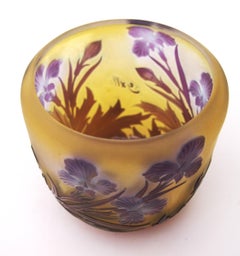
French Art Nouveau Blue On Yellow Signed Emile Gallé Iris Cameo Glass Vase c1920
By Émile Gallé
Located in Worcester Park, GB
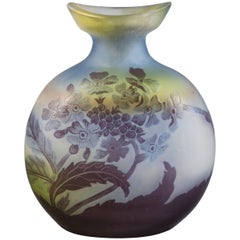
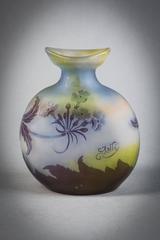
French Art Nouveau Emile Gallé small round squat shaped cameo vase depicting Irises in blues and
Category

Vintage 1920s French Art Nouveau Glass

Materials

Art Glass

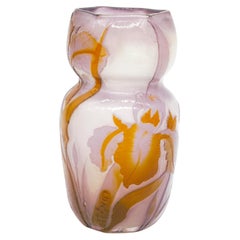
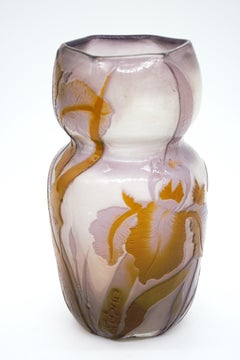
French Deco Cameo Cut Iris Vase by Galle
By Émile Gallé
Located in New York, NY
Exceptional cameo cut vase depicting light purple Iris against a deep orange background.
Category

Vintage 1930s French Vases

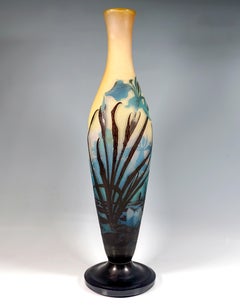
Soufflé Vase Gallé Iris Flowers Galle Nancy Art Nouveau 18.11 inches circa 1900
By Émile Gallé
Located in Vienna, AT
Gallé Nancy Art Nouveau finest tall Soufflé Vase made in France (Nancy, Lorraine) / circa 1900
Category

Antique Early 1900s French Art Nouveau Glass

Materials

Glass

People Also Browsed

Gilded Peacock Sculpture in Porcelain and Crystal
Located in Paris, FR
Sculpture gilded peacock handmade in precious porcelain one by one, feather by feather. Each feather is unique. Made with shiny porcelain, hand-painted with 24-karat gold and preciou...
Category

21st Century and Contemporary Italian Animal Sculptures

Materials

Crystal, Gold Plate, Brass

Gilded Peacock Sculpture in Porcelain and Crystal
$83,592
H 25.6 in W 25.6 in D 13.39 in
Rene Lalique Piriac Vase Designed 1930 – Marcilhac 1043
By René Lalique
Located in Tunbridge Wells, GB
Heading : Rene Lalique Piriac vase – Marcilhac 1043 Date : Designed 1930 Origin : Wingen-sur-Moder. France Bowl Features : Clear and frosted glass with moulded blue stained band of f...
Category

Early 20th Century French Art Deco Vases

Materials

Art Glass

Armoire, Bleached Oak, France, circa 1940
Located in Split, Splitsko-dalmatinska županija
Armoire, Bleached Oak, France, circa 1940 Echoing the Sculptural Language of French Provincial Modernism Sculptural in stance and restrained in detail, this tall French cabinet fro...
Category

Vintage 1940s French French Provincial Cabinets

Materials

Oak

Armoire, Bleached Oak, France, circa 1940
On Hold
$4,500
H 68.51 in W 30.71 in D 18.12 in
Sideboard in Carved Oak with Turned Legs, Spain, 1940s
Located in Split, Splitsko-dalmatinska županija
This sideboard unfolds as a wooden reliquary of Iberian heritage, its façade a dialogue of geometry and ornament. Deeply framed panels converge in architectural precision, drawing th...
Category

Vintage 1940s Spanish Spanish Colonial Sideboards

Materials

Oak

Sideboard in Carved Oak with Turned Legs, Spain, 1940s
$7,410
H 35.83 in W 60.63 in D 20.08 in
Maple Bentwood Twin Bed
By Jacob & Josef Kohn
Located in Queens, NY
Bentwood (19/20th Century) maple stained twin size bed with double scroll center design (includes: headboard, footboard, rails).(paper label: JACOB JOSEP KOHN, WEIN). (Irregular size...
Category

Antique 19th Century Austrian Vienna Secession Beds and Bed Frames

Materials

Bentwood

Maple Bentwood Twin Bed
$3,600
H 42.92 in W 36.62 in D 75.6 in
Bureau / Secretary Gustavian in Blue Painted In Pine. 18th Ctr. Swedish
Located in Kastrup, DK
Gustavian secretary crafted in pine, finished in a charming blue tone with an elegant patina. The piece is composed of two sections with refined detailing throughout. The upper cabi...
Category

Antique Early 19th Century Swedish Gustavian Secretaires

Materials

Brass

Art Deco Bedroom Set: Armoire, Bed and Mirror - France, 1920s
Located in Isle Sur La Sorgue, Vaucluse
Lovely and lively exotic bedroom set comprised of one three-door wardrobe, a double bed and a large mirror. The set is lacquered in red and black with gilt and silvered decor repr...
Category

Early 20th Century French Art Deco Bedroom Sets

Art Deco Bedroom Set: Armoire, Bed and Mirror - France, 1920s
$11,787 / set
H 72.05 in W 89.77 in D 25.99 in
Antique Ivory French Art Deco Carpet
Located in Milan, IT
An outstanding Art Deco carpet distinguished by an ivory background decorated by a large scale floral pattern drawn with intricate detail. Many Art Deco artists took patterns such as...
Category

Vintage 1920s French Art Deco Western European Rugs

Materials

Wool

Antique Ivory French Art Deco Carpet
$33,677
W 121.26 in L 165.36 in
René Lalique (1860-1945), Glass Clock "Pendulette 8 jours Cinq Hirondelles" 1920
By René Lalique
Located in Saint-Ouen, FR
René Lalique (1860-1945), Pendulette 8 jours Cinq Hirondelles,1920 René Lalique Pendulette 8 jours « Cinq Hirondelles » glass clock Also called pendulette « Vol d’Hirondelles » Whi...
Category

Vintage 1920s French Art Deco Glass

Materials

Glass

Vienna Secession J. & J. Kohn Bench No. 67
By Jacob & Josef Kohn
Located in Vienna, AT
Extremely rare, beech bentwood frame with an embossed plywood seat and backrest. First time mentioned in the J. & J. Kohn catalog 1902 with the catalog no. 67. Still in original cond...
Category

Antique Early 1900s Austrian Vienna Secession Benches

Materials

Beech, Bentwood, Plywood

Vienna Secession J. & J. Kohn Bench No. 67
$4,980
H 31.5 in W 43.31 in D 19.69 in
Buffet in Carved Oak, France, Early 20th Century
Located in Split, Splitsko-dalmatinska županija
This French buffet unfolds like a carved hymn to symmetry and craft. Its tripartite façade is marked by a rhythmic procession of concentric rosettes, each hand-carved with meditative...
Category

Early 20th Century French French Provincial Buffets

Materials

Oak

Buffet in Carved Oak, France, Early 20th Century
$7,000
H 44.1 in W 70.87 in D 21.26 in
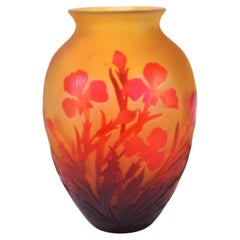
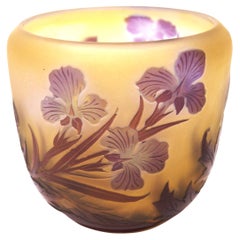
E Gallé Red and yellow glass vase
Located in SAINT-OUEN-SUR-SEINE, FR
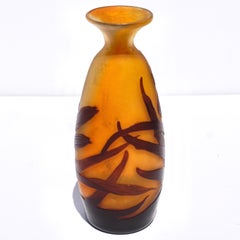
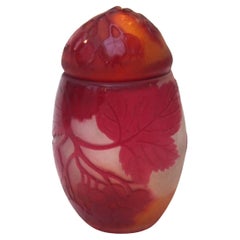
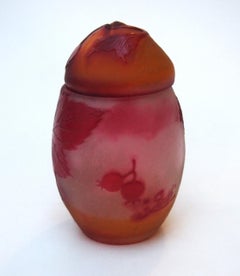
Emile Gallé Small ball-shaped vase with a flattened belly, made of multilayer glass with acid-etched decoration in shades of purple-red on a yellow background. Dimensions: 17 cm
Category

20th Century Vases

Materials

Glass

E Gallé Red and yellow glass vase
$3,909
H 7.88 in Dm 6.7 in
Buffet in Hand-Carved Oak, Spain, Early 20th Century
Located in Split, Splitsko-dalmatinska županija
A procession of geometric medallions unfurls across the façade of this Spanish buffet, its surfaces etched with deep, rhythmic carvings that oscillate between order and ornament. Eac...
Category

Early 20th Century Spanish Spanish Colonial Buffets

Materials

Oak

Buffet in Hand-Carved Oak, Spain, Early 20th Century
$7,200
H 47.45 in W 70.87 in D 25.6 in
Jacques Adnet, Ceramic Turtledove, 1920s
By Jacques Adnet
Located in CA, CA
This wonderful ceramic sculpture of a Turtledove is by the key Art Deco designer Jacques Adnet and was first shown at the pivotal 'Exposition des Arts Decoratifs et Industriels Moder...
Category

Vintage 1920s French Art Deco Animal Sculptures

Materials

Ceramic

Jacques Adnet, Ceramic Turtledove, 1920s
$1,100
H 7.5 in W 3.15 in D 7.5 in
Very Tall Gilded Iron and Marble Tulip Floor Lamps, France, circa 1950s
Located in Isle Sur La Sorgue, Vaucluse
Delightful, one-of-a-kind set of five gold-painted textured iron "tulip" floor lamps, set on round, black marble bases, veined with white. Striking and very decorative pieces.
Category

Mid-20th Century French Mid-Century Modern Floor Lamps

Materials

Marble, Iron

Elegant Crystalline Glaze Porcelain Vase, University City, Taxile Doat
By Taxile Doat
Located in Riverdale, NY
Elegant thrown porcelain vase with an expansive and vibrant aquamarine crystalline glaze on a sand colored base by master French ceramist Taxile Doat, from the University City Porcel...
Category

Vintage 1910s American Arts and Crafts Vases

Materials

Porcelain

Get Updated with New Arrivals
Save "Galle Vase Iris", and we’ll notify you when there are new listings in this category.

Galle Vase Iris For Sale on 1stDibs

With a vast inventory of beautiful furniture at 1stDibs, we’ve got just the galle vase iris you’re looking for. Frequently made of glass, art glass and metal, every galle vase iris was constructed with great care. Your living room may not be complete without a galle vase iris — find older editions for sale from the 19th Century and newer versions made as recently as the 20th Century. Each galle vase iris bearing Art Nouveau hallmarks is very popular. Many designers have produced at least one well-made galle vase iris over the years, but those crafted by Émile Gallé, Daum and Loetz Glass are often thought to be among the most beautiful.
How Much is a Galle Vase Iris?

A galle vase iris can differ in price owing to various characteristics — the average selling price 1stDibs is $3,174, while the lowest priced sells for $1,500 and the highest can go for as much as $24,500.

Émile Gallé for sale on 1stDibs

“Art for art’s sake” was a belief strongly espoused by the celebrated French designer and glassworker Émile Gallé. Through his ethereal glass vases, other vessels and lamps, which he adorned with botanical and religious motifs, Gallé advanced the Art Nouveau ideology and led the modern renaissance of French glass.

Gallé was the son of successful faience and furniture maker Charles Gallé but studied philosophy and botany before coming to glassmaking later in life. The young Gallé’s expertise in botany, however, would inform his design style and become his signature for generations to come.
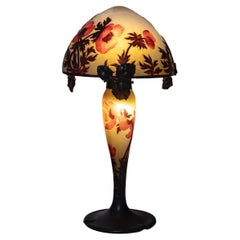
After learning the art of glassmaking, Gallé went to work at his father’s factory in Nancy. He initially created clear glass objects but later began to experiment with layering deeply colored glass.

While glassmakers on Murano had applied layers of glass and color on decorative objects before Gallé had, he was ever-venturesome in his northeastern France, taking advantage of defects that materialized during his processes and etching in natural forms like insects such as dragonflies, marine life, the sun, vines, fruits and flowers modeled from local specimens.

Gallé is also credited with reviving cameo glass, a glassware style that originated in Rome. He used cabochons, which were applied raised-glass decorations colored with metallic oxides and made to resemble rich jeweling. Gallé's cameo glass vases and vessels were widely popular at the Paris Exhibition of 1878, cementing his position as a talented designer and pioneer.

During the late 19th century, Gallé led breakthroughs in mass production and employed hundreds of artisans in his workshop.

Botany and nature remained great sources of inspiration for the artist's glassmaking — just as they had for other Art Nouveau designers. From approximately 1890 to 1910, the movement’s talented designers produced furniture, glass and architecture in the form of — or adorned with — gently intertwining trees, flowers and vines. But Gallé had many interests, such as Eastern art and ceramics. The Japanese collection he visited at the Victoria and Albert Museum in London (then the South Kensington Museum) during the 1870s had made an impression too.

Breaking free from the rigid Victorian traditions, Gallé infused new life and spirit into the art and design of his time through exquisitely crafted glass vessels and pioneering new glassworking techniques.

Find a collection of Émile Gallé vases and other furniture and decorative objects on 1stDibs.

A Close Look at Art Nouveau Furniture

In its sinuous lines and flamboyant curves inspired by the natural world, antique Art Nouveau furniture reflects a desire for freedom from the stuffy social and artistic strictures of the Victorian era. The Art Nouveau movement developed in the decorative arts in France and Britain in the early 1880s and quickly became a dominant aesthetic style in Western Europe and the United States.

ORIGINS OF ART NOUVEAU FURNITURE DESIGN

CHARACTERISTICS OF ART NOUVEAU FURNITURE DESIGN

  • Sinuous, organic and flowing lines
  • Forms that mimic flowers and plant life
  • Decorative inlays and ornate carvings of natural-world motifs such as insects and animals 
  • Use of hardwoods such as oak, mahogany and rosewood

ART NOUVEAU FURNITURE DESIGNERS TO KNOW

ANTIQUE ART NOUVEAU FURNITURE ON 1STDIBS

Art Nouveau — which spanned furniture, architecture, jewelry and graphic design — can be easily identified by its lush, flowing forms suggested by flowers and plants, as well as the lissome tendrils of sea life. Although Art Deco and Art Nouveau were both in the forefront of turn-of-the-20th-century design, they are very different styles — Art Deco is marked by bold, geometric shapes while Art Nouveau incorporates dreamlike, floral motifs. The latter’s signature motif is the "whiplash" curve — a deep, narrow, dynamic parabola that appears as an element in everything from chair arms to cabinetry and mirror frames.

The visual vocabulary of Art Nouveau was particularly influenced by the soft colors and abstract images of nature seen in Japanese art prints, which arrived in large numbers in the West after open trade was forced upon Japan in the 1860s. Impressionist artists were moved by the artistic tradition of Japanese woodblock printmaking, and Japonisme — a term used to describe the appetite for Japanese art and culture in Europe at the time — greatly informed Art Nouveau. 

The Art Nouveau style quickly reached a wide audience in Europe via advertising posters, book covers, illustrations and other work by such artists as Aubrey Beardsley, Henri de Toulouse-Lautrec and Alphonse Mucha. While all Art Nouveau designs share common formal elements, different countries and regions produced their own variants.

In Scotland, the architect Charles Rennie Mackintosh developed a singular, restrained look based on scale rather than ornament; a style best known from his narrow chairs with exceedingly tall backs, designed for Glasgow tea rooms. Meanwhile in France, Hector Guimard — whose iconic 1896 entry arches for the Paris Metro are still in use — and Louis Majorelle produced chairs, desks, bed frames and cabinets with sweeping lines and rich veneers. 

The Art Nouveau movement was known as Jugendstil ("Youth Style") in Germany, and in Austria the designers of the Vienna Secession group — notably Koloman Moser, Josef Hoffmann and Joseph Maria Olbrich — produced a relatively austere iteration of the Art Nouveau style, which mixed curving and geometric elements.

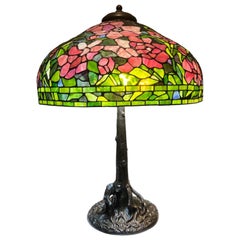
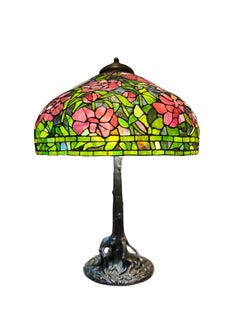
Art Nouveau revitalized all of the applied arts. Ceramists such as Ernest Chaplet and Edmond Lachenal created new forms covered in novel and rediscovered glazes that produced thick, foam-like finishes. Bold vases, bowls and lighting designs in acid-etched and marquetry cameo glass by Émile Gallé and the Daum Freres appeared in France, while in New York the glass workshop-cum-laboratory of Louis Comfort Tiffany — the core of what eventually became a multimedia decorative-arts manufactory called Tiffany Studios — brought out buoyant pieces in opalescent favrile glass. 

Jewelry design was revolutionized, as settings, for the first time, were emphasized as much as, or more than, gemstones. A favorite Art Nouveau jewelry motif was insects (think of Tiffany, in his famed Dragonflies glass lampshade).

Like a mayfly, Art Nouveau was short-lived. The sensuous, languorous style fell out of favor early in the 20th century, deemed perhaps too light and insubstantial for European tastes in the aftermath of World War I. But as the designs on 1stDibs demonstrate, Art Nouveau retains its power to fascinate and seduce.

There are ways to tastefully integrate a touch of Art Nouveau into even the most modern interior — browse an extraordinary collection of original antique Art Nouveau furniture on 1stDibs, which includes decorative objects, seating, tables, garden elements and more.