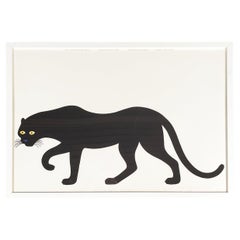
Enzo Mari was an influential industrial designer and a beloved curmudgeon who revered Marxism. His vintage mid-century modern designs are simple, functional and poetic. Widely known Mari-designed objects include desk accessories, such as the Formosa perpetual wall calendar, vases, cocktail tables and chandeliers.
Enzo Mari's work is embedded within the city of Milan, the Italian capital of all things design. In fact, the traffic bollards he devised are part of the city itself: Shaped like "panettone" cakes, they simultaneously direct traffic and provide seating for pedestrians.
In 1974, Mari published Autoprogettazione? (roughly translated as self-design), a Marx-inspired, anti-industrial, do-it-yourself handbook for the everyday person to use to build furniture without the assistance of a glitzy designer or knowledge of complex joinery. Mari’s intent with the publication was to remove the alienation of the creator and manufacturer from the end product by teaching anyone to develop a critical eye for production.
Artek relaunched kits based on the blueprints in the manual in an exhibition at Spazio Rossana Orlandi in 2010. The subsequent collectability of his work was reportedly irksome for Mari because he abhorred the industrial production for which he was becoming known.
Mari’s meager upbringing heavily influenced his politics, and even in childhood, he would come up with ingenious ways to support the family financially. As a designer, the desire to envision and build significant pieces was more important to Mari than devising new marketing and retail sales tactics. He optimistically believed objects could change the world. This view went against the rising consumer mania for every next trend that surfaced in the late 20th century. Not surprisingly, his ecological and economical stance led him to produce fewer objects.
Mari's philosophy did not stop people from desiring his creations, nor prevent other designers from wanting to collaborate with him. Following World War II, he worked for companies like Danese, Olivetti, Artemide, Driade and Alessi, who brought his prodigious designs to the public, and Mari’s work was widely celebrated.
The Golden Compass, Italy's highest honor for industrial design, was awarded to Mari four times before he died from COVID in 2020, and New York’s Museum of Modern Art has a permanent collection of his objects on display.
On 1stDibs, find a collection of Enzo Mari decorative objects, folk art and serveware.
The late 19th and early 20th centuries saw sweeping social change and major scientific advances — both of which contributed to a new aesthetic: modernism. Rejecting the rigidity of Victorian artistic conventions, modernists sought a new means of expression. References to the natural world and ornate classical embellishments gave way to the sleek simplicity of the Machine Age. Architect Philip Johnson characterized the hallmarks of modernism as “machine-like simplicity, smoothness or surface [and] avoidance of ornament.”
Early practitioners of modernist design include the De Stijl (“The Style”) group, founded in the Netherlands in 1917, and the Bauhaus School, founded two years later in Germany.
Followers of both groups produced sleek, spare designs — many of which became icons of daily life in the 20th century. The modernists rejected both natural and historical references and relied primarily on industrial materials such as metal, glass, plywood, and, later, plastics. While Bauhaus principals Marcel Breuer and Ludwig Mies van der Rohe created furniture from mass-produced, chrome-plated steel, American visionaries like Charles and Ray Eames worked in materials as novel as molded plywood and fiberglass. Today, Breuer’s Wassily chair, Mies van der Rohe’s Barcelona chair — crafted with his romantic partner, designer Lilly Reich — and the Eames lounge chair are emblems of progressive design and vintage originals are prized cornerstones of collections.
It’s difficult to overstate the influence that modernism continues to wield over designers and architects — and equally difficult to overstate how revolutionary it was when it first appeared a century ago. But because modernist furniture designs are so simple, they can blend in seamlessly with just about any type of décor. Don’t overlook them.