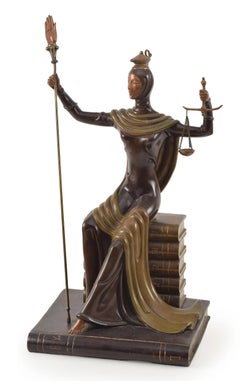
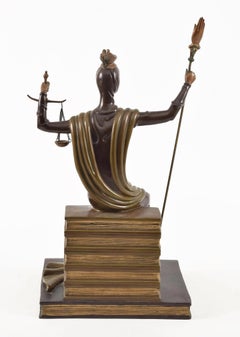
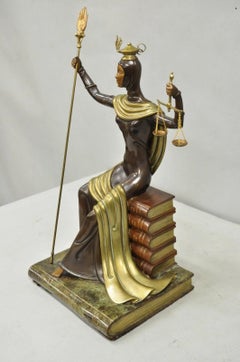
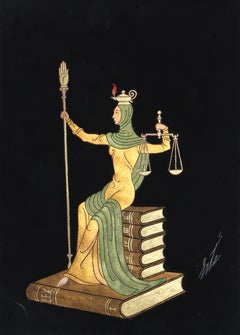
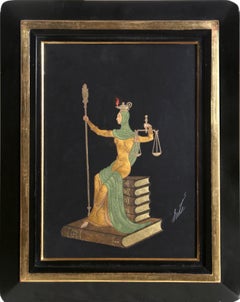
Born Romain de Tirtoff (1892–1990) in St. Petersburg, Russia, to an aristocratic family, the artist known as Erté — a pseudonym derived from the French pronunciation of his initials — was a Renaissance man of the art and design world. He worked in graphic arts, interior design, fashion, jewelry and set design for the stage and silver screen, becoming a leader of the Art Deco style.
Moving to Paris in 1912, Erté worked as a fashion designer under couturier Paul Poiret before securing a job with Harper’s Bazaar as a cover artist. Over 22 years, Erté created more than 240 magazine covers alongside his ongoing work in fashion design.
Extending his prolific career into theater sets, costumes, prints and lithographs, Erté became one of the most famous artists of the era. His style — a combination of the nature-inspired flourishes of Art Nouveau and bold, geometric linework — directly contributed to the birth of Art Deco, earning him the nickname “the Father of Art Deco.”
After a lull of creative production in the 1940s and 1950s, Erté reentered the public eye in the 1960s, when a renewed interest in Art Deco had taken shape.
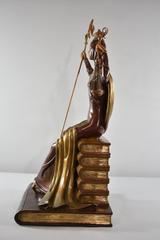
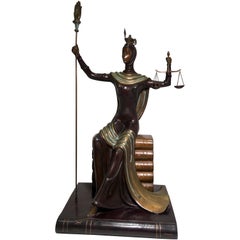
Creating colorful lithographs, bold serigraphs (silk-screen prints) and bronze sculptures, he contributed to a resurgence of the style in France and beyond. This late-life acclaim for his art led to exhibitions in museums and galleries all over the world as well as his first published monograph in 1970. That same year he was awarded the title of Chevalier du Mérite Artistique et Cultural and in 1976 was named Officier des Arts et Lettres by the French government.
Today, Erté’s works are in the collections of the Metropolitan Museum of Art and the Cooper Hewitt, Smithsonian Design Museum, in New York, the Victoria and Albert Museum in London and LACMA in Los Angeles.
On 1stDibs, browse a collection of Erté art, including fine art prints, paintings and other works.
Art Deco furniture is characterized by its celebration of modern life. More than its emphasis on natural wood grains and focus on traditional craftsmanship, vintage Art Deco dining chairs, tables, desks, cabinets and other furniture — which typically refers to pieces produced during the 1920s and 1930s — is an ode to the glamour of the “Roaring Twenties.”
ORIGINS OF ART DECO FURNITURE DESIGN
CHARACTERISTICS OF ART DECO FURNITURE DESIGN
- Bold geometric lines and forms, floral motifs
- Use of expensive materials such as shagreen or marble as well as exotic woods such as mahogany, ebony and zebra wood
- Metal accents, shimmering mirrored finishes
- Embellishments made from exotic animal hides, inlays of mother-of-pearl or ivory
ART DECO FURNITURE DESIGNERS TO KNOW
VINTAGE ART DECO FURNITURE ON 1STDIBS
Few design styles are as universally recognized and appreciated as Art Deco. The term alone conjures visions of the Roaring Twenties, Machine Age metropolises, vast ocean liners, sleek typography and Prohibition-era hedonism. The iconic movement made an indelible mark on all fields of design throughout the 1920s and ’30s, celebrating society’s growing industrialization with refined elegance and stunning craftsmanship.
Widely known designers associated with the Art Deco style include Émile-Jacques Ruhlmann, Eileen Gray, Maurice Dufrêne, Paul Follot and Jules Leleu.
The term Art Deco derives from the name of a large decorative arts exhibition held in Paris in 1925. “Art Deco design” is often used broadly, to describe the work of creators in associated or ancillary styles. This is particularly true of American Art Deco, which is also called Streamline Moderne or Machine Age design. (Streamline Moderne, sometimes known as Art Moderne, was a phenomenon largely of the 1930s, post–Art Nouveau.)
Art Deco textile designers employed dazzling floral motifs and vivid colors, and while Art Deco furniture makers respected the dark woods and modern metals with which they worked, they frequently incorporated decorative embellishments such as exotic animal hides as well as veneers in their seating, case pieces, living room sets and bedroom furniture.
From mother-of-pearl inlaid vitrines to chrome aviator chairs, bold and inventive works in the Art Deco style include chaise longues (also known as chaise lounges) and curved armchairs. Today, the style is still favored by interior designers looking to infuse a home with an air of luxury and sophistication.
The vintage Art Deco furniture for sale on 1stDibs includes dressers, coffee tables, decorative objects and more.