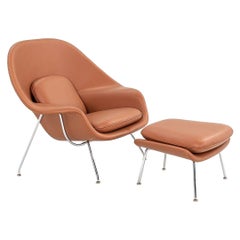
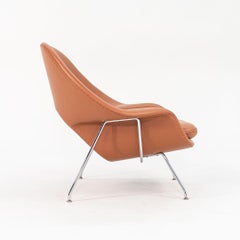
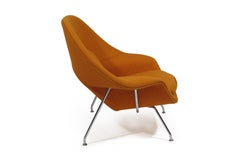
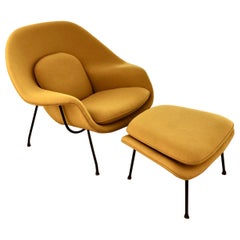
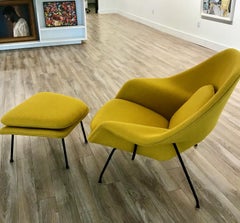
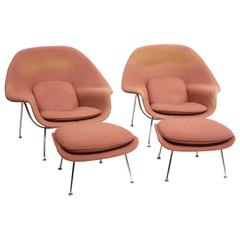
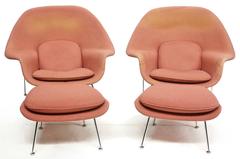
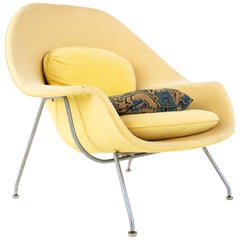
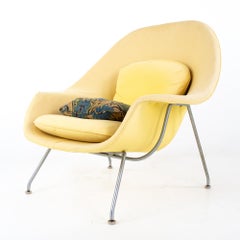
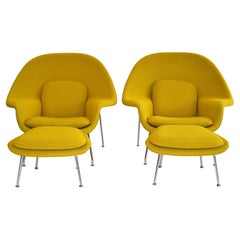
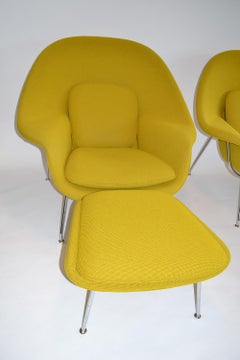
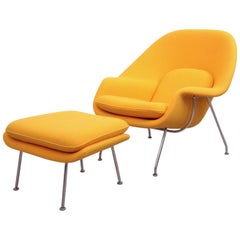
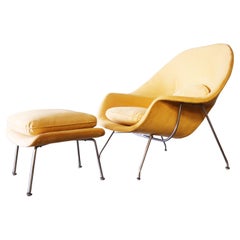
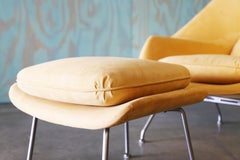
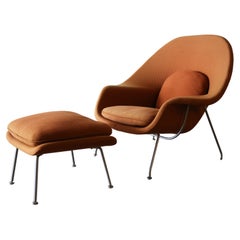
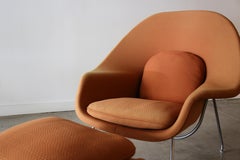
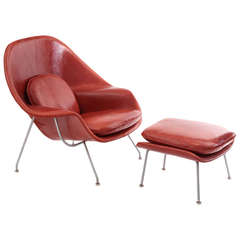
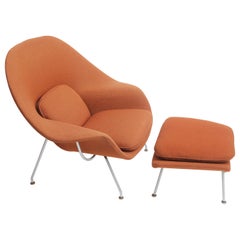
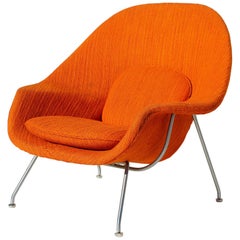
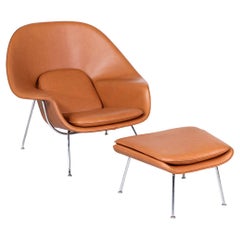
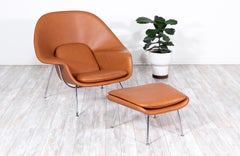
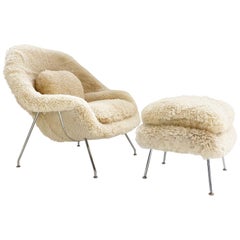
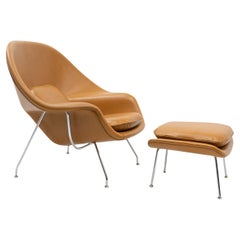
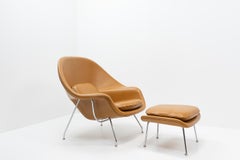
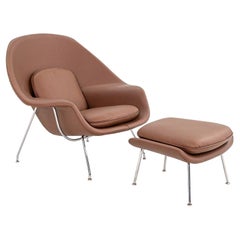
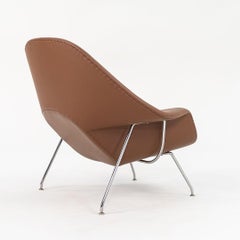
Choose from an assortment of styles, material and more with respect to the orange womb you’re looking for at 1stDibs. Each orange womb for sale was constructed with extraordinary care, often using
fabric,
metal and
steel. Whether you’re looking for an older or newer orange womb, there are earlier versions available from the 20th Century and newer variations made as recently as the 20th Century. Each orange womb bearing
Mid-Century Modern hallmarks is very popular.
Eero Saarinen and
Knoll each produced at least one beautiful orange womb that is worth considering.
Through his work as an architect and designer, Eero Saarinen was a prime mover in the introduction of modernism into the American mainstream. Particularly affecting were the organic, curvilinear forms seen in Saarinen’s furniture and his best-known structures: the gull-winged TWA Flight Center at John F. Kennedy airport in New York (opened 1962), Dulles International Airport in Virginia (1962) and the Gateway Arch in St. Louis, Missouri (1965).
Saarinen had a peerless modernist pedigree. His father, Eliel Saarinen, was an eminent Finnish architect who in 1932 became the first head of the Cranbrook Academy of Art in suburban Detroit. The school became synonymous with progressive design and decorative arts in the United States, and while studying there the younger Saarinen met and befriended several luminaries of mid-century modernism, among them Harry Bertoia and Charles and Ray Eames.
At Cranbrook, Saarinen also met Florence Schust Knoll, who, as director of her husband Hans Knoll's eponymous furniture company, would put Saarinen’s best designs into production. These include the Grasshopper chair, designed in 1946 and so named because its angled bentwood frame resembles the insect; the Tulip chair (1957), a flower-shaped fiberglass shell mounted on a cast-aluminum pedestal; and the lushly contoured Womb lounge chair and ottoman (1948). In his furniture as in his architecture, the keynotes of Eero Saarinen’s designs are simplicity, strength and grace.
Find vintage Eero Saarinen tables, chairs and other furniture on 1stDibs.
While this specific seating is known to all for its comfort and familiar form, the history of how your favorite antique or vintage lounge chair came to be is slightly more ambiguous.
Although there are rare armchairs dating back as far as the 17th century, some believe that the origins of the first official “lounge chair” are tied to Hungarian modernist designer-architect Marcel Breuer. Sure, Breuer wasn’t exactly reinventing the wheel when he introduced the Wassily lounge chair in 1925, but his seat was indeed revolutionary for its integration of bent tubular steel.
Officially, a lounge chair is simply defined as a “comfortable armchair,” which allows for the shape and material of the furnishings to be extremely diverse. Whether or not chaise longues make the cut for this category is a matter of frequent debate.
The Eames lounge chair, on the other hand, has come to define somewhat of a universal perception of what a lounge chair can be. Introduced in 1956, the Eames lounger (and its partner in cozy, the ottoman) quickly became staples in television shows, prestigious office buildings and sumptuous living rooms. Venerable American mid-century modern designers Charles and Ray Eames intended for it to be the peak of luxury, which they knew meant taking furniture to the next level of style and comfort. Their chair inspired many modern interpretations of the lounge — as well as numerous copies.
On 1stDibs, find a broad range of unique lounge chairs that includes everything from antique Victorian-era seating to vintage mid-century modern lounge chairs by craftspersons such as Hans Wegner to contemporary choices from today’s innovative designers.