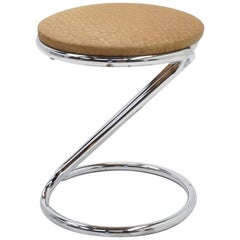
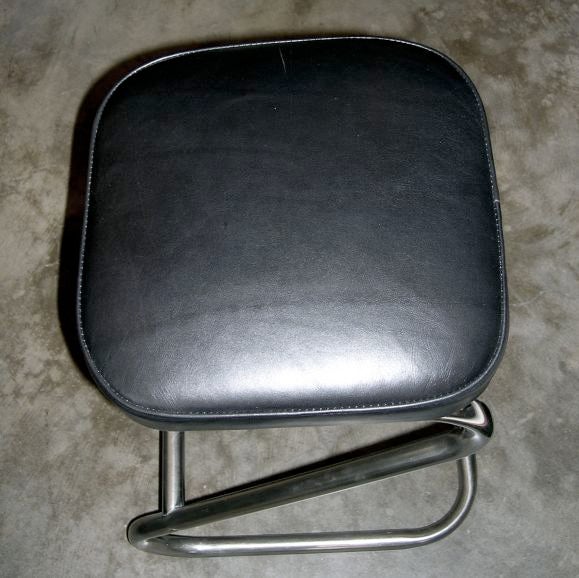
At 1stDibs, there are many versions of the ideal rare z stool for your home. Each rare z stool for sale was constructed with extraordinary care, often using
wood,
metal and
fabric. Whether you’re looking for an older or newer rare z stool, there are earlier versions available from the 18th Century and newer variations made as recently as the 21st Century. A rare z stool made by
Mid-Century Modern designers — as well as those associated with
Scandinavian Modern — is very popular. Many designers have produced at least one well-made rare z stool over the years, but those crafted by
Charlotte Perriand,
Knoll and
Nanna Ditzel are often thought to be among the most beautiful.
Pioneering self-taught industrial designer, writer and teacher Gilbert Rohde helped define the earliest phase of modernism in the United States. He is one of the most influential figures of 20th-century design and is credited with helping legendary mid-century modern furniture manufacturer Herman Miller avert financial disaster during the Great Depression.
Born in New York City, Rohde studied painting at the Art Students League after high school. He found lucrative employment, first as a political cartoonist and then as a catalog illustrator for American department stores. He was particularly enthralled with drawing furnished interiors.
Rohde began to design furniture in his spare time. He traveled to the Bauhaus school in Germany and the International Exhibition of Modern Decorative and Industrial Arts in Paris, and drew on the Art Deco movement and the work of designers such as Émile-Jacques Ruhlmann in his early pieces. Rohde opened his own studio in 1929 and secured private and commercial commissions. His clients would come to include formidable furniture makers Heywood-Wakefield and Troy Sunshade, and his innovative bentwood furnishings for them were practical and intended for the modern consumer.
In 1930, Rohde met Herman Miller founder D.J. De Pree in the company’s Michigan showroom during a business trip. By then, Rohde had a long list of prominent clients and his furniture had been exhibited in museums and galleries. Herman Miller was weathering a devastating slowdown in business, and the American furniture industry had generally been hit hard by the Great Depression.
Rohde boldly informed De Pree that the brand’s furniture had become outdated, which was part of the reason the company was in financial jeopardy. Homes had become smaller and could no longer accommodate the large Gothic– and Victorian–style furnishings and traditional reproductions of period bedroom suites that Herman Miller was offering at the time, Rohde explained.
Rohde secured a contract to design for the Michigan manufacturer. He championed the use of exotic woods and tubular steel, and created streamlined, unadorned bedroom furniture for Herman Miller — collections that included convenient vanities, which were unconventional pieces for De Pree’s company back then.
In 1933, Rohde oversaw the design of two bedrooms featuring sleek Herman Miller furniture — including innovative storage pieces he designed — as part of an International–style exhibit at the 1933 Chicago World’s Fair. The installation garnered acclaim for De Pree’s brand all over the world and afforded Rohde the opportunity to execute on his visionary ideas in front of a global audience. Rohde later designed lighting, seating and more for Herman Miller and was extensively involved in the company's marketing strategy and other areas of the business.
In 1942, Herman Miller, anticipating a postwar economic boom, began to produce office furniture for the first time, but its legacy is in the home. Working with legendary designers such as Ray and Charles Eames, Isamu Noguchi and Alexander Girard, the manufacturer fostered some of the boldest expressions of what we now call mid-century modern style.
Find vintage Gilbert Rohde coffee tables, lounge chairs, table lamps and other items on 1stDibs.
Stools are versatile and a necessary addition to any living room, kitchen area or elsewhere in your home. A sofa or reliable lounge chair might nab all the credit, comfort-wise, but don’t discount the roles that good antique, new and vintage stools can play.
“Stools are jewels and statements in a space, and they can also be investment pieces,” says New York City designer Amy Lau, who adds that these seats provide an excellent choice for setting an interior’s general tone.
Stools, which are among the oldest forms of wooden furnishings, may also serve as decorative pieces, even if we’re talking about a stool that is far less sculptural than the gracefully curving molded plywood shells that make up Sōri Yanagi’s provocative Butterfly stool.
Fawn Galli, a New York interior designer, uses her stools in the same way you would use a throw pillow. “I normally buy several styles and move them around the home where needed,” she says.
Stools are smaller pieces of seating as compared to armchairs or dining chairs and can add depth as well as functionality to a space that you’ve set aside for entertaining. For a splash of color, consider the Stool 60, a pioneering work of bentwood by Finnish architect and furniture maker Alvar Aalto. It’s manufactured by Artek and comes in a variety of colored seats and finishes.
Barstools that date back to the 1970s are now more ubiquitous in kitchens. Vintage barstools have seen renewed interest, be they a meld of chrome and leather or transparent plastic, such as the Lucite and stainless-steel counter stool variety from Indiana-born furniture designer Charles Hollis Jones, who is renowned for his acrylic works. A cluster of barstools — perhaps a set of four brushed-aluminum counter stools by Emeco or Tubby Tube stools by Faye Toogood — can encourage merriment in the kitchen. If you’ve got the room for family and friends to congregate and enjoy cocktails where the cooking is done, consider matching your stools with a tall table.
Whether you need counter stools, drafting stools or another kind, explore an extensive range of antique, new and vintage stools on 1stDibs.