Mersad Berber Art

to
1
Overall Width
to
Overall Height
to
1
1
1
1
1
1
1
1
1
1
11,627
2,880
2,492
1,600
1
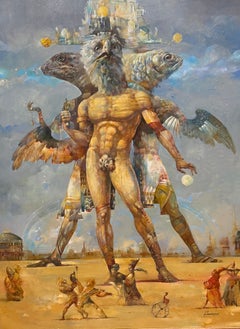
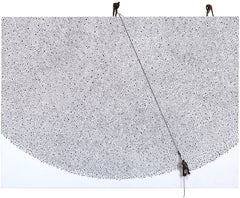
Artist: Mersad Berber
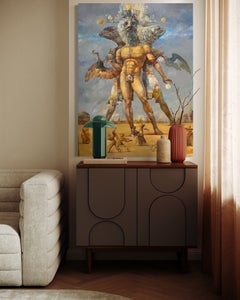
Head with Figure, 2008

Head with Figure, 2008

By Mersad Berber

Located in Atlanta, GA

Mersad Berber was a Bosnian painter and printmaker. Known for his particularly skilled draughtsmanship in depicting historical and contemporary Bosnian events, Berber frequently empl...

Category

20th Century Modern Mersad Berber Art

Materials

Oil

Related Items
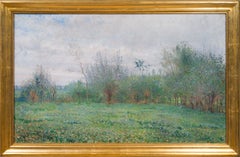
America impressionist portrait young boy 1937 Modern Figurative Oil Painting

America impressionist portrait young boy 1937 Modern Figurative Oil Painting

Located in Buffalo, NY

A fantastic modern portrait of a young boy. This work is signed what appears to be Paul Sellers and dated 1937, but we have not found information on the artist. The work dated 1936...

Category

1930s American Modern Mersad Berber Art

Materials

Oil, Board

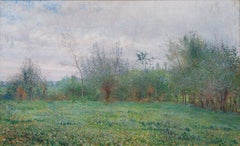
"Woodstock Landscape" Albert Heckman, American Modernist, Atmospheric Valley

"Woodstock Landscape" Albert Heckman, American Modernist, Atmospheric Valley

By Albert Heckman

Located in New York, NY

Albert Heckman Woodstock Landscape Oil on board 10 x 8 inches Albert Heckman was born in Meadville, Western Pennsylvania, 1893. He went to New York City to try his hand at the art ...

Category

1940s American Modern Mersad Berber Art

Materials

Oil, Board

1930's Modernist Oil Painting Paris Rooftops Hazel Guggenheim Mckinley Fauvist

1930's Modernist Oil Painting Paris Rooftops Hazel Guggenheim Mckinley Fauvist

By Hazel Guggenheim McKinley

Located in Surfside, FL

Hazel Guggenheim King-Farlow McKinley (American, London, New Orleans, 1903-1995), "Paris Rooftops" c. 1930 Oil paint on wood panel Attributed, dated and titled verso (I am not sure in whose hand not signed by the artist herself). Dimensions H.- 18 in., W.- 15 in., Framed- H.- 26 1/2 in., W.- 23 in. Provenance: From an estate New Orleans, Louisiana. Hazel Guggenheim King-Farlow McKinley (born Barbara Hazel Guggenheim; April 30, 1903 – June 10, 1995) was an American painter, art collector, and art benefactor. Hazel Guggenheim was born in New York City to Benjamin Guggenheim and Fleurette (Seligman) Guggenheim. The marriage united two wealthy German-Jewish families. Born into the well-known Guggenheim family, a niece of Solomon Guggenheim who founded the Guggenheim Museum, she grew up in New York, alongside her sisters Benita Guggenheim and Marguerite Peggy Guggenheim who would become the influential gallery proprietor, art collector, museum founder, and midwife to the Abstract Expressionism art movement. Her father Benjamin gave up much of his financial interest in the family's mining business to start his own business in Paris. With his business failing, in 1912 he set out to return to the United States in time for McKinley's ninth birthday on the Titanic. Following the shipwreck, he drowned aged 46; his body was not recovered. McKinley inherited $450,000. She later inherited money on the deaths of her mother, and of her older sister, Benita, who died in childbirth. The loss of her father haunted McKinley for the rest of her life, and in 1969 she recorded "In Memoriam, Titanic Lifeboat Blues." McKinley began painting as a teenager and was a prolific artist throughout her life. When she fled New York for Paris at age 19 she studied at the Sorbonne and became part of 1920's bohemian Paris, France, where she was taught by key modernism artists of the time. Her primary mediums were ink, water color, tempera, and crayon. Some of her work is hand signed and some is not. In 1928 her sister Peggy moved to London and mar­ried the British writer John Holmes. In 1931, McKinley married the Englishman Denys King-Farlow. They settled in Sussex, UK, and had two children, John King-Farlow, who became a philosopher and poet, and Barbara Benita King-Farlow, who became an artist in her own right. In 1938 Peggy opened Guggenheim Jeune, a London gallery of mod­ern art, starring Wassily Kandinsky, Henry Moore, Salvador dali, Constantin Brancusi, Max Ernst, Pablo Pic­asso and Jean Miro with whom they socialized. Whilst living in the south of England with Denys King-Farlow in the 1930s, McKinley was influenced by a group of avant-garde artists, and had her first solo exhibition in London in April 1937 at the Coolings Gallery. She received instruction from British artists Rowland Suddaby, Raymond Coxon, and Edna Ginesi, becoming associated with the London Group and the Euston Road School. She painted primarily in watercolor. Her work included still-life, portraits, townscapes and landscapes. Although her first work was done in a "slightly plain palette," her later work in the 1930s brightened, sometimes falling within the realm of fauvism. "Under the influence of the Surrealist artists, Hazel's paintings after the 1930's became freer, though her work was far more whimsical and humorous than many artists more closely associated with the surrealism movement." In 1939 McKinley fled Europe due to the impending war and returned to the US, living mostly in California. She took brief art lessons from her sister Peggy's one-time husband Max Ernst and much later attended several summer schools taught by muralist and renowned teacher Xavier Gonzalez. In her life in the United States and abroad, McKinley met many prominent artists of the Paris, London, and New York art scenes including Jackson Pollock. McKinley continued to paint, and ran a small gallery of her own in the late 1950s and early 1960s in West Cornwall, Connecticut. One show at her gallery featured the works of British and Irish painters including Rowland Suddaby, Frank Beteson, Tom Nisbett, and Patrick Swift. McKinley showed two of her own works in the same exhibit, a watercolor painted at Positano, Italy and one painted at the Tuileries, Paris. Another featured work was a surrealistic water color portrait of McKinley by London artist Mervyn Peake. McKinley exhibited her work both in Europe and the United States throughout her long career, mostly at smaller venues. An incomplete listing of her exhibits and museum acquisitions of her work include: Berkshire Museum, the Galerie Raymond Duncan in Paris, Stendahl Galleries, the Jake Zeitlin Gallery, the Montgomery Museum of Fine Art, the Artists' Own Gallery in London, the Manchester City Art Gallery, and Santa Fe Art Museum. McKinley's work was only once included in a show by her sister Peggy. In 1943 McKinley was selected to exhibit a painting in Peggy's infamous show Exhibition by 31 Women in her New York gallery Art of This Century. The exhibition was radical at the time for being one of the first all-woman exhibitions, as well as showing only abstract or Surrealist works. The Exhibition by 31 Women was conceived by Peggy Guggenheim in collaboration with Marcel Duchamp, who is usually credited with suggesting the idea. The participating artists were selected by a jury that included André Breton, Max Ernst Duchamp, and Guggenheim. Advice was sought from Alfred H. Barr Jr., first director of the Museum of Modern Art in New York, who provided Guggenheim with five names, of which three were included in the exhibition, Suzy Frelinghuysen, Irene Rice Pereira, and Esphyr Slobodkina. Those already known to Guggenheim through their partners included Xenia Cage, wife of the composer John Cage, Frida Kahlo, wife of Diego Rivera, who was noted for his frescoes, Sophie Taeuber-Arp, wife of the sculptor, Hans Jean Arp, and Jacqueline Lamba, ex-wife of the surrealist André Breton. Guggenheim’s sister, Hazel Guggenheim McKinley and her daughter, Pegeen Vail Guggenheim exhibited. Also in the exhibition was the burlesque dancer, Gypsy Rose Lee, another friend of Guggenheim, who was possibly included more to help publicise the event than for her artistic skills. Other artists were friends of Guggenheim or of Max Ernst. One, Dorothea Tanning, was Ernst's lover, leading Guggenheim to say: "I realized that I should have only had thirty women in the show". Only one artist is known to have refused the invitation to submit works, Georgia O'Keeffe, who reportedly responded that she wished to be identified as a painter, and not singled out because of her gender. In the late 1950s, McKinley moved back to Europe for a while, before returning to the United States in 1969. She lived in New Orleans until her death in 1995. On her death, her only living son, John King-Farlow, wrote a poem in his mother's honor, entitled "Eulogy For My Mother (Hazel Guggenheim McKinley, Artist)." A short obituary distributed by the Associated Press noted she was a member of the illustrious New York Guggenheim family, that she was determined to make a name for herself as an artist, that her art works were shown in museums in the United States and Europe, and were in the collections of such celebrities as Greer Garson, Benny Goodman, and Jason Robards. In 1998 after her death, one of her paintings was exhibited in Peggy Guggenheim's Venice home museum the Palazzo Venier dei Leoni. Guggenheim’s work in various media and her connections to influential artists and collectors provide glimpses into the complex tapestry of the art world in the first half of the 20th century. In her later life she settled in New Orleans, where she continued painting, exhibiting, and studying art into her eighties at Newcomb College, New Orleans. She was part of a regional art scene that included Ida Kohlmeyer, George Rodrigue, Noel Rockmore and Hunt Slonem. Towards the end of her life while confined to bed, her last works were colored pen drawings and sketches. McKinley collected major contemporary artworks and she donated many of these works to public institutions. She donated over 15 works to Wakefield Art Gallery, UK, in the 1930s, and in 1938 presented the painting Cossacks...

Category

1930s Modern Mersad Berber Art

Materials

Oil, Panel

“The Wizard”
“The Wizard”

Nahum Tschacbasov“The Wizard”, 1954

$16,000

H 44 in W 27 in D 0.25 in

“The Wizard”

By Nahum Tschacbasov

Located in Southampton, NY

Here for your consideration is a mid century modern oil painting on masonite by the well known Russian/American artist, Nahum Tschacbasov. The painting depicts an old man with a long wispy beard holding a group of birds. Signed lower right and dated 1954. Presently unframed. Condition is very good. Provenance: The estate of the artist Nahum Tschacbasov. Nahum Tschacbasov Biography : Russian-American artist Nahum Tschacbasov (1899-1984) is known for his cubo-surrealistic works which feature a strong psychological element. Some of his work bears a resemblance to work of another Russian-American artist--David Burliuk. He was somewhat of a late starter, moving to Paris in 1932 to study under Adolph Gottlieb, Marcel Gromaire and Fernand Leger. He had his first exhibition in Paris in 1934. He then returned to the US where he joined Rothko and Gottlieb at the Galery Seccession. He was one of the co-founders of The Ten, a group of social conscious abstract painters which included Rothko, Gottlieb, Joseph Solman and Ilya Bolotowsky, among others. In 1944, he began to work at Stanley Hayter's Atelier 17, a center for surrealistic ideas. Between 1936 and 1943, he had five one-man exhibitions at the ACA Galleries and participated in five group shows. He also exhibited at the Whitney, the Pennsylvania Academy of Fine Arts, the Knox Albright Museum, the Chicago Institute of Fine Art and Corcoran, among others. His work can be found in the permanent collections of the Met, the Whitney, the Brooklyn Museum and the Jewish Museum. Tschacbasov has been the subject of two recent retrospective at Fletcher Gallery, Woodstock, NY and Arthur...

Category

1950s Modern Mersad Berber Art

Materials

Masonite, Oil

Jeaune Femme au Port de Sanary, Oil on Canvas, French, 1956, Framed

Jeaune Femme au Port de Sanary, Oil on Canvas, French, 1956, Framed

Located in London, GB

'Jeaune Femme au Port de Sanary' (Young Woman in the Port of Sanary), oil on canvas, French School (1956). This large, luminous painting captures the languid warmth of the French Riv...

Category

1950s Modern Mersad Berber Art

Materials

Canvas, Oil

Industrial Working Man Social Realism Mid-20 Century Modern American Scene Art

Industrial Working Man Social Realism Mid-20 Century Modern American Scene Art

By Edith Kramer

Located in New York, NY

Industrial Working Man Social Realism Mid-20 Century Modern American Scene Art Edith Kramer (1916-2014) "Man on Lathe II" Oil on linen, 1949 23 x 22 inches Signed and dated in blac...

Category

1940s American Modern Mersad Berber Art

Materials

Oil, Linen

"Chess" Mid-20th Century American Scene Social Realism Modern Art

"Chess" Mid-20th Century American Scene Social Realism Modern Art

Located in New York, NY

"Chess" Mid-20th Century American Scene Social Realism Modern Art John Grabach (1886-1981) Chess Oil on canvas 30 x 36 inches Signed John R. Grabach ANA lower center Framed 35 x 41...

Category

1940s American Modern Mersad Berber Art

Materials

Canvas, Oil

Portrait of Child with Flowers in Hands - Miniature Painting by A. Noci

Portrait of Child with Flowers in Hands - Miniature Painting by A. Noci

By Arturo Noci

Located in Roma, IT

Little portrait by Arturo Noci realized in 1909 probably in US. Oil on board. Bronze frame Signed and dated by the artist at bottom right. Very good conditions.

Category

Early 1900s Modern Mersad Berber Art

Materials

Oil, Board

Modernist American Judaica Painting Gaon and his Disciples

Modernist American Judaica Painting Gaon and his Disciples

By Ervin B. Nussbaum

Located in Surfside, FL

In this painting, Nussbaum portrays a Rabbi, or Rebbe outside the synagogue The vibrant colors used in this painting seem to overlay each other without being previous mixed. Ervin B...

Category

20th Century American Modern Mersad Berber Art

Materials

Oil, Board

Post Soviet Russian Jewish Oil Painting Marc Klionsky Jerusalem Angel & Shofar

Post Soviet Russian Jewish Oil Painting Marc Klionsky Jerusalem Angel & Shofar

Located in Surfside, FL

Marc Khonsky (American Russian, 1927-2017) Untitled (Winged Prophet Playing Music) 1978 Oil on board Hand signed and dated lower right Dimensions: board: 14"h x 11"w, overall (with frame): 19.5"h x 16.5"w This depicts a winged angel in the guise of a rabbi, possibly the messiah, moshiach, or Prophet Elijah blowing a shofar over the old city of Jerusalem. A masterpiece laden with mystical symbolism. Marc Klionsky (Марк Клионский) (1927 – 2017) was a Russian-American Jewish artist who worked in New York City from his immigration in 1974 until his passing in 2017. Klionsky developed a style of American Realism uniquely defined by his classical training in the Soviet Union and his perspective of daily life in New York and America. Over the course of his career, Klionsky painted portraits of prominent world figures who shaped the 20th century. John Russell, art critic for The New York Times, described him as "a good man and a brave man and one of the most eloquent painters around. We need him" and as "one of the best portrait painters around." Marc Klionsky was born in Minsk, Belarus to a Jewish family in 1927. His father, Leo (Zev Vulf) Klionsky was a printer from Borisov, Belarus. The son of a woodcutter and engraver Klionsky's father moved to Minsk and eventually married Liza (née Rozenstein) in 1926. As a child, Klionsky attended the Art School for Gifted Children in Minsk. During World War II, Klionsky's family was evacuated to Kazan, Republic of Tatarstan, where Klionsky began to earn a living producing anti-Fascist posters and illustrations for local newspapers and other publications. Klionsky studied at the Drama Institute at the Kazan Theater, where he primarily focused on developing costume designs for various productions. After the war, Mark Klionsky attended first the Serov Art Institute before entering the Ilya Repin Leningrad Institute for Painting, Sculpture and Architecture (now known as the Russian Academy of Arts in Saint Petersburg). Klionsky's diploma piece was reproduced in an edition of 50,000 copies and distributed throughout the USSR. Klionsky received his PhD in 1957, during which period he studied with Professor Boris Ioganson. Klionsky became the youngest artist to be exhibited at the Tretyakov National Gallery in Moscow. During this period, Klionsky met his future wife of nearly 59 years, Irina Klionsky (née Korolik), with whom he had two daughters, Nadia, an artist, and Elena, a pianist. Klionsky established himself in the Soviet Union initially by producing official Social Realist works that depicted political figures and daily life in the Soviet Union. However, in the privacy of his own studio, Klionsky began to explore the themes of Jewish life, anti-Semitism and the Holocaust. He soon discovered the creative and intellectual restrictions of working as a Jewish artist in the Soviet Union. After Klionsky left the Soviet Union with his family in 1974, traveling first to Rome, Italy and then to New York, he expressed in his work the newborn freedom that he found in America. Shortly after his arrival, he was recognized in an ABC television production about his work, Canvases of Freedom. This was followed by a U.S. State Department documentary (produced by the U.S. Information Agency) shown in ninety-two countries about one of his exhibitions at Hammer Galleries. During this period, Klionsky also taught at the School of Visual Arts in New York and at the Pennsylvania Academy of Fine Arts in Philadelphia, birthplace of the Ashcan School of American Realism. While Klionsky took advantage of his creative freedom in the United States to explore a range of abstract styles and media, he ultimately gained prominence as a master of portrait painting and of American Realism. His works include portraits of leaders in the world of politics and humanitarianism, such as Israeli premier Golda Meir, Elie Wiesel, Prince Bandar Bin Sultan, and Vernon Jordan; music, including Dizzy Gillespie, Mstislav Rostropovich, and B.B. King; business leaders Armand Hammer, Steve Forbes, and Dwayne Andreas; and many others. His portraits are in the permanent collections of the National Portrait Gallery in Washington, D.C., the Russian Museum in St. Petersburg, and the Museum of Contemporary Art in Lausanne, Switzerland. Klionsky was also honored during his lifetime to have been selected to sculpt the Nobel Peace Prize Commemorative Medal for Elie Wiesel. During his lifetime, Marc Klionsky's paintings and prints were exhibited throughout the Soviet Union, Europe, America, Israel and Asia, as well as Australia and New Zealand. His Soviet works were exhibited in the Tretyakov National Gallery in Moscow and the State Russian Museum in Leningrad multiple times throughout the 1950s. In 1962, his work was shown alongside that of Marc Chagall at Grosvenor Gallery in London. Separately, his work was shown along with other Soviet artists at the time in West Berlin, Hiroshima, Rome, and New York. After emigrating to New York in 1974, his first international exhibition was held in Paris at the Salon des Reprouves with Galleries Hardy in 1978. His first solo New York show took place a Nakhamkin Fine Arts Gallery on Madison Avenue in 1979, after which Klionsky was represented by Hammer Galleries for the remainder of his career. Klionsky had several solo shows in Europe between 1991 and 1992, showing at the Musée d’Art Contemporain in Lausanne, Switzerland, the Salon Internationale des Musées at the Grand Palais in Paris, France, and his "God Bless America" traveling retrospective that began at the St. Ingbert Museum in Germany. The last exhibition of Klionsky's work during his lifetime was at an event titled "Painting the Face of Russian Jewry: The Art and Journey of Marc Klionsky” at Brandeis University in Waltham, Massachusetts in 2010, with presentations made by Sir Antony Polonsky, Emeritus Professor of Holocaust Studies, and Professor Nancy Scott, former chair of the Fine Arts department at Brandeis University. Marc Klionsky's works hang in the collections of the National Portrait Gallery in Washington, D.C., The Elie Wiesel Foundation for Humanity in New York, the Musée d’Art Contemporain in Lausanne, Switzerland, the Yad Vashem Art Museum in Jerusalem, Israel, and the State Hermitage Museum and the State Russian Museum in St. Petersburg, Russia, among other private and public collections internationally. He was part of a tradition of Soviet Jewish artists that included El Lissitzky, and Natan Altman, Marc Chagall, Robert Falk, Anatoly Kaplan, Ilya Kabakov, Oscar Rabin...

Category

1970s Modern Mersad Berber Art

Materials

Oil, Board

Guy Pene du Bois WPA American Modernism Realism NYC Scene Oil Lawyers in Court

Guy Pene du Bois WPA American Modernism Realism NYC Scene Oil Lawyers in Court

By Guy Pène Du Bois

Located in New York, NY

Guy Pene du Bois (1884-1958) "Two Figures in a Courtroom" 16 x 22 inches Oil on paper mounted to, c. 1945 Framed: 25 x 31 inches Provenance: James Graham & Sons Gallery Guy Pene du Bois' "Two Figures in Courtroom" is a WPA era American scene oil painting created in a realistic style. Modernism at its best The work is framed by Heydenryk. Pène du Bois descended from French immigrants who settled in Louisiana in 1738 and was raised in a Creole household. He was born in 1884 in Brooklyn, NY and first studied with William Merritt Chase at the New York School of Art and later continued his training with Robert Henri. Pène du Bois was greatly impressed with Henri's credo that "real life" was subject matter for art and throughout his life a realist philosophy informed his art as well as his parallel career, art criticism. In 1905, Pène du Bois made his first visit to Paris where he painted scenes of fashionable people in cafes rendered in the dark tonalities and impasto associated with the Ashcan School. By 1920, he had achieved his mature style, which was characterized by stylized, rounded, almost sculptural figures painted with invisible brushstrokes. The subjects of his paintings were often members of society whom he gently satirized. In 1924, Pène du Bois and his wife, Floy, left for France where they would remain until 1930. Returning to America showcases pictures the artist produced after this very productive period abroad. After five years of living in France, Pène du Bois was able to observe American life with fresh eyes. His work becomes more psychologically intense and less satirical. In Girl at Table a slender, blond is shown gazing at a small statue that she holds at arm's distance. The meaning is elusive, but a powerful sense of longing is evoked. Similarly, paintings such as Dramatic Moment and Jane are taut with unresolved dialogue. Both pictures depict mysterious interiors in which a lone woman anxiously awaits the denouement of a suspenseful scene. Other pictures, for example, Chess Tables, Washington Square and Bar, New Orleans, recall Pene du Bois's Ashcan origins in their depiction of urban entertainment. During this period, landscape becomes an important subject for Pène du Bois. Girl Sketching...

Category

1930s American Modern Mersad Berber Art

Materials

Paper, Oil, Board

Previously Available Items
Empire I, 2008

Empire I, 2008

By Mersad Berber

Located in Atlanta, GA

Mersad Berber was a Bosnian painter and printmaker. Known for his particularly skilled draughtsmanship in depicting historical and contemporary Bosnian events, Berber frequently empl...

Category

20th Century Modern Mersad Berber Art

Materials

Oil

Girl with a Lute. 1969. Oil Painting & Gold Leaf. Djevojka sa Lutnjom. Byzantine

Girl with a Lute. 1969. Oil Painting & Gold Leaf. Djevojka sa Lutnjom. Byzantine

By Mersad Berber

Located in Sutton Poyntz, Dorset

This original painting highlighted with gold leaf by Mersad Berber, dating from 1969, is presented and supplied in a sympathetic contemporary frame (which is shown in these photographs), mounted using conservation materials and behind non-reflective glass (Tru Vue UltraVue® UV70 glass). The frame dimensions are 51cm high x 44.5cm wide. The visible painting is 34cm high x 27.5cm wide (13.4inches high x 10.8inches wide). This vintage painting is in superb condition. It wants for nothing and is supplied ready to hang and display. The painting is signed lower right. Mersad Berber is one of the most significant and best-known contemporary artists in the world. His achievements are all the more incredible because he was a member of Bosnia’s Muslim community and lived through the chaos of the Balkan wars of the 1990s. He achieved an unprecedented degree of international celebrity for an artist from this region; during his lifetime had exhibitions in London, Hamburg, Istanbul, Chicago, Abu Dhabi, Moscow, Madrid, Zurich and New York. In 2009 a large retrospective was held in Barcelona, covering the whole of his career. Berber was born in Bosanski Petrovac, Yugoslavia in 1940. He was the eldest son of Muhammed Berber and Sadika Berber, a well-known weaver and embroiderer. The family moved to Banja Luka...
Category

Mid-20th Century Renaissance Mersad Berber Art

Materials

Gold Leaf

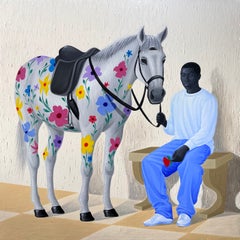
White Horse
White Horse

Mersad BerberWhite Horse, 1988

Sold

H 29.5 in W 23 in

White Horse

By Mersad Berber

Located in Long Island City, NY

Artist: Mersad Berber, Bosnian (1940 - 2012) Title: White Horse Year: 1988 Medium: Oil on Panel, signed l.l. Image Size: 18 x 12 inches Size: 22 x 15.5 in...

Category

1980s Surrealist Mersad Berber Art

Materials

Oil, Panel

Mersad Berber art for sale on 1stDibs.

Find a wide variety of authentic Mersad Berber art available for sale on 1stDibs. You can also browse by medium to find art by Mersad Berber in oil paint, paint and more. Much of the original work by this artist or collective was created during the 20th century and is mostly associated with the modern style. Not every interior allows for large Mersad Berber art, so small editions measuring 46 inches across are available. Customers who are interested in this artist might also find the work of Ron Blumberg, Ernst Neizvestny, and Alfredo Roldan. Mersad Berber art prices can differ depending upon medium, time period and other attributes. On 1stDibs, the price for these items starts at $24,000 and tops out at $26,000, while the average work can sell for $25,000.

Artists Similar to Mersad Berber