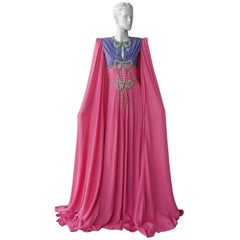
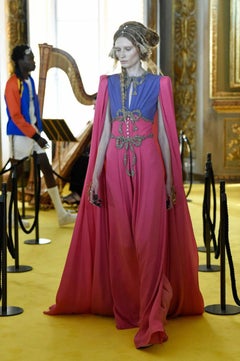
Gucci Runway Fairy Tale Embellished Dress Gown
By Gucci
Located in Los Angeles, CA
Gucci cape gown designed by Alessandro Michele. Shown on the runway in look 24 from Gucci's Resort
Category
Gucci Runway Fairy Tale Embellished Dress Gown
By Gucci
Located in Los Angeles, CA
Gucci cape gown designed by Alessandro Michele. Shown on the runway in look 24 from Gucci's Resort
Long before trend-bucking creative director Alessandro Michele brought his hallucinatory “Utopian Fantasy” campaign to Gucci, it was a modest Italian leather shop. Today, it’s an internationally renowned luxury house with an iconic logo, and vintage Gucci clothing, handbags and shoes are among high fashion's most covetable goods.
Guccio Gucci (1881–1953) admired the stylish suitcases he saw wealthy guests arrive with at the Savoy Hotel in London, where he worked as a bellhop. So, in 1921, after a stint at Franzi, a luggage company in his hometown of Florence, he opened a leather goods shop of his own.
At first, Gucci’s Florence business specialized in equestrian accessories. But as its reputation flourished, particularly among the English aristocracy, so too did its footprint. In 1938, he brought three of his sons — Aldo, Vasco and Rodolfo — into the business and expanded it to Rome and later Milan. In the mid-1930s, a League of Nations embargo against Italy pushed Gucci to experiment with alternatives to imported leather. Its woven hemp fabric from Naples, adorned with the brand’s signature diamond print, was a hit, especially among A-list celebrities. The material was first used on suitcases before finding enduring popularity on handbags. (No list of revered designer purses would be complete without Gucci.)
In the 1950s, Elizabeth Taylor carried one of Gucci’s bamboo-handled tote bags, another adaptation to material rationing. After Jackie Kennedy was seen sporting a slouchy Gucci tote in 1961, it was renamed for the First Lady. Then Grace Kelly, on a visit to the boutique in Milan, inspired Rodolfo Gucci to work with Italian illustrator and Gucci textile designer Vittorio Accornero on the Flora print in 1966. Taking cues from Sandro Botticelli’s Primavera, with its pattern of flora and insects, it was painted entirely by hand and featured no fewer than 37 colors.
In 1953, just 15 days after opening his first store on New York’s 5th Avenue, Guccio passed away at 72. The early 1970s saw store openings in Tokyo and Hong Kong, but by the late 1980s, Gucci was floundering. Rodolfo Gucci took charge in 1982, but family drama and lawsuits ensued. In 1993, Rodolfo’s son, Maurizio, transferred his shares in the company to Investcorp, ending the family’s involvement in Gucci. Dawn Mello, then-president of Bergdorf Goodman, joined as creative director in 1989. But it was Tom Ford, who took over as creative director in 1994, who ultimately revived the brand.
Ford’s racy ads, shot by photographers such as Mario Testino, stirred controversy. And his potent vision of sexed-up femininity — with “jewel-toned satin shirts unbuttoned to there,” as Vogue described his breakthrough 1995 runway show — was wildly successful. The new millennium brought new ownership — Pinault Printemps Redoute in 2004 — and a more toned-down vision from Frida Giannini, who became sole creative director in 2006. Alessandro Michele was named creative director in 2015, and the storied brand took a giant leap forward.
Find vintage Gucci clothing and accessories on 1stDibs.
With entire museum exhibitions dedicated to examining fashion designers and their creations, we’re finally recognizing that costuming is art. Evening dresses over time have conveyed specific statements about social class, position and beliefs. Fashion is a powerful means of self-expression, and sophisticated vintage evening dresses and gowns by our favorite couturier play no small role in making us feel wonderful but, perhaps more importantly, making us feel like ourselves.
In the 16th century, dresses and gowns were so important that England's Queen Elizabeth I defined rules about what dresses women could wear — guidance included long skirts and fitted bodices. Forward-thinking designers have responded to this history.
Gabrielle “Coco” Chanel reimagined traditionally masculine garments for feminine shapes, and her elegant evening dresses and gowns promoted comfort and grace in women’s wear that had been dominated in the previous century by layers of fabric. Christian Dior's gowns celebrated luxury and femininity in the late 1940s — and gave to women the gift of glamour they’d lost in the miserable years of the war. French fashion designer Yves Saint Laurent introduced innovative and highly coveted dress designs in the 1960s while at the same time challenging sexist stereotypes about which members of society could wear tuxedos.
Works by unconventional British designer John Galliano — featured in houses like Givenchy and Dior — redefined limits that dressmakers faced in terms of material, construction and vision during the late 20th century. From his embroidered absinthe-green Oscars gown for actress Nicole Kidman to the iconic sleeveless Dior newspaper dress that Sex and the City’s Carrie Bradshaw made famous, Galliano’s intricate and multifaceted work is reliably collectible and newsworthy
Today’s designers target an increasingly broad audience with their boundary-crossing work, and their tendency to play off of each other’s ideas means that every walk down the runway is also a walk through an entire history of fashion design and dress craftsmanship.
Whether you gravitate toward backless maxi dresses or silk charmeuse gowns by Alexander McQueen or embellished, ruffled floral-print designs by Chloe or Versace, there is an extraordinary collection of vintage and designer evening dresses and gowns waiting for you on 1stDibs.