Recognized Dealers Clocks

to
17
615
106
3
68
464
83
109
37
17
9
10
3
2
7
2
4
3
3
4
77
71
66
49
33
33
32
16
12
9
6
6
6
2
2
1
569
279
258
166
157
537
159
667
416
87
63
51
Height
to
Width
to
724
629
684
32
23
23
17
13
Victorian Ormolu Clock and Barometer Desk Set, of Maritime or Naval Interest

Victorian Ormolu Clock and Barometer Desk Set, of Maritime or Naval Interest

Located in London, GB

Each in the form of a ship's wheel with 2.5 inch silvered dial, contained in cases, one with seven turned banded agate handles, the other with eight banded agate handles, each on ova...

Category

Antique 19th Century English Victorian Clocks

Materials

Agate, Ormolu

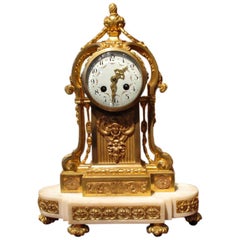
French Louis XVI style carved giltwood mantel clock

French Louis XVI style carved giltwood mantel clock

Located in London, GB

French Louis XVI style carved giltwood mantel clock French, early 20th Century Height 60cm, width 39cm, depth 18cm This elegant mantel clock is crafted from giltwood and designed in a classical style. The clock features a large circular enamel dial set within a giltwood drum. The drum is surmounted by an urn finial and is supported atop an entablature complete with floral motifs and large ball finials. The entablature is raised on four columns, each with a profile bust capital, which in turn are set on a base raised on toupie feet. The base also hosts a carved seated figure...

Category

Early 20th Century French Neoclassical Clocks

Materials

Enamel

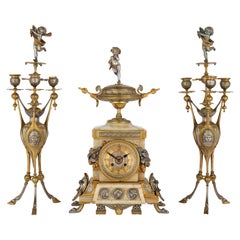
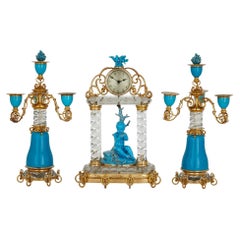
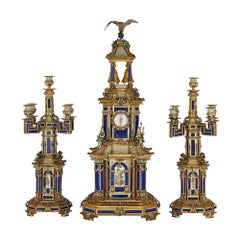
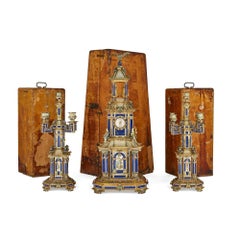
Impressive Antique Austrian Champlevé Enamel, Silver-Gilt and Lapis Lazuli Clock

Impressive Antique Austrian Champlevé Enamel, Silver-Gilt and Lapis Lazuli Clock

Located in London, GB

Impressive antique Austrian champlevé enamel, silver-gilt and lapis lazuli clock set Austrian, Late 19th century Clock: Height 91cm, width 37cm, depth 37cm Candelabra: Height 64cm, width 24cm, depth 24cm Clock case: Height 97cm, width 44cm, depth 41cm Candelabra case: 67cm, width 27cm, depth 27cm Crafted in Austria in the late 19th century, this magnificent three-piece clock set was most likely gifted to the Imperial Russian family by the Austro-Hungarian Royal family. Its design is inspired by various cultures and styles, whilst its high quality celebrates some of the best craftsmen of the late 19th century. Of a tiered pagoda shape, the clock is surmounted by an eagle, its wings spread wide landing atop a vibrant lapis lazuli ball. The eagle is most likely a reference to Turul, a mythological animal which is a symbol of Hungary. This bird of prey is also a popular feature within Turkish traditions. Within a canopy, supported on four sturdy lapis lazuli pillars two prominent silver-gilt bells are hanging. These are carved with various motifs such as acanthus leaf design and connect to the clock mechanism below. The bells ring informing its users of the time. All four sides of the piece are inset with a clock, an unusual feature on an object of this type and a testament to its highest quality. The inclusion of clocks on all sides signifies that the antique is aimed to be a centrepiece, admired from all sides. The dial is decorated using the champlevé enamelling technique, whereby ‘parcels’ are carved into the silver gilt and into which enamel is poured. The 12 numbers are coloured in black with a gold outline and are surrounded by a white circular background making them stand out and easy to read. The hour clock dial is cast in the form of a sun, while the minute hand is represented as the moon. The two motifs symbolise one’s bright and gloomy sides of existence. The four corners around the clocks are mounted with three-dimensional female figures dressed in traditional garments from around the world. For example, one figure is dressed in typical Turkish clothing...

Category

Antique Late 19th Century Austrian Table Clocks and Desk Clocks

Materials

Lapis Lazuli, Silver, Bronze, Enamel

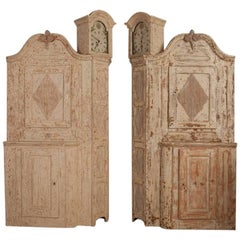
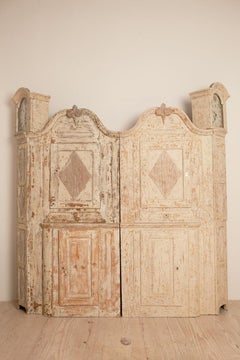
Unusual Pair of Gustavian Corner Clock Cabinets, Origin Mora, Sweden, Circa 1780

Unusual Pair of Gustavian Corner Clock Cabinets, Origin Mora, Sweden, Circa 1780

Located in New York, NY

Unusual pair of Gustavian corner clock cabinets, origin: Mora, Sweden, circa 1780 Each cabinet with matching working, tall case clocks decorated with four fluted diamond patterns an...

Category

Antique 18th Century Swedish Gustavian Cabinets

Materials

Wood, Paint