1910s Art

to
234
1,102
344
385
193
186
Overall Width
to
Overall Height
to
7,503
21,324
163,919
233,476
2,028
2,261
4,945
6,518
5,800
15,038
20,785
25,818
18,701
14,200
5,325
445
295
145
131
49
19
17
12
6
1
1,243
877
36
1,419
681
601
404
391
344
220
152
143
138
136
120
116
99
95
91
77
75
57
56
852
618
497
408
397
134
47
33
23
23
843
400
1,157
982
Period: 1910s
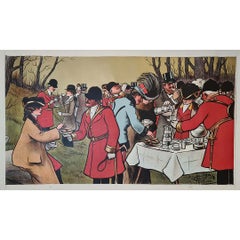
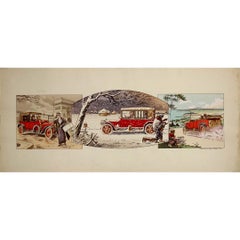
Lefevre-Utile Lu Lu French cookie poster

Lefevre-Utile Lu Lu French cookie poster

Located in Spokane, WA

Lu Lu Bisquites; Lefevre -Utile ( Lefèvre-Utile) crackers. The original lithographic poster is printed in colors, and the vintage vintage poster is archival li...

Category

Art Nouveau 1910s Art

Materials

Lithograph

Lizzie Nichols and Perkins, 1913

Lizzie Nichols and Perkins, 1913

Located in New York, NY

Listing includes framing with UV plexiglas, free shipping and a 14 day return policy. Lizzie Nichols and Perkins, 1913 15 x 15 inch gelatin silver print Image Size: 10.75 x 11 inches Frame size: 18 x 18 x 2 inches Edition of 15 Lora Webb Nichols was born in 1883 and grew up in the small mining town of Encampment, Wyoming. At the age of 16 Lora received her first camera and from that moment and for the next few decades she produced work that is both stunning in its singular voice and revealing in the world it opens up for us. At first Nichols photographed her family, friends, and the landscape around Encampment, but when the town experienced a copper mining boom Nichols expanded her scope to become a photographer for hire shooting portraits and industrial photographs. When the boom collapsed, Nichols took the risk of opening her own business in Encampment - The Rocky Mountain Studio - which opened in 1925. The studio ran for ten years, accumulating 24,000 negatives that illustrate the lives and environment of the people living in and around the town while creating a distinctive and surprising body of work. If one was to attempt an analogy – Nichols’ pictures fit somewhere between Lartigue and Lange - joyful and generous while objectively intimate. In particular what seems to distinguish Nichols’ work is the way she sees the world from a female perspective. As Vince Aletti...

Category

Other Art Style 1910s Art

Materials

Silver Gelatin

Gentle Evening - Pencil drawing - circa 1914

Gentle Evening - Pencil drawing - circa 1914

By Georges Conrad

Located in Paris, IDF

Georges CONRAD (1874-1936) Gentle evening Original pencil and color pencil drawing Signed with the stamp of atelier On paper 26.5 x 20 cm (c. 10,4 x 7.8 in) Very good condition, pa...

Category

Academic 1910s Art

Materials

Carbon Pencil, Color Pencil

Original 'Cleveland War Fund, All for Victory' vintage lithograph poster

Original 'Cleveland War Fund, All for Victory' vintage lithograph poster

Located in Spokane, WA

Original CLEVELAND WAR FUND, ALL FOR VICTORY, vintage poster, museum linen backed. Presents in Good condition B+ due to restored tears. Printer: The Central Lithograph Co., Cleveland. Original World War One poster. Museum linen backed. Restored original fold lines. No paper loss, full lithograph. Please see the large images for the minor defects. Promoting the Salvation Army...

Category

American Realist 1910s Art

Materials

Lithograph

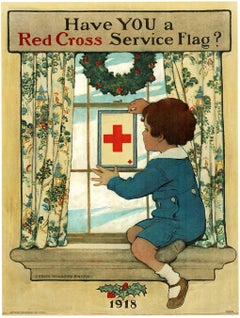
Original Have You a Red Cross Service Flag? vintage WW1 poster

Original Have You a Red Cross Service Flag? vintage WW1 poster

By Jessie Willcox Smith

Located in Spokane, WA

Original 1918 Red Cross Poster - "Have YOU a Red Cross Service Flag?" - Illustrated by Jessie Willcox Smith, Linen Backed. Restored horizontal fold mark and restored small tears along the bottom. This poster is, after all, more than 107 years old. Own a Piece of History! 1918 "Have You a Red Cross Service Flag?" Poster ✨ Step back into history with this original 1918 Red Cross poster. It is a poignant and touching piece of WWI-era Americana, beautifully preserving a time of nationwide unity and heartfelt service. Illustrated by the celebrated artist Jessie Willcox Smith, this lithograph captures the tender moment of a child hanging a Red Cross service flag in the window—a symbol of hope, sacrifice, and pride in supporting humanitarian efforts during World War I. The poster radiates warmth, with Smith’s signature style of innocence and emotional depth shining through in the delicate depiction of the boy, the adorned window, and the serene winter backdrop. The vibrant red and white cross emblem on the service flag is a focal point of the artwork, inspiring viewers to reflect on the values of compassion and generosity that the Red Cross championed during this period. As a significant historical artifact and a beautiful piece of early 20th-century American illustration, this poster would be an exceptional addition to any serious collection of WWI memorabilia...

Category

American Modern 1910s Art

Materials

Lithograph

Original Keep These Off The U.S.A., Buy Liberty Bonds vintage WW1 poster

Original Keep These Off The U.S.A., Buy Liberty Bonds vintage WW1 poster

Located in Spokane, WA

Original Keep These Off the U.S.A." buy more Liberty Bonds vintage World War One posters. Archival linen backed in excellent condition, ready to frame. The images shown are of the exact poster you will receive. Grade A- Artist: John Norton. Printed by The Strobridge Litho Co., Cincinnati & New York. Ref: Johnson 21, Rawls 214, Full-size paper, not trimmed 31" x 40.25" in size. Bend right corner straightened during linen backing and tiny edge repair. Excellent bright colors. Clean, ready to frame. This poster was part of the Committee on Public Information (CPI) 's broader propaganda campaign to rally American support for the war effort. It shows a pair of boots with red stains, showing blood dripping onto the ground. The German Adler is on the top of each boot and is shown wearing spurs. The "Keep These Off the USA" poster was created during World War I as part of a broader American propaganda campaign to rally support for the war effort and demonize the enemy, particularly Germany. Propaganda posters...

Category

American Modern 1910s Art

Materials

Lithograph

Nature's Bounty Trilogy

Nature's Bounty Trilogy

Located in Missouri, MO

Framed Size: 29 1/4 x 63 1/2 inches Signed and Dated Lower Right William McKendree Snyder (December 20, 1848-September 1930) was an American painter active in Indiana in the late 19...

Category

American Realist 1910s Art

Materials

Canvas, Oil

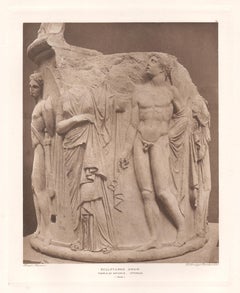
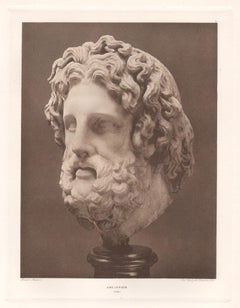
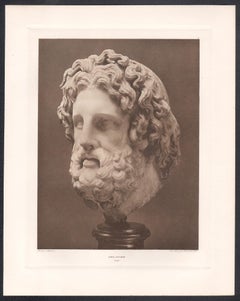
Farnese Hermes, British Museum Roman antiquity Classical sculpture photogravure

Farnese Hermes, British Museum Roman antiquity Classical sculpture photogravure

Located in Melbourne, Victoria

'Farnese Hermes' Photogravure from a collection of photogravures depicting Greek and Roman marbles and bronzes in the British museum. Plate number above top right corner of the imag...

Category

Other Art Style 1910s Art

Materials

Photogravure

"Croquis" etching

"Croquis" etching

By Alexandre Lunois

Located in Henderson, NV

Medium: etching. This impression was printed on laid paper in 1914 by Porcabeuf and published by Henri Floury for the catalogue raisonne "Alexandre Lunois, peintre, graveur et lithog...

Category

1910s Art

Materials

Etching

First Steps, Early 20th Century Bronze Sculpture, Cleveland School

First Steps, Early 20th Century Bronze Sculpture, Cleveland School

By William Zorach

Located in Beachwood, OH

William Zorach (American 1891-1966) First Steps, 1918 Bronze 8.5 x 5 x 4 inches, including base Born in 1887 in Lithuania, William Zorach immigrated with his family to the United States when he was just four years old, settling in Cleveland, Ohio. Zorach displayed an exceptional artistic talent at a young age and, at the recommendation of his seventh-grade teacher, began studying lithography at night at the Cleveland School of Art. It was not long before he was apprenticing at a lithography company in Cleveland. It was there that he realized he wanted to become an artist - to escape the commercial end of the field in which he was suddenly immersed. In 1907, Zorach saved enough money to move to New York and study art at the National Academy of Design, where he received several awards for his paintings and drawings. He continued his studies in Paris in 1910 at La Palette. This year abroad would turn out to be quite fruitful because in Paris he was greatly influenced by the Cubist and Fauvist movements and had several paintings exhibited at the Salon d'Automme. This influence and subsequent success fueled his career back in the states where he was honored with his first one-man exhibition. Due to this new-found stability, he married a young woman he met at school in Paris, and they moved to New York and set up a studio. Shortly after, their work was accepted into the famous 1913 Armory Show. For the next nine years, Zorach continued to think of himself as a painter, although he had already begun to experiment in sculpting. He was experiencing modest success with his painting and was therefore reluctant to abandon it completely. However, he was impelled toward sculpting, and in 1922, he painted his last oil. Zorach's involvement with sculpture began largely be accident. While he was working on a series of wood-block prints, Zorach suddenly became more interested in the butternut panel than the print and turned the panel into a carved relief. With no formal training as a sculptor, Zorach's first sculptures were of wood and his carving tools were primitive, such as a jack-knife. I n fact, his early works have a certain stylized look, suggesting the influence of various primitive arts such as African and American folk. Zorach found his sculptural direction by instinct, but was not unaware of what other sculptors were doing, both here and abroad. He soon allied himself with a growing number of modern sculptors who believed in the esthetic necessity of carving their own designs directly in the block of stone or wood rather than modeling them in clay. From the beginning he found a deep satisfaction in the slow and patient process of freeing the image from its imprisoning block, watching the forms emerge and appear. "The actual resistance of tough material is a wonderful guide," Zorach said in a lecture on direct sculpture in 1930. The sculptor "cannot make changes easily, there is no putting back tomorrow what was cut away today. His senses are constantly alert. If something goes wrong there is the struggle to right the rhythm. And slowly the vision grows as the work progresses." Zorach also found that the material itself had a constantly modifying effect on the artist's vision. The grain of the wood, the markings in the stone, the shape of the log or boulder all set limits and suggested possibilities. He was always sensitive to the characteristic qualities of his material and occasionally let them play a major role in determining his forms. In works such as these, the feel of the original material is preserved in the finished piece and is often heightened by leaving parts of the original surface untouched and other areas roughly marked by the sculptors tools...

Category

1910s Art

Materials

Bronze

DER SCHATTEN II - Rich Drypoint - 1st State

DER SCHATTEN II - Rich Drypoint - 1st State

By Max Pechstein

Located in Santa Monica, CA

MAX PECHSTEIN (1881 -1955) DER SCHATTEN II 1918 (Knupp 79, Fecher 143 I/ii) Rich drypoint, signed and annotated, FIRST STATE. Image: 8 1/4 x 6 inches on japan paper; 15 x 11 1/4 i...

Category

Expressionist 1910s Art

Materials

Drypoint

'Search' — Australian Romanticism

'Search' — Australian Romanticism

Located in Myrtle Beach, SC

Thomas Balfour Garrett, 'Search', monotype in colors, c. 1910, a unique impression. Signed and titled in pencil. A superb, painterly impression with fresh colors on off-white, wove p...

Category

Romantic 1910s Art

Materials

Monotype

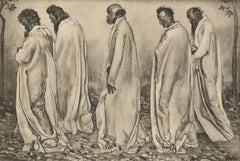
Les Aveugles ( The Blind )

Les Aveugles ( The Blind )

By Henry de Groux

Located in Paonia, CO

Henri DeGroux (1866-1930) was a Belgian Symbolist painter, sculptor and lithographer. He was known for his allegorical, religious and historical subject matter. He became an inspired...

Category

Symbolist 1910s Art
Materials

Lithograph

Musketeer 28th Foot (Gloucestershire Regiment) 1746 in Watercolor on Paper

Musketeer 28th Foot (Gloucestershire Regiment) 1746 in Watercolor on Paper

By Clarence F. Bretherick

Located in Soquel, CA

Muskateer 28th Foot (Gloucestershire Regiment) 1746 in Watercolor on Paper A beautiful watercolor of a British Musketeer of the 28th (North Gloucestershire) Regiment of Foot, in full uniform standing with poise and readiness by English artist Clarence F. Bretherick (b. 1868). Signed lower right. Displayed in a rustic giltwood frame. Image, 12"H x 9"W. In 1892 Bretherick was appointed permanently on the Liverpool Weekly Post as artist to that journal, to be responsible for all illustrations therein. His great specialty was figure drawing, military figure subjects in particular. This particular watercolor is a fine example of his skill as an artist and his fine attention to detail. 28th (North Gloucestershire) Regiment of Foot. The regiment was first raised in 1694 by Colonel Sir John Gibson, the Lieutenant-Governor of Portsmouth, as Sir John Gibson's Regiment of Foot and was posted to Newfoundland to protect the colony there. They saw action in Flanders during the War of the Austrian Succession...

Category

Realist 1910s Art

Materials

Paper, Watercolor

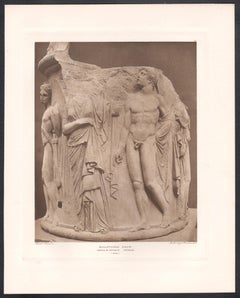
Endymion, British Museum Roman Classical sculpture photogravure

Endymion, British Museum Roman Classical sculpture photogravure

Located in Melbourne, Victoria

'Endymion' Photogravure from a collection of photogravures depicting Greek and Roman marbles and bronzes in the British museum. Plate number above top right corner of the image. 1...

Category

Other Art Style 1910s Art

Materials

Photogravure

Portrait - The Old Days -  The Early 20th century

Portrait - The Old Days - The Early 20th century

Located in Roma, IT

Portrait- The Old Days is a black and white vintage photo, silver salt print, realized in the early 20th century.  It belongs to historical album including historical moment, royal ...

Category

Modern 1910s Art

Materials

Photographic Paper

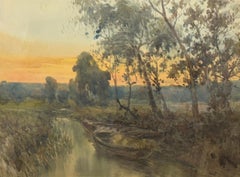
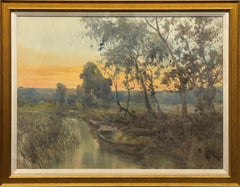
Evening Calm by the Northern River

Evening Calm by the Northern River

Located in Stockholm, SE

ink on paper signed OSC. LYCKE unframed 24 x 34 cm (9.4 x 13.4 in) framed 33.5 x 43.5 cm (13.2 x 17.1 in) Provenance: Acquired directly from Katarina Gunnarsson, who inherited the ...

Category

Romantic 1910s Art

Materials

Paper, Pencil

Erotic Scene - Héliogravure by Micheal Von Zichy - 1911

Erotic Scene - Héliogravure by Micheal Von Zichy - 1911

Located in Roma, IT

Erotic scene is an original Héliogravure artwork on ivory-colored paper, realized by Micheal Von Zichy in 1911. Printed in only 300 copies, Leipzig; Privatdruck, from the Catalogue ...

Category

Modern 1910s Art

Materials

Paper, Engraving

Choiseul-Gouffier Apollo, British Museum Roman Classical sculpture photogravure

Choiseul-Gouffier Apollo, British Museum Roman Classical sculpture photogravure

Located in Melbourne, Victoria

'Choiseul-Gouffier Apollo' Photogravure from a collection of photogravures depicting Greek and Roman marbles and bronzes in the British museum. Plate number above top right corner o...

Category

Other Art Style 1910s Art

Materials

Photogravure

Remember Belgium Buy Bonds Fourth Liberty Loan original WW1 vintage poster

Remember Belgium Buy Bonds Fourth Liberty Loan original WW1 vintage poster

Located in Spokane, WA

Original vintage poster”. Remember Belgium, Buy Bonds Fourth Liberty Loan. Mounted on acid free archival linen. Ready to frame. Over 100 years old! This original World War 1 poste presents well, but the fold marks have been restored during the linen backing process. The occupation of Belgium was a major propaganda theme of the First World War. There were horror stories of how the civilian population was treated and, true or not, they became fodder for the persuasion machine that was created to stir up the populace for a variety of causes, most having to do with raising money via bond issues. This especially powerful and frightening image, was created by Ellsworth Young...

Category

American Impressionist 1910s Art

Materials

Lithograph

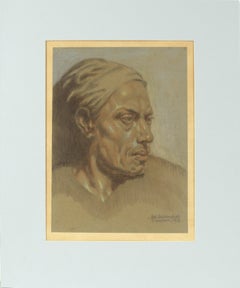
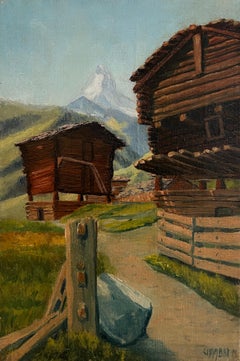
The Swiss by Otto Vautier - Drawing 31x24 cm

The Swiss by Otto Vautier - Drawing 31x24 cm

Located in Geneva, CH

Work on canvas Otto Vautier is a renowned Swiss painter, born in 1863 in Düsseldorf. He was influenced by a family of artists and developed his style dur...

Category

Academic 1910s Art

Materials

Crayon, Watercolor

Cubist Painting from 1918-19, Portrait of Dr Mens III

Cubist Painting from 1918-19, Portrait of Dr Mens III

Located in Stockholm, SE

Dick Beer (b. London 1893 - d. Stockholm 1938) Portrait of Dr Mens III, 1918-1919 oil on board 70 x 50 cm stamp signed painted c. 1918-1919 Provenance: Within the family Beer until today Dick Beer (1893-1938) Dick Beer was born in London in 1893. His father, John Beer (1853-1906), was a Swedish painter from Stockholm who had a career mainly as a watercolour painter with motifs of horses from racetracks and fox hunts from the countryside. Barely fifteen years old, Dick Beer became an orphan and came to Sweden in 1907. Already in 1908-1909, he started at Althin's painting school in Stockholm. And later, at the Royal Academy of Arts from 1910-1912. His teachers were, among others, Gustaf Cederström, Oscar Björk and Alfred Bergström...

Category

Cubist 1910s Art

Materials

Oil, Board

NIGHT WINDOWS
NIGHT WINDOWS

NIGHT WINDOWS

By John Sloan

Located in Portland, ME

Sloan, John (American, 1871-1951). NIGHT WINDOWS. Morse 152. Etching and drypoint, 1910. The 5th state of 5. Edition of 100. Titled, signed, and inscribed...

Category

1910s Art

Materials

Drypoint, Etching

'Improvisation 7' original first ed. woodcut  from 'Klänge' by Wassily Kandinsky

'Improvisation 7' original first ed. woodcut from 'Klänge' by Wassily Kandinsky

By Wassily Kandinsky

Located in Milwaukee, WI

The present woodcut print comes from 'Klänge (Sounds),' a book of original graphics and poetry by Wassily Kandinsky. This first edition was released in an edition of 300, each book signed and numbered by the artist. The title of the album and this particular print, 'Improvisation,' demonstrated Kandinsky's interest in music and how abstract musical forms could be translated into images on a two-dimensional surface. This particular composition is difficult to read, but through the abstraction, one can make out various figures and a landscape beyond. 7.5 x 5 inches, image 22 x 19.5 inches, frame Woodcut in black ink on laid paper (watermark Van Gelder Zonen) Signed with encircled 'K' in the block, lower right Framed to conservation standards using 100 percent acid free archival materials including silk-lined matting with 1/4 inch bevel, museum glass, and a gold-gilded moulding Ref. Roethel 124 The Museum of Modern Art described 'Klänge (Sounds)' as follows: Vasily Kandinsky's self-described "musical album," Klänge (Sounds), consists of thirty-eight prose-poems he wrote between 1909 and 1911 and fifty-six woodcuts he began in 1907. In the woodcuts Kandinsky veiled his subject matter, creating increasingly indecipherable images (though the horse and rider, his symbol for overcoming objective representation, runs through as a leitmotif). This process proved crucial for the development of abstraction in his art. Kandinsky said his choice of media sprang from an "inner necessity" for expression: the woodcuts were not merely illustrative, nor were the poems purely verbal descriptions. Kandinsky sought a synthesis of the arts, in which meaning was created through the interaction of, and space between, text and image, sound and meaning, mark and blank space. The experimental typography shows his interest in the physical aspects of the book. Klänge is one of three major publications by Kandinsky that appeared shortly before World War I, alongside Über die Geistige in der Kunst (Concerning the Spiritual in Art) and the Blaue Reiter almanac...

Category

Blue Rider 1910s Art

Materials

Woodcut

"Mountain Stream" Copper Plate Heliogravure

"Mountain Stream" Copper Plate Heliogravure

By Ferdinand Hodler & R. Piper & Co.

Located in Palm Beach, FL

2018 marks the centenary anniversary of Ferdinand Hodler’s death. In that 100 years time, the art world’s esteem of this important artist has proved fickle. It has shifted from extolling his artistic merits during his lifetime to showing something of a feigned disdain- more reflective of the world political order than a true change of heart for Hodler’s work. After years of Hodler being all but a footnote in the annals of art history and generally ignored, finally, the pendulum has righted itself once again. Recent retrospective exhibitions in Europe and the United States have indicated not only a joyful rediscovery of Hodler’s art but a firm conviction that his work and world view hold particular relevance today. DAS WERK FERDINAND HODLERS is not only a collection of printed work reflecting the best of all of his painted work created up to 1914 just before the outbreak of World War I, the portfolio itself is an encapsulation of Hodler’s ethos, Parallelisme. Hodler developed his philosophy of Parallelisme as a unifying approach to art which strips away detail in search of harmony. By means of abstraction, symmetry and repetition, Hodler sought ways to depict Nature’s essence and her fundamental, universal order. He believed these universal laws governing the natural, observable world extend to the spiritual realm. Symbolist in nature with Romantic undertones, his works are equally portraits of these universal concepts and feelings governing all life as they are a visual portrait in the formal sense. Whether his subject is a solitary tree, a moment in battle, mortal fear, despair, the awe inspired by a vast mountain range, a tender moment or even the collective conviction in a belief, Hodler unveils this guiding principle of Parallelisme. Several aspects of Hodler’s portfolio reinforce his tenets of Parallelisme. The Table of Contents clearly preferences a harmonious design over detail. The two columns, consisting of twenty lines each, list the images by order of appearance using their German titles. The abbreviated titles are somewhat cryptic in that they obscure the identities of the sitters. Like the image Hodler presents, they are distillations of the sitter without any extraneous details. This shortening was also done in an effort to maintain a harmonious symmetry of the Table of Contents, themselves, and keep titles to a one-line limit. The twenty-fourth title: “Bildnis des Schweizerischen Gesandten C.” was so long, even with abbreviation, that it required two lines; so, for the sake of maintaining symmetry, the fortieth title: “Bauernmadchen” was omitted from the list. This explains why the images are not numbered. Hodler’s reasoning is not purely esoteric. Symmetry and pattern reach beyond mere formal design principles. Finding sameness and imposing it over disorder goes to the root of Hodler’s identity and his art. A Swiss native, Hodler was bi-lingual and spoke German and French. Each printed image, even number forty, have titles in both of Hodler’s languages. Certainly, there was a market for Hodler’s work among francophones and this inclusion may have been a polite gesture to that end; however, this is the only place in the portfolio which includes French. With German titles at the lower left of each image, Hodler’s name at bottom center and corresponding French titles at the lower right of each image, there is a harmony and symmetry woven into all aspects of the portfolio. This holds true for the page design, as it applies to each printed image and as it describes the Swiss artist himself. Seen in this light, Hodler’s portfolio of printed work is the epitome of Hodler’s Parallelisme. DAS WERK FERDINAND HODLERS is also one of the most significant documents to best tell the story of how Hodler, from Switzerland, became caught between political cross-hairs and how the changing tides of nations directly impacted the artist during his lifetime as well as the accessibility of his art for generations to come. The Munich-based publisher of the portfolio, R. Piper & Co., Verlag, plays a crucial role in this story. Publishing on a wide range of subjects from philosophy and world religion to music, literature and the visual arts; the publisher’s breadth of inquiry within any one genre was equal in scope. Their marketing strategy to publish multiple works on Hodler offers great insight as to what a hot commodity Hodler was at that time. R.Piper & Co.’s Almanach, which they published in 1914 in commemoration of their first ten years in business, clearly illustrates the rapid succession- strategically calculated for achieving the deepest and broadest impact - in which they released three works on Hodler to hit the market by the close of 1914. DAS WERK FERDINAND HODLERS was their premier publication. It preceded C.A. Loosli’s Die Zeichnungen Ferdinand Hodlers, a print portfolio after 50 drawings by Hodler which was released in Autumn of 1914 at the mid-level price-point of 75-150 Marks; and a third less expensive collection of prints after original works by Hodler, which had not been included in either of the first two portfolios, was released at the end of that year entitled Ferdinand Hodler by Dr. Ewald Bender. The title and timing of DAS WERK FERDINAND HODLERS' debut leaves little doubt as to the connection it has with another avant-garde portfolio of art prints, Das Werk Gustav Klimts, released in 5 installments from 1908 -1914 by Galerie Miethke in Vienna. Hodler, himself, was involved in Klimt’s ground-breaking project. As the owner of Klimt’s 1901 painting, “Judith with the Head of Holifernes” which appears as the ninth collotype print in the second installment of Das Werk Gustav Klimts, Hodler was obliged to grant access of the painting to the art printers in Vienna for them to create the collotype sometime before 1908. Hodler had been previously invited in 1904 to take part in what would be the last exhibition of the Vienna Secession before Klimt and others associated with Galerie Miethke broke away. In an interview that same year, Hodler indicated that he respected and was impressed by Klimt. Hodler’s esteem for Klimt went beyond the art itself; he emulated Klimt’s method aimed at increasing his market reach and appeal to a wider audience by creating a print portfolio of his painted work. By 1914, Hodler and his publisher had the benefit of hindsight to learn from Klimt’s Das Werk publication. Responding to the sluggish sales of Klimt’s expensive endeavor, Hodler’s publisher devised the same diversified 1-2-3 strategy for selling Hodler’s Das Werk portfolio as they did with regards to all three works on Hodler they published that year. For their premium tier of DAS WERKS FERDINAND HODLERS, R. Piper & Co. issued an exclusive Museum quality edition of 15 examples on which Hodler signed each page. At a cost of 600 Marks, this was generally on par with Klimt’s asking price of 600 Kronen for his Das Werk portfolio. A middle-tiered Preferred edition of 30, costing somewhat less and with Hodler’s signature only on the Title Page, was also available. The General edition, targeting the largest audience with its much more affordable price of 150 Marks, is distinguishable by its smaller size. Rather than use the subscription format Miethke had chosen for Klimt’s portfolios which proved to have had its challenges, R. Piper & Co. employed a different strategy. In addition to instantly gratifying the buyer with all 40 of the prints comprising DAS WERK FERDINAND HODLERS and the choice among three price points, they advertised in German journals a fourth possibility of ordering single prints from them directly. These printed images are easily discernible from the three complete folio editions. The paper size of the single purchased images is of the larger format like the Museum and Preferred editions, measuring 65 h x 50 w cm; however, the paper itself is the same copper print paper used in the General edition and then mounted on poster board. The publishing house positioned itself to be a direct retailer of Hodler’s art. They astutely recognized the potential for profitability and the importance, therefore, of having proprietary control over his graphic works. R. Piper & Co. owned the exclusive printing rights to Hodler’s best work found in their three publications dating from 1914. That same year, a competing publication out of Weimar entitled Ferdinand Hodler: Ein Deutungsversuch von Hans...

Category

Symbolist 1910s Art
Materials

Paper