1910s Art

to
325
1,098
358
391
194
179
Overall Width
to
Overall Height
to
7,582
21,454
163,150
226,023
2,003
2,272
4,953
6,507
5,817
14,927
20,601
25,682
18,590
14,025
5,364
430
309
134
133
49
22
19
12
6
1
1,251
885
31
1,426
692
597
404
401
345
216
151
146
135
134
121
119
102
96
91
78
75
60
59
880
631
497
404
387
110
50
34
23
22
862
388
1,176
971
Period: 1910s
The Rhone River, Post-Impressionist Lithograph after Vincent van Gogh

The Rhone River, Post-Impressionist Lithograph after Vincent van Gogh

By (After) Vincent van Gogh

Located in Long Island City, NY

A lithograph from the "Vincent Van Gogh" portfolio with text by Oskar Hagen published by Marees-Gesellschaft in Munich 1919. The portfolio consisted of 15 lithographic reproductions of drawings and watercolors. The artwork is accompanied by a copy of the colophon. Artist: Vincent van Gogh (After) Title: The Rhone River...

Category

Post-Impressionist 1910s Art

Materials

Lithograph

Erotic Scene - Héliogravure by Micheal Von Zichy - 1911

Erotic Scene - Héliogravure by Micheal Von Zichy - 1911

Located in Roma, IT

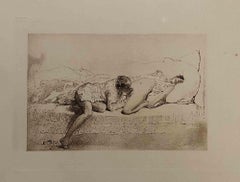
Erotic scene is an original Héliogravure artwork on ivory-colored paper, realized by Micheal Von Zichy in 1911. Printed in only 300 copies, Leipzig; Privatdruck, from the Catalogue "Liebe" (Dear), Text in German on the plate, The drawing created unusually bold erotic subjects through deft strokes. Good conditions. Mihály Zichy...

Category

Modern 1910s Art

Materials

Paper, Engraving

Gathering Wildflowers on a Breezy Day

Gathering Wildflowers on a Breezy Day

Located in Saratoga Springs, NY

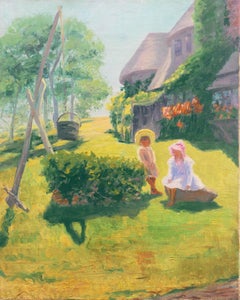
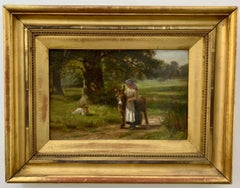
Clarence Montfort Gihon (1871 Philadelphia - 1929 France) Gathering Wildflowers on a Breezy Day Oil on Canvas, 39 x 32 inches, 49 ½ x 43 inches frame size Provenance: Sotheby’s 4186,...

Category

Post-Impressionist 1910s Art

Materials

Canvas, Oil

'Self-Portrait', Paris Salon, Royal Danish Academy, Impressionist oil, Benezit

'Self-Portrait', Paris Salon, Royal Danish Academy, Impressionist oil, Benezit

By Julius Paulsen

Located in Santa Cruz, CA

Initialed lower left, 'J.P' for Julius Paulsen (Danish, 1860-1940) and painted circa 1910. A dramatic, early twentieth-century work by this notable Post-Impressionist painter and th...

Category

Impressionist 1910s Art

Materials

Canvas, Oil

Erotic Scene - Héliogravure by Micheal Von Zichy - 1911

Erotic Scene - Héliogravure by Micheal Von Zichy - 1911

Located in Roma, IT

Erotic scene is an original Héliogravure artwork on ivory-colored paper, realized by Micheal Von Zichy in 1911. Printed in only 300 copies, Leipzig; Privatdruck, from the Catalogue ...

Category

Modern 1910s Art

Materials

Paper, Engraving

Erotic Scene - Héliogravure by Micheal Von Zichy - 1911

Erotic Scene - Héliogravure by Micheal Von Zichy - 1911

Located in Roma, IT

Erotic scene is an original Héliogravure artwork on ivory-colored paper, realized by Micheal Von Zichy in 1911. Printed in only 300 copies, Leipzig; Privatdruck, from the Catalogue "Liebe" (Dear), Text in German on the plate, The drawing created unusually bold erotic subjects through deft strokes. Good conditions. Mihály Zichy...

Category

Modern 1910s Art

Materials

Paper, Engraving

Antique American Marine Seascape Oil Painting Crashing Surf Atlantic Coast Maine

Antique American Marine Seascape Oil Painting Crashing Surf Atlantic Coast Maine

By Frederick Judd Waugh

Located in Portland, OR

A fine antique seascape oil painting on panel by the celebrated marine artist, Frederick Judd Waugh (1861-1940), depicting the Atlantic of the coast of Maine, circa 1910. The painting is finely executed with bold and decisive brush strokes with crisp edges, one can almost hear the roar of the ocean as the surf crashes upon the rocks. The painting is signed lower right "Waugh" and is housed in the original carved & gilded frame. Condition is very good indeed, this fine seascape by one of America's most acclaimed late 19th early 20th century marine artists is ready to grace your wall. The painting will be accompanied with a certicificate of authenticity & provenance. Frederick Judd Waugh was an American artist, primarily known as a marine artist. During World War I, he designed ship camouflage for the U.S. Navy, under the direction of Everett L. Warner. Waugh was the son of a well-known Philadelphia portrait painter, Samuel Waugh. He studied at the Pennsylvania Academy of Fine Arts with Thomas Eakins, and at the Académie Julian in Paris with Adolphe-William Bouguereau. After leaving Paris, he moved to England, residing on the island of Sark in the English Channel, where he made his living as a seascape painter. In 1898 he was recorded as living in Heath and Reach, Bedfordshire. In 1908, Waugh returned to the U.S., settling in Montclair Heights, New Jersey. He had no studio until art collector William T. Evans (a railroad financier and President of the dry goods firm, Mills Gibbs Corporation) offered him one in exchange for one painting a year. In later years, he lived on Bailey Island, Maine, and in Provincetown, Massachusetts. Waugh’s marinescapes were highly acclaimed, garnering him the Popular Prize at the Carnegie International Exhibition for five years in a row, a feat accomplished by no other artist. In 1914, he was a judge of the art exhibit on Monhegan Island, Maine during the 1914 Ter-Centenary celebration of the Voyage of Captain John Smith. In addition to his marinescapes, Waugh sometimes published work in periodicals, such as The Green Sheaf, to which he contributed at least one illustration. He also produced paintings and sketches on legendary and mythological themes; see, for instance, his 1921 sketch “Levitation in Dream No. 3”, and his c. 1912 painting “The Knight of the Holy Grail”. In 1918, Waugh was recommended to serve as a camouflage artist (or camoufleur) for the U.S. Navy, as a member of the Design Section of its marine camouflage unit. That section was located in Washington, D.C., and was headed by American painter Everett L. Warner. According to a biography of Waugh, “Many large ships, including the Leviathan, were painted according to his designs. Though the enterprise was of course a team effort in which no man played a solo part, he had every reason to be proud of his record. Only one ship with his system of camouflage was lost during the war”. Waugh was known to produce literary work, publishing a short poem in Pamela Colman Smith’s short-lived periodical The Green Sheaf; a fairy tale in The English Illustrated Magazine; and, in 1916, the book The Clan of Munes...

Category

Realist 1910s Art

Materials

Oil, Panel

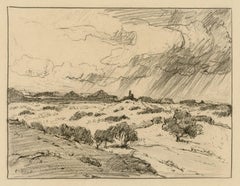
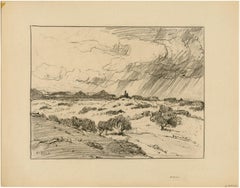
Post-Impressionist Painting By Dick Beer, Stormy Weather in St.Arnoult, 1917

Post-Impressionist Painting By Dick Beer, Stormy Weather in St.Arnoult, 1917

Located in Stockholm, SE

Dick Beer (b. London 1893 - d. Stockholm 1938) Title: Stormy Weather in St.Arnoult Dick Beer was born in London in 1893. His father, John Beer (1853-1906), was a Swedish painter from Stockholm who had a career mainly as a watercolour painter with motifs of horses from racetracks and fox hunts from the countryside. Barely fifteen years old, Dick Beer became an orphan and came to Sweden in 1907. Already in 1908-1909, he started at Althin's painting school in Stockholm. And later, at the Royal Academy of Arts from 1910-1912. His teachers were, among others, Gustaf Cederström, Oscar Björk and Alfred...

Category

Post-Impressionist 1910s Art

Materials

Canvas, Oil

Hunting Dog at the Ready (l)- Louis Lartigau (French, 19th/20th)

Hunting Dog at the Ready (l)- Louis Lartigau (French, 19th/20th)

Located in SANTA FE, NM

Hunting Dog at the Ready (L) Louis Lartigau (French, 19th/20th) Oil on canvas 9 1/8 x 11 3/4 (frame) Signed lower right A very finely drawn and executed painting of a hunting dog at...

Category

1910s Art

Materials

Canvas, Oil

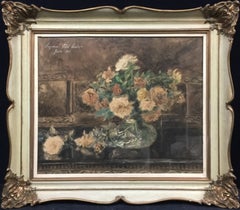
Roses Still Life Watercolor by M Boyer Cooper 1915

Roses Still Life Watercolor by M Boyer Cooper 1915

Located in Soquel, CA

Roses Still Life Watercolor by M Boyer Cooper 1915 Water of bouquet of Roses by California artist M Boyer Cooper circa 1915. (aunt of Opal Nelson Dean). Signed lower right "M. Cooper...

Category

American Impressionist 1910s Art
Materials

Watercolor, Laid Paper

The Serpent, Impressionist Woodcut by Raoul Dufy

The Serpent, Impressionist Woodcut by Raoul Dufy

By Raoul Dufy

Located in Long Island City, NY

Raoul Dufy, French (1877 - 1953) - The Serpent, Year: c. 1911, Medium: Woodcut on laid paper, Image Size: 8 x 7.5 inches, Size: 11.25 x 8.75 in. (28.58 x 22.23 cm), Description: Fr...

Category

Impressionist 1910s Art
Materials

Woodcut

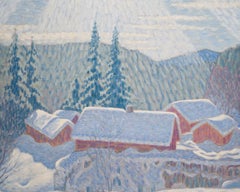
A Rare Winter Landscape With Clouds by Sam Uhrdin (1910)

A Rare Winter Landscape With Clouds by Sam Uhrdin (1910)

By Sam Uhrdin

Located in Stockholm, SE

This atmospheric landscape from 1910 offers a rare glimpse into a lesser-known side of Sam Uhrdin’s work. Painted before his formal art education, the canvas reveals an emerging arti...

Category

Post-Impressionist 1910s Art
Materials

Canvas, Oil

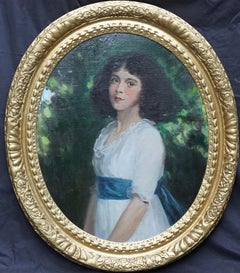
Antique American Impressionist Expressive Young Woman Oil Painting Portrait

Antique American Impressionist Expressive Young Woman Oil Painting Portrait

Located in Buffalo, NY

Very finely painted late 19th or early 20th century portrait painting. Oil on canvas. In excellent original condition. Handsomely framed in a giltwood molding. Excellent conditio...

Category

Impressionist 1910s Art
Materials

Canvas, Oil

Erotic Scene - Héliogravure by Micheal Von Zichy - 1911

Erotic Scene - Héliogravure by Micheal Von Zichy - 1911

Located in Roma, IT

Erotic scene is an original Héliogravure artwork on ivory-colored paper, realized by Micheal Von Zichy in 1911. Printed in only 300 copies, Leipzig; Privatdruck, from the Catalogue ...

Category

Modern 1910s Art

Materials

Paper, Engraving

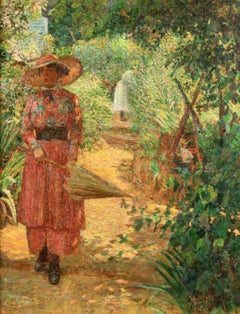
Au Jardin
Au Jardin

Au Jardin

By Georges d'Espagnat

Located in Mc Lean, VA

Elegant figures in a spring garden with mother and child. Colors are pure and fresh. Has everything that one would want in a D'espagnat . A top 2 % work by this artist .. Signed ...

Category

1910s Art

Materials

Oil

The Old Days - Historical Photo  - 1913

The Old Days - Historical Photo - 1913

Located in Roma, IT

The Old Days - Historical Photo  is a black and white vintage photo, realized in 1913.  Good conditions and aged.

Category

Modern 1910s Art

Materials

Photographic Paper

"Lago Maggiore" original lithograph

"Lago Maggiore" original lithograph

Located in Henderson, NV

Medium: original lithograph. Catalogue reference: Jentsch 91. This impression on wove paper was printed in 1919 for Das Kestnerbuch, an important collection of original prints publis...

Category

Expressionist 1910s Art
Materials

Lithograph

WWI American Scene Ashcan Modern 20th Century Historical Realism Industrial WPA

WWI American Scene Ashcan Modern 20th Century Historical Realism Industrial WPA

By Gerrit Beneker

Located in New York, NY

WWI American Scene Ashcan Modern 20th Century Historical Realism Industrial WPA "Constant Driving Will Win the War," 30 x 40 inches. Oil on canvas. Signed and dated 1918 lower right. In 1905, Gerrit Beneker began his art career as an illustrator. He married Flora Judd, his high school sweetheart from Grand Rapids and they moved to Brooklyn, NY. Gerrit's early passion was to create an art that would inspire and provide honor to the workingman. As such, he had no interest in painting portraits of pretty women, which were so often seen on the magazine covers of the day. Rather he wanted to seek out workingmen on the bridges, tunnels and skyscrapers of NYC, and paint them in their environments. He completed over 150 magazine covers, numerous ads including many for Ivory Soap...

Category

1910s Art

Materials

Canvas, Oil

Sparrows, Sumi-e Ink on Paper, Signed Kahô, Japan, 1919 (#000036)

Sparrows, Sumi-e Ink on Paper, Signed Kahô, Japan, 1919 (#000036)

Located in Frankfurt am Main, DE

Nakajima Kahô (1866-1939) Sparrows Ink on paper Signed: Kahô sha and dated: Taishô, Year of the Sheep, early spring Japan. Kyoto, early spring 1919 31.8 x 45.6 cm Nakajima Kahô...

Category

Showa 1910s Art

Materials

Paper, Ink

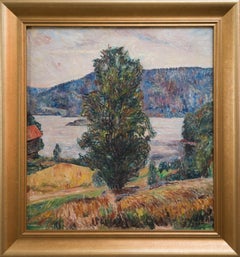
View from Månberget, Källvik (1912)

View from Månberget, Källvik (1912)

Located in Stockholm, SE

The view from Månberget at sunset, as captured by Gottfrid Kallstenius in this 1912 oil painting, displays a warm golden light over Djupsundet, framed by the silhouette of a gnarled ...

Category

Romantic 1910s Art

Materials

Canvas, Oil

"Three Mountaintops Emerging From Fog" Copper Plate Heliogravure

"Three Mountaintops Emerging From Fog" Copper Plate Heliogravure

By Ferdinand Hodler & R. Piper & Co.

Located in Palm Beach, FL

2018 marks the centenary anniversary of Ferdinand Hodler’s death. In that 100 years time, the art world’s esteem of this important artist has proved fickle. It has shifted from extolling his artistic merits during his lifetime to showing something of a feigned disdain- more reflective of the world political order than a true change of heart for Hodler’s work. After years of Hodler being all but a footnote in the annals of art history and generally ignored, finally, the pendulum has righted itself once again. Recent retrospective exhibitions in Europe and the United States have indicated not only a joyful rediscovery of Hodler’s art but a firm conviction that his work and world view hold particular relevance today. DAS WERK FERDINAND HODLERS is not only a collection of printed work reflecting the best of all of his painted work created up to 1914 just before the outbreak of World War I, the portfolio itself is an encapsulation of Hodler’s ethos, Parallelisme. Hodler developed his philosophy of Parallelisme as a unifying approach to art which strips away detail in search of harmony. By means of abstraction, symmetry and repetition, Hodler sought ways to depict Nature’s essence and her fundamental, universal order. He believed these universal laws governing the natural, observable world extend to the spiritual realm. Symbolist in nature with Romantic undertones, his works are equally portraits of these universal concepts and feelings governing all life as they are a visual portrait in the formal sense. Whether his subject is a solitary tree, a moment in battle, mortal fear, despair, the awe inspired by a vast mountain range, a tender moment or even the collective conviction in a belief, Hodler unveils this guiding principle of Parallelisme. Several aspects of Hodler’s portfolio reinforce his tenets of Parallelisme. The Table of Contents clearly preferences a harmonious design over detail. The two columns, consisting of twenty lines each, list the images by order of appearance using their German titles. The abbreviated titles are somewhat cryptic in that they obscure the identities of the sitters. Like the image Hodler presents, they are distillations of the sitter without any extraneous details. This shortening was also done in an effort to maintain a harmonious symmetry of the Table of Contents, themselves, and keep titles to a one-line limit. The twenty-fourth title: “Bildnis des Schweizerischen Gesandten C.” was so long, even with abbreviation, that it required two lines; so, for the sake of maintaining symmetry, the fortieth title: “Bauernmadchen” was omitted from the list. This explains why the images are not numbered. Hodler’s reasoning is not purely esoteric. Symmetry and pattern reach beyond mere formal design principles. Finding sameness and imposing it over disorder goes to the root of Hodler’s identity and his art. A Swiss native, Hodler was bi-lingual and spoke German and French. Each printed image, even number forty, have titles in both of Hodler’s languages. Certainly, there was a market for Hodler’s work among francophones and this inclusion may have been a polite gesture to that end; however, this is the only place in the portfolio which includes French. With German titles at the lower left of each image, Hodler’s name at bottom center and corresponding French titles at the lower right of each image, there is a harmony and symmetry woven into all aspects of the portfolio. This holds true for the page design, as it applies to each printed image and as it describes the Swiss artist himself. Seen in this light, Hodler’s portfolio of printed work is the epitome of Hodler’s Parallelisme. DAS WERK FERDINAND HODLERS is also one of the most significant documents to best tell the story of how Hodler, from Switzerland, became caught between political cross-hairs and how the changing tides of nations directly impacted the artist during his lifetime as well as the accessibility of his art for generations to come. The Munich-based publisher of the portfolio, R. Piper & Co., Verlag, plays a crucial role in this story. Publishing on a wide range of subjects from philosophy and world religion to music, literature and the visual arts; the publisher’s breadth of inquiry within any one genre was equal in scope. Their marketing strategy to publish multiple works on Hodler offers great insight as to what a hot commodity Hodler was at that time. R.Piper & Co.’s Almanach, which they published in 1914 in commemoration of their first ten years in business, clearly illustrates the rapid succession- strategically calculated for achieving the deepest and broadest impact - in which they released three works on Hodler to hit the market by the close of 1914. DAS WERK FERDINAND HODLERS was their premier publication. It preceded C.A. Loosli’s Die Zeichnungen Ferdinand Hodlers, a print portfolio after 50 drawings by Hodler which was released in Autumn of 1914 at the mid-level price-point of 75-150 Marks; and a third less expensive collection of prints after original works by Hodler, which had not been included in either of the first two portfolios, was released at the end of that year entitled Ferdinand Hodler by Dr. Ewald Bender. The title and timing of DAS WERK FERDINAND HODLERS' debut leaves little doubt as to the connection it has with another avant-garde portfolio of art prints, Das Werk Gustav Klimts, released in 5 installments from 1908 -1914 by Galerie Miethke in Vienna. Hodler, himself, was involved in Klimt’s ground-breaking project. As the owner of Klimt’s 1901 painting, “Judith with the Head of Holifernes” which appears as the ninth collotype print in the second installment of Das Werk Gustav Klimts, Hodler was obliged to grant access of the painting to the art printers in Vienna for them to create the collotype sometime before 1908. Hodler had been previously invited in 1904 to take part in what would be the last exhibition of the Vienna Secession before Klimt and others associated with Galerie Miethke broke away. In an interview that same year, Hodler indicated that he respected and was impressed by Klimt. Hodler’s esteem for Klimt went beyond the art itself; he emulated Klimt’s method aimed at increasing his market reach and appeal to a wider audience by creating a print portfolio of his painted work. By 1914, Hodler and his publisher had the benefit of hindsight to learn from Klimt’s Das Werk publication. Responding to the sluggish sales of Klimt’s expensive endeavor, Hodler’s publisher devised the same diversified 1-2-3 strategy for selling Hodler’s Das Werk portfolio as they did with regards to all three works on Hodler they published that year. For their premium tier of DAS WERKS FERDINAND HODLERS, R. Piper & Co. issued an exclusive Museum quality edition of 15 examples on which Hodler signed each page. At a cost of 600 Marks, this was generally on par with Klimt’s asking price of 600 Kronen for his Das Werk portfolio. A middle-tiered Preferred edition of 30, costing somewhat less and with Hodler’s signature only on the Title Page, was also available. The General edition, targeting the largest audience with its much more affordable price of 150 Marks, is distinguishable by its smaller size. Rather than use the subscription format Miethke had chosen for Klimt’s portfolios which proved to have had its challenges, R. Piper & Co. employed a different strategy. In addition to instantly gratifying the buyer with all 40 of the prints comprising DAS WERK FERDINAND HODLERS and the choice among three price points, they advertised in German journals a fourth possibility of ordering single prints from them directly. These printed images are easily discernible from the three complete folio editions. The paper size of the single purchased images is of the larger format like the Museum and Preferred editions, measuring 65 h x 50 w cm; however, the paper itself is the same copper print paper used in the General edition and then mounted on poster board. The publishing house positioned itself to be a direct retailer of Hodler’s art. They astutely recognized the potential for profitability and the importance, therefore, of having proprietary control over his graphic works. R. Piper & Co. owned the exclusive printing rights to Hodler’s best work found in their three publications dating from 1914. That same year, a competing publication out of Weimar entitled Ferdinand Hodler: Ein Deutungsversuch von Hans...

Category

Symbolist 1910s Art

Materials

Paper

Etching 1916 Number II

Etching 1916 Number II

By Wassily Kandinsky

Located in New York, NY

Wassily Kandinsky (1866-1944), Etching 1916 Number II, drypoint, signed in pencil lower right, titled, numbered (No. 9) and dated lower left [also with initials and date in the plate lower right]. Reference: Roethel 154, only state, edition of 10. In excellent condition (the barest handling fold at sheet edge), printed on a heavy ivory wove paper, the full sheet with full margins, 4 7/8 x 3 1/4, the sheet 17 1/2 x 13 inches, archival mount with window mat. A fine fresh impression of this great rarity, printed in a dark brown ink. Kandinsky created this drypoint (erroneously named Etching 1916) in early 1916 while staying with Gabriel Munter in Stockholm during the winter of 1915-16. This is from the second series of drypoints he made; the first was in the year 1913-14. Provenance: Kornfeld Auction, Bern, June 2007. The tiny size of this edition (10) makes this print a great rarity within the Kandinsky’s printed...

Category

Abstract 1910s Art

Materials

Drypoint

The Old Days - Historical Photo -  The Early 20th century

The Old Days - Historical Photo - The Early 20th century

Located in Roma, IT

The Old Days - Historical Photo is a black and white vintage photo, realized in Early 20th century.  It belongs to historical album including historical moment, royal families, and ...

Category

Modern 1910s Art

Materials

Photographic Paper

“India, 1912”
“India, 1912”

“India, 1912”

Located in Southampton, NY

Original watercolor and gouache on paper of a busy street scene in India done in 1912 by the American artist, William Henry Drake. Copyrighted signed and dated 1912 lower left. Condition is good. Recently professionally matted. Unframed. Overall matte size is 12 by 16 inches. Provenance: A Long Island, New York estate. William Henry Drake Born: 1856 New York Died: 1926 Los Angeles Nationality: American Education: Académie Julian, Art Students League of New York Known for: Painting, illustration Awards: National Academy Biography: Drake studied at the Académie Julian in Paris, with Jean-Joseph Benjamin-Constant and Henri Lucien Doucet. Back from Europe, he studied at the Cincinnati School of Design, and would often go to the zoo, where he could draw the animals. He was then employed by the Museum of Natural History. He continued to study at the Art Students League of New York. In 1878 he worked as a freelance pen-and-ink artist for such periodicals as Century or Harper’s with animal studies...

Category

Academic 1910s Art

Materials

Paper, Watercolor, Gouache

Meditation, Oil, Figurative, Nude, Impressionist, Early 20th Century

Meditation, Oil, Figurative, Nude, Impressionist, Early 20th Century

By Henry R. Rittenberg

Located in Wiscasset, ME

Henry R. Rittenberg, a native of Libau, Latvia, studied at the Pennsylvania Academy of Fine Art and continued to live and work in Philadelphia and New York for the majority of his ca...

Category

Impressionist 1910s Art
Materials

Oil, Canvas

The Old Days - Historical Photo  - 1913

The Old Days - Historical Photo - 1913

Located in Roma, IT

The Old Days - Historical Photo  is a black and white vintage photo, realized in 1913.  It belongs to historical album including historical moment, royal families, and political eve...

Category

Modern 1910s Art

Materials

Photographic Paper

Dejeuner sur l'Herbe

Dejeuner sur l'Herbe

By After Paul Cezanne

Located in Fairlawn, OH

Dejeuner sur l'Herbe Lithograph, c. 1914 Edition: c. 100 Unsigned as issued by Vollard References And Exhibitions: Commissioned from Cezanne by Ambrose Vollard in the late 1890s Prin...

Category

French School 1910s Art

Materials

Lithograph

Sitting Nude - Female nude after the original drawing of Gustav Klimt art deco

Sitting Nude - Female nude after the original drawing of Gustav Klimt art deco

By (after) Gustav Klimt

Located in Hamburg, DE

"Sitting Nude" (1963) is a lithograph based on Gustav Klimt's original drawing of 1914-16. It depicts in his typical art deco style a nude woman posing with her arms over her head. ...

Category

Art Deco 1910s Art

Materials

Lithograph

"Zehlendorf" original lithograph

"Zehlendorf" original lithograph

By Rudolf Grossmann

Located in Henderson, NV

Medium: original lithograph. This is one of the Berlin Scenes executed by Rudolf Grossmann during the years before World War I and published in Germany by Bruno Cassirer from 1911-14...

Category

Expressionist 1910s Art
Materials

Lithograph

Sunset in the Forest, c. 1910

Sunset in the Forest, c. 1910

Located in Stockholm, SE

This luminous painting by Oscar Lycke captures a tranquil sunset scene deep within a Nordic forest. The warm, golden light of the setting sun filters through the dense spruce trees, ...

Category

Post-Impressionist 1910s Art
Materials

Oil, Board