1910s Art

2,172 Results
to
246
1,148
357
401
195
189
Overall Width
to
Overall Height
to
7,639
21,536
166,308
236,340
2,158
2,340
4,730
6,562
6,041
15,973
21,232
26,542
19,290
14,061
5,454
473
291
144
127
52
35
19
12
5
1
1,267
933
38
1,468
717
617
421
393
368
223
147
145
141
132
131
117
106
99
93
83
79
61
59
866
629
514
430
408
136
53
33
23
23
893
443
1,197
1,110
Period: 1910s
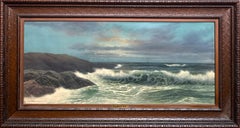
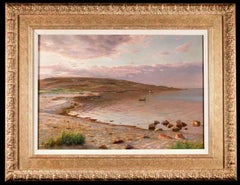
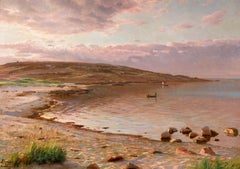
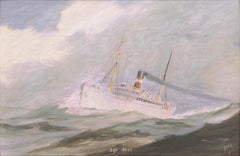
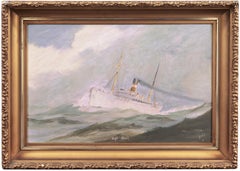
Twilight Crashing Surf”

Twilight Crashing Surf”

By George Howell Gay

Located in Southampton, NY

Original watercolor on archival paper by the well known American artist, George Howell Gay. Signed lower left by the artist. Circa 1910. Condition is excellent. Great vibrant colo...

Category

Academic 1910s Art

Materials

Watercolor, Archival Paper

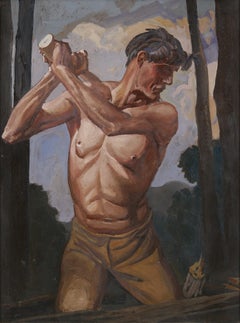
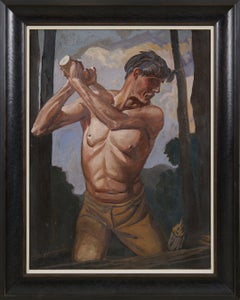
The Wood Chopper, Brecksville, Ohio, Early 20th Century Cleveland School

The Wood Chopper, Brecksville, Ohio, Early 20th Century Cleveland School

By Frank Wilcox

Located in Beachwood, OH

Frank Nelson Wilcox (American, 1887-1964) The Wood Chopper, Brecksville, Ohio, c. 1917 Oil on masonite 33 x 24 inches "We were fortunate in that the two farms in Brecksville were still open to our visits. The urbanization of the township was then only beginning and we spent several summers there where I tried to capture something of the rural peace so soon to be erased from the countryside." - Wilcox Exhibited: “Water Colors and Oils by Frank N. Wilcox,” Cleveland Museum of Art, January 1937. Frank Nelson Wilcox (October 3, 1887 – April 17, 1964) was a modernist American artist and a master of watercolor. Wilcox is described as the "Dean of Cleveland School...

Category

American Modern 1910s Art

Materials

Oil

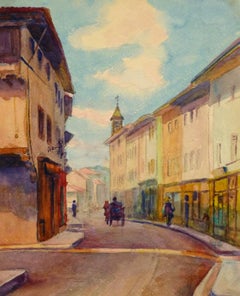
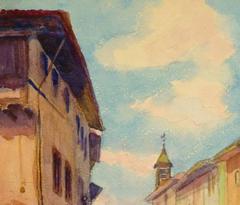
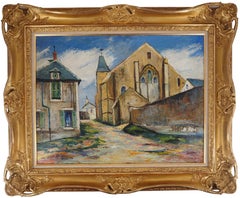
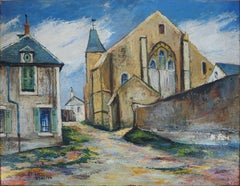
Antique French Town Watercolor Painting

Antique French Town Watercolor Painting

By Alphonse Soumers

Located in Houston, TX

Mesmerizing one-of-a-kind watercolor of an old town French street scene by artist Alphonse Soumers, circa 1920. Original one-of-a-kind vintage work of art on paper displayed on a w...

Category

Other Art Style 1910s Art

Materials

Paper, Watercolor

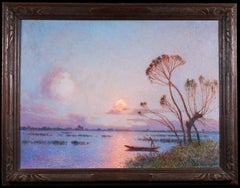
Clair de Lune - Post Impressionist Landscape Oil by Ferdinand du Puigaudeau

Clair de Lune - Post Impressionist Landscape Oil by Ferdinand du Puigaudeau

By Ferdinand du Puigaudeau

Located in Marlow, Buckinghamshire

Signed post impressionist riverscape oil on canvas circa 1910 by French painter Ferdinand du Puigaudeau. The work depicts a view of La Briere - a wetland region in France - by moonli...

Category

Post-Impressionist 1910s Art

Materials

Canvas, Oil

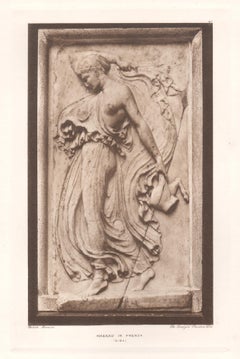
Maenad in Frenzy, British Museum Roman Classical sculpture photogravure

Maenad in Frenzy, British Museum Roman Classical sculpture photogravure

Located in Melbourne, Victoria

'Maenad in Frenzy' Photogravure from a collection of photogravures depicting Greek and Roman marbles and bronzes in the British museum. Plate number above top right corner of the im...

Category

Other Art Style 1910s Art

Materials

Photogravure

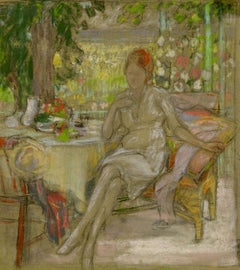
Woman on a Patio, Pastel on Paper, Abstract Impressionist, Circa 1915

Woman on a Patio, Pastel on Paper, Abstract Impressionist, Circa 1915

By Karl Albert Buehr

Located in Fairlawn, OH

Woman on a Patio Pastel on paper, c. 1915 Unsigned Provenance: Gift of the artist to his wife, Mary Hess Buehr By decent to the artist's niece, daughter of Will Hess David Saltzman Robert Henry Adams Fine Art Thomas French Fine Art Ronald C. Sloter, Columbus, Ohio Columbus College of Art and Design (de-accessed) Exhibited at Robert Henry Adams Fine Art, 1994, the first exhibition at the North Franklin Street Gallery. One of the early Chicago artists to adopt Impressionism, Karl Buehr became a figure and landscape painter. As a figure painter, his specialty became "gorgeously colored images of young women on porches overlooking brilliant summertime gardens." (Kennedy 98) His later work often showed a female figure with serious expression engaging the viewer with a direct stare. In his landscapes, he was noted for his strong coloration. In a December 1896 student exhibition at the Art Institute, a reviewer for the "Chicago Times Herald" described Buehr's landscapes as "blithe and joyous" with "country roads brilliant in sunlight . . . fields rich in summer verdure, under soft skies painted in a high, musical key." (Gerdts 68) Buehr was born as one of seven sons to a prosperous German family who immigrated to America and settled in Chicago in 1869. He was first exposed to his signature style of Impressionism in 1888 when he enrolled in night classes at the Art Institute while working in the shipping department of a lithographic firm near the Institute. He remained a student there until 1897 and was recognized in a "Chicago Times Herald" editorial of June 13, 1897 as one of the Institute's most outstanding pupils. The next year, his art career was temporarily put on hold when he briefly enlisted with the U.S. Army in the Spanish American War. In 1899, he resumed his art studies, this time with Frank Duveneck. He exhibited a painting at the Paris Salon of 1900. In 1905, thanks to a wealthy Chicago patron, Buehr and his family moved to France. They spent the following year in Taormina, Sicily, and spent time in Venice as well. In Paris, Buehr studied at the Academy Julian with Raphael Collin for two years. Then he went to England, enrolling in the London Art School but had returned to Paris by 1908. During this time, he began painting at Giverny, the home of Impressionist leader Claude Monet (1840-1926, and by 1912, Buehr was listing that village as his home address. One of his good friends and associates at Giverny was Frederick Frieseke. One of Buehr's paintings from that time, "News from Home", was exhibited in 1913 at the French Salon in Paris and at the annual exhibit of the Chicago Art Institute. It shows a woman in floral dress sitting on a porch with a background with potted flowers and lush greenery background. Of his painting done at Giverny, Buehr wrote in 1912 to William Macbeth of Macbeth Galleries in New York: "My figures painted in and around Giverny are costumed and in appropriate out door settings." (Gerdts 68) In 1914, he returned to the United States and took a teaching position in Chicago at the Art Institute, which he held for the remainder of his life. He was married to Mary Hess, a painter of miniatures and decorative works. In 1928-29, he was a guest artist at Stanford University. Courtesy, AskArt “Karl Albert Buehr (1866–1952) was a painter born in Germany. Buehr was born in Feuerbach - near Stuttgart. He was the son of Frederick Buehr and Henrietta Doh (Dohna?). He moved to Chicago with his parents and siblings in the 1880s. In Chicago, young Karl worked at various jobs until he was employed by a lithograph company near the Art Institute of Chicago. Introduced to art at work, Karl paid regular visits to the Art Institute, where he found part-time employment, enabling him to enroll in night classes. Later, working at the Institute as a night watchman, he had a unique opportunity to study the masters and actually posted sketchings that blended in favorably with student's work. Having studied under John H. Vanderpoel, Buehr graduated with honors, while his work aroused such admiration that he was offered a teaching post there, which he maintained for many years thereafter. He graduated from the Art Inst. of Chicago and served in the IL Cav in the Spanish–American War. Mary Hess became Karl's wife—she was a student of his and an accomplished artist in her own right. In 1922, he was elected into the National Academy of Design as an Associate member. Art Studies in Europe In 1904, Buehr received a bronze medal at the St. Louis Universal Exposition, then, in 1905, Buehr and his family moved to France, thanks to a wealthy Chicago patron, and they spent the following year in Taormina, Sicily, where the artist painted local subjects, executing both genre subjects and landscapes as well as time in Venice. Buehr spent at least some time in Paris, where he worked with Raphaël Collin at the Académie Julian. Giverny and American Impressionism Prior to this time, Buehr had developed a quasi-impressionistic style, but after 1909, when he began spending summers near Monet in Giverny, his work became decidedly characteristic of that plein-air style but he began focusing on female subjects posed out-of-doors. He remained for some time in Giverny, and here he became well-acquainted with other well known expatriate America impressionists such as Richard Miller, Theodore Earl Butler, Frederick Frieseke, and Lawton Parker. It seems likely that Buehr met Monet, since his own daughter Kathleen and Monet’s granddaughter, Lili Butler, were playmates, according to George Buehr, the painter’s son. His other daughter Lydia died before adulthood due to diabetes. He returned to Chicago at the onset of World War I and taught at The Art Inst for many years. One of his noted pupils at the Art Institute was Archibald Motley...

Category

Abstract Impressionist 1910s Art

Materials

Pastel

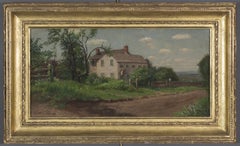
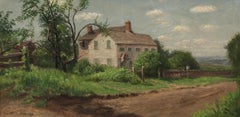
A house in the country, probably near Morristown NJ

A house in the country, probably near Morristown NJ

By Frank Waller

Located in Philadelphia, PA

Frank Waller (American, 1842-1923) House in the Country Oil on canvas, 10 1/2 x 20 1/4 inches FRAMED: 16 x 26 inches (approx.) Signed and dated at lower left: "Frank Waller Study 19...

Category

Realist 1910s Art

Materials

Canvas, Oil

The Harbor

The Harbor

Located in Wiscasett, ME

Beautiful impasto, oil on canvas. Contemporary custom frame. Unsigned, but very well executed painting.

Category

Post-Impressionist 1910s Art

Materials

Oil

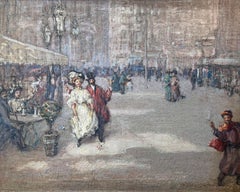
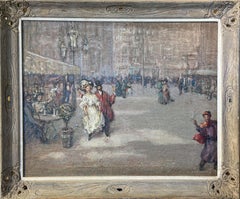
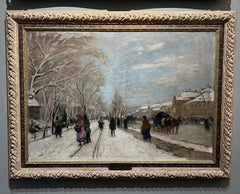
Winter Street Scene
Winter Street Scene

Winter Street Scene

Located in Houston, TX

Antal Berkes (1874-1938) Antal Berkes (1874–1938) was a Hungarian painter, born in Budapest, Hungary. He lived in Paris for some time and produced cityscapes there as well as simi...

Category

Other Art Style 1910s Art

Materials

Oil

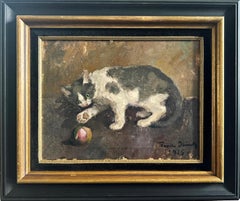
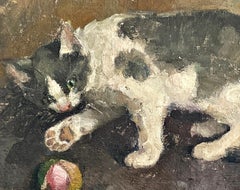
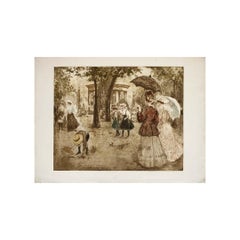
Frode Kierulf, Danish Impressionist "Playing Cat 1916" Oil Painting

Frode Kierulf, Danish Impressionist "Playing Cat 1916" Oil Painting

Located in Eltville am Rhein, DE

Frode Kierulf Copenhagen 1889 - 1963 Playing Cat, 1916 Oil on canvas Signed lower right and dated "1916" Size: 33 x 43 cm Frame: 55 x 65 cm Authenticity guaranteed in writing. D...

Category

Impressionist 1910s Art
Materials

Oil

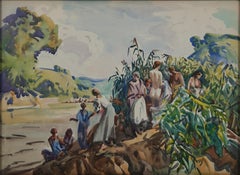
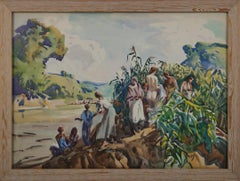
Women's Corner, Along the Cuyahoga River, Early 20th Century Landscape

Women's Corner, Along the Cuyahoga River, Early 20th Century Landscape

By Frank Wilcox

Located in Beachwood, OH

Frank Nelson Wilcox (American, 1887-1964) Women's Corner, Along the Cuyahoga River, c. 1916 Watercolor and graphite on paper 21 x 29 inches Frank Nelson Wilcox (October 3, 1887 – April 17, 1964) was a modernist American artist and a master of watercolor. Wilcox is described as the "Dean of Cleveland School painters," though some sources give this appellation to Henry Keller or Frederick Gottwald. Wilcox was born on October 3, 1887 to Frank Nelson Wilcox, Sr. and Jessie Fremont Snow Wilcox at 61 Linwood Street in Cleveland, Ohio. His father, a prominent lawyer, died at home in 1904 shortly before Wilcox' 17th birthday. His brother, lawyer and publisher Owen N. Wilcox, was president of the Gates Legal Publishing Company or The Gates Press. His sister Ruth Wilcox was a respected librarian. In 1906 Wilcox enrolled from the Cleveland School of Art under the tutelage of Henry Keller, Louis Rorimer, and Frederick Gottwald. He also attended Keller's Berlin Heights summer school from 1909. After graduating in 1910, Wilcox traveled and studied in Europe, sometimes dropping by Académie Colarossi in the evening to sketch the model or the other students at their easels, where he was influenced by French impressionism. Wilcox was influenced by Keller's innovative watercolor techniques, and from 1910 to 1916 they experimented together with impressionism and post-impressionism. Wilcox soon developed his own signature style in the American Scene or Regionalist tradition of the early 20th century. He joined the Cleveland School of Art faculty in 1913. Among his students were Lawrence Edwin Blazey, Carl Gaertner, Paul Travis, and Charles E. Burchfield. Around this time Wilcox became associated with Cowan Pottery. In 1916 Wilcox married fellow artist Florence Bard, and they spent most of their honeymoon painting in Berlin Heights with Keller. They had one daughter, Mary. In 1918 he joined the Cleveland Society of Artists, a conservative counter to the Bohemian Kokoon Arts Club, and would later serve as its president. He also began teaching night school at the John Huntington Polytechnic Institute at this time, and taught briefly at Baldwin-Wallace College. Wilcox wrote and illustrated Ohio Indian Trails in 1933, which was favorably reviewed by the New York Times in 1934. This book was edited and reprinted in 1970 by William A. McGill. McGill also edited and reprinted Wilcox' Canals of the Old Northwest in 1969. Wilcox also wrote, illustrated, and published Weather Wisdom in 1949, a limited edition (50 copies) of twenty-four serigraphs (silk screen prints) accompanied by commentary "based upon familiar weather observations commonly made by people living in the country." Wilcox displayed over 250 works at Cleveland's annual May Show. He received numerous awards, including the Penton Medal for as The Omnibus, Paris (1920), Fish Tug on Lake Erie (1921), Blacksmith Shop (1922), and The Gravel Pit (1922). Other paintings include The Trailing Fog (1929), Under the Big Top (1930), and Ohio Landscape...

Category

American Modern 1910s Art

Materials

Watercolor, Graphite

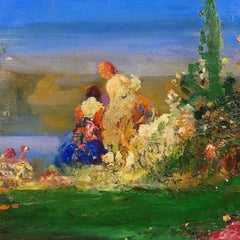
Figures in an Enchanted Garden

Figures in an Enchanted Garden

By Thomas Edwin Mostyn

Located in Naples, Florida

Thomas Edwin Mostyn was an English painter associated with late Victorian and early 20th-century idealism. He is best known for his romantic garden scenes and refined portraits, ofte...

Category

Aesthetic Movement 1910s Art
Materials

Canvas, Oil

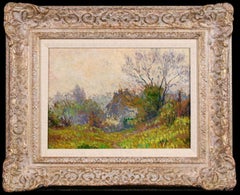
"Ferme a Vauhalan" original etching

"Ferme a Vauhalan" original etching

Located in Henderson, NV

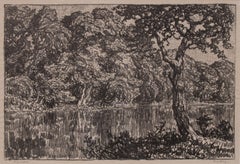
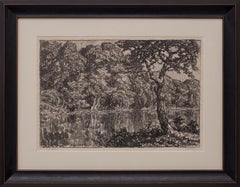
Medium: original etching. Published in 1912 by Gazette des Beaux Arts. Plate size: 5 x 9 1/4 inches (128 x 232 mm) on cream laid paper. Signed in the plate, not by hand. The Gazett...

Category

1910s Art
Materials

Etching

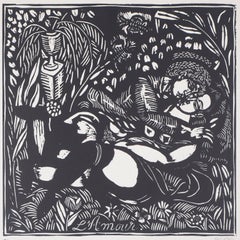
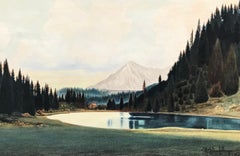
The Love - Original woodcut - Signed

The Love - Original woodcut - Signed

By Raoul Dufy

Located in Paris, IDF

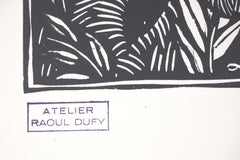
Raoul DUFY The Love, c. 1910 Original woodcut Signed stamp of the artist's studio Numbered on /220 On vellum 50.5 x 65.4 cm (c. 19.6 x 25.5 inch) Excellent condition

Category

Modern 1910s Art
Materials

Woodcut

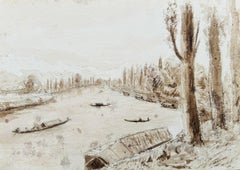
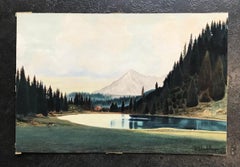
India 3 X 19th century Kashmir NW Frontier Field Sketches Manasbal Lake, Kashmir

India 3 X 19th century Kashmir NW Frontier Field Sketches Manasbal Lake, Kashmir

Located in Norfolk, GB

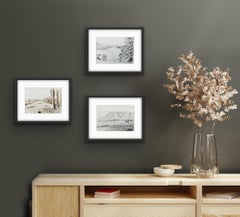
3 Field, on the spot Sketches NW Frontier India : Manasbal Lake, Kashmir Artist: Unknown Medium: Pen & Ink Created: 1890s Size: 13 x 18 cm each A charming set of on-the-spot sketch...

Category

Other Art Style 1910s Art
Materials

Paper, Ink, Pen

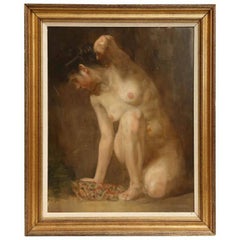
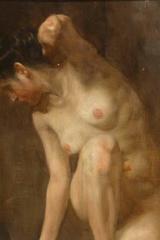
Female Nude in a Studio

Female Nude in a Studio

By Bertalan Karlovszky

Located in Houston, TX

"Female Nude in a Studio" circa 1910. 19 X 13 1/2 inches, oil on wood panel. Etched signature lower right. Well listed Hungarian artist. Spent his student years under the guidance o...

Category

Academic 1910s Art
Materials

Oil

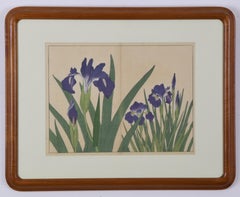
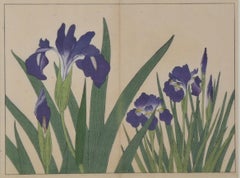
Iris
Iris

Iris

Located in Fairlawn, OH

Tanigami Konan (1879-1928) Iris Color woodcut, 1917-1918 Unsigned (as issued) Note: This print comes from a famous book and has a centerfold as usual. The colors are fresh and unfade...

Category

Other Art Style 1910s Art
Materials

Woodcut

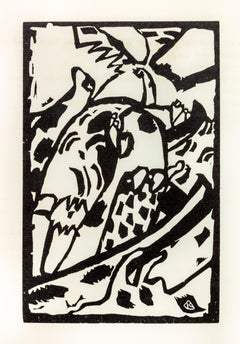
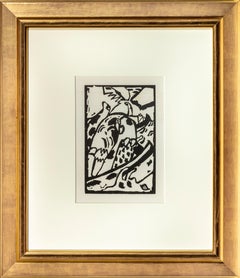
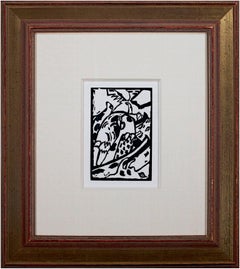
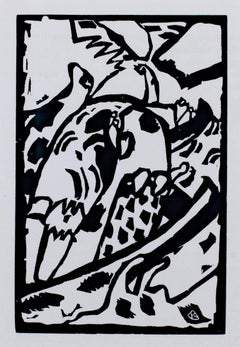
'Improvisation 7' original first ed. woodcut  from 'Klänge' by Wassily Kandinsky

'Improvisation 7' original first ed. woodcut from 'Klänge' by Wassily Kandinsky

By Wassily Kandinsky

Located in Milwaukee, WI

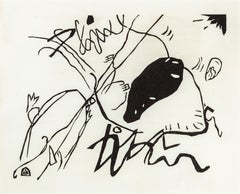
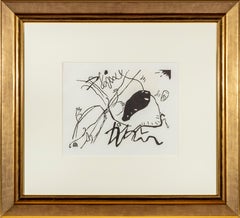
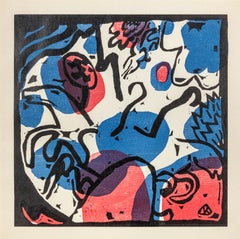
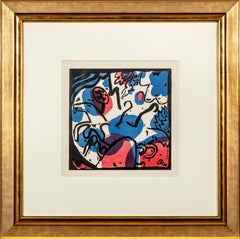
The present woodcut print comes from 'Klänge (Sounds),' a book of original graphics and poetry by Wassily Kandinsky. This first edition was released in an edition of 300, each book signed and numbered by the artist. The title of the album and this particular print, 'Improvisation,' demonstrated Kandinsky's interest in music and how abstract musical forms could be translated into images on a two-dimensional surface. This particular composition is difficult to read, but through the abstraction, one can make out various figures and a landscape beyond. 7.5 x 5 inches, image 22 x 19.5 inches, frame Woodcut in black ink on laid paper (watermark Van Gelder Zonen) Signed with encircled 'K' in the block, lower right Framed to conservation standards using 100 percent acid free archival materials including silk-lined matting with 1/4 inch bevel, museum glass, and a gold-gilded moulding Ref. Roethel 124 The Museum of Modern Art described 'Klänge (Sounds)' as follows: Vasily Kandinsky's self-described "musical album," Klänge (Sounds), consists of thirty-eight prose-poems he wrote between 1909 and 1911 and fifty-six woodcuts he began in 1907. In the woodcuts Kandinsky veiled his subject matter, creating increasingly indecipherable images (though the horse and rider, his symbol for overcoming objective representation, runs through as a leitmotif). This process proved crucial for the development of abstraction in his art. Kandinsky said his choice of media sprang from an "inner necessity" for expression: the woodcuts were not merely illustrative, nor were the poems purely verbal descriptions. Kandinsky sought a synthesis of the arts, in which meaning was created through the interaction of, and space between, text and image, sound and meaning, mark and blank space. The experimental typography shows his interest in the physical aspects of the book. Klänge is one of three major publications by Kandinsky that appeared shortly before World War I, alongside Über die Geistige in der Kunst (Concerning the Spiritual in Art) and the Blaue Reiter almanac...

Category

Blue Rider 1910s Art
Materials

Woodcut

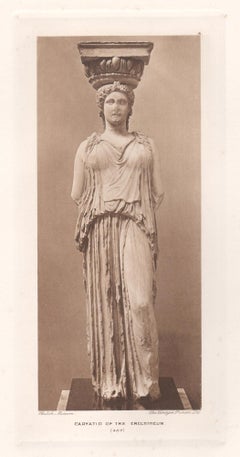
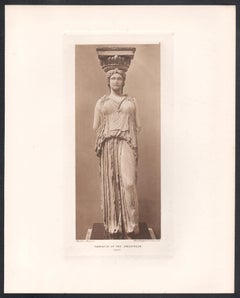
Caryatid of the Erechtheum, British Museum Greek Classical photogravure

Caryatid of the Erechtheum, British Museum Greek Classical photogravure

Located in Melbourne, Victoria

'Caryatid of the Erechtheum' Photogravure from a collection of photogravures depicting Greek and Roman marbles and bronzes in the British museum. Plate number above top right corner...

Category

Other Art Style 1910s Art
Materials

Photogravure

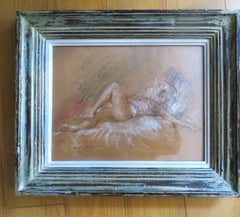
Original watercolour Nude by Antoine Calbet

Original watercolour Nude by Antoine Calbet

By Antoine Calbet

Located in Pasadena, CA

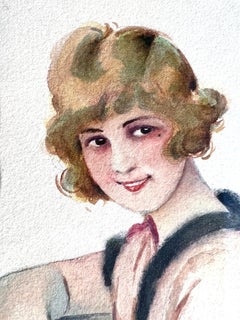
Antoine Calbet presents his works, mainly portraits and genre scenes, at the Salons of the Société des artistes français from 1881 until 1940, as well as at the international exhibit...

Category

Art Nouveau 1910s Art
Materials

Pastel, Watercolor