American Modern Art

to
615
1,631
1,294
907
642
556
Overall Width
to
Overall Height
to
2
17
4,327
688
16
64
179
663
486
417
413
368
279
141
117,203
64,422
56,452
28,356
14,570
9,602
6,737
6,000
4,185
3,165
2,536
2,339
2,144
600
2,461
2,196
232
2,278
1,088
828
645
616
493
420
339
297
230
221
210
209
189
188
182
166
160
148
139
1,865
1,417
1,020
633
605
284
228
109
106
89
1,468
545
4,597
366
Style: American Modern
Barbara Latham 1950s Modernist Linocut “Saturday Morning, Taos Plaza”

Barbara Latham 1950s Modernist Linocut “Saturday Morning, Taos Plaza”

By Barbara Latham

Located in Denver, CO

A vibrant celebration of Taos life and culture, Saturday Morning (Market, Taos Plaza, New Mexico) is a striking 1950s modernist linocut print by acclaimed New Mexico artist Barbara L...

Category

Mid-20th Century American Modern Art

Materials

Linocut

A 1928 Modernist Woodcut, Self-Portrait of Notable Chicago Modernist Emil Armin

A 1928 Modernist Woodcut, Self-Portrait of Notable Chicago Modernist Emil Armin

By Emil Armin

Located in Chicago, IL

A 1928 woodcut on paper of a self-portrait of notable Chicago Modernist artist, Emil Armin. Artwork size: 10 1/2" x 8". Archivally matted to: 12 1/2" x 14 1/2. Signed, titled and numbered in pencil. Edition 7/30. Emil Armin was born in Radautz, Austria in 1883. By the age of 10, Armin was orphaned and was raised by his older siblings. He supported himself by working in restaurants and drew in his spare time. In 1905, at the age of 21, Armin immigrated to Chicago. He began studying at the Art Institute of Chicago in 1907, but financial difficulties forced him to start and stop a number of times, finally graduating in 1920. He studied with George Bellows and Randall Davey. Armin was an integral part of Chicago’s 57th Street Art Colony and exhibited in both the more avant-garde Chicago No-Jury Society Shows, as well as the more formal and conventional Chicago Society of Artists Exhibitions, the Chicago Renaissance Society and Art Institute of Chicago (1922-1949) exhibitions. He taught at Hull House...

Category

1920s American Modern Art

Materials

Paper, Woodcut

Pirate's Alley, French Quarter, New Orleans

Pirate's Alley, French Quarter, New Orleans

Located in Grand Rapids, MI

Nestor Hippoyle Fruge (American, 1914/16 - 2011/12) Signed: N Fruge 51 (Lower, Left) " Pirate's Alley, French Quarter ," 1951 (New Orleans) Watercolo...

Category

Mid-20th Century American Modern Art

Materials

Paper, Watercolor

"Manhattan Looking East, " Herman Rose, WPA New York City View from Midtown

"Manhattan Looking East, " Herman Rose, WPA New York City View from Midtown

By Herman Rose

Located in New York, NY

Herman Rose (1909 - 2007) Manhattan Looking East (View from Midtown), 1952-54 Oil on canvas 26 x 28 inches Signed lower right Fairfield Porter wrote an essay in ArtNews on this exact painting in 1955. Please inquire for a copy of the article. Literature: Fairfield Porter, "Herman Rose Paints a Picture," ArtNews, April 1955 Volume 54, Number 2, illustrated. Herman Rose was best known for his depictions of cityscapes of New York City. Herman Rappaport was born in Brooklyn, New York. in 1909. Herman Rose was the professional pseudonym of Herman Rappaport. Originally trained as a draftsman and studied at the National Academy of Design from 1927 to 1929, he was later employed by the Works Progress Administration's Murals Division under Arshile Gorky from 1934 until 1939. In 1939, after experimenting with a variety of contemporary expressionistic styles, Rose decided to paint from life. Working mostly in East New York and East Canarsie in Brooklyn, and in Manhattan, Rose began to paint roof tops and street scenes. Rappaport began using the name Herman Rose when he held his first solo art exhibition in 1946 at the Charles Egan Gallery in New York City. Although he initially began as an Expressionistic painter, he became known for small, light-filled Impressionist paintings of still life, cityscapes and skies by the early 1950s. His paintings and images were often composed of very small dabs of paint and tiny, blurry "squares," which combined to create the image on canvas, his favorite medium. Often described as a "lyrical painter" Rose's work "interpreted traditional subjects: landscape, still life and the figure like the Post-Impressionists from whom he developed his own style, Rose built up forms from distinct touches of color that don't entirely blend in the viewer's eye. This gives his surfaces an active quality that flattens forms, one of the great lessons of modernism." Herman Rose's work received official recognition when Ms. Dorothy Miller of Museum of Modern Art (MoMA) included his work in an exhibition called, "15 Americans," alongside work by Clyfford Still, Mark Rothko and Jackson Pollock. New York Times art critic Hilton Kramer wrote of Rose's work in 1981, "{he} must surely be counted among the most beautiful works anyone has produced in this challenging medium for many years." The Art in America art critic Lawrence Campbell...

Category

1950s American Modern Art

Materials

Canvas, Oil

Interior with Figures

Interior with Figures

By Arthur Osver

Located in Dallas, TX

Arthur Osver studied at Northwestern University and the Art Institute of Chicago. Osver was awarded the Prix de Rome in 1952. He taught at the Brooklyn Museum Art School, Columbia Un...

Category

1930s American Modern Art

Materials

Canvas, Oil

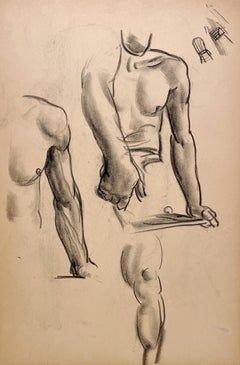
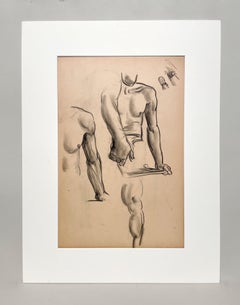
Edward Laning, Joe Jones Asleep

Edward Laning, Joe Jones Asleep

By Edward Laning

Located in New York, NY

This is a World War II drawing of the Missouri artist Joe Jones (1909-1963) by the New York artist Edward Laning (1906-1981). A typed note reads “Drawn in th...

Category

1940s American Modern Art

Materials

Ink

Dusk
Dusk

Dusk

By Virgil Trasher

Located in San Francisco, CA

This artwork titled "Dusk" 1984 in an original color serigraph by American artist Virgil Trasher b.1943. It is hand signed, dated and titled in pencil by the artist. The image size is 14 x 25 inches, sheet size is 19 x 28 inches. It is in excellent condition. About the artist: Virgil Thrasher...

Category

Late 20th Century American Modern Art

Materials

Screen

1950s "Black Floor" Mid Century Bay Area Figurative Movement Gouache Painting

1950s "Black Floor" Mid Century Bay Area Figurative Movement Gouache Painting

Located in Arp, TX

From the estate of Jerry Opper & Ruth Friedman Opper Black Floor c. 1940-1950's Gouache on Paper 15" x 18" Unframed *Custom framing available for additional charge. Please expect framing time between 3-5 weeks. From the estate of Ruth Friedmann Opper & Jerry Opper. Ruth was the daughter of Bauhaus artist, Gustav Friedmann. San Francisco Abstract Expression A free-spirited wave of creative energy swept through the San Francisco art community after World War II. Challenging accepted modes of painting, Abstract Expressionists produced highly experimental works that jolted the public out of its postwar complacency. Abstract Expressionism resulted from a broad collective impulse rather than the inspiration of a small band of New York artists. Documenting the interchanges between the East and West Coasts, she cites areas of mutual influence and shows the impact of San Francisco on the New York School, including artists such as Mark Rothko and Ad Reinhardt. San Francisco's Beat poets...

Category

Mid-20th Century American Modern Art

Materials

Paper, Gouache

Interior (Untitled)

Interior (Untitled)

By Robert Freiman

Located in Los Angeles, CA

nterior (Untitled), 1958, watercolor and ink on paper mounted on cardboard, signed and dated lower right, 11 ½ x 16 ½ inches (sight); 12 x 18 inches (sheet); inscribed lower left “To...

Category

1950s American Modern Art

Materials

Paper, Watercolor

Still Life #1
Still Life #1

Still Life #1

By Jerry Opper

Located in San Francisco, CA

This artwork "Still Life #1" c.1970 is a colors pastel and crayon on thick paper by American artist Jerry Opper, 1924-2014. It is hand signed in pencil at the lower right corner by the artist. The image size is 22 x 16 inches, sheet size is 24.25 x 18 inches. It is in excellent condition, there are pastel marks on the margin all around the artwork and also on the back, see picture #1. About the artist: Jerry Opper was born in Cleveland, Ohio, on September 5, 1924. He moved to Los Angeles with his family in 1933. After graduating from Hollywood High School, he worked in movie studios and attended art classes at Chouinard Art Institute. In May 1942, Opper was drafted into the army and was then able to study at the Colorado Springs Fine Arts Center while his outfit was stationed in Colorado. Later he was sent to Guam and was discharged in December 1945. Opper returned to Chouinard and his work in movie studios until 1947, when he moved to San Francisco. He enrolled as a full-time student at the California School of Fine Arts (now SFAI) and received his diploma in June of 1950. In 1948, Opper met his wife Gertrud Ruth Friedmann, daughter of artist Gustav Friedmann, whose works are also in the Lost Art Salon collection. It was love at first sight and a few weeks after their first encounter at the Black Cat in San Francisco's North Beach, they got married and enjoyed a passionate, life-long romance. Shortly after he finished school, Opper worked briefly as a decorator’s assistant and then started his career as a commercial artist, working for several firms such as Fibreboard, Beatrix Food and Precision. Working full-time and dedicating himself to having a rich family life occupied most of Opper's time, but he continued to be creative. He was above all a family man with the pride of having raised two exceptional daughters, Erika and Jody. Year after year, Opper would painstakingly craft their Halloween costumes...

Category

Late 20th Century American Modern Art

Materials

Pastel

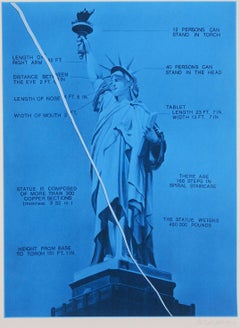
NYC Cityscape American Scene WPA Modern Realism Mid 20th Century Architectural

NYC Cityscape American Scene WPA Modern Realism Mid 20th Century Architectural

By Ernest Fiene

Located in New York, NY

NYC Cityscape American Scene WPA Modern Realism Mid 20th Century Architectural Ernest Fiene (1894-1965) Cityscape 36 x 30 inches Oil on canvas Signed and dated 1930. lower right Provenance Estate of the artist. ACA Galleries, New York Exhibited New York, Frank Rehn Gallery, Changing Old New York, 1931. New York, ACA Galleries, Ernest Fiene: Art of the City, 1925-1955, May 2-23, 1981, n.p., no. 5. BIO Ernest Fiene was born in Elberfeld, Germany in 1894. As a teenager, Fiene immigrated to the United States in 1912. He studied art at the National Academy of Design in New York City from 1914 to 1918, taking day classes with Thomas Maynard and evening classes with Leon Kroll. Fiene continued his studies at the Beaux-Arts Institute of Design in New York from 1916 to 1918, adding classes in printmaking at the Art Students League in 1923. Fiene began his career as an artist in 1919 with his first exhibition of watercolors at the MacDowell Club arranged by his mentor Robert Henri. In 1923 the Whitney Studio Club mounted a large exhibition of his works. The following year he had an exhibition at the New Gallery in New York, which completely sold out all fifty-two works, including paintings, watercolors, drawings, and etchings. With the proceeds of sales from the New Gallery exhibition, Ernest Fiene and his younger brother Paul, a sculptor, built studios in Woodstock, New York in 1925. In the early Twenties Ernest Fiene painted mostly landscapes of Woodstock and both the Ramapo and Hudson River Valleys. The first monograph from the Younger Artists Series was published on Fiene in 1922. Published in Woodstock, the series went on to include Alexander Brook, Peggy Bacon, and Yasuo Kuniyoshi. The book reproduced 1 illustration in color and another 27 reproductions in black and white. Around 1925 Fiene became fascinated with the intensity, excitement, and opportunities for color harmonies New York City offered as a subject. His paintings shifted to urban and industrial themes with architecture, industry, and transportation becoming his subjects. By 1926 Fiene had attracted the dealer Frank K.M. Rehn, who gave him a one-man exhibition that year, which travelled to the Boston Arts Club. C.W. Kraushaar Galleries gave Fiene a one-man exhibition of urban, landscape, portrait, and still life paintings in 1927. Julianna Force, the director of the Whitney Studio Club and first director of the Whitney Museum of American Art, included two of Fiene’s paintings in a fall exhibition in 1928. The Whitney Studio Club showed Fiene’s paintings in a two-man exhibition with Glenn O. Coleman that year and acquired three of Fiene’s paintings. Also in 1928 Fiene became affiliated with Edith Halpert’s Downtown Gallery where he had an exhibition of 20 lithographs in the spring. Fiene sold his house in Woodstock in 1928 to spend more of his time in New York City. With so many successful exhibitions, Fiene returned to Paris in 1928-29 where he rented Jules Pascin's studio and studied at the Académie de la Grande Chaumière. In France, Fiene painted both landscape and urban subjects developed from ideas influenced by Cubist geometry and the use of flat areas of broad color. Upon returning to New York in 1930, Fiene used this new approach to continue to paint New York skyscraper and waterfront subjects, as well as to begin a series of paintings on changing old New York based on the excavations for Radio City Music Hall and the construction of the Empire State Building. Frank K.M. Rehn Galleries exhibited this series, titled “Changing Old New York,” in 1931. Fiene also has solo exhibitions at Rehn Galleries in 1930 and 1932. Fiene’s oil paintings are exhibited at the Chicago Arts Club in 1930 as well. Fiene was included in the Museum of Modern Art’s exhibition Painting and Sculpture by Living Americans in December of 1931. Visiting New York, Henri Matisse saw the exhibition and called Fiene’s Razing Buildings, West 49th Street the finest painting he had seen in New York. Fiene had two mural studies from his Mechanical Progress series exhibited at the Museum of Modern Art’s exhibition Murals by American Painters and Photographers in 1932. Fiene sent View from my Window which depicts Fiene working on a lithograph stone while looking out his window to the newly completed Empire State Building to the Carnegie International in 1931. In 1932 Fiene participated in the first Biennial of American Painting at the Whitney Museum and his prints were included in exhibitions at the Downtown Gallery and the Wehye Gallery. In the same year, Fiene was awarded a Guggenheim fellowship to further study mural painting in Florence, Italy. On his return from Italy in 1933 Fiene re-engaged himself in New York City life and won several public and private mural projects. Fiene resumed his active exhibition schedule, participating in two group exhibitions at the Whitney Museum and a one-man exhibition of recent paintings at the Downtown Gallery in January 1934. In 1933 he purchased a farm in Southbury, Connecticut, which added Connecticut scenes to his landscape subjects. This was also the year Fiene began to spend summers on Monhegan Island, Maine, where he painted seascapes, harbor scenes, and still lifes. Fiene’s landscape paintings attracted numerous commissions as part of the American Scene movement. Through the fall and winter of 1935-36, Fiene took an extended sketching trip through the urban, industrial, and farming areas of Pennsylvania and West Virginia. Most of the twenty-four Pennsylvania urban and rural paintings...

Category

1930s American Modern Art
Materials

Canvas, Oil

Lady with Bird

Lady with Bird

By Ilse Getz

Located in Los Angeles, CA

Lady with White Bird, 1976, mixed media construction on wood panel, signed, dated, and titled verso, 17 x 17 inches, exhibited Ilse Getz Paintings, Collages, Constructions, Neuberger...

Category

Mid-20th Century American Modern Art

Materials

Wood, Paint

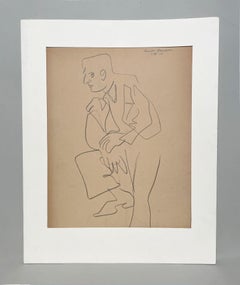
Edward Sacks, Seated Figure

Edward Sacks, Seated Figure

Located in New York, NY

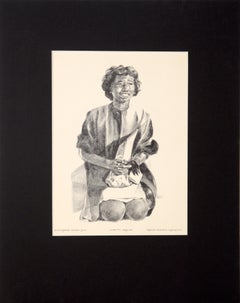
Little is known about the artist, Edward (Ed) Sacks, although this print may have been made at the Art Students League in NYC. it is a cross between, as the title suggests, a Seated ...

Category

1940s American Modern Art

Materials

Lithograph

Rooftop Bathers (Untitled)

Rooftop Bathers (Untitled)

Located in Los Angeles, CA

Rooftop Bathers (Untitled), c. 1940s, oil on canvas, 22 x 32 inches, signed lower right Betty Waldo Parish gives us a delightful slice of life in 1940s New York, as we see a coupl...

Category

1940s American Modern Art

Materials

Canvas, Oil

Dessin (Star) Mixed media Collage with Painting James Brown Galerie Bernd Kluser

Dessin (Star) Mixed media Collage with Painting James Brown Galerie Bernd Kluser

By James Brown

Located in Surfside, FL

James Brown (American, 1951-2020) Mixed media 1994, "Dessin (Star)", Paint and collage on paper, Hand signed and dated lower right, bears label verso Dimensions: 19.5"h x 29.5"w (sheet), 26"h x 36"w (frame) Provenance: Galerie Bernd Klüser, Bears label verso They represented internationally renowned artists such as Joseph Beuys, Tony Cragg, Enzo Cucchi, Jannis Kounellis, Mimmo Paladino and Andy Warhol. Their first exhibitions were with Andy Warhol, Tony Cragg, Julião Sarmento...

Category

1990s American Modern Art

Materials

Paint, Paper, Mixed Media

Kufstein, Austrian Tyrol

Kufstein, Austrian Tyrol

By John Marin

Located in London, GB

In the summer of 1910, Marin spent a number of weeks in the Austrian Alps. The subject of his second solo exhibition at Alfred Stieglitz’s 291 Gallery located in NYC, in February 191...

Category

Early 20th Century American Modern Art

Materials

Paper, Watercolor

Wolfman
Wolfman

Wolfman

By Donald Saff

Located in Middletown, NY

Etching with aquatint on white wove paper with a deckle edge, 23 1/2 x 17 1/2 inches (598 x 317 mm); sheet 30 x 22 1/2 inches (762 x 571 mm), full margins. Signed and numbered 4/10 i...

Category

Late 20th Century American Modern Art

Materials

Handmade Paper, Etching, Aquatint

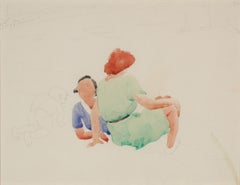
The Couple
The Couple

The Couple

Located in Dallas, TX

signed "EJB" at lower left 21 13/16 x 17 inches including frame

Category

1920s American Modern Art

Materials

Watercolor

Cindy Kane 1985 Original Painting on Plywood

Cindy Kane 1985 Original Painting on Plywood

By Cindy Kane

Located in New York, NY

Cindy Kane (American, b. 1957) Untitled, 1985 Oil on plywood Sight: 31 1/2 x 28 1/2 in. Framed: 39 3/4 x 36 x 2 in. Signed lower right: KANE Signed, titled, dated verso: Cindy Kane, Untitled, 1985 Cindy Kane (American, 1957-) grew up in Washington DC during the Vietnam War era, absorbing the period's powerful political climate. She is a self-taught artist whose multi media work is born out of a deep sense of connection to the political and environmental issues of our times. Her early work was influenced by the experience of living and working at the bottom of the Grand Canyon National Park, where she had the opportunity to document Anasazi Indian pictographs in pen and ink drawings. These images would inform her work for years to come. She draws on personal narrative and experience to create her paintings of maps, birds, toys, and artifacts from nature, often collaging bits of newspaper headlines, pieces of her children's homework, and pages of sheet music beneath layers of color and imagery. In a review of her work, author and critic John Loughery wrote; "Kane leads us into a peculiar netherworld, a hard to place area that's both reassuringly ancient, and anxiously modern. This is a painter who is interested in the unconscious and the archetypal, and utilizes her own private, (but not inaccessible) vocabulary and imagery." In a submission to AskART, Diana Wilson...

Category

1980s American Modern Art

Materials

Plywood, Oil

Large-Scale Abstract Expressionist Figurative Couple

Large-Scale Abstract Expressionist Figurative Couple

By Julius Wasserstein

Located in Soquel, CA

A striking large-scale abstract expressionist figurative acrylic on canvas by Bay Area artist Julius Wasserstein (American, 1924-1985). Two abstracted figures, a man in a suit and a woman in a blue wedding dress...

Category

1980s American Modern Art

Materials

Canvas, Acrylic, Stretcher Bars

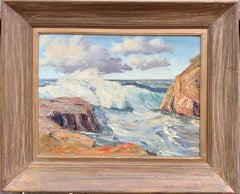
Plein Air American Oil Painting Rainstorm Signed Original Modern Impressionist

Plein Air American Oil Painting Rainstorm Signed Original Modern Impressionist

Located in Buffalo, NY

nknown Artist (Signed “Kaufman”) Untitled (Pastoral Horizon), mid-20th century Oil on board Framed dimensions: 25 in. H × 21 in. W Original cream-toned carved wood frame This expres...

Category

1920s American Modern Art

Materials

Masonite, Oil

Green Landscape, Abstract Countryside, Fields, Modern, Contemporary, Oil, French

Green Landscape, Abstract Countryside, Fields, Modern, Contemporary, Oil, French

By SOPHIE DUMONT

Located in LANGRUNE-SUR-MER, FR

Green Landscape Oil on canvas, 2023 Unframed: 38 x 61 cm (15 x 24 in) Framed: approximately 45 x 68 cm (17.7 x 26.8 in) Black floater frame included. Ready to hang. This expressive...

Category

21st Century and Contemporary American Modern Art

Materials

Oil

Fir Play Intaglio Print, American Modern, Artist Proof #4/5, 2010+

Fir Play Intaglio Print, American Modern, Artist Proof #4/5, 2010+

By Carol Wax

Located in New Orleans, LA

A series of prints was commissioned by the Metropolitan Museum in New York in a regular edition of 40. This impression is from an edition of 5 artist proofs. This impression is #4/5. Carol Wax originally trained to be a classical musician at the Manhattan School of Music but fell in love with printmaking. Soon after she began engraving mezzotints she was asked by the renowned print dealer Sylvan Cole to exhibit at Associated American Artists Gallery, launching her career as a professional artist/printmaker. With the publication of her book, The Mezzotint: History and Technique, published by Abrams, 1990 and 1996, Carol added author and teacher to her credits. In the ensuing years she has expanded her repertoire of mediums beyond printmaking into other works on paper and painting. In compositions reflecting an appreciation for antiquated machinery and vintage textiles, Wax creates imagery that, in her own words, “… speaks to an inner life perceived in inanimate objects.” She uses stylization and imagination to reinvent subjects, transforming an ordinary typewriter into a monumental icon...

Category

2010s American Modern Art

Materials

Intaglio

Persephone
Persephone

Persephone

By Virginia Dehn

Located in Fairlawn, OH

Persephone Oil on canvas, 1952 Signed lower left (see photo) Titled reverse "Persephone" Signed "V. 52" Exhibited: Columbus Gallery of the Arts label "71/30 Bt. 2", see label Condition: two very small flakes of missing paint Canvas size: 20 1/8 x 16" Frame size: 20 7/8 x 16 3/4" Provenance: Estate of the artist Dehn Heirs An important painting by the artist. Virginia Dehn From Wikipedia, the free encyclopedia Virginia Dehn (1922-2005) Virginia Dehn was an American painter and printmaker whose lyrical abstractions drew inspiration from nature, archaeology, ancient civilizations, and the spiritual dimensions of landscape. Born Virginia Engleman in Nevada, Missouri, on October 26, 1922, she studied at Stephens College, the Traphagen School of Design, and the Art Students League in New York. In the 1940s she met the distinguished lithographer and watercolorist Adolf Dehn, whom she married in 1947. Although initially known in connection with her husband's artistic circle, she developed an independent career that spanned more than five decades. Her mature work transformed natural forms, gardens, pottery, geological formations, and symbols from ancient cultures into richly textured, semi-abstract compositions characterized by luminous color and contemplative imagery. Her major series included Gardens and Galaxies, Ancient Landscapes, Earth Memory, The Egyptian Series, The Oriental Series, and The Gold Series. Dehn exhibited widely throughout the United States and was represented during her career by galleries including the Susan Teller Gallery in New York, Harmon-Meek Gallery in Naples, Florida, Cline LewAllen Contemporary Gallery in Santa Fe, New Mexico, and Thomas French Fine Art in Ohio. Her work was featured in numerous solo and group exhibitions and earned recognition for its synthesis of modern abstraction with enduring themes drawn from history and the natural world. Works by Virginia Dehn are held in a number of public collections, including the New Mexico Museum of Art, the Butler Institute of American Art, the Portland Art Museum, the Museum of Fine Arts, Springfield (Massachusetts), the University of California, Berkeley, the Minnesota Historical Society, and the New York State Library. These institutional holdings reflect the broad geographic reach of her career and the continuing appreciation of her contribution to twentieth-century American art. Virginia Dehn died in Santa Fe, New Mexico, on July 28, 2005. Today her paintings, drawings, and prints are represented in museum collections and private collections throughout the United States, and her work remains associated with a distinctive vision that united abstraction, memory, and the enduring forms of the natural world. Virginia and Adolf Dehn The Dehns lived in a Chelsea brownstone on West 21st Street where they worked side by side. They often hosted gatherings of other influential artists and intellectuals of the 20th century. Among their closest friends were sculptor Federico Castellón and his wife Hilda; writer Sidney Alexander and his wife Frances; artists Sally and Milton Avery; Ferol and Bill Smith, also an artist; and Lily and Georges Schreiber, an artist and writer. Bob Steed and his wife Gittel, an anthropologist, were also good friends of the Dehns. According to friend Gretchen Marple Pracht, "Virginia was a glamorous and sophisticated hostess who welcomed visitors to their home and always invited a diverse crowd of guests..." Despite their active social life, the two were disciplined artists, working at their easels nearly daily and taking Saturdays to visit galleries and view new work. The Dehns made annual trips to France to work on lithographs at the Atelier Desjobert in Paris. Virginia used a bamboo pen to draw directly on the stone for her lithographs, which often depicted trees or still lifes. The Dehns' other travels included visits to Key West, Colorado, Mexico, and countries such as Greece, Haiti, Afghanistan, and India. Dehn's style of art differend greatly from that of her husband, though the two sometimes exhibited together. A friend of the couple remarked, "Adolf paints landscapes; Virginia paints inscapes." Virginia Dehn generally painted an interior vision based on her feelings for a subject, rather than a literal rendition of it.] Many of her paintings consist of several layers, with earlier layers showing through. She found inspiration in the Abstract Expressionism movement that dominated the New York and Paris art scenes in the 1950s. Some of her favorite artists included Adolf Gottileb, Rothko, William Baziotes, Pomodoro, and Antonio Tapies. Dehn most often worked with bold, vibrant colors in large formats. Her subjects were not literal, but intuitive. She learned new techniques of lithography from her husband Adolf, and did her own prints. Texture was very important to her in her work. Her art was influenced by a variety of sources. In the late 1960s she came across a book that included photographs of organic patterns of life as revealed under a microscope. These images inspired her to change the direction of some of her paintings. Other influences on Dehn's art came from ancient and traditional arts of various cultures throughout the world, including Persian miniatures, illuminated manuscripts, Dutch still life painting, Asian art, ancient Egyptian artifacts...

Category

1950s American Modern Art

Materials

Acrylic

Colorado Cabin Scene 1931 Ink Resist by Beulah Beardsley

Colorado Cabin Scene 1931 Ink Resist by Beulah Beardsley

Located in Denver, CO

This original 1931 ink resist painting by Colorado artist Beulah House Beardsley (1913–2001) offers a rare and intimate glimpse into early 20th-century Western life. The composition ...

Category

1930s American Modern Art
Materials

Ink

"The Morning Paper"
"The Morning Paper"

"The Morning Paper"

By Elsa Warner

Located in San Francisco, CA

"The Morning Paper" 1949, a fine original tempera painting on board by listed artist Elsa Warner (1900-1988). Elsa Warner was born on June 6, 1900 in Illinois. After studying at the ...

Category

1940s American Modern Art

Materials

Tempera, Board

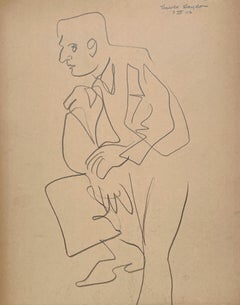
Study for The Aerialists: Graphite Drawing, American Modern, 1932

Study for The Aerialists: Graphite Drawing, American Modern, 1932

By John Steuart Curry

Located in Fairlawn, OH

Untitled (Study for The Aerialists) Graphite on paper, 1932 Signed lower right in pencil: "John Steuart Curry" Dated: 1932 in pencil Exhibited: Schroeder Romero & Shredder, NYC (label), Master Drawings, Oct. 13, 2011-Nov. 12, 2011 (see photo of label) Arkansas Arts Center (label), 44th Collector Show & Sale, Nov. 30-December 30, 2012, Offered at $22,000. (see photo of label) This drawing is closely related to a painting by Curry entitled The Aerialists, 1932, once in the Erskine Collection, Cedar Rapids, Iowa. It is part of a group of preliminary drawings and three finished paintings executed by Curry around 1932 which were based on The Flying Cadonas. The painting The Flying Cadonas is an icon of American art purchased by the Whitney Museum of Art and now on permanent exhibition. There are other know studies for these works, nos. 199 through 222 and in John Steuart Curry: Rural America, page 32 (Mongerson Wunderlich, Chicago, 1990. Provenance: Mrs. Kathleen Curry (artist’s widow), included in the estate schedule of works Treadway Toomey Auction, Oak Park, Illinois, 2009 Don Joint, New York An important American Regionalist drawing. Like Grant Wood and Thomas Hart Benton, John Steuart Curry was a major American scene painter of the 1930s. His subjects were taken from American history and his most famous mural, The Tragic Prelude...

Category

1930s American Modern Art
Materials

Graphite

Pleasant Ridge

Pleasant Ridge

By Robert Herrmann

Located in Los Angeles, CA

Pleasant Ridge, 1966-7, oil on board, signed, dated and titled verso, 16 x 24 inches, exhibited: Robert Herrmann, Cincinnati Art Galleries, Cincinnati, OH, March 4 to 28, 2000, no. 1...

Category

Mid-20th Century American Modern Art

Materials

Masonite, Oil

Untitled

Untitled

By Fred Nagler

Located in Dallas, TX

Fred Nagler was born in 1891 in Springfield, Massachusetts, where he first studied wood carving. From 1914 to 1917, he studied at The Art Students League of New York, where his prof...

Category

20th Century American Modern Art

Materials

Graphite, Paper, Watercolor

Untitled (Elevated Platform)

Untitled (Elevated Platform)

Located in Los Angeles, CA

This painting is part of our current exhibition - America Coast to Coast: Artists of the 1940s Untitled (Elevated Platform), 1950, oil on canvas, signed and dated lower right, 30 x...

Category

1950s American Modern Art
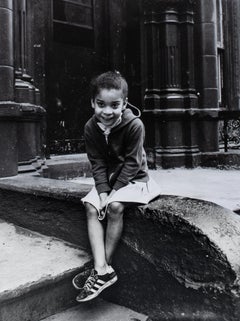
Materials

Canvas, Oil

Blanche Grambs, (Lazy Susan)

Blanche Grambs, (Lazy Susan)

By Blanche Grambs

Located in New York, NY

In the 1950s and 60s Grambs worked on many commissions. This was probably for a cookbook. The dimensions are for the drawing. The sheet is somewhat larger, 7 x 6 1/2 inches.

Category

Mid-20th Century American Modern Art

Materials

Ink

American Modern art for sale on 1stDibs.
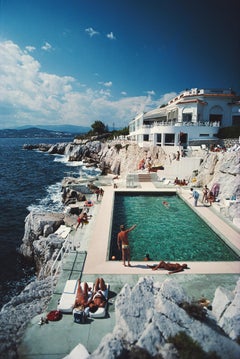
Find a wide variety of authentic American Modern art available for sale on 1stDibs. Works in this style were very popular during the 21st Century and Contemporary, but contemporary artists have continued to produce works inspired by this movement. If you’re looking to add art created in this style to introduce contrast in an otherwise neutral space in your home, the works available on 1stDibs include elements of blue, orange, purple, red and other colors. Many Pop art paintings were created by popular artists on 1stDibs, including Slim Aarons, Destro, Howard Schatz, and John Taylor Arms. Frequently made by artists working with Paint, and Oil Paint and other materials, all of these pieces for sale are unique and have attracted attention over the years. Not every interior allows for large American Modern art, so small editions measuring 0.25 inches across are also available.