American Modern Art

to
650
1,619
1,302
897
625
554
Overall Width
to
Overall Height
to
2
17
4,318
664
10
55
172
663
488
415
412
376
278
144
116,598
63,507
56,324
28,307
14,610
9,487
6,631
5,844
4,181
3,139
2,477
2,311
2,136
600
2,448
2,176
227
2,264
1,086
820
634
615
485
414
329
301
223
218
210
207
191
184
182
163
159
142
135
1,849
1,393
1,015
614
599
283
230
107
105
90
1,445
545
4,571
373
Style: American Modern
Lou Jacobs Ringling Bros. and Barnum & Bailey Circus Clown with Giraffe

Lou Jacobs Ringling Bros. and Barnum & Bailey Circus Clown with Giraffe

Located in Middletown, NY

Gelatin silver print mounted on board, 9 1/2 x 7 1/2 in. (241 x 190 mm) from the Roland Butler Collection, Press Agent, Ringling Bros. and Barnum & Bailey Circus (1930s-1960s) Roland...

Category

Mid-20th Century American Modern Art

Materials

Photographic Paper

'Fashion Able II', Parsons School of Design, Haute Couture, Costume

'Fashion Able II', Parsons School of Design, Haute Couture, Costume

By Isaac Mizrahi

Located in Santa Cruz, CA

Signed verso lower left, 'Isaac Mizrahi'. A fashion designer and creator of costume, Isaac Mizrahi attended the Parsons School of Design before becoming immersed in haute couture in...

Category

1990s American Modern Art

Materials

Oil Pastel, Acrylic, Synthetic Paper, Graphite

Large Bold Colorful Monoprint Painting Floral in Vase February Amaryllis Flowers

Large Bold Colorful Monoprint Painting Floral in Vase February Amaryllis Flowers

By Gary Bukovnik

Located in Surfside, FL

Image is 48 X 36 inches. Still life of flowers in a vase. In bold red, orange green and yellow color. Born and educated in Cleveland, Gary Bukovnik has lived in San Francisco for more than a third of a century. Primarily using the media of watercolor, monotype, and lithograph, Bukovnik fuses sensual vitality with fluid yet powerful colorations, creating floral and culinary images of great depth, intensity, and size. In 2003 and 2005, invited Bukovnik was Visiting Artist at the American Academy in Rome in 2003 and 2005 and was an artist-in-residence at the Michigan Institute of Arts in Kalamazoo in 2010, as well as making a tour of exhibitions and watercolor demonstrations across Japan in 2010. Solo exhibitions include Caldwell Snyder Gallery in San Francisco and in St. Helena, CA, Campton Gallery in New York City; the Concept Gallery in Pittsburgh, the A.C.T. Gallery in San Francisco, and the Bonfoey Gallery in Cleveland. Other recent exhibitions have been organized by the Butler Institute of American Art, Youngstown, Paula Brown Gallery, Toledo, Neuhoff Gallery, New York; Lisa Kurts Gallery, Memphis; Irving Galleries, Palm Beach; Galerie Kutter, Luxembourg; the Southern Alleghenies Museum of Art, Johnstown, Pennsylvania; Chin Show Cultural Center, Taipei; Takashimaya, Tokyo; the Hunt Institute for Botanical Documentation, Carnegie Mellon University, Pittsburgh; and Brevard Museum of Art, Melbourne, Florida. SELECTED MUSEUM COLLECTIONS Art Gallery of Hamilton, Ontario The Art Institute of Chicago Atlanta Botanical Garden Brooklyn Museum Brooks Museum of Art, Memphis The Butler Institute of American Art, Youngstown Dallas Museum of Art Fine Arts Museums of San Francisco Frye Art Museum, Seattle Hunt Institute for Botanical Documentation, Carnegie Mellon University, Pittsburgh Hunterian Art Gallery, University of Glasgow Library of Congress, Washington, DC The Metropolitan Museum of Art, New York The Minneapolis Institute of Arts, Minnesota Museum of Fine Arts, Boston The Museum of Modern Art, New York The Richard L. Nelson Gallery, U.C. Davis, California The New York Public Library Oakland Museum of California Philadelphia Museum of Art Phoenix Art Museum Portland Art Museum, Oregon Rhode Island School of Design Museum, Providence San Francisco Museum of Modern Art University of Arizona Museum of Art, Tucson University of California, Berkeley Art Museum SELECTED PUBLIC COLLECTIONS ALZA Corporation, Mountain View ART In Embassies Program, U.S. Department of State AT&T, New York Atlantic Richfield, Los Angeles BankAmerica Corporation, Charlotte Citigroup, New York Cleveland Institute of Music Clorox Company, Oakland Comerica Bank, Costa Mesa & San Jose H.J. Heinz Company, Pittsburgh Illinois Bell...

Category

1990s American Modern Art

Materials

Monoprint

Female Figure
Female Figure

Female Figure

By Lorrie Goulet

Located in New York, NY

It is marvelous to find discoveries such as Lorrie Goulet's female form, one of our few American women sculptors who direct carved in marble. Goulet has an attractive technique of u...

Category

1960s American Modern Art
Materials

Marble

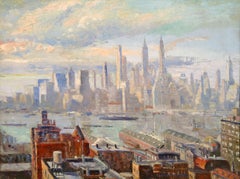
North on West Street (West Side Highway NYC Cityscape)

North on West Street (West Side Highway NYC Cityscape)

By De Hirsch Margules

Located in Wilton Manors, FL

De Hirsh Margules (1899-1965). North on West Street , 1939. Watercolor on Arches wove paper. Signed and dated in pencil by artist lower margin. Sheet measures 15 x 22 inches. Framed measurement: 27 x 34 inched. Incredibly vibrant and saturated color with no fading or toning of sheet. Provenance: Babcock Galleries, NYC De Hirsh Margules (1899–1965) was a Romanian-American "abstract realist" painter who crossed paths with many major American artistic and intellectual figures of the first half of the 20th century. Elaine de Kooning said that he was "[w]idely recognized as one of the most gifted and erudite watercolorists in the country". The New York Times critic Howard Devree stated in 1938 that "Margules uses color in a breath-taking manner. A keen observer, he eliminates scrupulously without distortion of his material." Devree later called Margules "one of our most daring experimentalists in the medium" Margules was also a well-known participant in the bohemian culture of New York City's Greenwich Village, where he was widely known as the "Baron" of Greenwich Village.[1] The New York Times described him as "one of Greenwich Village's best-known personalities" and "one of the best known and most buoyant characters about Greenwich Village. Early Life De Hirsh Margules was born in 1899 in the Romanian city of Iași (also known as Iasse, Jassy, or Jasse). When Margules was 10 weeks old, his family immigrated to New York City. Both of his parents were active in the Yiddish theater, His father was Yekutiel "Edward" Margules, a "renowned Jewish actor-impresario and founder of the Yiddish stage." Margules' mother, Rosa, thirty-nine years younger than his father, was an actress in the Yiddish theater and later in vaudeville. Although Margules appeared as a child actor with the Adler Family[11] and Bertha Kalich, his sister, Annette Margules, somewhat dubiously continued in family theater and vaudeville tradition, creating the blackface role of the lightly-clad Tondelayo (a part later played on film Hedy Lamarr) in Earl Carroll's 1924 Broadway exoticist hit, White Cargo. Annette herself faced stereotyping as an exotic flower: writing about her publicist Charles Bouchert stated that "Romania produces a stormy, temperamental type of woman---a type admirably fitted to portray emotion." His brother Samuel became a noted magician who appeared under the name "Rami-Sami." Samuel later became a lawyer, representing magician Horace Goldin, among others. A family portrait including a young De Hirsh, a portrait of Rosa and Annette together, and individual photos of Rosa and Edward can be found on the Museum of the City of New York website. At around age 9 or 10, Margules took art classes with the Boys Club on East Tenth Street, and his first taste of exhibition was at a student art show presented by the club. By age 11, he had won a city-wide prize (a box camera) at a children's art show presented by the department store Wanamakers. As a young teenager, Margules was already displaying a characteristic kindness and loyalty. Upon hearing that two friends (one of them was author Alexander King), were in trouble for breaking a school microscope, the nearly broke Margules gave them five dollars to repair the microscope . Margules had to approach a wealthy man that Margules had once saved on the subway from a heart attack. Margules didn't reveal the source of the five dollars to King until twenty-five years later. In his late teens, Margules studied for a couple of months in Pittsburgh with Edwin Randby, a follower of Western painter Frederic Remington. Thereafter he pursued a two-year course of studies in architecture, design and decoration at the New York Evening School of Art and Design, while working as a clerk during the day at Stern's Department Store. He was encouraged in these artistic pursuits by his neighbor, the painter Benno Greenstein (who later went by the name of Benjamin Benno). Artistic career In 1922, Margules began work as a police reporter for the City News Association of New York .Margules then considered himself something of an expert on art, and the painter Myron Lechay is said to have responded to some unsolicited analysis of his work with the remark "Since you seem to know so much about it, why don't you paint yourself?" This led to study with Lechay and a flurry of painting. Margules' first show was in 1922 at Jane Heap's Little Review Gallery. Thereafter Margules began to participate in shows with a group including Stuart Davis, Jan Matulka, Buckminster Fuller (exhibiting depictions of his "Dymaxion house") in a gallery run by art-lover and restaurateur Romany Marie on the floor above her cafe. Jane Heap, left, with Mina Loy and Ezra Pound During the 1920s, Margules traveled outside of the country a number of times. In 1922, with the intent of reaching Bali, he took a job as a "'wiper on a tramp steamer where [he] played nursemaid to the engine." He reached Rotterdam before he turned back. He would return to Rotterdam shortly thereafter. In 1927, Margules took a lengthy leave of absence from his day job as a police reporter in order to travel to Paris, where he "set up a studio in Montmartre's Place du Tertre, on the top floor of an almost deserted hotel, a shabby establishment, lacking both heat and running water." He studied at the Louvre and traveled to paint landscapes in provincial France and North Africa. Margules also joined the "Noctambulist" movement and experimented with painting and showing his artwork in low light.Jonathan Cott wrote that: the painter De Hirsch Margulies sat on the quays of the Seine and painted pictures in the dark. In fact, the first exhibition of these paintings, which could be seen only in a darkened room, took place in [ Walter Lowenfels'] Paris apartment. Elaine de Kooning remarked that studying the works of the Noctambulists confirmed Margules' "direction toward the use of primary colors for perverse effects of heavy shadow." It was also in Paris that Margules initially conceived his idea of "Time Painting", where a painting is divided into sectors, each representing a different time of day, with color choices meant to evoke that time of day. In Paris, his social circle included Lowenfels, photographer Berenice Abbott, publisher Jane Heap, composer George Anthiel, sculptor Thelma Wood, painter André Favory, writer Norman Douglas, writer and editor George Davis, composer and writer Max Ewing, and writer Michael Fraenkel. Upon his return to New York in 1929, Margules attended an exhibition of John Marin's paintings. While at the exhibition, he "launched into an eloquent explanation of Marin to two nearby women", and was overheard by an impressed Alfred Stieglitz. The famous photographer and art promoter invited Margules to dine with his wife, the artist Georgia O'Keeffe, and his assistant, painter Emil Zoler. Stieglitz thereafter became a friend and mentor to Margules, becoming for him "what Socrates was to his friends." Alfred Stieglitz Stieglitz introduced Margules to John Marin, who quickly became the most important painterly influence upon Margules. Elaine de Kooning later noted that Margules was "indebted to Marin and through Marin to Cézanne for his initial conceptual approach - for his constructions of scenes with no negative elements, for skies that loom with the impact of mountains." Margules himself said that Marin was his "father and ... academy." The admiration was by no means unreciprocated: Marin said that Margules was "an art lover with abounding faith and sincerity, with much intelligence and quick seeing." Stieglitz also introduced Margules to many other artistic and intellectual figures in New York. With the encouragement of Alfred Stieglitz, Margules in 1936 opened a two-room gallery at 43 West 8th Street called "Another Place." Over the following two years there were fourteen solo exhibitions by Margules and others, and the gallery was well-respected by the press. It was in this gallery that the painter James Lechay, Myron's brother, exhibited his first painting. In 1936, Margules first saw recognition by major art museums when both the Museum of Modern Art and the Museum of Fine Arts, Boston purchased his works. In 1942, Margules gave up working as a police reporter, and apparently dedicated himself thereafter solely to an artistic vocation. "The Baron of Greenwich Village"[edit] Margules made his mark not only as an artist, but also as an outsized personality known throughout Greenwich Village and beyond. To local residents, Margules was known as the "Baron", after Baron Maurice de Hirsch, a prominent German Jewish philanthropist. Margules was easily recognizable by the beret he routinely wore over his long hair. Writer Charles Norman said that he "dressed with a flair for sloppiness." He was said to "know everybody" in Greenwich Village, to the extent that when the novelist and poet Maxwell Bodenheim was murdered, Margules was the first one the police sought to identify the body. Margules' letters show him interacting with art world figures such as Sacha Kolin, John Marin and Alfred Stieglitz, as well as with prominent figures outside the art world such as polymath Buckminster Fuller and writer Henry Miller. Most of his friends and acquaintances found Margules a generous and voluble man, given to broadly emotionally expressive gestures and acts of kindness and loyalty. In 1929, he exhibited an example of this loyalty and fellow-feeling when he appeared in court to fight what the wrongful commitment of his friend, writer and sculptor Alfred Dreyfuss, who appeared to have been a victim of an illicit attempt to block an inheritance. The Greenwich Village chronicler Charles Norman described the bone-crushing hugs that Margules would routinely bestow on his friends and acquaintances, and speaks of the "persuasive theatricality" that Margules seemed to have inherited from his actor parents. Norman also wrote about Margules' routine acts of kindness, taking in homeless artists, constantly feeding his friends and providing the salvatory loan where needed. Norman also notes that Margules was blessed with a loud and good voice, and was apt to sing an operatic air without provocation. The writer and television personality Alexander King said I think the outstanding characteristics of my friend's personality are affirmation, emphasis, and overemphasis. He chooses to express himself predominantly in superlatives and the gestures which accompany his utterances are sometimes dangerous to life and limb. Of the bystanders, I mean. King also spoke with affectionate amusement about Margules' pride in his cooking, speaking of how "if he should ever invite you to dinner, he may serve you a hamburger with onions, in his kitchen-living room, with such an air of gastronomic protocol, such mysterious hints and ogliing innuendoes, as if César Ritz and Brillat-Savarin had sneaked out, only a moment before, with his secret recipe in their pockets." Margules was such a memorable New York personality that comic book writer Alvin Schwartz imagined him at the Sixth Avenue Cafeteria in a risible yet poignant debate with Clark Kent about whether Superman had the ability to stop Hitler. Margules' entrenchment in the Greenwich Village milieu can be seen in a photograph from Fred McDarrah's "Beat Generation Album" of a January 13, 1961 writers' and poets' meeting to discuss "The Funeral of the Beat Generation", in Robert Cordier [fr]'s railroad flat at 85 Christopher Street. Among the people in the same photograph are Shel Silverstein...

Category

1930s American Modern Art

Materials

Watercolor, Rag Paper

NYC Cityscape American Scene WPA Modern Realism Mid 20th Century Architectural

NYC Cityscape American Scene WPA Modern Realism Mid 20th Century Architectural

By Ernest Fiene

Located in New York, NY

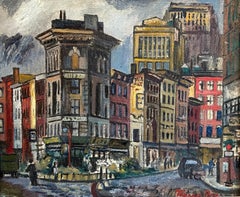
NYC Cityscape American Scene WPA Modern Realism Mid 20th Century Architectural Ernest Fiene (1894-1965) Cityscape 36 x 30 inches Oil on canvas Signed and dated 1930. lower right Provenance Estate of the artist. ACA Galleries, New York Exhibited New York, Frank Rehn Gallery, Changing Old New York, 1931. New York, ACA Galleries, Ernest Fiene: Art of the City, 1925-1955, May 2-23, 1981, n.p., no. 5. BIO Ernest Fiene was born in Elberfeld, Germany in 1894. As a teenager, Fiene immigrated to the United States in 1912. He studied art at the National Academy of Design in New York City from 1914 to 1918, taking day classes with Thomas Maynard and evening classes with Leon Kroll. Fiene continued his studies at the Beaux-Arts Institute of Design in New York from 1916 to 1918, adding classes in printmaking at the Art Students League in 1923. Fiene began his career as an artist in 1919 with his first exhibition of watercolors at the MacDowell Club arranged by his mentor Robert Henri. In 1923 the Whitney Studio Club mounted a large exhibition of his works. The following year he had an exhibition at the New Gallery in New York, which completely sold out all fifty-two works, including paintings, watercolors, drawings, and etchings. With the proceeds of sales from the New Gallery exhibition, Ernest Fiene and his younger brother Paul, a sculptor, built studios in Woodstock, New York in 1925. In the early Twenties Ernest Fiene painted mostly landscapes of Woodstock and both the Ramapo and Hudson River Valleys. The first monograph from the Younger Artists Series was published on Fiene in 1922. Published in Woodstock, the series went on to include Alexander Brook, Peggy Bacon, and Yasuo Kuniyoshi. The book reproduced 1 illustration in color and another 27 reproductions in black and white. Around 1925 Fiene became fascinated with the intensity, excitement, and opportunities for color harmonies New York City offered as a subject. His paintings shifted to urban and industrial themes with architecture, industry, and transportation becoming his subjects. By 1926 Fiene had attracted the dealer Frank K.M. Rehn, who gave him a one-man exhibition that year, which travelled to the Boston Arts Club. C.W. Kraushaar Galleries gave Fiene a one-man exhibition of urban, landscape, portrait, and still life paintings in 1927. Julianna Force, the director of the Whitney Studio Club and first director of the Whitney Museum of American Art, included two of Fiene’s paintings in a fall exhibition in 1928. The Whitney Studio Club showed Fiene’s paintings in a two-man exhibition with Glenn O. Coleman that year and acquired three of Fiene’s paintings. Also in 1928 Fiene became affiliated with Edith Halpert’s Downtown Gallery where he had an exhibition of 20 lithographs in the spring. Fiene sold his house in Woodstock in 1928 to spend more of his time in New York City. With so many successful exhibitions, Fiene returned to Paris in 1928-29 where he rented Jules Pascin's studio and studied at the Académie de la Grande Chaumière. In France, Fiene painted both landscape and urban subjects developed from ideas influenced by Cubist geometry and the use of flat areas of broad color. Upon returning to New York in 1930, Fiene used this new approach to continue to paint New York skyscraper and waterfront subjects, as well as to begin a series of paintings on changing old New York based on the excavations for Radio City Music Hall and the construction of the Empire State Building. Frank K.M. Rehn Galleries exhibited this series, titled “Changing Old New York,” in 1931. Fiene also has solo exhibitions at Rehn Galleries in 1930 and 1932. Fiene’s oil paintings are exhibited at the Chicago Arts Club in 1930 as well. Fiene was included in the Museum of Modern Art’s exhibition Painting and Sculpture by Living Americans in December of 1931. Visiting New York, Henri Matisse saw the exhibition and called Fiene’s Razing Buildings, West 49th Street the finest painting he had seen in New York. Fiene had two mural studies from his Mechanical Progress series exhibited at the Museum of Modern Art’s exhibition Murals by American Painters and Photographers in 1932. Fiene sent View from my Window which depicts Fiene working on a lithograph stone while looking out his window to the newly completed Empire State Building to the Carnegie International in 1931. In 1932 Fiene participated in the first Biennial of American Painting at the Whitney Museum and his prints were included in exhibitions at the Downtown Gallery and the Wehye Gallery. In the same year, Fiene was awarded a Guggenheim fellowship to further study mural painting in Florence, Italy. On his return from Italy in 1933 Fiene re-engaged himself in New York City life and won several public and private mural projects. Fiene resumed his active exhibition schedule, participating in two group exhibitions at the Whitney Museum and a one-man exhibition of recent paintings at the Downtown Gallery in January 1934. In 1933 he purchased a farm in Southbury, Connecticut, which added Connecticut scenes to his landscape subjects. This was also the year Fiene began to spend summers on Monhegan Island, Maine, where he painted seascapes, harbor scenes, and still lifes. Fiene’s landscape paintings attracted numerous commissions as part of the American Scene movement. Through the fall and winter of 1935-36, Fiene took an extended sketching trip through the urban, industrial, and farming areas of Pennsylvania and West Virginia. Most of the twenty-four Pennsylvania urban and rural paintings...

Category

1930s American Modern Art

Materials

Canvas, Oil

Gloucester, Modernist New England Landscape, Student of Henry Keller

Gloucester, Modernist New England Landscape, Student of Henry Keller

Located in Grand Rapids, MI

Clara Deike (American, 1881 - 1964) Signed: Clara L. Deike (Lower, Right) " Gloucester ", 1919 Watercolor and Gouache on Paper Sight Size: 20" x 23 1/4" Housed in a Period Carve...

Category

Early 20th Century American Modern Art

Materials

Paper, Watercolor, Gouache

Original Tommy  The WHO  original 1975 US 1-sheet linen backed movie poster

Original Tommy The WHO original 1975 US 1-sheet linen backed movie poster

Located in Spokane, WA

Iconic 1975 "Tommy" Original One-Sheet Movie Poster – Linen Backed. The Ultimate Visual Anthem for the Ultimate Rock Opera Own a piece of music and cinematic history with this stunn...

Category

1970s American Modern Art

Materials

Offset

Plowman, Brecksville, Ohio, Early 20th Century Farm Landscape, Cleveland School

Plowman, Brecksville, Ohio, Early 20th Century Farm Landscape, Cleveland School

By Frank Wilcox

Located in Beachwood, OH

Frank Nelson Wilcox (American, 1887–1964) Plowman, Brecksville, Ohio, c. 1922 Watercolor on paper Signed lower right 22.5 x 27.75 inches 27.75 x 34.5 inches, framed Frank Nelson Wilcox (October 3, 1887 – April 17, 1964) was a modernist American artist and a master of watercolor. Wilcox is described as the "Dean of Cleveland School painters," though some sources give this appellation to Henry Keller or Frederick Gottwald. Wilcox was born on October 3, 1887 to Frank Nelson Wilcox, Sr. and Jessie Fremont Snow Wilcox at 61 Linwood Street in Cleveland, Ohio. His father, a prominent lawyer, died at home in 1904 shortly before Wilcox' 17th birthday. His brother, lawyer and publisher Owen N. Wilcox, was president of the Gates Legal Publishing Company or The Gates Press. His sister Ruth Wilcox was a respected librarian. In 1906 Wilcox enrolled from the Cleveland School of Art under the tutelage of Henry Keller, Louis Rorimer, and Frederick Gottwald. He also attended Keller's Berlin Heights summer school from 1909. After graduating in 1910, Wilcox traveled and studied in Europe, sometimes dropping by Académie Colarossi in the evening to sketch the model or the other students at their easels, where he was influenced by French impressionism. Wilcox was influenced by Keller's innovative watercolor techniques, and from 1910 to 1916 they experimented together with impressionism and post-impressionism. Wilcox soon developed his own signature style in the American Scene or Regionalist tradition of the early 20th century. He joined the Cleveland School of Art faculty in 1913. Among his students were Lawrence Edwin Blazey, Carl Gaertner, Paul Travis, and Charles E. Burchfield. Around this time Wilcox became associated with Cowan Pottery. In 1916 Wilcox married fellow artist Florence Bard, and they spent most of their honeymoon painting in Berlin Heights with Keller. They had one daughter, Mary. In 1918 he joined the Cleveland Society of Artists, a conservative counter to the Bohemian Kokoon Arts Club, and would later serve as its president. He also began teaching night school at the John Huntington Polytechnic Institute at this time, and taught briefly at Baldwin-Wallace College. Wilcox wrote and illustrated Ohio Indian Trails in 1933, which was favorably reviewed by the New York Times in 1934. This book was edited and reprinted in 1970 by William A. McGill. McGill also edited and reprinted Wilcox' Canals of the Old Northwest in 1969. Wilcox also wrote, illustrated, and published Weather Wisdom in 1949, a limited edition (50 copies) of twenty-four serigraphs (silk screen prints) accompanied by commentary "based upon familiar weather observations commonly made by people living in the country." Wilcox displayed over 250 works at Cleveland's annual May Show. He received numerous awards, including the Penton Medal for The Omnibus, Paris (1920), Fish Tug on Lake Erie (1921), Blacksmith Shop (1922), and The Gravel Pit (1922). Other paintings include The Trailing Fog (1929), Under the Big Top (1930), and Ohio Landscape...

Category

1920s American Modern Art

Materials

Watercolor

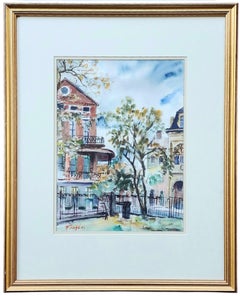
Pirate's Alley, French Quarter, New Orleans

Pirate's Alley, French Quarter, New Orleans

Located in Grand Rapids, MI

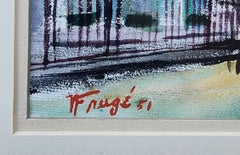
Nestor Hippoyle Fruge (American, 1914/16 - 2011/12) Signed: N Fruge 51 (Lower, Left) " Pirate's Alley, French Quarter ," 1951 (New Orleans) Watercolo...

Category

Mid-20th Century American Modern Art

Materials

Paper, Watercolor

New York Skyline, NY; East River

New York Skyline, NY; East River

By Leon Dolice

Located in Middletown, NY

Etching on medium stock, cream wove paper, 5 15/16 x 10 3/16 inches (151 x 259 mm), full margins. Signed and titled in pencil, lower margin. A fine and detailed impression in dark bl...

Category

1930s American Modern Art

Materials

Archival Paper, Etching

'Tenant Farmers' — Depression Era, WPA

'Tenant Farmers' — Depression Era, WPA

By Lou Barlow

Located in Myrtle Beach, SC

Lou Barlow (Louis Breslow), 'Tenant Farmers', color wood engraving, 1936, edition 25. Signed, titled, and numbered '15/25' in pencil. A superb, richly-inked impression, with fresh c...

Category

1930s American Modern Art

Materials

Woodcut

Harry Shokler, Island Harbor

Harry Shokler, Island Harbor

By Harry Shokler

Located in New York, NY

Harry Shokler used serigraphy to great advantage in this landscape. It's colorful and detailed. It is signed in the image at the lower left. When printmakers began making serigraphs...

Category

1940s American Modern Art

Materials

Screen

ROCKY 36x48 Sylvester Stallone Photomosaic Photography Pop Art Print

ROCKY 36x48 Sylvester Stallone Photomosaic Photography Pop Art Print

By Destro

Located in Los Angeles, CA

"Rocky" is an acrylic photomosaic artwork by Destro. The first release in a series mosaic works called "Icons". Destro has created large prints which are made up of many hundreds of...

Category

21st Century and Contemporary American Modern Art

Materials

Archival Pigment

Fisherman's Island, Boothbay, Maine, early 20th century landscape watercolor

Fisherman's Island, Boothbay, Maine, early 20th century landscape watercolor

By Frank Wilcox

Located in Beachwood, OH

Frank Nelson Wilcox (American, 1887-1964) Fisherman's Island, Boothbay, Maine, c. 1925 Watercolor on paper Signed lower left 15 x 20 inches 20.75 x 25.75 inches, framed Frank Nelson Wilcox (October 3, 1887 – April 17, 1964) was a modernist American artist and a master of watercolor. Wilcox is described as the "Dean of Cleveland School painters," though some sources give this appellation to Henry Keller or Frederick Gottwald. Wilcox was born on October 3, 1887 to Frank Nelson Wilcox, Sr. and Jessie Fremont Snow Wilcox at 61 Linwood Street in Cleveland, Ohio. His father, a prominent lawyer, died at home in 1904 shortly before Wilcox' 17th birthday. His brother, lawyer and publisher Owen N. Wilcox, was president of the Gates Legal Publishing Company or The Gates Press. His sister Ruth Wilcox...

Category

1920s American Modern Art

Materials

Watercolor

Mid-Century Painting of Party by African-American from Detroit.

Mid-Century Painting of Party by African-American from Detroit.

Located in Marco Island, FL

The scale of this dynamic party painting by Leroy Foster (1925-1993) makes you feel like you are in the room with a cocktail in hand. He was an accomplished muralist, so it is no s...

Category

1950s American Modern Art

Materials

Canvas, Oil

'Little Girl' — American Modernism

'Little Girl' — American Modernism

By Milton Avery

Located in Myrtle Beach, SC

Milton Avery, 'Little Girl', drypoint, 1936, edition 60, Lunn 11. Signed, dated, and numbered '22/60' in pencil. A superb impression, in warm black ink with delicate overall plate tone, on off-white wove paper, with wide margins (2 5/8 to 4 1/8 inches); hinge stains on the top sheet edge, verso, otherwise in excellent condition. Matted to museum standards, unframed. Image size 8 3/4 x 4 3/4 inches (222 x 121 mm); sheet size 14 7/8 x 13 1/8 inches (378 x 333 mm). Collections: Cantor Arts Center, National Gallery of Art. ABOUT THE ARTIST "I never have any rules to follow; I follow myself." "I paint not by sight but by faith. Faith gives you sight." —Milton Avery 'His is the poetry of sheer loveliness.' —Mark Rothko in his 1965 eulogy to Avery. Milton Avery (1885-1965) is recognized as one of America's foremost modernist artists, renowned for his uniquely expressive style, evocative use of color, and captivating compositions. Growing up in a working-class family in Altmar, New York, Avery's early life was marked by the struggles and realities of rural New York. Despite lacking formal artistic training, he displayed an innate talent for drawing from an early age. In 1905, his family relocated to Hartford, Connecticut, where he worked various odd jobs while developing his artistic skills through self-study and experimentation. In 1915, he enrolled at the Connecticut League of Art Students, where he received formal instruction and began to refine his distinctive style. In 1918, Avery transferred to the School of the Art Society of Hartford and worked in the evenings so that he could paint during the day. He became a member of the Connecticut Academy of Fine Arts in 1924. That summer in Gloucester, Massachusetts, he met the artist Sally Michael...

Category

1930s American Modern Art

Materials

Drypoint

Saint Tropez Boucherie, August 1971 - Nude Women Portrait French Riviera Fashion

Saint Tropez Boucherie, August 1971 - Nude Women Portrait French Riviera Fashion

By Slim Aarons

Located in Brighton, GB

Saint Tropez Boucherie, August 1971 - Nude Women Portrait French Riviera Fashion by Slim Aarons 16 x 20" print. Limited Edition Estate Stamped Print. Edition of 150. Printed Later. ...

Category

20th Century American Modern Art

Materials

Photographic Paper, C Print, Color, Digital

Ted Egri Taos Modernist Judaica Cubist Bronze Sculpture Rabbi & Torah WPA Artist

Ted Egri Taos Modernist Judaica Cubist Bronze Sculpture Rabbi & Torah WPA Artist

Located in Surfside, FL

Ted Egri (American, 1913-2010) Bronze sculpture Rabbi Signed Egri and numbered 4/30 on side. Dimensions: 12"L x 8.5"H x 6.75" D Born in New York city in 1913 to a Hungarian Jewish emigre family (both of his parents were born in Hungary), Egri was first exposed to music later dropping that for art. He studied with Howard Giles at the Master Institute of the Roerich Museum in New York where he was introduced to Oriental arts, Chinese and Japanese art forms, and later with Hans Hofmann. He worked for the Federal Arts Project, the WPA, making mural paintings and silkscreen prints as well as easel painting. Once WWII began, Egri signed up to serve as a map maker for the Navy, and was witness to some of the fiercest battles in the Pacific. As an artist, he painted many important depictions of his wartime experiences and these works have all be donated to the U.S. Naval Museum. Already a practicing painter and instructor at the Kansas City Art Institute, Ted Egri came to Taos, New Mexico with his wife Kit in 1950 to continue his study of painting at Ribak's Taos Valley Art School on the GI Bill. Louis Ribak quickly introduced Egri to Eulalia Emetaz, the owner of La Galleria Escondida, who gave him his first one-person show in 1951. A prolific and versatile artist, as well as arts organizer and advocate, Egri's contributions to underserved African American, Native American, Hispanic and women were honored by two Taos mayors, with no less than two Ted Egri days during his 50-year art career in Taos. Egri remained in Taos. He became widely known for his sculpture, influenced by cubism and painting, with his style ranging from abstract to realistic. Egri had incredible draftsmanship - charcoal, pencil, pastel, watercolor, oils, mixed media, pen and ink, acrylic, gouache Over time his work gradually shifted from its focus on human struggle to an exploration of natural elements and the changes that come about as a result of living in a physical environment like Taos. "The impact of the majestic Sangre de Cristo Mountain Range and the vast spaces of the mesas directed me toward space and form. I moved into sculpture," Egri said in a 1987 interview with ARTSPACE magazine. He was included in a show at Stables Gallery along with Emil Bisttram, Louis Catusco, Edward Corbett, Lawrence Calcagno, Keith Crown, Andrew Dasburg, John De...

Category

Mid-20th Century American Modern Art

Materials

Bronze

Julie London - Portrait Julie London Jazz Singer Beverly Hills Hotel Hollywood

Julie London - Portrait Julie London Jazz Singer Beverly Hills Hotel Hollywood

By Slim Aarons

Located in Brighton, GB

Julie London - Portrait Julie London Jazz Singer Beverly Hills Hotel Hollywood by Slim Aarons 16 x 20" print. Limited Edition Estate Stamped Print. Edition of 150. Printed Later. J...

Category

20th Century American Modern Art

Materials

Photographic Paper, C Print, Color, Digital

Mid Century Floral Still-Life in Oil on Canvas-Wrapped Illustration Board

Mid Century Floral Still-Life in Oil on Canvas-Wrapped Illustration Board

Located in Soquel, CA

Mid Century Floral Still-Life in Oil on Canvas-Wrapped Illustration Board Classic mid century floral still-life with impasto in warm, autumn colors by Frances Christensen American, ...

Category

Mid-20th Century American Modern Art

Materials

Canvas, Oil, Illustration Board

“Americana”
“Americana”

Ralph Fabri“Americana”, 1947

$675Sale Price|30% Off

“Americana”

By Ralph Fabri

Located in Southampton, NY

Here for your consideration is a wonderful original etching on archival paper by the well known American artist, Ralph Fabri. Strong impression; signed in pencil by the artist lower right margin. Titled and dated bottom left of the sheet “1947-Americana”. Condition of the etching is excellent. Top corner of sheet and bottom right corner of sheet have tiny creases. Not visible, under the mat. Sheet size is 12 by 15 inches. Image size is 8 by 9.75 inches. Matted but not framed. Provenance: A Long Island, New York collector. Painter and printmaker, commercial artist, writer, and teacher, Ralph Fabri was born Fabri Reszo in Hungary in 1894. He was educated in Budapest, first studying architecture at the Royal Institute of Technology from 1912 to 1914. He then enrolled in the Royal Academy of Fine Arts, from which he graduated in 1918 with a Professor's Diploma (M.A.) "for teaching drawing, painting and geometry – including descriptive and projective geometry – in schools of higher education." Fabri arrived in New York City in 1921 and soon adopted the anglicized version of his name, Ralph Fabri. He began doing commercial design work and during the academic year of 1923/24 was enrolled as an evening student at the National Academy of Design. After becoming an American citizen in 1927, he traveled extensively in Europe. Upon returning to New York that same year, Fabri decided his financial situation was stable enough to allow him to focus his attention on fine art. During the Great Depression, Fabri's already inadequate portrait commissions and art sales further declined and he returned to commercial work. He established a workshop known as the Ralph Fabri Studios, that designed theatrical and movie sets, window displays, and retail interiors. But Fabri found the workshop dirty and distasteful, and eventually was able to concentrate on advertising work which could be done from home. The largest clients for his pen and ink drawings were The Stamp and Album Co. of America, Inc. (for which he designed covers for stamp albums and produced illustrations for envelopes housing sets of stamps sold to collectors), Geographica Map Co., and Joseph H. Cohen & Sons (for whom he designed and illustrated mail order catalogs). Another source of income during this period was the design and construction of an addition to "Iroki," Theodore Dreiser...

Category

1940s American Modern Art

Materials

Archival Paper, Etching

Original 1937 US One-Sheet Poster  Manhattan Merry-Go-Round + Joe DiMaggio

Original 1937 US One-Sheet Poster Manhattan Merry-Go-Round + Joe DiMaggio

Located in Spokane, WA

Original 1937 US One-Sheet Poster Manhattan Merry-Go-Round Featuring Joe DiMaggio. The film starred Jackie Gleason, Gene Autry, Leo Carrillo, Louie Prima, and Cab Calloway. And in...

Category

1930s American Modern Art

Materials

Offset

Blizzard in Woods
Blizzard in Woods

Blizzard in Woods

By Charles E. Burchfield

Located in Fairlawn, OH

Blizzard in Woods Graphite on paper, c. 1945-1963 Unsigned Provenance: Sid Deutsch Gallery, New York Annotated with notes for completing the drawing. Deutsch Gallery has handled Bur...

Category

1940s American Modern Art

Materials

Graphite

Elephant Long Mount Ringling Bros. and Barnum & Bailey Circus

Elephant Long Mount Ringling Bros. and Barnum & Bailey Circus

Located in Middletown, NY

Gelatin silver print mounted on board, 7 1/2 x 9 1/2 in. (190 x 241 mm) from the Roland Butler Collection, Press Agent, Ringling Bros. and Barnum & Bailey Circus (1930s-1960s) Roland...

Category

Mid-20th Century American Modern Art

Materials

Photographic Paper

Original National Florida's Westcoast vintage airline poster, linen-backed

Original National Florida's Westcoast vintage airline poster, linen-backed

Located in Spokane, WA

National Florida's West Coast Original Vintage Poster, linen-backed and ready to frame. Grade A condition. No restoration, no damage, no tears. Generally, posters for National Airlin...

Category

1960s American Modern Art
Materials

Offset

Hotel Hacienda, 1978 - Hotel Swimming Pool, Spanish Island of Ibiza Photograph

Hotel Hacienda, 1978 - Hotel Swimming Pool, Spanish Island of Ibiza Photograph

By Slim Aarons

Located in Brighton, GB

Hotel Hacienda, 1978 - Hotel Swimming Pool, Spanish Island of Ibiza Photograph by Slim Aarons 16" x 20" print. Limited Edition Estate Stamped Print. Edition of 150. Printed Later. ...

Category

20th Century American Modern Art
Materials

C Print, Photographic Paper, Color, Digital

American Modern art for sale on 1stDibs.
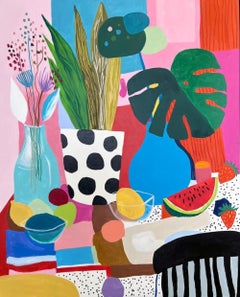
Find a wide variety of authentic American Modern art available for sale on 1stDibs. Works in this style were very popular during the 21st Century and Contemporary, but contemporary artists have continued to produce works inspired by this movement. If you’re looking to add art created in this style to introduce contrast in an otherwise neutral space in your home, the works available on 1stDibs include elements of blue, orange, purple, red and other colors. Many Pop art paintings were created by popular artists on 1stDibs, including Slim Aarons, Destro, Howard Schatz, and John Taylor Arms. Frequently made by artists working with Paint, and Oil Paint and other materials, all of these pieces for sale are unique and have attracted attention over the years. Not every interior allows for large American Modern art, so small editions measuring 0.25 inches across are also available.