American Modern Art

to
662
1,621
1,299
905
633
554
Overall Width
to
Overall Height
to
2
17
4,325
672
10
56
173
662
487
417
413
375
277
143
116,515
63,525
56,286
28,463
14,632
9,511
6,630
5,841
4,181
3,133
2,481
2,328
2,139
601
2,453
2,187
226
2,264
1,083
822
631
617
486
416
331
300
223
217
210
207
191
185
182
163
162
144
135
1,859
1,396
1,019
624
601
283
226
107
105
90
1,454
547
4,584
370
Style: American Modern
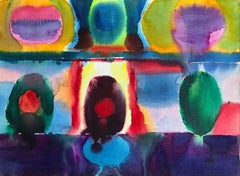
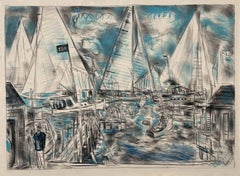
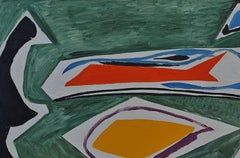
'Abstract Boats' — American Modernism, WPA

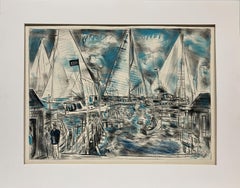
'Abstract Boats' — American Modernism, WPA

By Leon Bibel

Located in Myrtle Beach, SC

Leon Bibel, 'Abstract Boats', color serigraph, 1938, edition 12. Signed, dated, and numbered ' /12' in pencil. A fine, painterly impression, with fresh colors, on buff wove paper; t...

Category

1930s American Modern Art

Materials

Screen

Underwater — Mid-century Modern

Underwater — Mid-century Modern

By Charles Quest

Located in Myrtle Beach, SC

Charles Quest, 'Underwater', 1948, chiaroscuro wood engraving, edition 12. Signed, titled, dated and numbered '3/12' in pencil. A fine, richly-inked impression, in dark brown and warm black, on off-white wove paper, with full margins (5/8 to 1 1/2 inch), in excellent condition. Scarce. ABOUT THE ARTIST Charles Quest, painter, printmaker, and fine art instructor, worked in various mediums, including mosaic, stained glass, mural painting, and sculpture. Quest grew up in St. Louis, his talent evident as a teenager when he began copying the works of masters such as Michelangelo on his bedroom walls. He studied at the Washington University School of Fine Arts, where he later taught from 1944 to 1971. He traveled to Europe after his graduation in 1929 and studied at La Grande Chaumière and Academie Colarossi, Paris, continuing to draw inspiration from the works of the Old Masters. After returning to St. Louis, Quest received several commissions to paint murals in public buildings, schools, and churches, including one from Joseph Cardinal Ritter, to paint a replica of Velasquez's Crucifixion over the main altar of the Old Cathedral in St. Louis. Quest soon became interested in the woodcut medium, which he learned through his study of J. J. Lankes' A Woodcut Manual (1932) and Paul Landacre's articles in American Artist magazine ‘since no artists in St. Louis were working in wood’ at that time. Quest also revealed that for him, wood cutting and engraving were ‘more enjoyable than any other means of expression.’ In the late 1940s, his graphic works began attracting critical attention—several of his woodcuts won prizes and were acquired by major American and European museums. His wood engraving entitled ‘Lovers’ was included in the American Federation of Art's traveling print exhibition in 1947. Two years later, Quest's two prize-winning prints, ‘Still Life with Grindstone’ and ‘Break Forth into Singing’, were exhibited in major American museums in a traveling show organized by the Philadelphia Print Club. His work was included in the Chicago Art Institute's exhibition, ‘Woodcut Through Six Centuries’, and the print ‘Still Life with Vise’ was purchased by the Museum of Modern Art in New York. In 1951 he was invited by artist-Curator Jacob Kainen to exhibit thirty wood engravings and color woodcuts in a one-person show at the Smithsonian's National Museum (now known as the American History Museum). Kainen's press release praised the ‘technical refinement’ of Quest's work: ‘He obtains a great variety of textural effects through the use of the graver, and these dense or transparent grays are set off against whites or blacks to achieve sparkling results. His work has the handsome qualities characteristic of the craftsman and designer.’ At the time of the Smithsonian exhibition, Quest's work was represented by three New York galleries in addition to one in his home town. He had won 38 prizes, and his prints were in the collections of the Library of Congress, the Chicago Art Institute, the Metropolitan Museum, and the Philadelphia Museum of Art. In cooperation with the Art in Embassies program, his color woodcuts were displayed at the American Embassy in Paris in 1951. Recognition at home came in 1955 with his first solo exhibition in St. Louis. Press coverage of the show heralded the ‘growth of graphic arts toward rivaling painting and sculpture as a major independent medium’. An exhibition of his prints at the Bethesda Art Gallery in 1983 attracted Curator Emeritus Joseph A. Haller, S.J., who began purchasing his work for Georgetown University's collection. In 1990 Georgetown University Library's Special Collections Division was the recipient of a large body of Quest's work, including prints, drawings, paintings, sculpture, stained glass, and his archive of correspondence and professional memorabilia. These extensive holdings, including some 260 of his fine prints, provide a rich opportunity for further study and appreciation of this versatile and not-to-be-forgotten mid-Western American artist...

Category

1940s American Modern Art

Materials

Woodcut

Scotti's Yacht, Monte Carlo, 1981 - Luxury Sailboats in Monte Carlo in Monaco

Scotti's Yacht, Monte Carlo, 1981 - Luxury Sailboats in Monte Carlo in Monaco

By Slim Aarons

Located in Brighton, GB

Scotti's Yacht, Monte Carlo, 1981 - Luxury Sailboats in Monte Carlo in Monaco by Slim Aarons 16 x 20" print. Limited Edition Estate Stamped Print. Edition of 150. Printed Later. 'S...

Category

20th Century American Modern Art

Materials

Photographic Paper, C Print, Color, Digital

Gertrude Barrer Oil on Board

Gertrude Barrer Oil on Board

Located in San Francisco, CA

Gertrude Barrer: 1921-1992. Well listed American artist with auction records over $9500. She studied a the Arts Student League in the 1940s. More recently art historians have said s...

Category

20th Century American Modern Art

Materials

Oil

Beautiful large impressionist pastel by Francesco Spicuzza

Beautiful large impressionist pastel by Francesco Spicuzza

By Francesco Spicuzza

Located in New York, NY

Francesco Spicuzza (American, 1883-1962) Untitled Landscape, 20th century Pastel on paper Sight size: 24 x 30 in. Framed: 26 1/4 x 32 3/8 in. Signed lower right: Spicuzza Italian-born Francesco Spicuzza was primarily a Wisconsin painter who did portraits, still-lives and local landscapes. He spent the first part of his life in near-poverty to become a painter. An eternal optimist, in 1917, the artist reported: "I am happy and my only ambition now is to paint better and better until I shall have reached the measure of the best of which I am capable." (Spicuzza, 1917, p. 22). His predilection for beach scenes germinated early: reportedly, the five-year-old boy first drew the outlines of his father's fishing boat in the sand on the seashore near their home in Sicily. After setting himself up as a fruit peddler in Milwaukee, Spicuzza's father sent for his family when Francesco was eight years old. For the following six years the boy was unable to attend school because of his job in his father's fruit and vegetable business. The poor lad suffered a caved-in shoulder from carrying a heavy wooden crate. The young Spicuzza was aided by moral and financial support from a sympathetic Milwaukee businessman named John Cramer, publisher and editor of the Evening Wisconsin, who raised Spicuzza's salary as a newspaper assembler so that he could attend school. In 1899 or 1900, Spicuzza began studying drawing and anatomy under Robert Schade (1861-1912), a painter of panoramas who had been trained in Munich under Carl Theodor von Piloty. Spicuzza was also taught by Alexander Mueller (1872-1935), a product of the Weimar and Munich academies. Mueller realized Spicuzza was a colorist and encouraged that orientation (Madle, 1961). Spicuzza found it beneficial to accept an apprenticeship in a lithographic studio for $8 a week, which demanded most of his time. During the St. Louis Universal Exposition in 1904, still a struggling student, Spicuzza attended the fair, thanks to Cramer. It was not long before Spicuzza received a twenty-five dollar portrait commission, and this inaugural success led to new commissions and allowed him to continue as a painter. The earliest influences in his work appear to be from Edward H. Potthast and Maurice Prendergast, though Spicuzza never mentioned either artist. Already in August 1910, Spicuzza was described in a newspaper as "one of the most talented of Milwaukee's rising workers." He undoubtedly received lasting inspiration from his one summer study period in 1911 with John F. Carlson at the Art Students League's Summer School in Woodstock, New York. Certainly Spicuzza would have picked up spontaneity in handling the brush from Carlson. Although he executed numerous still-lives and an occasional religious work, Spicuzza is best known for his Milwaukee beach scenes populated with frolicking bathers in multi-colored attire, not unlike the images of Potthast, who used a similar technique. Many of these are small, preparatory works on canvas board executed between 1910 and 1915. Frequently with even greater animation than Potthast, Spicuzza produced moving images of youthful energy and uninhibited child's play. These beach genre scenes reflect the attitude of American impressionists who depicted the more pleasant side of life. Spicuzza manipulated a successful balance of rich pigment applied in varying degrees of impasto texture with subtle nuances of hue. Working all'aperto, he sought "the soft enticing shades of yellow, blue, green, pink and lavender . . . to get the effects of bright glistening summer air." (L.E.S., n.d.). As a painter whose color not only derived from direct observation but also from a personal theory of color symbolism, Spicuzza traded the linear approach of lithography for dynamic patches of brilliant color. Like Prendergast, he would often tilt the angle of the picture plane to bring the viewer's position above the scene. Spicuzza was unable to enter the 1913 Armory Show or the Panama-Pacific International Exposition two years later but he did submit work to the annual exhibitions of the Pennsylvania Academy of the Fine Arts and those of the Art Institute of Chicago. His first important award was the bronze medal presented by the St. Paul Institute in 1913, which was followed by the silver medal two years later. Before long, Spicuzza had acquired a greater sense of security in his profession and was described by a writer in International Studio (April 1917) as "an independent artist with an assured future. His pastels and water-colours are poetic and joyous bits of nature with a genuine out-of-door feeling." In 1918, his Spirit of Youth, exhibited at the National Academy of Design, sold for $112.50. Four years later, the artist achieved his greatest local recognition by winning the gold medal from the Milwaukee Art Institute. Spicuzza spent a great deal of time painting en plein air and by 1925 he began summering at Big Cedar Lake, near West Bend, Wisconsin to gather his subject matter. Easter Morning (1926) owes something to the Symbolist movement, with its figure of Christ appearing over a seascape. During the difficult era of the Depression, patrons came to Spicuzza's aid and during the 40s, he taught housewives, businessmen and students at the Milwaukee Art Institute, the Milwaukee Art Center, and in his private studio. In the following decade, although his kind of art was no longer popular in the "make-it-or-break-it" New York gallery world, Spicuzza enjoyed regular patronage and sales. His beach scenes became more static and he would experiment with modernist techniques. Spicuzza died at the age of seventy-eight. Sources: L.E.S., "Do Colors Change a Person's disposition? Experiments of a Milwaukee Artist...

Category

20th Century American Modern Art

Materials

Paper, Pastel

Ranchos Church
Ranchos Church

Ranchos Church

By Anna Barry

Located in Fairlawn, OH

Ranchos Church Screen print, Late 1940's Signed lower right (see photo) Titled lower left (see photo) Edition: Unknown This image depicts the famous church San Francisco de Asis Miss...

Category

1940s American Modern Art

Materials

Screen

Crying Clown Portrait in Oil on Canvas

Crying Clown Portrait in Oil on Canvas

Located in Soquel, CA

Crying Clown Portrait in Oil on Canvas Portrait of a sad clown by San Francisco artist John Peers (American, 1922-2009). This portrait is closely fra...

Category

1970s American Modern Art

Materials

Canvas, Oil

Elephant Long Mount Ringling Bros. and Barnum & Bailey Circus

Elephant Long Mount Ringling Bros. and Barnum & Bailey Circus

Located in Middletown, NY

Gelatin silver print mounted on board, 7 1/2 x 9 1/2 in. (190 x 241 mm) from the Roland Butler Collection, Press Agent, Ringling Bros. and Barnum & Bailey Circus (1930s-1960s) Roland...

Category

Mid-20th Century American Modern Art

Materials

Photographic Paper

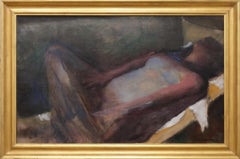
Reclining Figures

Reclining Figures

By Otis Huband

Located in Dallas, TX

Born in 1933, Otis Huband declared his intention to be an artist at age 6. He earned his BFA and MFA at Richmond Professional Institute of the College of William & Mary, now Virginia...

Category

2010s American Modern Art

Materials

Canvas, Oil

Sunburst over the Mesas

Sunburst over the Mesas

Located in San Francisco, CA

In late spring, the high desert floor is still covered with grass and flowering yuccas. Against this colorful backdrop, the artist has captured a burst of sunlight breaking through t...

Category

1970s American Modern Art

Materials

Canvas, Oil

Original 1937 US One-Sheet Poster  Manhattan Merry-Go-Round + Joe DiMaggio

Original 1937 US One-Sheet Poster Manhattan Merry-Go-Round + Joe DiMaggio

Located in Spokane, WA

Original 1937 US One-Sheet Poster Manhattan Merry-Go-Round Featuring Joe DiMaggio. The film starred Jackie Gleason, Gene Autry, Leo Carrillo, Louie Prima, and Cab Calloway. And in...

Category

1930s American Modern Art

Materials

Offset

Tom

Tom

Located in Los Angeles, CA

This painting is part of our exhibition Charles Goeller: A Wistful Loneliness. Oil on canvas, 30 x 25 inches, Signed lower right, Signed verso on stret...

Category

1930s American Modern Art

Materials

Oil

Cameo Pink Seaform with Black Lip Wrap (94.678.s1)

Cameo Pink Seaform with Black Lip Wrap (94.678.s1)

By Dale Chihuly

Located in Missouri, MO

Cameo Pink Seaform with Black Lip Wrap (94.678.s1), 1994 Dale Chihuly (American, b. 1941) 14 x 32 x 18 inches Born in Tacoma, Washington, Dale Chihuly became the most famous ornate ...

Category

1990s American Modern Art

Materials

Glass, Blown Glass

Female Figure
Female Figure

Female Figure

By Lorrie Goulet

Located in New York, NY

It is marvelous to find discoveries such as Lorrie Goulet's female form, one of our few American women sculptors who direct carved in marble. Goulet has an attractive technique of u...

Category

1960s American Modern Art

Materials

Marble

Cafe Society: The Smoker, male portait Closerie des Lilas, Lost Generation Paris

Cafe Society: The Smoker, male portait Closerie des Lilas, Lost Generation Paris

By John Wentworth Russell

Located in Norwich, GB

A strong portrait, and a piece of history. It was confidently sketched in 1923, during the heyday of the "Lost Generation" in Paris, at the Closerie des Lilas - Ernest Hemingway's favourite haunt and home-from-home in the City. This historical café is where Hemingway first read The Great Gatsby with his friend F. Scott Fitzgerald and where he wrote most of The Sun Also Rises...

Category

1920s American Modern Art

Materials

Paper, Graphite

Plowman, Brecksville, Ohio, Early 20th Century Farm Landscape, Cleveland School

Plowman, Brecksville, Ohio, Early 20th Century Farm Landscape, Cleveland School

By Frank Wilcox

Located in Beachwood, OH

Frank Nelson Wilcox (American, 1887–1964) Plowman, Brecksville, Ohio, c. 1922 Watercolor on paper Signed lower right 22.5 x 27.75 inches 27.75 x 34.5 inches, framed Frank Nelson Wilcox (October 3, 1887 – April 17, 1964) was a modernist American artist and a master of watercolor. Wilcox is described as the "Dean of Cleveland School painters," though some sources give this appellation to Henry Keller or Frederick Gottwald. Wilcox was born on October 3, 1887 to Frank Nelson Wilcox, Sr. and Jessie Fremont Snow Wilcox at 61 Linwood Street in Cleveland, Ohio. His father, a prominent lawyer, died at home in 1904 shortly before Wilcox' 17th birthday. His brother, lawyer and publisher Owen N. Wilcox, was president of the Gates Legal Publishing Company or The Gates Press. His sister Ruth Wilcox was a respected librarian. In 1906 Wilcox enrolled from the Cleveland School of Art under the tutelage of Henry Keller, Louis Rorimer, and Frederick Gottwald. He also attended Keller's Berlin Heights summer school from 1909. After graduating in 1910, Wilcox traveled and studied in Europe, sometimes dropping by Académie Colarossi in the evening to sketch the model or the other students at their easels, where he was influenced by French impressionism. Wilcox was influenced by Keller's innovative watercolor techniques, and from 1910 to 1916 they experimented together with impressionism and post-impressionism. Wilcox soon developed his own signature style in the American Scene or Regionalist tradition of the early 20th century. He joined the Cleveland School of Art faculty in 1913. Among his students were Lawrence Edwin Blazey, Carl Gaertner, Paul Travis, and Charles E. Burchfield. Around this time Wilcox became associated with Cowan Pottery. In 1916 Wilcox married fellow artist Florence Bard, and they spent most of their honeymoon painting in Berlin Heights with Keller. They had one daughter, Mary. In 1918 he joined the Cleveland Society of Artists, a conservative counter to the Bohemian Kokoon Arts Club, and would later serve as its president. He also began teaching night school at the John Huntington Polytechnic Institute at this time, and taught briefly at Baldwin-Wallace College. Wilcox wrote and illustrated Ohio Indian Trails in 1933, which was favorably reviewed by the New York Times in 1934. This book was edited and reprinted in 1970 by William A. McGill. McGill also edited and reprinted Wilcox' Canals of the Old Northwest in 1969. Wilcox also wrote, illustrated, and published Weather Wisdom in 1949, a limited edition (50 copies) of twenty-four serigraphs (silk screen prints) accompanied by commentary "based upon familiar weather observations commonly made by people living in the country." Wilcox displayed over 250 works at Cleveland's annual May Show. He received numerous awards, including the Penton Medal for The Omnibus, Paris (1920), Fish Tug on Lake Erie (1921), Blacksmith Shop (1922), and The Gravel Pit (1922). Other paintings include The Trailing Fog (1929), Under the Big Top (1930), and Ohio Landscape...

Category

1920s American Modern Art

Materials

Watercolor

Original California Figurative Abstract Still Life Ink Drawing Joyce Treiman

Original California Figurative Abstract Still Life Ink Drawing Joyce Treiman

By Joyce Treiman

Located in Surfside, FL

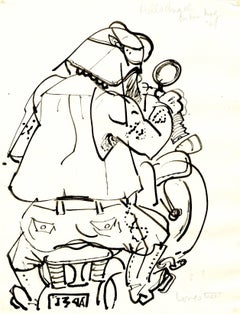
Joyce Treiman Ink on paper, framed under glass; signed in pencil lower right; Dimensions: 16 1/2 x 13 3/4 inches; 18 3/4 x 14 3/4 inches frame. Joyce Wahl Treiman was an American p...

Category

Mid-20th Century American Modern Art

Materials

Paper, India Ink

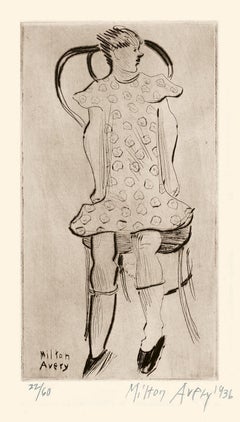
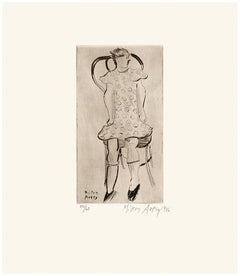
'Little Girl' — American Modernism

'Little Girl' — American Modernism

By Milton Avery

Located in Myrtle Beach, SC

Milton Avery, 'Little Girl', drypoint, 1936, edition 60, Lunn 11. Signed, dated, and numbered '22/60' in pencil. A superb impression, in warm black ink with delicate overall plate tone, on off-white wove paper, with wide margins (2 5/8 to 4 1/8 inches); hinge stains on the top sheet edge, verso, otherwise in excellent condition. Matted to museum standards, unframed. Image size 8 3/4 x 4 3/4 inches (222 x 121 mm); sheet size 14 7/8 x 13 1/8 inches (378 x 333 mm). Collections: Cantor Arts Center, National Gallery of Art. ABOUT THE ARTIST "I never have any rules to follow; I follow myself." "I paint not by sight but by faith. Faith gives you sight." —Milton Avery 'His is the poetry of sheer loveliness.' —Mark Rothko in his 1965 eulogy to Avery. Milton Avery (1885-1965) is recognized as one of America's foremost modernist artists, renowned for his uniquely expressive style, evocative use of color, and captivating compositions. Growing up in a working-class family in Altmar, New York, Avery's early life was marked by the struggles and realities of rural New York. Despite lacking formal artistic training, he displayed an innate talent for drawing from an early age. In 1905, his family relocated to Hartford, Connecticut, where he worked various odd jobs while developing his artistic skills through self-study and experimentation. In 1915, he enrolled at the Connecticut League of Art Students, where he received formal instruction and began to refine his distinctive style. In 1918, Avery transferred to the School of the Art Society of Hartford and worked in the evenings so that he could paint during the day. He became a member of the Connecticut Academy of Fine Arts in 1924. That summer in Gloucester, Massachusetts, he met the artist Sally Michael...

Category

1930s American Modern Art
Materials

Drypoint

Some Like it Hot  Qualcuno Piace Caldo original vintage Italian movie poster

Some Like it Hot Qualcuno Piace Caldo original vintage Italian movie poster

Located in Spokane, WA

Original Some Like it Hot vintage movie poster. A Qualcuno Piace Caldo". Linen-backed Italian size 39" x 55", in Good condition. Ready to frame. The images are of the exact poster you will receive. These Italian vintage movie...

Category

Late 20th Century American Modern Art

Materials

Offset

Cowboy Hunting Pronghorn Deer ("American Antelope") in Watercolor and Gouache

Cowboy Hunting Pronghorn Deer ("American Antelope") in Watercolor and Gouache

Located in Soquel, CA

Cowboy Hunting Pronghorn Deer ("American Antelope") in Watercolor and Gouache Detailed western scene by H. Rich (American, 20th Century). A cowboy is on a ridge, with two horses, ha...

Category

1960s American Modern Art

Materials

Paper, Watercolor, Gouache

Headland & Rocks, White Island, Maine, early 20th century watercolor

Headland & Rocks, White Island, Maine, early 20th century watercolor

By Frank Wilcox

Located in Beachwood, OH

Frank Nelson Wilcox (American, 1887-1964) Headland & Rocks, White Island, Maine, c. 1923 Watercolor on paper Signed lower left 15 x 19.5 inches Frank Nelson Wilcox (October 3, 1887 – April 17, 1964) was a modernist American artist and a master of watercolor. Wilcox is described as the "Dean of Cleveland School painters," though some sources give this appellation to Henry Keller or Frederick Gottwald. Wilcox was born on October 3, 1887 to Frank Nelson Wilcox, Sr. and Jessie Fremont Snow Wilcox at 61 Linwood Street in Cleveland, Ohio. His father, a prominent lawyer, died at home in 1904 shortly before Wilcox' 17th birthday. His brother, lawyer and publisher Owen N. Wilcox, was president of the Gates Legal Publishing Company or The Gates Press. His sister Ruth Wilcox...

Category

1920s American Modern Art

Materials

Watercolor

Mid Century Oil Painting, South Lake Tahoe in Winter

Mid Century Oil Painting, South Lake Tahoe in Winter

Located in Soquel, CA

Mid Century South Lake Tahoe in Winter Landscape Original Oil Painting Snow-capped stone pillars with split-rail fence framing iconic South Lake Tahoe valley in winter. A crisp blue...

Category

1960s American Modern Art

Materials

Canvas, Oil, Illustration Board

Unfinished Problem

Unfinished Problem

Located in Los Angeles, CA

Unfinished Problem, by 1953, oil on canvas, signed lower right, signed and inscribed verso on stretcher “Charles Goeller/1272 Clinton Place, Elizabeth, NJ...

Category

1950s American Modern Art

Materials

Canvas, Oil

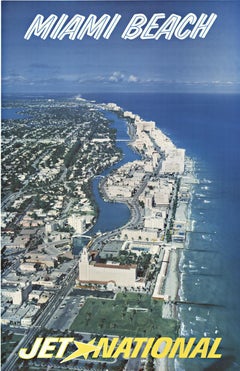
Original National Florida's Westcoast vintage airline poster, linen-backed

Original National Florida's Westcoast vintage airline poster, linen-backed

Located in Spokane, WA

National Florida's West Coast Original Vintage Poster, linen-backed and ready to frame. Grade A condition. No restoration, no damage, no tears. Generally, posters for National Airlin...

Category

1960s American Modern Art

Materials

Offset

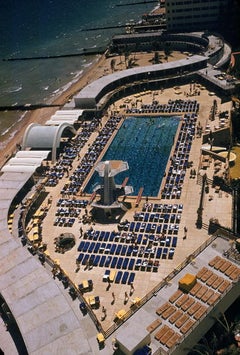
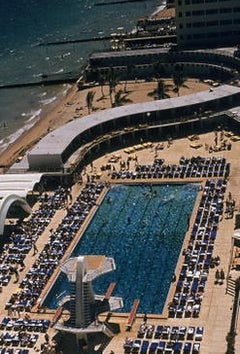
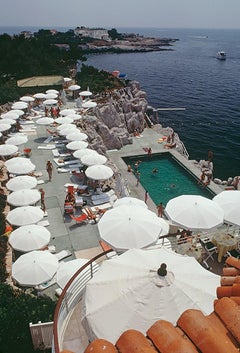
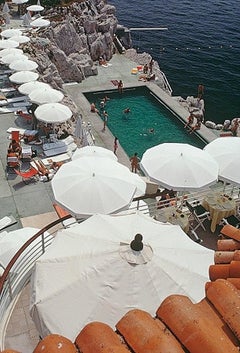
Ariel Pool, Miami - Fontainebleau Hotel Miami Florida Coastline Swimming Pool

Ariel Pool, Miami - Fontainebleau Hotel Miami Florida Coastline Swimming Pool

By Slim Aarons

Located in Brighton, GB

Ariel Pool, Miami - Fontainebleau Hotel Miami Florida Coastline Swimming Pool by Slim Aarons 16 x 20" print. Limited Edition Estate Stamped Print. Edition of 150. Printed Later. "A...

Category

20th Century American Modern Art

Materials

Photographic Paper, Color, C Print, Digital

Snowmass Village - Apres Ski Lunch Picnic at Snowmass in Aspen Colorado

Snowmass Village - Apres Ski Lunch Picnic at Snowmass in Aspen Colorado

By Slim Aarons

Located in Brighton, GB

Snowmass Village - Apres Ski Lunch Picnic at Snowmass in Aspen Colorado by Slim Aarons 16 x 20" print. Limited Edition Estate Stamped Print. Edition of 150. Printed Later. "Snowmas...

Category

20th Century American Modern Art

Materials

Photographic Paper, Color, C Print, Digital

'Tenant Farmers' — Depression Era, WPA

'Tenant Farmers' — Depression Era, WPA

By Lou Barlow

Located in Myrtle Beach, SC

Lou Barlow (Louis Breslow), 'Tenant Farmers', color wood engraving, 1936, edition 25. Signed, titled, and numbered '15/25' in pencil. A superb, richly-inked impression, with fresh c...

Category

1930s American Modern Art
Materials

Woodcut

North on West Street (West Side Highway NYC Cityscape)

North on West Street (West Side Highway NYC Cityscape)

By De Hirsch Margules

Located in Wilton Manors, FL

De Hirsh Margules (1899-1965). North on West Street , 1939. Watercolor on Arches wove paper. Signed and dated in pencil by artist lower margin. Sheet measures 15 x 22 inches. Framed measurement: 27 x 34 inched. Incredibly vibrant and saturated color with no fading or toning of sheet. Provenance: Babcock Galleries, NYC De Hirsh Margules (1899–1965) was a Romanian-American "abstract realist" painter who crossed paths with many major American artistic and intellectual figures of the first half of the 20th century. Elaine de Kooning said that he was "[w]idely recognized as one of the most gifted and erudite watercolorists in the country". The New York Times critic Howard Devree stated in 1938 that "Margules uses color in a breath-taking manner. A keen observer, he eliminates scrupulously without distortion of his material." Devree later called Margules "one of our most daring experimentalists in the medium" Margules was also a well-known participant in the bohemian culture of New York City's Greenwich Village, where he was widely known as the "Baron" of Greenwich Village.[1] The New York Times described him as "one of Greenwich Village's best-known personalities" and "one of the best known and most buoyant characters about Greenwich Village. Early Life De Hirsh Margules was born in 1899 in the Romanian city of Iași (also known as Iasse, Jassy, or Jasse). When Margules was 10 weeks old, his family immigrated to New York City. Both of his parents were active in the Yiddish theater, His father was Yekutiel "Edward" Margules, a "renowned Jewish actor-impresario and founder of the Yiddish stage." Margules' mother, Rosa, thirty-nine years younger than his father, was an actress in the Yiddish theater and later in vaudeville. Although Margules appeared as a child actor with the Adler Family[11] and Bertha Kalich, his sister, Annette Margules, somewhat dubiously continued in family theater and vaudeville tradition, creating the blackface role of the lightly-clad Tondelayo (a part later played on film Hedy Lamarr) in Earl Carroll's 1924 Broadway exoticist hit, White Cargo. Annette herself faced stereotyping as an exotic flower: writing about her publicist Charles Bouchert stated that "Romania produces a stormy, temperamental type of woman---a type admirably fitted to portray emotion." His brother Samuel became a noted magician who appeared under the name "Rami-Sami." Samuel later became a lawyer, representing magician Horace Goldin, among others. A family portrait including a young De Hirsh, a portrait of Rosa and Annette together, and individual photos of Rosa and Edward can be found on the Museum of the City of New York website. At around age 9 or 10, Margules took art classes with the Boys Club on East Tenth Street, and his first taste of exhibition was at a student art show presented by the club. By age 11, he had won a city-wide prize (a box camera) at a children's art show presented by the department store Wanamakers. As a young teenager, Margules was already displaying a characteristic kindness and loyalty. Upon hearing that two friends (one of them was author Alexander King), were in trouble for breaking a school microscope, the nearly broke Margules gave them five dollars to repair the microscope . Margules had to approach a wealthy man that Margules had once saved on the subway from a heart attack. Margules didn't reveal the source of the five dollars to King until twenty-five years later. In his late teens, Margules studied for a couple of months in Pittsburgh with Edwin Randby, a follower of Western painter Frederic Remington. Thereafter he pursued a two-year course of studies in architecture, design and decoration at the New York Evening School of Art and Design, while working as a clerk during the day at Stern's Department Store. He was encouraged in these artistic pursuits by his neighbor, the painter Benno Greenstein (who later went by the name of Benjamin Benno). Artistic career In 1922, Margules began work as a police reporter for the City News Association of New York .Margules then considered himself something of an expert on art, and the painter Myron Lechay is said to have responded to some unsolicited analysis of his work with the remark "Since you seem to know so much about it, why don't you paint yourself?" This led to study with Lechay and a flurry of painting. Margules' first show was in 1922 at Jane Heap's Little Review Gallery. Thereafter Margules began to participate in shows with a group including Stuart Davis, Jan Matulka, Buckminster Fuller (exhibiting depictions of his "Dymaxion house") in a gallery run by art-lover and restaurateur Romany Marie on the floor above her cafe. Jane Heap, left, with Mina Loy and Ezra Pound During the 1920s, Margules traveled outside of the country a number of times. In 1922, with the intent of reaching Bali, he took a job as a "'wiper on a tramp steamer where [he] played nursemaid to the engine." He reached Rotterdam before he turned back. He would return to Rotterdam shortly thereafter. In 1927, Margules took a lengthy leave of absence from his day job as a police reporter in order to travel to Paris, where he "set up a studio in Montmartre's Place du Tertre, on the top floor of an almost deserted hotel, a shabby establishment, lacking both heat and running water." He studied at the Louvre and traveled to paint landscapes in provincial France and North Africa. Margules also joined the "Noctambulist" movement and experimented with painting and showing his artwork in low light.Jonathan Cott wrote that: the painter De Hirsch Margulies sat on the quays of the Seine and painted pictures in the dark. In fact, the first exhibition of these paintings, which could be seen only in a darkened room, took place in [ Walter Lowenfels'] Paris apartment. Elaine de Kooning remarked that studying the works of the Noctambulists confirmed Margules' "direction toward the use of primary colors for perverse effects of heavy shadow." It was also in Paris that Margules initially conceived his idea of "Time Painting", where a painting is divided into sectors, each representing a different time of day, with color choices meant to evoke that time of day. In Paris, his social circle included Lowenfels, photographer Berenice Abbott, publisher Jane Heap, composer George Anthiel, sculptor Thelma Wood, painter André Favory, writer Norman Douglas, writer and editor George Davis, composer and writer Max Ewing, and writer Michael Fraenkel. Upon his return to New York in 1929, Margules attended an exhibition of John Marin's paintings. While at the exhibition, he "launched into an eloquent explanation of Marin to two nearby women", and was overheard by an impressed Alfred Stieglitz. The famous photographer and art promoter invited Margules to dine with his wife, the artist Georgia O'Keeffe, and his assistant, painter Emil Zoler. Stieglitz thereafter became a friend and mentor to Margules, becoming for him "what Socrates was to his friends." Alfred Stieglitz Stieglitz introduced Margules to John Marin, who quickly became the most important painterly influence upon Margules. Elaine de Kooning later noted that Margules was "indebted to Marin and through Marin to Cézanne for his initial conceptual approach - for his constructions of scenes with no negative elements, for skies that loom with the impact of mountains." Margules himself said that Marin was his "father and ... academy." The admiration was by no means unreciprocated: Marin said that Margules was "an art lover with abounding faith and sincerity, with much intelligence and quick seeing." Stieglitz also introduced Margules to many other artistic and intellectual figures in New York. With the encouragement of Alfred Stieglitz, Margules in 1936 opened a two-room gallery at 43 West 8th Street called "Another Place." Over the following two years there were fourteen solo exhibitions by Margules and others, and the gallery was well-respected by the press. It was in this gallery that the painter James Lechay, Myron's brother, exhibited his first painting. In 1936, Margules first saw recognition by major art museums when both the Museum of Modern Art and the Museum of Fine Arts, Boston purchased his works. In 1942, Margules gave up working as a police reporter, and apparently dedicated himself thereafter solely to an artistic vocation. "The Baron of Greenwich Village"[edit] Margules made his mark not only as an artist, but also as an outsized personality known throughout Greenwich Village and beyond. To local residents, Margules was known as the "Baron", after Baron Maurice de Hirsch, a prominent German Jewish philanthropist. Margules was easily recognizable by the beret he routinely wore over his long hair. Writer Charles Norman said that he "dressed with a flair for sloppiness." He was said to "know everybody" in Greenwich Village, to the extent that when the novelist and poet Maxwell Bodenheim was murdered, Margules was the first one the police sought to identify the body. Margules' letters show him interacting with art world figures such as Sacha Kolin, John Marin and Alfred Stieglitz, as well as with prominent figures outside the art world such as polymath Buckminster Fuller and writer Henry Miller. Most of his friends and acquaintances found Margules a generous and voluble man, given to broadly emotionally expressive gestures and acts of kindness and loyalty. In 1929, he exhibited an example of this loyalty and fellow-feeling when he appeared in court to fight what the wrongful commitment of his friend, writer and sculptor Alfred Dreyfuss, who appeared to have been a victim of an illicit attempt to block an inheritance. The Greenwich Village chronicler Charles Norman described the bone-crushing hugs that Margules would routinely bestow on his friends and acquaintances, and speaks of the "persuasive theatricality" that Margules seemed to have inherited from his actor parents. Norman also wrote about Margules' routine acts of kindness, taking in homeless artists, constantly feeding his friends and providing the salvatory loan where needed. Norman also notes that Margules was blessed with a loud and good voice, and was apt to sing an operatic air without provocation. The writer and television personality Alexander King said I think the outstanding characteristics of my friend's personality are affirmation, emphasis, and overemphasis. He chooses to express himself predominantly in superlatives and the gestures which accompany his utterances are sometimes dangerous to life and limb. Of the bystanders, I mean. King also spoke with affectionate amusement about Margules' pride in his cooking, speaking of how "if he should ever invite you to dinner, he may serve you a hamburger with onions, in his kitchen-living room, with such an air of gastronomic protocol, such mysterious hints and ogliing innuendoes, as if César Ritz and Brillat-Savarin had sneaked out, only a moment before, with his secret recipe in their pockets." Margules was such a memorable New York personality that comic book writer Alvin Schwartz imagined him at the Sixth Avenue Cafeteria in a risible yet poignant debate with Clark Kent about whether Superman had the ability to stop Hitler. Margules' entrenchment in the Greenwich Village milieu can be seen in a photograph from Fred McDarrah's "Beat Generation Album" of a January 13, 1961 writers' and poets' meeting to discuss "The Funeral of the Beat Generation", in Robert Cordier [fr]'s railroad flat at 85 Christopher Street. Among the people in the same photograph are Shel Silverstein...

Category

1930s American Modern Art
Materials

Watercolor, Rag Paper

Nuba 1981 Graphite Drawing on Brown Paper James Brown Galerie Bernd Kluser

Nuba 1981 Graphite Drawing on Brown Paper James Brown Galerie Bernd Kluser

By James Brown

Located in Surfside, FL

James Brown (American, 1951-2020) "Study on the Nuba" (African men drawings) 1981 Graphite on brown paper, two works framed together Bears gallery labels verso Dimensions: approx. 16"h x 12"w (each sheet), 24.5"h x 35.25"w (frame) Provenance: Galerie Bernd Klüser, Bears label verso They represented internationally renowned artists such as Joseph Beuys, Tony Cragg, Enzo Cucchi, Jannis Kounellis, Mimmo Paladino and Andy Warhol. Their first exhibitions were with Andy Warhol, Tony Cragg, Julião Sarmento...

Category

1980s American Modern Art
Materials

Paper, Graphite

Untitled

Untitled

Located in Los Angeles, CA

Untitled, c. 1940s, oil on Masonite, signed lower right, 19 ¾ x 25 ¾ inches Ava Vorhaus Gabriel was a New York-based painter, lithographer, and designer. Born in Larchmont, Gabriel ...

Category

1940s American Modern Art

Materials

Masonite, Oil

The 18th at Pebble Beach

The 18th at Pebble Beach

By LeRoy Neiman

Located in Missouri, MO

The 18th at Pebble Beach Leroy Neiman (American, 1921-2012) Signed in pencil lower right Edition 176/400 lower left 26 x 43 inches 37.25 x 54.5 inches with frame Known for his bright, colorful paintings and screen prints of famous sports stars...

Category

20th Century American Modern Art
Materials

Color, Lithograph

American Modern art for sale on 1stDibs.
Find a wide variety of authentic American Modern art available for sale on 1stDibs. Works in this style were very popular during the 21st Century and Contemporary, but contemporary artists have continued to produce works inspired by this movement. If you’re looking to add art created in this style to introduce contrast in an otherwise neutral space in your home, the works available on 1stDibs include elements of blue, orange, purple, red and other colors. Many Pop art paintings were created by popular artists on 1stDibs, including Slim Aarons, Destro, Howard Schatz, and John Taylor Arms. Frequently made by artists working with Paint, and Oil Paint and other materials, all of these pieces for sale are unique and have attracted attention over the years. Not every interior allows for large American Modern art, so small editions measuring 0.25 inches across are also available.