American Modern Art

to
695
1,603
1,293
879
622
548
Overall Width
to
Overall Height
to
2
17
4,280
650
10
59
171
636
487
417
407
374
281
143
116,390
63,526
57,517
27,858
14,589
9,436
6,668
5,796
4,334
3,117
2,510
2,374
2,124
613
2,431
2,144
228
2,243
1,078
824
639
612
477
410
327
298
222
216
210
204
189
181
181
160
150
140
135
1,810
1,387
986
602
592
283
230
106
105
91
1,416
544
4,531
371
Style: American Modern
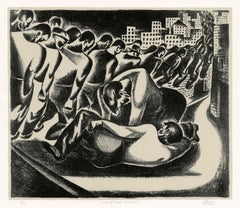
Samuel J. Woolf Antique Litho: First Aid Station at Seicheprey

Samuel J. Woolf Antique Litho: First Aid Station at Seicheprey

Located in New York, NY

Samuel J. Woolf (American, 1880-1948) First Aid Station at Seicheprey Lithograph Sight: 11 x 14 1/2 in. Framed: 20 x 23 x 1 in. Signed lower right: S. J. Woolf Numbered lower left: 23/150 This print is based on Woolf 1918 oil painting: Front Line Dressing Station...

Category

Early 20th Century American Modern Art

Materials

Lithograph

Left Bank Cafe, Paris

Left Bank Cafe, Paris

By LeRoy Neiman

Located in San Francisco, CA

This artwork titled "Left Bank Cafe, Paris" 1987 is an original color serigraph by noted American artist LeRoy Neiman, 1921-2012. It is hand signed and numbered H.C 166/175 in pencil by the artist. The image size is 26 x 38 inches, sheet size is 32.25 x 44 inches. With the blind stamp of the printer Styria Studio at the lower left corner margin. It is in excellent condition, two small pieces of hanging tape remain on the back. About the artist: Mr. Neiman's kinetic, quickly executed paintings and drawings, many of them published in Playboy, offered his fans gaudily colored visual reports on heavyweight boxing matches, Super Bowl games and Olympic contests, as well as social panoramas like the horse races at Deauville, France, and the Cannes Film Festival. Quite consciously, he cast himself in the mold of French Impressionists like Toulouse-Lautrec, Renoir and Degas, chroniclers of public life who found rich social material at racetracks, dance halls and cafes. Mr. Neiman often painted or sketched on live television. With the camera recording his progress at the sketchpad or easel, he interpreted the drama of Olympic Games and Super Bowls for an audience of millions. When Bobby Fischer and Boris Spassky faced off in Reykjavik, Iceland, to decide the world chess championship, Mr. Neiman was there, sketching. He was on hand to capture Federico Fellini directing "8 ½" and the Kirov Ballet performing in the Soviet Union. In popularity, Mr. Neiman rivaled American favorites like Norman Rockwell, Grandma Moses and Andrew Wyeth. A prolific one-man industry, he generated hundreds of paintings, drawings, watercolors, limited-edition serigraph prints and coffee-table books yearly, earning gross annual revenue in the tens of millions of dollars. Although he exhibited constantly and his work was included in the collections of dozens of museums around the world, critical respect eluded him. Mainstream art critics either ignored him completely or, if forced to consider his work, dismissed it with contempt as garish and superficial — magazine illustration with pretensions. Mr. Neiman professed not to care. Maybe the critics are right," he told American Artist magazine in 1995. "But what am I supposed to do about it — stop painting, change my work completely? I go back into the studio, and there I am at the easel again. I enjoy what I'm doing and feel good working. Other thoughts are just crowded out." His image suggested an artist well beyond the reach of criticism. A dandy and bon vivant, he cut an arresting figure with his luxuriant ear-to-ear mustache, white suits, flashy hats and Cuban cigars. "He quite intentionally invented himself as a flamboyant artist not unlike Salvador Dalí, in much the same way that I became Mr. Playboy in the late '50s," Hugh Hefner told Cigar Aficionado magazine in 1995. LeRoy Runquist was born on June 8, 1921, in St. Paul. His father, a railroad worker, deserted the family when LeRoy was quite young, and the boy took the surname of his stepfather. He showed a flair for art at an early age. While attending a local Roman Catholic school, he impressed schoolmates by drawing ink tattoos on their arms during recess. As a teenager, he earned money doing illustrations for local grocery stores. "I'd sketch a turkey, a cow, a fish, with the prices," he told Cigar Aficionado. "And then I had the good sense to draw the guy who owned the store. This gave me tremendous power as a kid." After being drafted into the Army in 1942, he served as a cook in the European theater but in his spare time painted risqué murals on the walls of kitchens and mess halls. The Army's Special Services Division, recognizing his talent, put him to work painting stage sets for Red Cross shows when he was stationed in Germany after the war. On leaving the military, he studied briefly at the St. Paul School of Art (now the Minnesota Museum of American Art) before enrolling in the School of the Art Institute of Chicago, where, after four years of study, he taught figure drawing and fashion illustration throughout the 1950s. When the janitor of the apartment building next door to his threw out half-empty cans of enamel house paint, Mr. Neiman found his métier. Experimenting with the new medium, he embraced a rapid style of applying paint to canvas imposed by the free-flowing quality of the house paint. While doing freelance fashion illustration for the Carson Pirie Scott department store in Chicago in the early 1950s, he became friendly with Mr. Hefner, a copywriter there who was on the verge of publishing the first issue of a men's magazine. In 1954, after five issues of Playboy had appeared, Mr. Neiman ran into Mr. Hefner and invited him to his apartment to see his paintings of boxers, strip clubs and restaurants. Mr. Hefner, impressed, showed the work to Playboy's art director, Art Paul, who commissioned an illustration for "Black Country," a story by Charles Beaumont about a jazz musician. Thus began a relationship that endured for more than half a century and established Mr. Neiman's reputation. In 1955, when Mr. Hefner decided that the party-jokes page needed visual interest, Mr. Neiman came up with the Femlin, a curvaceous brunette who cavorted across the page in thigh-high stockings, high-heeled shoes, opera gloves and nothing else. She appeared in every issue of the magazine thereafter. Three years later, Mr. Neiman devised a running feature, "Man at His Leisure." For the next 15 years, he went on assignment to glamour spots around the world, sending back visual reports on subjects as varied as the races at Royal Ascot, the dining room of the Tour d'Argent in Paris, the nude beaches of the Dalmatian coast, the running of the bulls at Pamplona and Carnaby Street in swinging London. He later produced more than 100 paintings and 2 murals for 18 of the Playboy clubs that opened around the world. "Playboy made the good life a reality for me and made it the subject matter of my paintings — not affluence and luxury as such, but joie de vivre itself," Mr. Neiman told V.I.P. magazine in 1962. Working in the same copywriting department at Carson Pirie Scott as Mr. Hefner was Janet Byrne, a student at the Art Institute. She and Mr. Neiman married in 1957. She survives him. A prolific artist, he generated dozens of paintings each year that routinely commanded five-figure prices. When Christie's auctioned off the Playboy archives in 2003, his 1969 painting Man at His Leisure: Le Mans sold for $107,550. Sales of the signed, limited-edition print versions of his paintings, published in editions of 250 to 500, became a lucrative business in itself after Knoedler Publishing, a wholesale operation, was created in 1975 to publish and distribute his serigraphs, etchings, books and posters. Mr. Neiman's most famous images came from the world of sports. His long association with the Olympics began with the Winter Games in Squaw Valley in 1960, and he went on to cover the games, on live television, in Munich in 1972, Montreal in 1976, Lake Placid in 1980, and Sarajevo and Los Angeles in 1984, using watercolor, ink or felt-tip marker to produce images with the dispatch of a courtroom sketch artist. At the 1978 and 1979 Super Bowls, he used a computerized electronic pen to portray the action for CBS. Although he was best known for scenes filled with people and incident, he also painted many portraits. Athletes predominated, with Muhammad Ali and Joe Namath among his more famous subjects, but he also painted Leonard Bernstein, the ballet dancer Suzanne Farrell...

Category

21st Century and Contemporary American Modern Art

Materials

Screen

'Financial District', New York City — American Modernism

'Financial District', New York City — American Modernism

By Howard Norton Cook

Located in Myrtle Beach, SC

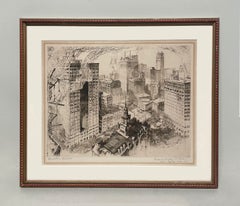
Howard Cook, 'Financial District', lithograph, 1931, edition 75, Duffy 155. A fine, richly-inked impression, on cream wove paper, the full sheet with wide margins (2 3/4 to 5 5/8 inches), in excellent condition. Image size 13 5/16 x 10 3/8 inches (338 x 264 mm); sheet size 23 x 16 inches (584 x 406 mm). Matted to museum standards, unframed. Literature: 'American Master Prints from the Betty and Douglas Duffy Collection', the Trust for Museum Exhibitions, Washington, D.C., 1987. Collections: Crystal Bridges Museum of American Art, Library of Congress, Metropolitan Museum of Art, Philadelphia Museum of Art, Smithsonian American Art Museum. ABOUT THE ARTIST Howard Norton Cook (1901-1980) was one of the best-known of the second generation of artists who moved to Taos. A native of Massachusetts, he studied at the Art Students League in New York City and at the Woodstock Art Colony. Beginning his association with Taos in 1926, he became a resident of the community in the 1930s. During his career, he received two Guggenheim Fellowships and was elected an Academician in the National Academy of Design. He earned a national reputation as a painter, muralist, and printmaker. Cook’s work in the print mediums received acclaim early in his career with one-person exhibitions at the Denver Art Museum (1927) and the Museum of New Mexico (1928). He received numerous honors and awards over the years, including selection in best-of-the-year exhibitions sponsored by the American Institute of Graphics Arts, the Brooklyn Museum, the Society of American Etchers, and the Philadelphia Print Club. His first Guggenheim Fellowship took him to Taxco, Mexico in 1932 and 1933; his second in the following year enabled him to travel through the American South and Southwest. Cook painted murals for the Public Works of Art Project in 1933 and the Treasury Departments Art Program in 1935. The latter project, completed in Pittsburgh, received a Gold Medal from the Architectural League of New York. One of his most acclaimed commissions was a mural in the San Antonio Post Office in 1937. He and Barbara Latham settled in Talpa, south of Taos, in 1938 and remained there for over three decades. Cook volunteered in World War II as an Artist War Correspondent for the US Navy, where he was deployed in the Pacific. In 1943 he was appointed Leader of a War Art Unit...

Category

1930s American Modern Art

Materials

Lithograph

Pool Diver - Lithograph (Olympic Games Munich 1972)

Pool Diver - Lithograph (Olympic Games Munich 1972)

By David Hockney

Located in Paris, IDF

David HOCKNEY Pool Diver, 1972 Original lithograph Signature printed in the plate On paper 101 x 64 cm (c. 40 x 26 inch) Made for the Olympic Games in Munich, 1972 REFERENCES : Bri...

Category

1970s American Modern Art

Materials

Lithograph

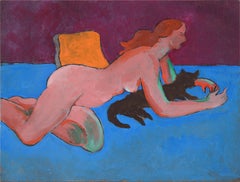
Reclining Figures

Reclining Figures

By Otis Huband

Located in Dallas, TX

Born in 1933, Otis Huband declared his intention to be an artist at age 6. He earned his BFA and MFA at Richmond Professional Institute of the College of William & Mary, now Virginia...

Category

2010s American Modern Art

Materials

Canvas, Oil

"Portrait of Dr. Monroe Mufson"

"Portrait of Dr. Monroe Mufson"

By Joseph Biel

Located in Southampton, NY

Unsigned ; attributed to Joseph Biel Good friend of Dr. Mufson View is from New York University School of Medicine. Overall size with original frame 25.5 x 21 in.

Category

Mid-20th Century American Modern Art

Materials

Oil, Board

Mid Century Desert Mesa Landscape with Cacti in Oil on Canvas

Mid Century Desert Mesa Landscape with Cacti in Oil on Canvas

By Vina McPheeters

Located in Soquel, CA

Mid Century Desert Mesa Landscape with Cacti in Oil on Canvas Colorful mid century desert landscape with beautiful cacti by Vina McPheeters (American, 1892-1964). Colorful cacti are dotted throughout the foreground, lush with yellow and pink blooms. In the distance, dramatic mesas rise to meet a cloud-filled sky. Signed "Vina McPheeters" in the lower right corner. Presented in an antiqued bronze-colored frame. Frame size: 25.75"H x 29.75"W Image size: 20"H x 24"W Vina Pearl McPheeters (American, 1892-1964) was born in Iowa on October 7, 1892. Vina was the wife of Robert Guy...

Category

1950s American Modern Art

Materials

Canvas, Oil, Stretcher Bars

Downtown New York

Downtown New York

Located in Los Angeles, CA

Downtown New York, c. 1930s, oil on canvas, signed lower right, 10 x 12 inches; label verso reads: "Harry Dix / Title Downtown New York / Medium Oil" Harry Dix was a 20th-century p...

Category

1930s American Modern Art

Materials

Canvas, Oil

Watercolor Painting American Modern Painting Bridge Harbor Female Artist 1950

Watercolor Painting American Modern Painting Bridge Harbor Female Artist 1950

Located in Buffalo, NY

Dorothy Rivo Untitled (Bridge Tower), c. 1960s–70s Acrylic on paper, floated in a mat Framed dimensions: 30 in. H × 24 in. W Contemporary walnut or black wood frame with white archiv...

Category

1940s American Modern Art
Materials

Archival Ink, Watercolor, Archival Paper, Acrylic

Andros Island - Setting Sail on Watercraft from Archipelago in Bahamas

Andros Island - Setting Sail on Watercraft from Archipelago in Bahamas

By Slim Aarons

Located in Brighton, GB

Andros Island - Setting Sail on Watercraft from Archipelago in Bahamas 16" x 16" print on 16" x 20" paper. Limited Edition Estate Stamped Print. Edition of 150. Printed Later. "And...

Category

20th Century American Modern Art

Materials

C Print, Photographic Paper, Color, Digital

"Hydrangeas, " Walter Inglis Anderson, Mississippi Southern Illustrator, Flowers

"Hydrangeas, " Walter Inglis Anderson, Mississippi Southern Illustrator, Flowers

Located in New York, NY

Walter Anderson ( American, 1903 - 1965) Hydrangeas, circa 1950 Mixed media on paper 11 x 8 1/2 inches Provenance: Luise Ross Gallery, New York Private Collection, New Jersey Acquired from the estate of the above, 2021 Walter Anderson firmly believed that quality art was an important part of life and should be made available to everyone. As he said, "There should be simple, good decorations, to be sold at prices to rival the five-and-ten." Noticing that only poor quality art was available in stores and little was available for children, he resolved to make art which could be reproduced easily and sell inexpensively — linoleum block prints. This technique enabled him to provide affordable, quality art. The technique of linoleum block printing is a simple concept; however, it requires much skill and talent to actually produce memorable art. Anderson purchased surplus "battleship linoleum," thicker than ordinary linoleum with a burlap backing for better support, to create his blocks. During the mid-1940s, he created almost 300 linocuts working in the attic of the sea-side plantation house, Oldfields, his wife's family home in Gautier. Masses of linoleum chips accumulated at the foot of the attic stairs as he often worked night and day. He began with sketching out a design directly on the linoleum. Once he had carved the image into the surface, he used the back of faded, surplus stock wallpaper that a friend sent him, laying long strips on top of the inked linoleum. A roller made of sewer pipe filled with sand served as his press. When the print was completed, he often colored it by hand with bold strokes and vivid colors. The prints were sold at Shearwater Pottery, the family business, for a mere dollar a foot. But "what about a well-designed fairy tale for a child's room?" he asked himself. Since there was a lack of affordable art for children, much of his work with linoleum blocks focused on subjects for children. He depicted fables and fairy tales ranging from Arabian Nights, to Germany and the Grimm Brothers' Rapunzel, to the French story of The White Cat, to the Greek tales such as Europa and the Bull, and to tales from China, India, and other cultures. Anderson also created "mini" books featuring the alphabet and Robinson Cat. The blocks are not only alive with the story being depicted, but they are also filled with designs taken from Best-Maugard's Method for Creative Design. Swirls, half-circles and zig-zag lines fill every available space on the linoleum block making them come alive and capture their audience. But fairy tales, children's verses and the "mini" books, consisting of about 90 blocks, were not the sole subject of Anderson's linoleum block prints. In total, he created approximately 300 linoleum blocks with subjects ranging from coastal flora and fauna, coastal animals, and sports and other coastal activities. Anderson even created linoleum blocks to be used to print tablecloths and clothing, some worn by his own children. Color and subjects of the linoleum block prints were not the only things that got them noticed. In 1945 when Anderson was creating these prints, the standard size of linoleum block prints was only 12 by 18 inches. These small dimensions were due to the common size of the paper available and the restrictions made by national competitions. Since Anderson used wallpaper...

Category

Mid-20th Century American Modern Art

Materials

Paper, Crayon

Emil Ganso, (Reclining Nude)

Emil Ganso, (Reclining Nude)

By Emil Ganso

Located in New York, NY

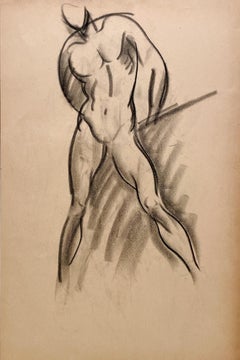
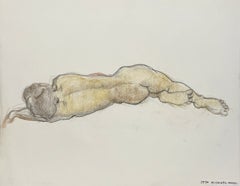
A classic Emil Ganso nude. Quite large, the sheet is 14 1/8 x 21 inches and the image goes all the way across the sheet from left to right. Very delicately drawn - especially for Ganso.

Category

1930s American Modern Art

Materials

Pencil

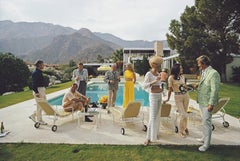
Catch Up by the Pool, 1970 - Poolside Conversation, Kaufmann House Palm Springs

Catch Up by the Pool, 1970 - Poolside Conversation, Kaufmann House Palm Springs

By Slim Aarons

Located in Brighton, GB

Catch Up by the Pool, 1970 - Poolside Conversation, Kaufmann House Palm Springs by Slim Aarons 16 x 20" print. Limited Edition Estate Stamped Print. Edition of 150. Printed Later. ...

Category

20th Century American Modern Art

Materials

Photographic Paper, Color, C Print, Digital

A Fine 1946 Modern Figure Study of a Handsome Young Male Model Wearing a Suit

A Fine 1946 Modern Figure Study of a Handsome Young Male Model Wearing a Suit

By Harold Haydon

Located in Chicago, IL

A Fine 1940s, Mid-Century Modern Academic Figure Study Portrait of a Handsome, Seated Male Model Wearing a Suit by Notable Chicago Artist, Harold Haydon (Am. 1909-1994). An exceptionally well executed early 1940s charcoal...

Category

Mid-20th Century American Modern Art

Materials

Paper, Charcoal

I'll Be There
I'll Be There

I'll Be There

Located in Lexington, MA

“I’ll Be There” by Craig Greene is a compelling 20 x 16 inch oil on canvas that captures quiet strength, emotion, and human connection through a modern figurative lens. Executed in G...

Category

2010s American Modern Art

Materials

Canvas, Oil

Arnold Rönnebeck WPA Modernist Lithograph Central City Colorado 1930s Cityscape

Arnold Rönnebeck WPA Modernist Lithograph Central City Colorado 1930s Cityscape

By Arnold Rönnebeck

Located in Denver, CO

A compelling WPA-era lithograph by Arnold Rönnebeck, this 1930s composition presents a modernist interpretation of Central City, Colorado—one of the state’s most historically signifi...

Category

1930s American Modern Art

Materials

Lithograph

Still Life with Irises

Still Life with Irises

Located in Bryn Mawr, PA

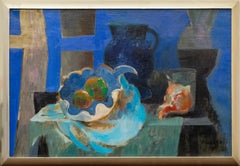
Still Life with Irises Oil on canvas 46 3/4 x 38 inches (118.7 x 96.5 cm) Framed dimensions 55 1/2 x 46 1/2 inches Signed lower right: CARLES Provenance Alexander Liberman, Philadel...

Category

Early 20th Century American Modern Art

Materials

Canvas, Oil

Baden Baden, Casino
Baden Baden, Casino

Baden Baden, Casino

By LeRoy Neiman

Located in San Francisco, CA

This artwork titled "Baden Baden, Casino" 1988 is an original color serigraph by noted American artist LeRoy Neiman, 1921-2012. It is hand signed and numbered 261/375 in pencil by the artist. The image size is 36 x 42 inches, sheet size is 42 x 48 inches. With the blind stamp of the printer Styria Studio at the lower left corner margin. It is in excellent condition, three small pieces of hanging tape remain on the back. About the artist: Mr. Neiman's kinetic, quickly executed paintings and drawings, many of them published in Playboy, offered his fans gaudily colored visual reports on heavyweight boxing matches, Super Bowl games and Olympic contests, as well as social panoramas like the horse races at Deauville, France, and the Cannes Film Festival. Quite consciously, he cast himself in the mold of French Impressionists like Toulouse-Lautrec, Renoir and Degas, chroniclers of public life who found rich social material at racetracks, dance halls and cafes. Mr. Neiman often painted or sketched on live television. With the camera recording his progress at the sketchpad or easel, he interpreted the drama of Olympic Games and Super Bowls for an audience of millions. When Bobby Fischer and Boris Spassky faced off in Reykjavik, Iceland, to decide the world chess championship, Mr. Neiman was there, sketching. He was on hand to capture Federico Fellini directing "8 ½" and the Kirov Ballet performing in the Soviet Union. In popularity, Mr. Neiman rivaled American favorites like Norman Rockwell, Grandma Moses and Andrew Wyeth. A prolific one-man industry, he generated hundreds of paintings, drawings, watercolors, limited-edition serigraph prints and coffee-table books yearly, earning gross annual revenue in the tens of millions of dollars. Although he exhibited constantly and his work was included in the collections of dozens of museums around the world, critical respect eluded him. Mainstream art critics either ignored him completely or, if forced to consider his work, dismissed it with contempt as garish and superficial — magazine illustration with pretensions. Mr. Neiman professed not to care. Maybe the critics are right," he told American Artist magazine in 1995. "But what am I supposed to do about it — stop painting, change my work completely? I go back into the studio, and there I am at the easel again. I enjoy what I'm doing and feel good working. Other thoughts are just crowded out." His image suggested an artist well beyond the reach of criticism. A dandy and bon vivant, he cut an arresting figure with his luxuriant ear-to-ear mustache, white suits, flashy hats and Cuban cigars. "He quite intentionally invented himself as a flamboyant artist not unlike Salvador Dalí, in much the same way that I became Mr. Playboy in the late '50s," Hugh Hefner told Cigar Aficionado magazine in 1995. LeRoy Runquist was born on June 8, 1921, in St. Paul. His father, a railroad worker, deserted the family when LeRoy was quite young, and the boy took the surname of his stepfather. He showed a flair for art at an early age. While attending a local Roman Catholic school, he impressed schoolmates by drawing ink tattoos on their arms during recess. As a teenager, he earned money doing illustrations for local grocery stores. "I'd sketch a turkey, a cow, a fish, with the prices," he told Cigar Aficionado. "And then I had the good sense to draw the guy who owned the store. This gave me tremendous power as a kid." After being drafted into the Army in 1942, he served as a cook in the European theater but in his spare time painted risqué murals on the walls of kitchens and mess halls. The Army's Special Services Division, recognizing his talent, put him to work painting stage sets for Red Cross shows when he was stationed in Germany after the war. On leaving the military, he studied briefly at the St. Paul School of Art (now the Minnesota Museum of American Art) before enrolling in the School of the Art Institute of Chicago, where, after four years of study, he taught figure drawing and fashion illustration throughout the 1950s. When the janitor of the apartment building next door to his threw out half-empty cans of enamel house paint, Mr. Neiman found his métier. Experimenting with the new medium, he embraced a rapid style of applying paint to canvas imposed by the free-flowing quality of the house paint. While doing freelance fashion illustration for the Carson Pirie Scott department store in Chicago in the early 1950s, he became friendly with Mr. Hefner, a copywriter there who was on the verge of publishing the first issue of a men's magazine. In 1954, after five issues of Playboy had appeared, Mr. Neiman ran into Mr. Hefner and invited him to his apartment to see his paintings of boxers, strip clubs and restaurants. Mr. Hefner, impressed, showed the work to Playboy's art director, Art Paul, who commissioned an illustration for "Black Country," a story by Charles Beaumont about a jazz musician. Thus began a relationship that endured for more than half a century and established Mr. Neiman's reputation. In 1955, when Mr. Hefner decided that the party-jokes page needed visual interest, Mr. Neiman came up with the Femlin, a curvaceous brunette who cavorted across the page in thigh-high stockings, high-heeled shoes, opera gloves and nothing else. She appeared in every issue of the magazine thereafter. Three years later, Mr. Neiman devised a running feature, "Man at His Leisure." For the next 15 years, he went on assignment to glamour spots around the world, sending back visual reports on subjects as varied as the races at Royal Ascot, the dining room of the Tour d'Argent in Paris, the nude beaches of the Dalmatian coast, the running of the bulls at Pamplona and Carnaby Street in swinging London. He later produced more than 100 paintings and 2 murals for 18 of the Playboy clubs that opened around the world. "Playboy made the good life a reality for me and made it the subject matter of my paintings — not affluence and luxury as such, but joie de vivre itself," Mr. Neiman told V.I.P. magazine in 1962. Working in the same copywriting department at Carson Pirie Scott as Mr. Hefner was Janet Byrne, a student at the Art Institute. She and Mr. Neiman married in 1957. She survives him. A prolific artist, he generated dozens of paintings each year that routinely commanded five-figure prices. When Christie's auctioned off the Playboy archives in 2003, his 1969 painting Man at His Leisure: Le Mans sold for $107,550. Sales of the signed, limited-edition print versions of his paintings, published in editions of 250 to 500, became a lucrative business in itself after Knoedler Publishing, a wholesale operation, was created in 1975 to publish and distribute his serigraphs, etchings, books and posters. Mr. Neiman's most famous images came from the world of sports. His long association with the Olympics began with the Winter Games in Squaw Valley in 1960, and he went on to cover the games, on live television, in Munich in 1972, Montreal in 1976, Lake Placid in 1980, and Sarajevo and Los Angeles in 1984, using watercolor, ink or felt-tip marker to produce images with the dispatch of a courtroom sketch artist. At the 1978 and 1979 Super Bowls, he used a computerized electronic pen to portray the action for CBS. Although he was best known for scenes filled with people and incident, he also painted many portraits. Athletes predominated, with Muhammad Ali and Joe Namath among his more famous subjects, but he also painted Leonard Bernstein, the ballet dancer Suzanne Farrell...

Category

21st Century and Contemporary American Modern Art

Materials

Screen

"Coney Island" Brooklyn NYC Amusement Park Mid-century American Scene WPA Modern

"Coney Island" Brooklyn NYC Amusement Park Mid-century American Scene WPA Modern

By Ludwig Bemelmans, 1898-1962

Located in New York, NY

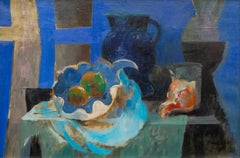
"Coney Island" Brooklyn NYC Amusement Park Mid-century American Scene WPA Modern Ludwig Bemelmans (1898 – 1962), “Coney Island" 35 x 27 inches Oil on board Signed lower right Origi...

Category

1940s American Modern Art
Materials

Oil, Board

New York Skyline, NY; East River

New York Skyline, NY; East River

By Leon Dolice

Located in Middletown, NY

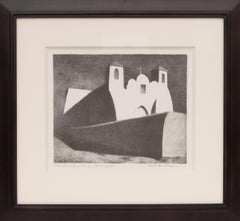
Etching on medium stock, cream wove paper, 5 15/16 x 10 3/16 inches (151 x 259 mm), full margins. Signed and titled in pencil, lower margin. A fine and detailed impression in dark bl...

Category

1930s American Modern Art
Materials

Archival Paper, Etching

Untitled Diptych by Suzanne Law. Paintings Framed

Untitled Diptych by Suzanne Law. Paintings Framed

Located in Miami Beach, FL

Untitled Diptych, painting by Suzanne Law. Framed Overall size: Image size: 12.6 in. H x 34.2 in W Frame size: 18.1 in. H x 44.8 in W x 1 in D Individual size: Image size: 12.6 in. ...

Category

1990s American Modern Art
Materials

Canvas, Wood, Acrylic

Factory #2/Yellow Shed

Factory #2/Yellow Shed

By Marina Stern

Located in Los Angeles, CA

This work is part of our exhibition Marina Stern Luminary, the first retrospective of the artist since 2007. Marina Stern was a multifaceted New York-based artist whose works ranged from Expressionism and Pop Art to the Neo Immaculate paintings and pastels for which she is best known. A native of Venice, Stern and her family fled in 1939 to escape Italy’s repressive racial laws. After living in England for several years, the family arrived in the United States in 1941. A bright and capable student, Stern graduated from New York’s Julia Richman High School at age 15 and soon enrolled in the Pratt Institute to pursue an interdisciplinary education in the arts. Despite majoring in advertising design, Stern favored her fine art courses. She graduated from Pratt in 1946 at age 18 and began working for advertising agencies. After a brief marriage which ended in divorce, Stern married her second husband, who encouraged the artist to study at the Art Students League of New York, under the renowned Japanese American modernist, Yasuo Kuniyoshi. In Fall 1953, Stern gave birth to her first child, Michael, as she continued to study at the Arts Students League. Later in the Spring of 1957, Stern gave birth to her daughter Nina, as she continued to balance motherhood with her fine art practice and commercial art and design work. Stern’s first significant exhibitions were in 1962 at the Waverly Gallery and the Osgood Gallery, both in New York, followed by inclusion of her work in the Bertha Schaefer Traveling Collage Show from 1963 to 1964. Stern made a splash in the avant-garde art world in 1964 when Time magazine reviewed a show at Amel Gallery which featured three of her audio-visual paintings. Time’s critic noted that Stern created the “cleverest noisemakers” in the exhibition. Time dubbed this work “Talkie Pop,” a label which Stern rejected. Following this recognition, Stern was selected for inclusion in The New American Realism at the Worcester Art Museum—a major showcase of leading artists, including Andy Warhol, Robert Indiana, Roy Lichtenstein, and Jasper Johns. After the Worcester exhibition, Stern began to shift away from her “talking” Pop paintings to mysterious, interior scenes with orange, blue or black walls with windows or doors rising above black and white floors, often depopulated, but sometimes with figures. One of these works, Seven Minus Twenty-One Equals Seven, entered the permanent collection of New York’s Museum of Modern Art in 1966. By 1969, Stern began to incorporate industrial images into these scenes, and in the early 1970s, Stern created her first Neo-Immaculate works of rural, and urban landscapes, which she described as her most satisfying work. Stern often depicted locations that she held close -- New York, New Jersey, Iowa (where her son attended college), Sharon, Connecticut (where her family spent weekends and vacations) and her native Venice, Italy. Stern’s success as a Neo Immaculate painter led to consistent New York gallery representation for over two decades, first with Lee Ault & Co and James Yu Gallery, and then Forum Gallery, where she had six solo shows. Stern completed a Neo-Immaculate mural commission for the Port Authority of New York, George Washington Bridge #1 and #2, followed by another commission from the NY Cityarts Public Art Program in 1976 for a mural on Mulberry Street. Stern also enjoyed solo exhibitions in Boston (Eleanor Rigelhaupt Gallery), Connecticut (Silo Gallery, the Hotchkiss School, J. Rosenthal Fine Arts Gallery, Tremaine Gallery, and Staib Gallery), Chicago (Michael Rosenfeld Gallery), and Santa Fe (Santa Fe East Gallery). Her work was included in group shows at over a dozen public institutions, including The National Academy of Design, The Staten Island Museum, Worcester Art Museum, the Oklahoma Art Center, and the Arkansas Art Center. The Southern Alleghenies Museum of Art hosted a retrospective of four decades of Stern’s work from January 19 to April 22, 2007, entitled Perception and the Cultural Environment: The Paintings of Marina...

Category

1990s American Modern Art
Materials

Canvas, Oil

Conca dei Marini - Amalfi Coast Italian Coastline Cove Photograph

Conca dei Marini - Amalfi Coast Italian Coastline Cove Photograph

By Slim Aarons

Located in Brighton, GB

Conca dei Marini - Amalfi Coast Italian Coastline Cove Photograph by Slim Aarons 16 x 20" print. Limited Edition Estate Stamped Print. Edition of 150. Printed Later. "Conca dei Mar...

Category

20th Century American Modern Art
Materials

Photographic Paper, Color, C Print, Digital Pigment

Original National Florida's Westcoast vintage airline poster, linen-backed

Original National Florida's Westcoast vintage airline poster, linen-backed

Located in Spokane, WA

National Florida's West Coast Original Vintage Poster, linen-backed and ready to frame. Grade A condition. No restoration, no damage, no tears. Generally, posters for National Airlin...

Category

1960s American Modern Art
Materials

Offset

American Modern art for sale on 1stDibs.
Find a wide variety of authentic American Modern art available for sale on 1stDibs. Works in this style were very popular during the 21st Century and Contemporary, but contemporary artists have continued to produce works inspired by this movement. If you’re looking to add art created in this style to introduce contrast in an otherwise neutral space in your home, the works available on 1stDibs include elements of blue, orange, purple, red and other colors. Many Pop art paintings were created by popular artists on 1stDibs, including Slim Aarons, Destro, Howard Schatz, and John Taylor Arms. Frequently made by artists working with Paint, and Oil Paint and other materials, all of these pieces for sale are unique and have attracted attention over the years. Not every interior allows for large American Modern art, so small editions measuring 0.25 inches across are also available.