Modern Art

MODERN STYLE

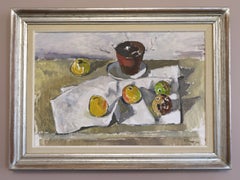
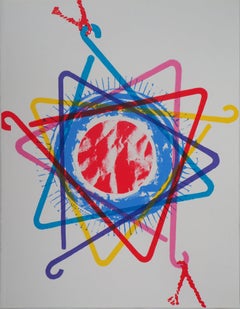
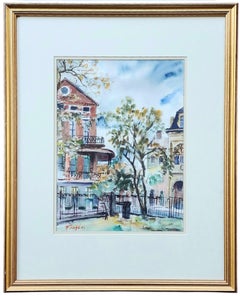
The first decades of the 20th century were a period of artistic upheaval, with modern art movements including Cubism, Surrealism, Futurism and Dadaism questioning centuries of traditional views of what art should be. Using abstraction, experimental forms and interdisciplinary techniques, painters, sculptors, photographers, printmakers and performance artists all pushed the boundaries of creative expression.

Major exhibitions, like the 1913 Armory Show in New York City — also known as the “International Exhibition of Modern Art,” in which works like the radically angular Nude Descending a Staircase by Marcel Duchamp caused a sensation — challenged the perspective of viewers and critics and heralded the arrival of modern art in the United States. But the movement’s revolutionary spirit took shape in the 19th century.

The Industrial Revolution, which ushered in new technology and cultural conditions across the world, transformed art from something mostly commissioned by the wealthy or the church to work that responded to personal experiences. The Impressionist style emerged in 1860s France with artists like Claude Monet, Paul Cézanne and Edgar Degas quickly painting works that captured moments of light and urban life. Around the same time in England, the Pre-Raphaelites, like Edward Burne-Jones and Dante Gabriel Rossetti, borrowed from late medieval and early Renaissance art to imbue their art with symbolism and modern ideas of beauty.

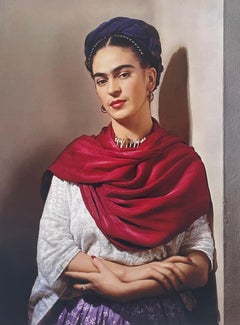
Emerging from this disruption of the artistic status quo, modern art went further in rejecting conventions and embracing innovation. The bold legacy of leading modern artists Georges Braque, Pablo Picasso, Frida Kahlo, Salvador Dalí, Henri Matisse, Joan Miró, Marc Chagall, Piet Mondrian and many others continues to inform visual culture today.

Find a collection of modern paintings, sculptures, prints and other fine art on 1stDibs.

to
4,264
26,444
10,697
7,296
5,642
4,835
Overall Width
to
Overall Height
to
1,273
6,402
40,950
6,311
280
463
1,001
2,314
1,801
6,414
6,881
5,649
3,015
1,078
1,143
119,214
64,207
54,939
28,520
14,471
9,046
6,175
5,489
4,209
3,140
2,526
2,287
2,118
569
28,663
20,117
4,384
31,668
16,097
11,762
8,519
8,049
6,223
4,717
3,863
3,707
3,588
3,291
3,153
2,592
2,338
2,109
1,994
1,722
1,687
1,669
1,605
10,696
9,762
8,341
6,006
5,932
6,891
2,494
1,243
389
267
6,010
26,850
35,747
18,347
Style: Modern
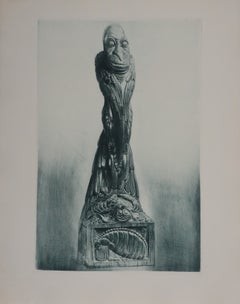
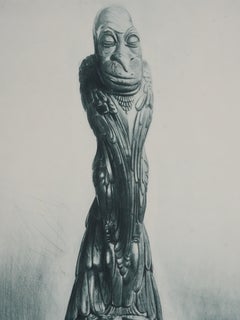
“The Crow”
“The Crow”

“The Crow”

Located in Southampton, NY

Original gouache and watercolor on brown archival paper of a standing crow in profile. Signed and dated lower right. Condition is good to very good. Colors of the bird are strong a...

Category

1920s Modern Art

Materials

Gouache, Archival Paper, Graphite

Rooftops - Mid 20th Century English Oil on Board Houses Landscape Painting

Rooftops - Mid 20th Century English Oil on Board Houses Landscape Painting

Located in Sevenoaks, GB

This lovely mid 20th century English oil on board by Tom White depicts a view over the rooftops of period houses in Spring. A quintessentially English view in the modern/impressioni...

Category

1960s Modern Art

Materials

Oil, Board

View of Palermo - Lithograph - 1862

View of Palermo - Lithograph - 1862

Located in Roma, IT

Palermo is a  hand colored lithograph realized in 1864. Good conditions. The artwork belongs to the Suite Uses and customs of all the peoples of the universe, or History of the gov...

Category

1860s Modern Art

Materials

Lithograph

Pensive Woman oil on canvas painting european art

Pensive Woman oil on canvas painting european art

Located in Sitges, Barcelona

Title: Pensive Woman Artist: Vicente Oliver (1896–1970) Technique: Oil on canvas Dimensions: 18.1 x 15.0 in (46 x 38 cm) Support: Unframed canvas Date: Mid-20th century Signatu...

Category

1930s Modern Art

Materials

Canvas, Oil

Chapel and houses along a lake, New England Landscape - American School, 19th C

Chapel and houses along a lake, New England Landscape - American School, 19th C

Located in Middletown, NY

Watercolor and pencil on buff wove watercolor paper, 10 x 8 inches (255 x 203 mm). In good condition with overall minor toning. Some watercolor paint splatters on the verso, contem...

Category

Early 1900s Modern Art

Materials

Watercolor, Pencil

Left Bank Cafe, Paris

Left Bank Cafe, Paris

By LeRoy Neiman

Located in San Francisco, CA

This artwork titled "Left Bank Cafe, Paris" 1987 is an original color serigraph by noted American artist LeRoy Neiman, 1921-2012. It is hand signed and numbered H.C 166/175 in pencil by the artist. The image size is 26 x 38 inches, sheet size is 32.25 x 44 inches. With the blind stamp of the printer Styria Studio at the lower left corner margin. It is in excellent condition, two small pieces of hanging tape remain on the back. About the artist: Mr. Neiman's kinetic, quickly executed paintings and drawings, many of them published in Playboy, offered his fans gaudily colored visual reports on heavyweight boxing matches, Super Bowl games and Olympic contests, as well as social panoramas like the horse races at Deauville, France, and the Cannes Film Festival. Quite consciously, he cast himself in the mold of French Impressionists like Toulouse-Lautrec, Renoir and Degas, chroniclers of public life who found rich social material at racetracks, dance halls and cafes. Mr. Neiman often painted or sketched on live television. With the camera recording his progress at the sketchpad or easel, he interpreted the drama of Olympic Games and Super Bowls for an audience of millions. When Bobby Fischer and Boris Spassky faced off in Reykjavik, Iceland, to decide the world chess championship, Mr. Neiman was there, sketching. He was on hand to capture Federico Fellini directing "8 ½" and the Kirov Ballet performing in the Soviet Union. In popularity, Mr. Neiman rivaled American favorites like Norman Rockwell, Grandma Moses and Andrew Wyeth. A prolific one-man industry, he generated hundreds of paintings, drawings, watercolors, limited-edition serigraph prints and coffee-table books yearly, earning gross annual revenue in the tens of millions of dollars. Although he exhibited constantly and his work was included in the collections of dozens of museums around the world, critical respect eluded him. Mainstream art critics either ignored him completely or, if forced to consider his work, dismissed it with contempt as garish and superficial — magazine illustration with pretensions. Mr. Neiman professed not to care. Maybe the critics are right," he told American Artist magazine in 1995. "But what am I supposed to do about it — stop painting, change my work completely? I go back into the studio, and there I am at the easel again. I enjoy what I'm doing and feel good working. Other thoughts are just crowded out." His image suggested an artist well beyond the reach of criticism. A dandy and bon vivant, he cut an arresting figure with his luxuriant ear-to-ear mustache, white suits, flashy hats and Cuban cigars. "He quite intentionally invented himself as a flamboyant artist not unlike Salvador Dalí, in much the same way that I became Mr. Playboy in the late '50s," Hugh Hefner told Cigar Aficionado magazine in 1995. LeRoy Runquist was born on June 8, 1921, in St. Paul. His father, a railroad worker, deserted the family when LeRoy was quite young, and the boy took the surname of his stepfather. He showed a flair for art at an early age. While attending a local Roman Catholic school, he impressed schoolmates by drawing ink tattoos on their arms during recess. As a teenager, he earned money doing illustrations for local grocery stores. "I'd sketch a turkey, a cow, a fish, with the prices," he told Cigar Aficionado. "And then I had the good sense to draw the guy who owned the store. This gave me tremendous power as a kid." After being drafted into the Army in 1942, he served as a cook in the European theater but in his spare time painted risqué murals on the walls of kitchens and mess halls. The Army's Special Services Division, recognizing his talent, put him to work painting stage sets for Red Cross shows when he was stationed in Germany after the war. On leaving the military, he studied briefly at the St. Paul School of Art (now the Minnesota Museum of American Art) before enrolling in the School of the Art Institute of Chicago, where, after four years of study, he taught figure drawing and fashion illustration throughout the 1950s. When the janitor of the apartment building next door to his threw out half-empty cans of enamel house paint, Mr. Neiman found his métier. Experimenting with the new medium, he embraced a rapid style of applying paint to canvas imposed by the free-flowing quality of the house paint. While doing freelance fashion illustration for the Carson Pirie Scott department store in Chicago in the early 1950s, he became friendly with Mr. Hefner, a copywriter there who was on the verge of publishing the first issue of a men's magazine. In 1954, after five issues of Playboy had appeared, Mr. Neiman ran into Mr. Hefner and invited him to his apartment to see his paintings of boxers, strip clubs and restaurants. Mr. Hefner, impressed, showed the work to Playboy's art director, Art Paul, who commissioned an illustration for "Black Country," a story by Charles Beaumont about a jazz musician. Thus began a relationship that endured for more than half a century and established Mr. Neiman's reputation. In 1955, when Mr. Hefner decided that the party-jokes page needed visual interest, Mr. Neiman came up with the Femlin, a curvaceous brunette who cavorted across the page in thigh-high stockings, high-heeled shoes, opera gloves and nothing else. She appeared in every issue of the magazine thereafter. Three years later, Mr. Neiman devised a running feature, "Man at His Leisure." For the next 15 years, he went on assignment to glamour spots around the world, sending back visual reports on subjects as varied as the races at Royal Ascot, the dining room of the Tour d'Argent in Paris, the nude beaches of the Dalmatian coast, the running of the bulls at Pamplona and Carnaby Street in swinging London. He later produced more than 100 paintings and 2 murals for 18 of the Playboy clubs that opened around the world. "Playboy made the good life a reality for me and made it the subject matter of my paintings — not affluence and luxury as such, but joie de vivre itself," Mr. Neiman told V.I.P. magazine in 1962. Working in the same copywriting department at Carson Pirie Scott as Mr. Hefner was Janet Byrne, a student at the Art Institute. She and Mr. Neiman married in 1957. She survives him. A prolific artist, he generated dozens of paintings each year that routinely commanded five-figure prices. When Christie's auctioned off the Playboy archives in 2003, his 1969 painting Man at His Leisure: Le Mans sold for $107,550. Sales of the signed, limited-edition print versions of his paintings, published in editions of 250 to 500, became a lucrative business in itself after Knoedler Publishing, a wholesale operation, was created in 1975 to publish and distribute his serigraphs, etchings, books and posters. Mr. Neiman's most famous images came from the world of sports. His long association with the Olympics began with the Winter Games in Squaw Valley in 1960, and he went on to cover the games, on live television, in Munich in 1972, Montreal in 1976, Lake Placid in 1980, and Sarajevo and Los Angeles in 1984, using watercolor, ink or felt-tip marker to produce images with the dispatch of a courtroom sketch artist. At the 1978 and 1979 Super Bowls, he used a computerized electronic pen to portray the action for CBS. Although he was best known for scenes filled with people and incident, he also painted many portraits. Athletes predominated, with Muhammad Ali and Joe Namath among his more famous subjects, but he also painted Leonard Bernstein, the ballet dancer Suzanne Farrell...

Category

21st Century and Contemporary Modern Art

Materials

Screen

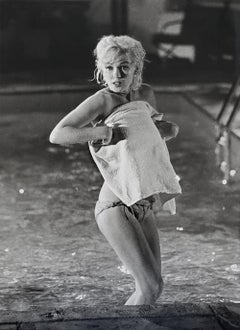
"Marilyn Monroe, 1962" Photography 16 x 24 in Edition 40/75 by Lawrence Schiller

"Marilyn Monroe, 1962" Photography 16 x 24 in Edition 40/75 by Lawrence Schiller

By Lawrence Schiller

Located in Culver City, CA

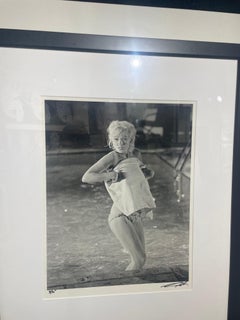
"Marilyn Monroe, 1962" Photography 16 x 24 in Edition 40/75 by Lawrence Schiller Silver Gelatin print Edition 40/75 Signed and numbered by the artist Printed later On Wednesday, May 23, 1962, Marilyn Monroe stepped onto the set of Something’s Got to Give to film what would become one of the most iconic and talked-about moments of her career: the now-legendary nude swimming pool scene. This extraordinary day—captured in a series of rare photographs by renowned photographer Lawrence Schiller—has since become a cornerstone of Hollywood history. Key moments that make this session truly historic: A Bold Cinematic First: Monroe spent nearly four hours in the pool on the 20th Century Fox lot, filming a sequence in which her character, Ellen Arden, appears to swim nude...

Category

20th Century Modern Art

Materials

Silver Gelatin

Midnight Flower 1969 Signed Limited Edition Large Woodcut

Midnight Flower 1969 Signed Limited Edition Large Woodcut

Located in Rochester Hills, MI

Peter Green Midnight Flower Paper Size = 26½" x 38½" inches Signed in pencil, titled, dated and marked 1/30 Born in 1933, Peter Green studied at Brighton College of Art and the In...

Category

1960s Modern Art

Materials

Woodcut

Bouteille Gravée (A.R.249)

Bouteille Gravée (A.R.249)

By Pablo Picasso

Located in PARIS, FR

• Picasso began working with ceramics in 1946 at the Madoura workshop in Vallauris, marking the beginning of an important and highly productive chapter in his career. What initially ...

Category

1950s Modern Art

Materials

Ceramic

Palace of Fine Arts, Mid-Century San Francisco Landscape

Palace of Fine Arts, Mid-Century San Francisco Landscape

Located in Soquel, CA

Palace of Fine Arts, Mid-Century San Francisco Landscape Lively watercolor piece by Garrett Price (American, 1896-1979). A geometric, multi-colored background forms the foundation f...

Category

1950s Modern Art

Materials

Paper, Watercolor

Faune à la Diaule
Faune à la Diaule

Faune à la Diaule

By Pablo Picasso

Located in PARIS, FR

• An authenticated work This work is authenticated by Claude Ruiz Picasso, who issued a certificate of authenticity on January 17, 2019. • A signed and dated work Dated July 11, 195...

Category

1950s Modern Art

Materials

Ceramic

Alexander Calder Mid Century Derrière le Miroir Lithograph

Alexander Calder Mid Century Derrière le Miroir Lithograph

By Alexander Calder

Located in Soquel, CA

Vintage 1960s Alexander Calder Lithograph double page part of portfolio "Derriere le Miroir". Published by: Galerie Maeght, Paris, 1966. No. 156. Text on verso. Unsigned, from an unknown edition. Presented in black mat with red core. Mat size: 20"H x 24"W. Image size: 15"H x 22"W. American artist Alexander Calder changed the course of modern art by developing an innovative method of sculpting, bending, and twisting wire to create three-dimensional “drawings in space.” Resonating with the Futurists and Constructivists, as well as the language of early nonobjective painting, Calder’s mobiles (a term coined by Marcel Duchamp in 1931 to describe his work) consist of abstract shapes made of industrial materials––often poetic and gracefully formed and at times boldly colored––that hang in an uncanny, perfect balance. His complex assemblage Cirque Calder (1926–31), which allowed for the artist’s manipulation of its various characters presented before an audience, predated Performance Art by some 40 years. Later in his career, Calder devoted himself to making outdoor monumental sculptures...

Category

1960s Modern Art

Materials

Paper, Ink

The Eiffel Tower (1929) Silver Gelatin Fibre Print - Oversized

The Eiffel Tower (1929) Silver Gelatin Fibre Print - Oversized

By H. Armstrong Roberts

Located in London, GB

The Eiffel Tower (1929) Silver Gelatin Fibre Print - Oversized (Photo by H. Armstrong Roberts/Alamy) Eiffel Tower built in 1889 seen from Trocadero wrought iron doors Paris France, circa 1929. Additional Information: Unframed Paper Size: 40x30'' Printed Later Silver Gelatin Fibre Print NOTE OTHER SIZES OF THIS IMAGE AVAILABLE 10 x 12'' 12 x 16'' 16 x 20'' 20 x 24'' 20 x 30'' 30 x 40'' FRAMING AVAILABLE ON REQUEST About the Artist: H. Armstrong ROBERTS (1883-1947) is an artist born in 1883 The oldest auction result ever registered on the website for an artwork by this artist is a photography sold in 2012. ACTORS ON SET, Bette Davis, Ladies Fashion...

Category

1920s Modern Art

Materials

Black and White, Silver Gelatin

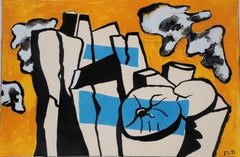
(Abstraction) by DD
(Abstraction) by DD

(Abstraction) by DD

Located in New York, NY

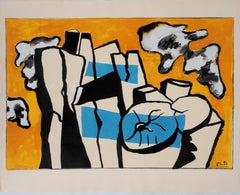
This image is an extravaganza of modernist motifs. The monogram 'D.D.' is at the lower right.

Category

Mid-20th Century Modern Art

Materials

Woodcut

"Paper Making" WPA Industrial Mid-Century American Scene Social Realism Workers

"Paper Making" WPA Industrial Mid-Century American Scene Social Realism Workers

Located in New York, NY

"Paper Making" WPA Industrial Mid-Century American Scene Social Realism Workers Douglas Crockwell (1904-1968) "Paper Making" 19 x 39 inches Oil on board, c. 1936 Signed verso Framed: 28 x 47 Provenance: Estate of the Artist BIO Spencer Douglass Crockwell was born into a comfortable middle class household on April 29, 1904 in Columbus, Ohio. His father, Charles Roland Crockwell, was a mining engineer; his mother, Cora, was the daughter of an Iowa attorney. He became a commercial artist and experimental filmmaker who spent a good part of his career creating illustrations and advertisements for the Saturday Evening Post. In 1907 the Crockwell family moved to St. Louis, Missouri, where he graduated from high school and then attended from Washington University. Initially he studied engineering, but soon switched to business. While still an undergraduate, Crockwell took courses at the St. Louis School of Fine Arts and quickly realized that he wanted to be an artist. After graduating from Washington University in 1926, Crockwell continued to study at the St. Louis School of Fine Arts until 1929. The following year he relocated to Chicago and continued his studies at the American Academy of Art. In 1930 and 1931 he studied in Europe on a Traveling Fellowship. In 1932 Douglass Crockwell moved to Glens Falls, New York, which was to be his home for the remainder of his life. The following year he married Margaret Braman. They had three children, a son Douglass and two daughters, Johanna and Margaret. During the depression he created murals and posters for the Works Progress Administration including Post Office murals in White River junction, Vermont; Endicott, New York; and Macon, Mississippi. In 1934 he painted Paper Workers, Finch Pruyn & Co. (the leading Glens Falls, New York company) for the WPA. In the 1930s Crockwell developed an interest in experimental animated films that occupied him for the rest of his life. In 1936 and 1937, he collaborated with David Smith, a sculptor, to create surrealist films. Because of his interest in experimental films, his output of paintings was limited to just twenty to forty illustrations a year during this time. Crockwell painted his first of many Saturday Evening Post cover in 1933. He also worked for Life, Look, and Esquire, and numerous national advertisers including Friskies dog food, Welch’s Grape Juice, Republic Steel...

Category

1930s Modern Art

Materials

Oil, Board

Peek-A-Boo Beatles (1965) - Silver Gelatin Print

Peek-A-Boo Beatles (1965) - Silver Gelatin Print

Located in London, GB

Peek-A-Boo Beatles (1937) - Silver Gelatin Print (Photo by R. McPhedran/Express/Getty Images) 14th June 1965: The British rock group The Beatles stand in a window at Twickenham Fil...

Category

1930s Modern Art

Materials

Black and White, Silver Gelatin

'Abstracted Figure', Sydney, Museum of Modern Art in Sao Paulo, Brazil

'Abstracted Figure', Sydney, Museum of Modern Art in Sao Paulo, Brazil

Located in Santa Cruz, CA

Signed lower right, 'Bonorat' and painted circa 1980 An elegant, modernist figural painting and early work by this Sydney-based Mexican artist who studied at the National School of Fine Arts in Mexico City (1982-84) and, subsequently, at the Museum of Modern Art in Sao Paulo, Brazil (1986). STUDIES 1982-1984 Painting and Drawing Ateliers – National School of Fine Arts, Mexico City 1985-1986 Artistic Experimentation – Carrillo Hill Museum, Mexico City 1986 Metal Engraving – Museum of Modern Art Sao Paulo Brazil SOLO EXHIBITIONS 1986 Art Gallery of Santos Municipal Cultural Centre, Sao Paulo, Brazil 1988 Art Gallery of Porto Alegre Municipal centre, R.S. Brazil 1991 Gallery Casa de la Cultura, Morelia Mexico 1994 The Beatty Gallery, Sydney 1996 The Beatty Gallery, Sydney 1996 Michael Burke Gallery, Brisbane 1997 The Beatty Gallery, Sydney 2019 ‘Golden Trinity’, Thienny Lee Gallery, Sydney 2019 ‘Continuous Thread, GAFFA Gallery, Sydney GROUP EXHIBITIONS 1985 Mail Art Network Kyoto City Museum, Kyoto Japan 1987 Banespa Cultural Centre, Sao Paulo Brazil 1988 IV National Contest of Fine Arts, Cubatao Brazil 1992 NCA Gallery, Sydney 1994 The Beatty Gallery, Sydney 1994/5/6 Selected for the “Fisher’s Ghost” Art...

Category

1980s Modern Art

Materials

Paper, Ink, Watercolor, Gouache

John Northcote Nash, Modern British art, A Window in Bucks

John Northcote Nash, Modern British art, A Window in Bucks

By John Nash

Located in Harkstead, GB

A wonderful image depicting a rural idyll by one of the great cornerstones of Modern British painting. John Northcote Nash (1893-1977) A window in Bucks Signed within print Print in...

Category

20th Century Modern Art

Materials

Paper, Color

Still Life in the Manner of Renoir, Signed Alberti

Still Life in the Manner of Renoir, Signed Alberti

Located in New York, NY

Untitled (Kitchen Still Life), 20th century Oil on canvas 11 1/8 x 15 3/4 in. Framed: 17 x 21 1/2 x 1 in. Signed lower right: Alberti

Category

20th Century Modern Art

Materials

Canvas, Oil

'Hill' — American Modernism, California

'Hill' — American Modernism, California

By Paul Landacre

Located in Myrtle Beach, SC

Paul Landacre, 'Hill', wood engraving, 1936, edition 60 (only 54 printed); only 2 impressions printed in a second edition of 150. Signed, titled, and numbered '49/60' in pencil. Wien...

Category

1930s Modern Art

Materials

Woodcut

Untitled

Untitled

Located in Los Angeles, CA

Untitled, c. 1940s, oil on Masonite, signed lower right, 19 ¾ x 25 ¾ inches Ava Vorhaus Gabriel was a New York-based painter, lithographer, and designer. Born in Larchmont, Gabriel ...

Category

1940s Modern Art
Materials

Masonite, Oil

Modern art for sale on 1stDibs.
Find a wide variety of authentic Modern art available for sale on 1stDibs. Works in this style were very popular during the 21st Century and Contemporary, but contemporary artists have continued to produce works inspired by this movement. If you’re looking to add art created in this style to introduce contrast in an otherwise neutral space in your home, the works available on 1stDibs include elements of blue, red, orange, purple and other colors. Many Pop art paintings were created by popular artists on 1stDibs, including Kevin Westenberg, Stuart Möller, Destro, and Christel Haag. Frequently made by artists working with Paint, and Paper and other materials, all of these pieces for sale are unique and have attracted attention over the years. Not every interior allows for large Modern art, so small editions measuring 0.4 inches across are also available. Prices for art made by famous or emerging artists can differ depending on medium, time period and other attributes. On 1stDibs, the price for these items starts at $33 and tops out at $390,000, while the average work sells for $1,912.