By Jean Chaleye
Located in Surfside, FL
Jean Chaleye, French (1878 - 1960)
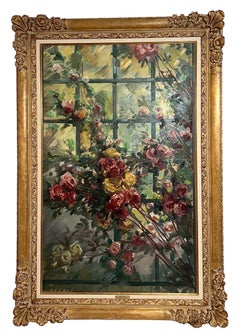
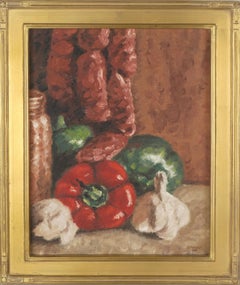
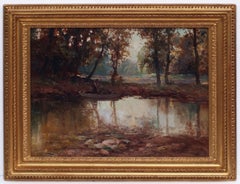
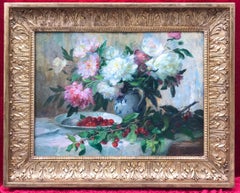
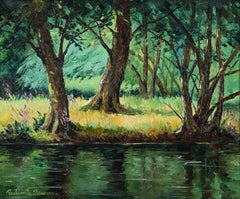
Oil on canvas
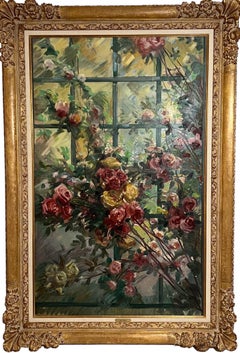
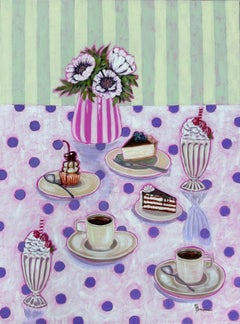
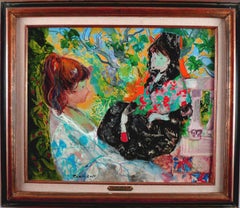
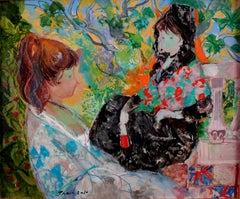
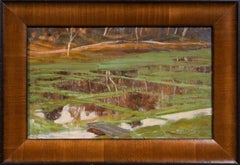
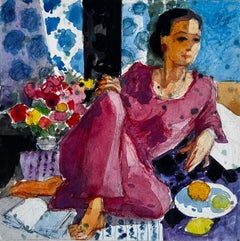
"Still Life of Roses".
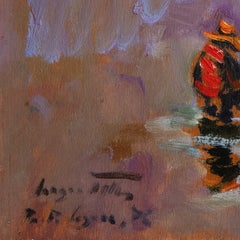
Hand signed
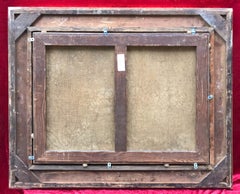
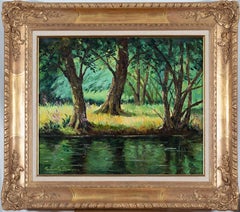
Brass name plate attached to frame,
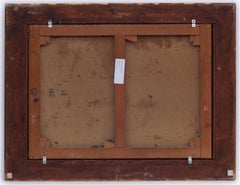
Provenance: Wally Findlay Galleries, bears label verso.
Measures: 56-1/4" x 37", frame measures 61-1/4" x 42"
This is a very large piece
Jean Chaleye (French 1878 - 1960) was active, lived in France.
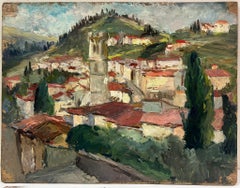
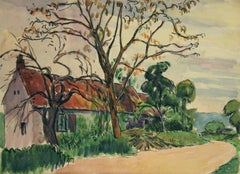
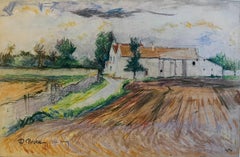
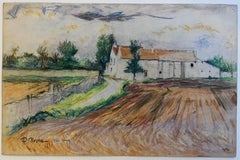
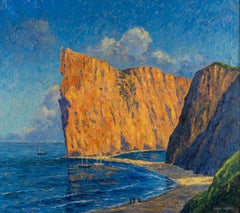
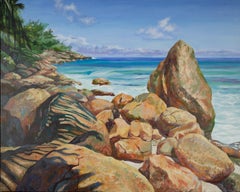
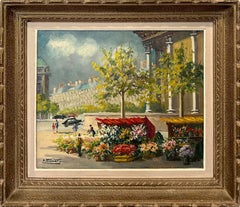
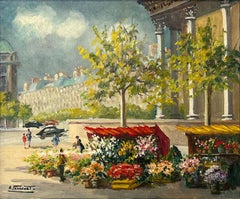
Jean Chaleye is known for Landscape, still life and coastal view painting.
Considered one of the most important Post Impressionist painters.
Jean-Baptiste Chaleye, known as Joannès Chaleyé, was born to working class parents in Saint Etienne in the middle of the 19th Century. He began his career as a commercial engraver at the age of fourteen, which he continued until 1899 when he took a trip to England. He returned the following year to do his military service and on completion returned to the city of his birth. He began his artistic training in Saint Etienne and then at the School of Fine Arts in Lyon in 1896. He was then offered the opportunity to complete his training in Paris. In 1899, he joined the class of Louvrier de Lajolais at the École Nationale Supérieure des Arts Décoratifs in Paris and was also a student of Fernand Cormon at the École Nationale Supérieure des Beaux-Arts. Through Cormon he me Andre Derain, Mary Cassatt and Dunoyer de Segonzac and a number of ther Barbizon painters influenced by Edouard Manet.
Jean Chaleye's life is divided between his attraction for painting and his passion for the art of lace. As early as 1902, he exhibited at the Salon des Artistes français and the Salon des indépendants. As a renowned painter of flowers, several museums acquired his paintings such as the cities of Puy-en-Velay, Lyon, Clermont-Ferrand and Saint-Gall in Switzerland. In 1903, Louvrier de Lajolais offered him to go to the provinces to teach the art of lacemaking at the École pratique de commerce et d'industrie du Puy-en-Velay. He then set out to replace the traditional geometric and repetitive designs by creations with supple and light forms, inspired by local flora. He devoted his entire life to highlighting the delicate art of lace making, participating in various competitions and international exhibitions during which he won several awards. Appointed director of the National Superior School of Arts and Textile Industries of Roubaix in 1930 but also artistic director of the school of laces of Bailleul, he favors the obtaining by this last one of the Grand Prix at the Exhibition of Brussels in 1935. Promoted to the rank of officer of the Legion of Honor in 1937, his involvement in the recognition of the know-how of the Velay lace industry is recognized. A renowned painter, one recognizes in his paintings as in his lace drawings all the delicacy and the love which he carries to the flowers and to the nature in general. He died in 1960 in Puy-en-Velay. After his death, the house in which he had lived in Puy was turned into the Musée Chaleyé.
International exhibitions
In 1904, he had the "Lace" section participate in the exhibition at the Galliera Museum in Paris, which presented the lace made according to his ideas. In 1905, he created the fan leaf for the lacemaker Oudin, which was purchased by the Saint-Gall Museum in Switzerland. He participated in various international competitions and exhibitions, during which he received several awards:
International Exhibition of Liège (1905): he created a fan leaf decorated with Virginia creeper which took part in this exhibition.
French Lace Competition (1907): the “Lace” section, the work of which he directed, won three distinctions: first prize (1000 Francs), second prize in collaboration, and for his personal work, the prize of the Under-Secretary of State for Fine Arts.
Franco-British Exhibition in London (1908): gold medal for a braid of fuchsias signed by Chaleyé.
Brussels World's Fair (1910): a grand prize was won by three laces signed by Chaleyé (landscape with grisaille effect, a cockfight in colour and a cushion with chestnut decorations with spider webs). Chaleyé also won a gold medal for his collaboration.
International Exhibition in Turin (1911): he had produced new drawings which had earned him a gold medal for his collaboration.
International Exhibition of Lyon (1914): he was awarded a medal for his collaboration. Participation in the “Lace” and “Cabinetmaking” sections, of which Chaleyé directed the work and designed the models for this exhibition.
Painting by Jean Chaleyé exhibited at the Crozatier Museum in Puy-en-Velay
Alongside his artistic involvement in lacemaking, he exhibited his paintings at the Salon des artistes français from 1902. At the Salon des indépendants, one of his works was selected by the Commission des beaux-arts de la Ville de Paris and several museums have acquired his paintings: the cities of Le Puy, Lyon, Clermont-Ferrand, Saint-Gall (Switzerland). Seven of them are still exhibited at the Musée Crozatier in Puy-en-Velay. A renowned painter of flowers, he enjoyed his main successes in the Lyon and Saint-Etienne regions where he exhibited mainly. He exhibited with Gaston Sebire, Louis Valtat, Leon-Alphonse Quizet...
Category
20th Century Post-Impressionist Art