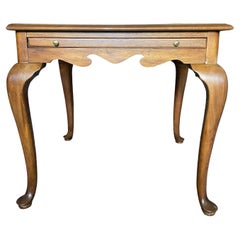
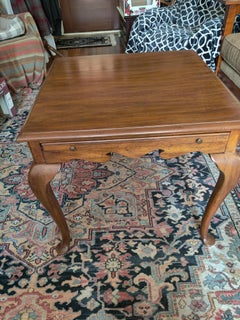
Drexel Tea Table w/Shelf and Queen Anne Legs
By Drexel
Located in Cincinnati, OH
Drexel Tea Table with Queen Anne Legs and pull out shelf.
Category
Late 20th Century Card Tables and Tea Tables
Materials
Wood
Drexel Tea Table w/Shelf and Queen Anne Legs
By Drexel
Located in Cincinnati, OH
Drexel Tea Table with Queen Anne Legs and pull out shelf.
Wood

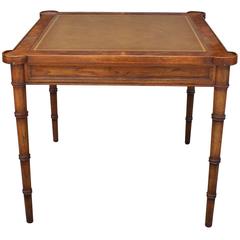
Faux Bamboo and Leather Burl Square Card Table by Drexel
By Baker Furniture Company, Drexel
Located in Houston, TX
Elegant burl walnut, leather, and faux bamboo square card or game table by Drexel. Table has
Leather, Burl, Faux Bamboo
While vintage Drexel Furniture dining tables, dressers and other pieces remain highly desirable for enthusiasts of mid-century modern design, the manufacturer's story actually begins decades before its celebrated postwar-era Declaration line took shape.
In 1903, in the small town of Drexel in the foothills of North Carolina’s Blue Ridge Mountains, six partners came together to found a company that would become one of the country’s leading furniture producers. The first offerings from Drexel Furniture were simple: a bed, washstand and bureau all crafted from native oak wood, sold as a bedroom suite for $14.50.
One of Drexel’s early innovations was to employ staff designers, something the company initiated in the 1930s. This focus on design, which few other furniture companies were committing to at the time, allowed Drexel to respond to a variety of new and traditional tastes. This included making pieces inspired by historic European furniture, like the popular French Provincial–style Touraine bedroom and dining group that borrowed its curves from Louis XV-era furniture. Others replicated the ornate details of 18th-century chinoiserie or the embellishments of Queen Anne furniture. Always ready to adapt to new customer demands, during World War II, Drexel built a sturdy desk designed especially for General Douglas MacArthur.
In the postwar era, Drexel embraced the clean lines of mid-century modernism with the Declaration collection designed by Stewart MacDougall and Kipp Stewart that featured elegant credenzas and more made in walnut, and the Profile and Projection collections designed with sculptural shapes by John Van Koert. In the 1970s, Drexel introduced high-end furniture in a Mediterranean style.
Drexel changed hands and visions throughout the years. It was managed by one of the original partners — Samuel Huffman — until 1935, at which time his son Robert O. Huffman took over as president. It was then that the company began to expand, with several acquisitions of competitors in the 1950s, including Table Rock Furniture, the Heritage Furniture Co. and more.
With the manufacturer’s success — spurred by its embrace of advertising in home and garden magazines — it opened more factories in both North and South Carolina. By 1957, the company that had started with a factory of 50 workers had 2,300 employees and was selling its furniture nationwide.
Drexel underwent a series of name changes in its long history. Its acquisition of Southern Desk Company in 1960 bolstered its production of institutional furniture for dormitories, classrooms, churches and laboratories.
In the following decades, contracts with government agencies, hotels, schools and hospitals brought its high-quality furniture to a global audience. U.S. Plywood-Champion Papers bought Drexel Enterprises in 1968, and it became Drexel Heritage Furnishings.
In 2014, the last Drexel Heritage plant, in Morganton, North Carolina, closed its doors. The company rebranded as Drexel in 2017.
The vintage Drexel furniture for sale on 1stDibs includes end tables designed by Edward Wormley, walnut side tables designed by Kipp Stewart and lots more.
Today, the phrase “card tables” might evoke the image of common plastic tables covered in felt, but historically these tables were statement pieces that invited merriment and were made of mahogany, walnut or other fine woods. Today, antique and vintage card tables and tea tables can enliven a space and encourage spirited competition in your home.
Card tables originated in England in the late 17th century, and during this time, as well as the 18th century, game tables in general became quite popular. We refer to early versions of card tables as antique Regency card tables because the Prince of Wales ruled England during the period and his official title was Regent. Back then, these furnishings were typically small, rectangular tables outfitted with hinged tops so that they could be opened to reveal a playing surface. Ornamental flourishes of the era might have included an integration of fine velvet or needlepoint as lining for the table’s surface. For furniture makers, wide adoption of a dense woven green material called baize for table covering — similar to felt but stronger — occurred during the early 1700s.
Tea became widely affordable during the early 1800s in England, and tea time exploded in popularity and involved large tea sets — especially during the Victorian era — as well as small, well-crafted tea tables. Your beverage was paired with petite baked goods, and the tea table would be home to teacups, saucers, a milk pot and other items. While tea tables are similar in design to card tables, the focus is more on presentation. Georgian card tables and tea tables — furniture made during the reign of England’s three Georges — were especially ornate. Some featured intricately carved design elements on each side and stood on elegantly curved legs. After all, tea time became a sacred ritual that society women dressed up for. It was a time to pause, reflect and sip a comforting beverage.
When no guests were visiting to enjoy tea or play games, owners could fold down both card tables and tea tables to their smaller size and tuck them away into a corner of the room.
Antique and vintage card tables and tea tables can make a lovely addition to any living room, entertainment room or game room. Find yours on 1stDibs.