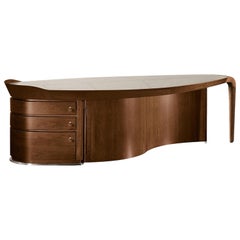
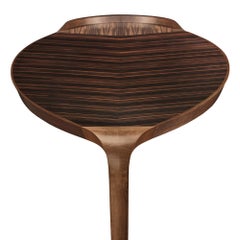
Erasmo Executive Desk by Giorgetti
By Massimo Scolari
Located in NEW YORK, NY
Executive desk with the frame in walnut Canaletto wood veneer. The top is in ebony macassar veneer
Category
2010s Italian Modern Desks and Writing Tables
Materials
Chrome
Erasmo Executive Desk by Giorgetti
By Massimo Scolari
Located in NEW YORK, NY
Executive desk with the frame in walnut Canaletto wood veneer. The top is in ebony macassar veneer
Chrome
In his role as art director and furniture designer for Italian furniture brand Giorgetti, architect, educator and painter Massimo Scolari spent over a decade producing so many imaginative, sculptural postmodern pieces that it’s easy to lose count. The Novi Ligure native has always had an eye for good design — he is an equally acclaimed painter with works in the permanent collections of the Museum of Modern Art and the Tehran Museum of Contemporary Art, and has taught at Harvard University, Cornell University and the University of Cambridge.
In 1969, Scolari completed his studies in architecture and became a professor in 1973. He taught architecture history in Palermo and drawing at Venice’s Istituto Universitario di Architettura di Venezia. From 1975 onward, Scolari was a visiting professor at many of the world’s top universities for nearly three decades while creating numerous installations for the La Biennale di Venezia and Milan Triennial.
Among Scolari’s notable furniture designs are the solid beechwood Spring swivel armchair, which is characterized by organic curves and has a backrest that features ebony insets, as well as the Erasmo and Zeno writing desks. Each piece offers innovative flourishes — the hidden spring in his armchair allows the sitter to lean back comfortably, which lends an unusual level of flexibility to the modern wooden seat, while his sleek writing desks are often outfitted with hidden drawers or secret pull-out compartments.
Scolari has exhibited across the United States. and Europe as well as in Russia and Japan. A retrospective of his work that featured over 100 paintings, drawings and architectural models was staged at the Cooper Union in 2012. For his distinct and creative contributions to architecture, Scolari was awarded the Arnold W. Brunner Memorial Prize in Architecture by the American Academy of Arts and Letters in New York in 2014.
Find vintage Massimo Scolari lighting, tables and seating on 1stDibs.
The late 19th and early 20th centuries saw sweeping social change and major scientific advances — both of which contributed to a new aesthetic: modernism. Rejecting the rigidity of Victorian artistic conventions, modernists sought a new means of expression. References to the natural world and ornate classical embellishments gave way to the sleek simplicity of the Machine Age. Architect Philip Johnson characterized the hallmarks of modernism as “machine-like simplicity, smoothness or surface [and] avoidance of ornament.”
Early practitioners of modernist design include the De Stijl (“The Style”) group, founded in the Netherlands in 1917, and the Bauhaus School, founded two years later in Germany.
Followers of both groups produced sleek, spare designs — many of which became icons of daily life in the 20th century. The modernists rejected both natural and historical references and relied primarily on industrial materials such as metal, glass, plywood, and, later, plastics. While Bauhaus principals Marcel Breuer and Ludwig Mies van der Rohe created furniture from mass-produced, chrome-plated steel, American visionaries like Charles and Ray Eames worked in materials as novel as molded plywood and fiberglass. Today, Breuer’s Wassily chair, Mies van der Rohe’s Barcelona chair — crafted with his romantic partner, designer Lilly Reich — and the Eames lounge chair are emblems of progressive design and vintage originals are prized cornerstones of collections.
It’s difficult to overstate the influence that modernism continues to wield over designers and architects — and equally difficult to overstate how revolutionary it was when it first appeared a century ago. But because modernist furniture designs are so simple, they can blend in seamlessly with just about any type of décor. Don’t overlook them.
Choosing the perfect writing desk or writing table is a profoundly personal journey, one that people have been embarking upon for centuries.
Queen Atossa of Persia, from her writing table circa 500 B.C., is said to have been the originator of the art of handwritten letters. Hers was reportedly the first in a long and colorful history of penned correspondence that grew in popularity alongside literacy. The demand for suitable writing desks, which would serve the composer of the letters as well as ensure the comfort of the recipient naturally followed, and the design of these necessary furnishings has evolved throughout history.
Once people began to seek freedom from the outwardly ornate styles of the walnut and rosewood writing desks and drafting tables introduced in the name of Queen Victoria and King Louis XV, radical shifts occurred, such as those that materialized during the Art Nouveau period, when designers longed to produce furniture inspired by the natural world’s beauty. A prime example is the work of the famous late-19th-century Spanish architect Antoni Gaudí — his rolltop desk featured deep side drawers and was adorned with carved motifs that paid tribute to nature. Gaudí regularly combined structural precision with decorative elements, creating beautiful pieces of furniture in wood and metal.
Soon afterward, preferences for sleek, geometric, stylized forms in furniture that saw an emphasis on natural wood grains and traditional craftsmanship took hold. Today, Art Deco desks are still favored by designers who seek to infuse interiors with an air of luxury. One of the most prominent figures of the Art Deco movement was French decorator and furniture designer Émile-Jacques Ruhlmann. With his use of neoclassical motifs as well as expensive and exotic materials such as imported dark woods and inlays of precious metals for his writing desks, Ruhlmann came to symbolize good taste and modernity.
The rise in appreciation for Scandinavian modernism continues to influence the design of contemporary writing desks. It employs the “no fuss” or “less is more” approach to creating a tasteful, sophisticated space. Sweden’s master cabinetmaker Bruno Mathsson created gallery-worthy designs that are as functional as they are beautiful. Finnish architect Alvar Aalto never viewed himself as an artist, but, like Mathsson, his furniture designs reflected a fondness for organic materials and a humanistic approach. Danish designers such as Hans Wegner introduced elegant shapes and lines to mid-century desks and writing tables, often working in oak and solid teak.
From vintage desks to contemporary styles, 1stDibs offers a broad spectrum of choices for conducting all personal and business writing and reading activities.