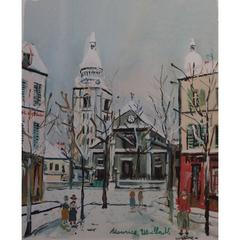
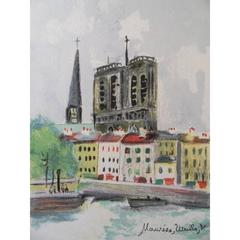
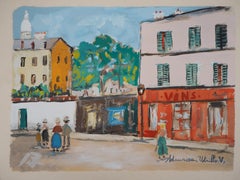
Maurice Utrillo Original For Sale on 1stDibs
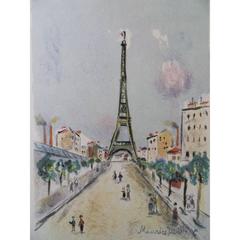
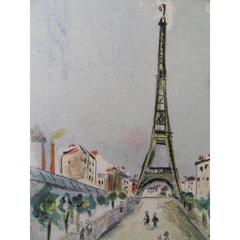
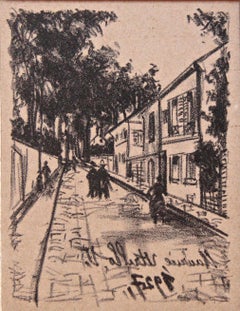
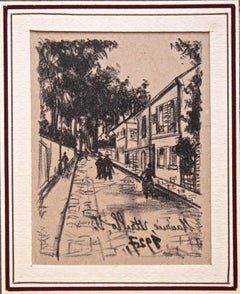
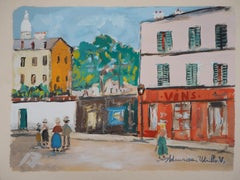
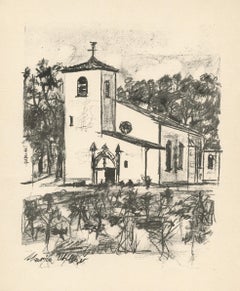
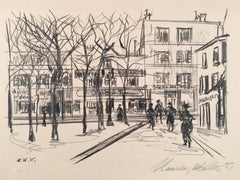
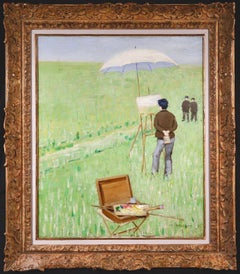
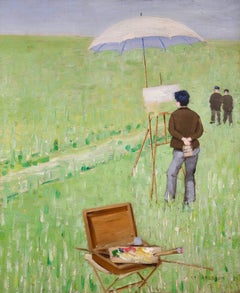
On 1stDibs, you can find the most appropriate maurice utrillo original for your needs in our varied inventory. In our selection of items, you can find
Post-Impressionist examples as well as a
Impressionist version. On 1stDibs, the right maurice utrillo original is waiting for you and the choices span a range of colors that includes
gray,
beige and
brown. These artworks were handmade with extraordinary care, with artists most often working in
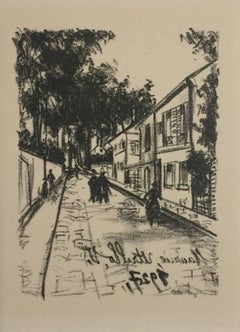
lithograph,
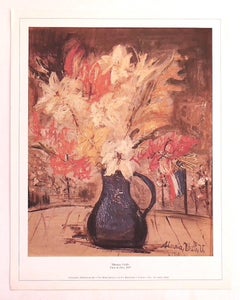
gouache and
paint. A large maurice utrillo original can prove too dominant for some spaces — a smaller maurice utrillo original, measuring 7.88 high and 5.52 wide, may better suit your needs.
How Much is a Maurice Utrillo Original?
The price for a maurice utrillo original in our collection starts at $296 and tops out at $98,545 with the average selling for $1,224.
Maurice Utrillo for sale on 1stDibs
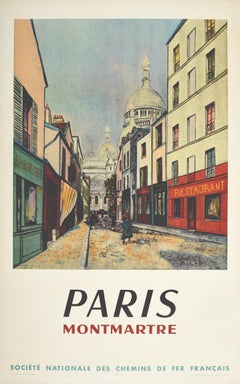
Maurice Utrillo, initially Maurice Valadon, was born in Paris, December 26, 1883, the illegitimate son of the artist Suzanne Valadon. She, who had become a model after a fall from a trapeze, ended her chosen career as a circus acrobat, found that posing for Berthe Morisot, Pierre-Auguste Renoir, Henri de Toulouse-Lautrec and others provided her with an opportunity to study their techniques; in some cases, she had also become their mistress. She taught herself to paint, and when Toulouse-Lautrec introduced her to Edgar Degas, he became her mentor. Eventually she became a peer of the artists she had posed for.
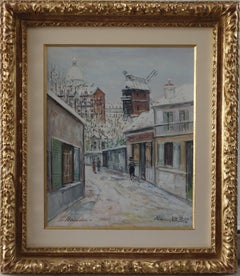
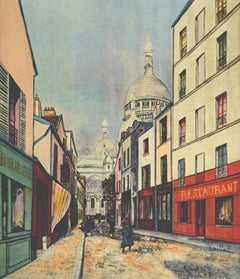
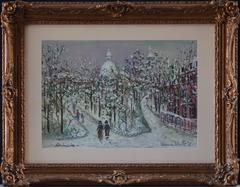
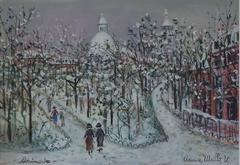
Meanwhile, Valedon's mother was left in charge of raising the young Utrillo, who soon showed a troubling inclination toward truancy and alcoholism. When a mental illness took hold of the twenty-one year old Utrillo in 1904, he was encouraged to paint by his mother. Under her tutelage, he began painting the streets of his childhood neighborhood, Montmartre. Working in the tradition of the conventional veduta, he depicted streets, buildings, fountains, and avenues, which he captured at different seasons of the year in a style influenced by the lyrical realism of Camille Pissarro and Albert Sisley. However, by deploying a subtle palette - mainly yellows, turquoise, maroon and zinc white - he suffused the scenes with atmospheric* qualities that evoke feelings either of familiarity or of alienation in the viewer.
Known as his 'White Period' (période blanche), the years between 1909 and 1914 represent the acme of Utrillo's creativity. During this time, he reduced his palette to white, shading into grays. He also mixed his paints with sand, plaster, and lime to render the physical substance of his subject matter, walls in particular. In 1910, art critics F. Jourdan and E. Faure discovered the artist. Their appreciation of his talent enabled Utrillo to take part for the first time in the 1912 Salon d'Automne*. Until 1914, Utrillo traveled in Brittany and Corsica; his works assumed an increasingly luminous* quality, which greatly enriched his earlier ascetic conception of reality. In 1924, he exhibited with his mother at the Galerie Bernheim-Jeune in Paris and was offered a contract for a year. However, that same year he also attempted to commit suicide, which was probably the result of years of alcohol abuse.
A powerful natural talent, Utrillo made an enormous contribution in consolidating painterly structure and texture. He was also important as a draughtsman*. In 1926, he designed stage scenery and costumes for Djaghilev's Ballets Russes. He received public recognition in 1928, when he was made a member of the Legion of Honour.
Starting where Impressionism* left off, Utrillo became the best-known portrayer of Paris, especially Montmartre, painting both from nature and from postcards. His poetic interpretations of the streets and squares of Montmartre contributed substantially to popularizing a romantic image of that quarter. However, when he painted people, they were always represented as solitary beings, lost in social isolation.
Finding the Right Prints And Multiples for You
Decorating with fine art prints — whether they’re figurative prints, abstract prints or another variety — has always been a practical way of bringing a space to life as well as bringing works by an artist you love into your home.
Pursued in the 1960s and ’70s, largely by Pop artists drawn to its associations with mass production, advertising, packaging and seriality, as well as those challenging the primacy of the Abstract Expressionist brushstroke, printmaking was embraced in the 1980s by painters and conceptual artists ranging from David Salle and Elizabeth Murray to Adrian Piper and Sherrie Levine.
Printmaking is the transfer of an image from one surface to another. An artist takes a material like stone, metal, wood or wax, carves, incises, draws or otherwise marks it with an image, inks or paints it and then transfers the image to a piece of paper or other material.
Fine art prints are frequently confused with their more commercial counterparts. After all, our closest connection to the printed image is through mass-produced newspapers, magazines and books, and many people don’t realize that even though prints are editions, they start with an original image created by an artist with the intent of reproducing it in a small batch. Fine art prints are created in strictly limited editions — 20 or 30 or maybe 50 — and are always based on an image created specifically to be made into an edition.
Many people think of revered Dutch artist Rembrandt as a painter but may not know that he was a printmaker as well. His prints have been preserved in time along with the work of other celebrated printmakers such as Pablo Picasso, Salvador Dalí and Andy Warhol. These fine art prints are still highly sought after by collectors.
“It’s another tool in the artist’s toolbox, just like painting or sculpture or anything else that an artist uses in the service of mark making or expressing him- or herself,” says International Fine Print Dealers Association (IFPDA) vice president Betsy Senior, of New York’s Betsy Senior Fine Art, Inc.
Because artist’s editions tend to be more affordable and available than his or her unique works, they’re more accessible and can be a great opportunity to bring a variety of colors, textures and shapes into a space.
For tight corners, select small fine art prints as opposed to the oversized bold piece you’ll hang as a focal point in the dining area. But be careful not to choose something that is too big for your space. And feel free to lean into it if need be — not every work needs picture-hanging hooks. Leaning a larger fine art print against the wall behind a bookcase can add a stylish installation-type dynamic to your living room. (Read more about how to arrange wall art here.)
Find fine art prints for sale on 1stDibs today.