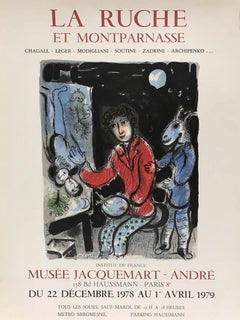
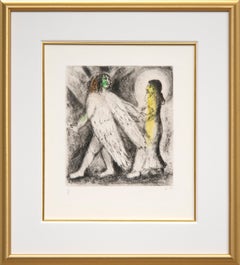
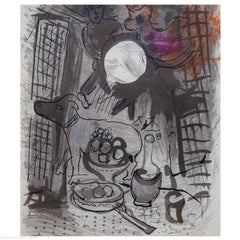
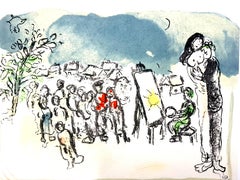
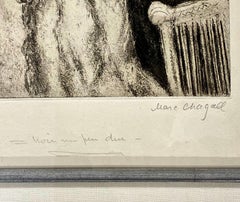
Marc Chagall Art

French, 1887-1985

Described by art critic Robert Hughes as "the quintessential Jewish artist of the twentieth century," the Russian-French modernist Marc Chagall worked in nearly every artistic medium. Influenced by Symbolism, Fauvism, Cubism and Surrealism, he developed his own distinctive style, combining avant-garde techniques and motifs with elements drawn from Eastern European Jewish folk art.

Born Moishe Segal in 1887, in Belarus (then part of the Russian empire), Chagall is often celebrated for his figurative paintings, but he also produced stained-glass windows for the cathedrals of Reims and Metz, in France; for the United Nations, in New York; and for the Hadassah Hospital in Jerusalem, as well as book illustrations, stage sets, ceramics, tapestries and fine-art prints. Characterized by a bold color palette and whimsical imagery, his works are often narrative, depicting small-village scenes and quotidian moments of peasant life, as in his late painting The Flight into Egypt from 1980.

Before World War I, Chagall traveled between St. Petersburg, Paris and Berlin. When the conflict broke out, he returned to Soviet-occupied Belarus, where he founded the Vitebsk Arts College before leaving again for Paris in 1922. He fled to the United States during World War II but in 1947 returned to France, where he spent the rest of his life. His peripatetic career left its mark on his style, which was distinctly international, incorporating elements from each of the cultures he experienced.

Marc Chagall remains one of the past century’s most respected talents — find his art on 1stDibs.

to
505
1,273
221
115
31
8
Overall Width
to
Overall Height
to
3
2
1,641
2
133
34
54
452
700
147
34
443
424
424
30
10
10
7
2
992
728
413
413
400
324
230
118
56
54
35
33
28
26
22
17
16
15
12
12
825
808

Use search to find more

11,946
2,897
2,541
1,501

Use search to find more

Artist: Marc Chagall
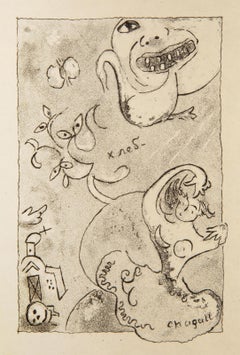
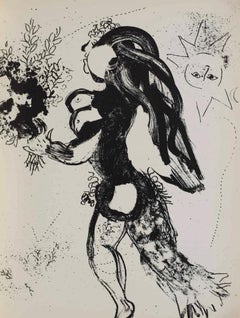
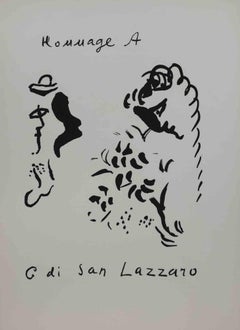
Hommage à San Lazzaro - Lithograph by M. Chagall - 1975

Hommage à San Lazzaro - Lithograph by M. Chagall - 1975

By Marc Chagall

Located in Roma, IT

Hommage à San Lazzaro is a lithograph realized by Marc Chagall for the Art Revew "XXème Siècle". This original print (not signed and not numbered) comes from the portfolio Hommage à...

Category

1970s Surrealist Marc Chagall Art

Materials

Lithograph

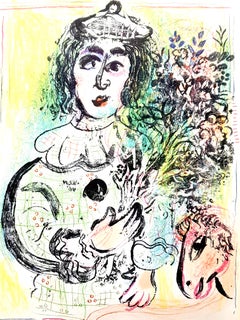
Marc Chagall - Flowered Clown - Original Lithograph

Marc Chagall - Flowered Clown - Original Lithograph

By Marc Chagall

Located in Collonge Bellerive, Geneve, CH

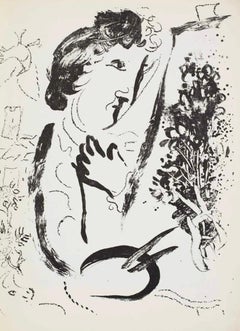
Marc Chagall Original Lithograph 1963 Dimensions: 32 x 24 cm From Chagall Lithograph II Reference: Mourlot 399 Condition : Excellent Unsigned and unumbered as issued

Category

1960s Surrealist Marc Chagall Art

Materials

Lithograph

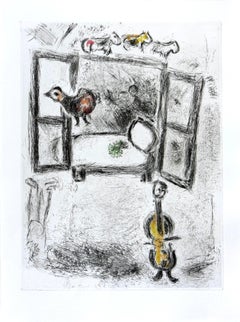
Et Sur La Terre, Original Etching, Modern, 1977, Excellent

Et Sur La Terre, Original Etching, Modern, 1977, Excellent

By Marc Chagall

Located in OPOLE, PL

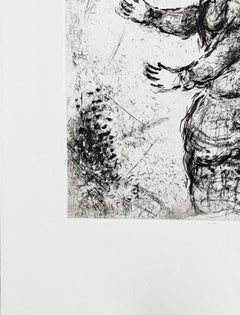
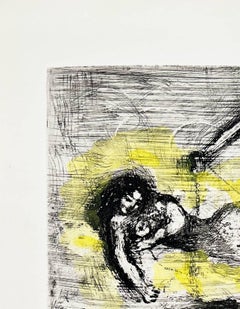
Marc Chagall (1887-1985) - Et sur la terre Etching from 1977. Edition of 225 proofs. On Rives paper. Dimensions of work: 43.5 x 33.2 cm. Publisher: Maeght Éditeur, Paris. Refer...

Category

1970s Modern Marc Chagall Art

Materials

Etching

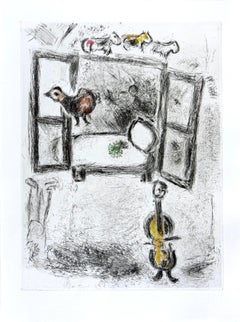
Et Sur La Terre, Original Etching, Modern, 1977, Excellent

Et Sur La Terre, Original Etching, Modern, 1977, Excellent

By Marc Chagall

Located in OPOLE, PL

Marc Chagall (1887-1985) - Et sur la terre Etching from 1977. Edition of 225 proofs. On Rives paper. Dimensions of work: 43.5 x 33.2 cm. Publisher: Maeght Éditeur, Paris. Refer...

Category

1970s Modern Marc Chagall Art

Materials

Etching

Rose des Vents - Rare Book Illustrated by Marc Chagall - 1920

Rose des Vents - Rare Book Illustrated by Marc Chagall - 1920

By Marc Chagall

Located in Roma, IT

Rose des Vents is an original Modern Rare book written by Philippe Soupault (Chaville, 1897 - Paris, 1990) and illustrated by Marc Chagall (Lëzna, 1887 – Saint-Paul-de-Vence, 1985...

Category

1920s Surrealist Marc Chagall Art

Materials

Paper, Photogravure

Marc Chagall - Couple With a Goat - Original Lithograph

Marc Chagall - Couple With a Goat - Original Lithograph

By Marc Chagall

Located in Collonge Bellerive, Geneve, CH

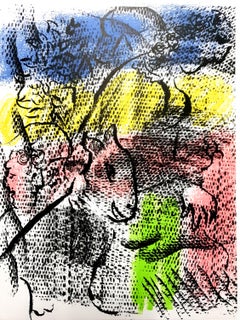
Marc Chagall Original Lithograph Title: Couple With a Goat 1970 Dimensions: 32 x 24 cm From the art revue XXè siècle Reference: Mourlot #608, Cramer, Books, No. 84 Unsigned and unum...

Category

Mid-20th Century Surrealist Marc Chagall Art

Materials

Lithograph

Le Clown Acrobate - Etching & Aquatint by Marc Chagall - 1967

Le Clown Acrobate - Etching & Aquatint by Marc Chagall - 1967

By Marc Chagall

Located in Roma, IT

Hand-signed. Edition 13/35 prints, numbered and hand signed in pencil. Image Dimensions : 31 x 24 cm Passepartout included : 70 x 50 cm Ref. Cramer 12. Very good conditions.

Category

1960s Surrealist Marc Chagall Art

Materials

Etching, Aquatint

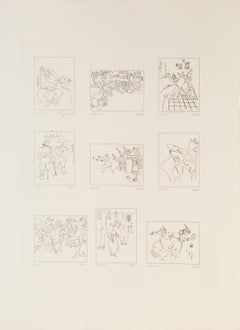
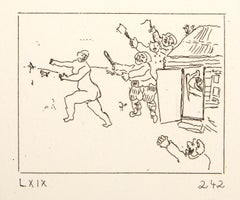
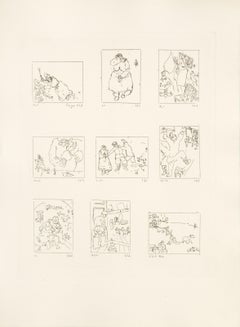
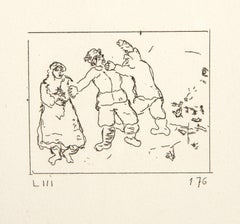
La Suite Tout Nu - Surrealist Etching, Circa 1920, Edition of 335

La Suite Tout Nu - Surrealist Etching, Circa 1920, Edition of 335

By Marc Chagall

Located in Roma, IT

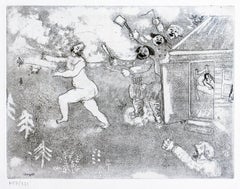
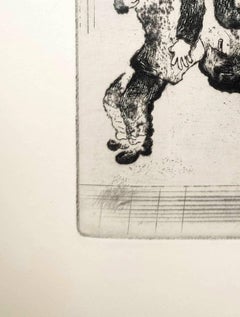
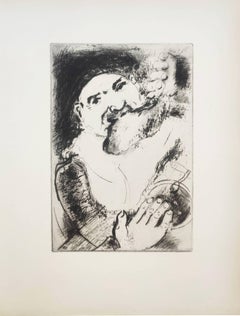
From "Les Ames Mortes de Gogol", illustrated by Marc Chagall. Not signed (signed on plate). Edition of 335 prints. Excellent conditions. This artwork is shipped from Italy. Under ex...

Category

1920s Surrealist Marc Chagall Art

Materials

Etching

Marc Chagall - The Ballet, Frontispiece

Marc Chagall - The Ballet, Frontispiece

By Marc Chagall

Located in Collonge Bellerive, Geneve, CH

The Ballet, Frontispiece for the book “Daphnis and Chloe” Lithograph in colors, 1969. Unsigned and unnumbered, as issued from an edition of 10,000. Printed ...

Category

1960s Surrealist Marc Chagall Art

Materials

Lithograph

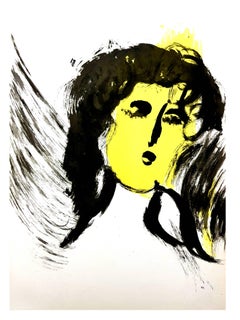
L'Ange

L'Ange

By Marc Chagall

Located in London, GB

Original lithograph by Marc Chagall, printed during the artist's lifetime directly from Chagall's own lithographic stones.

Category

Mid-20th Century Marc Chagall Art

Materials

Lithograph

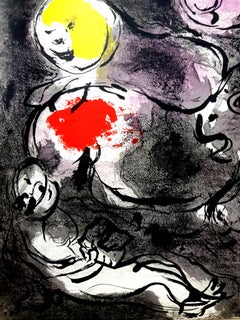
Marc Chagall - The Bible - Original Lithograph

Marc Chagall - The Bible - Original Lithograph

By Marc Chagall

Located in Collonge Bellerive, Geneve, CH

Marc Chagall, Original Lithograph depicting an instant of the Bible. Technique: Original lithograph in colours Year: 1956 Sizes: 35,5 x 26 cm / 14" x 10.2" (sheet) Published by: Édit...

Category

1950s Modern Marc Chagall Art

Materials

Lithograph

Celui qui dit les choses sans rien dire, Planche XVI

Celui qui dit les choses sans rien dire, Planche XVI

By Marc Chagall

Located in OPOLE, PL

Marc Chagall (1887-1985) - Celui qui dit les choses sans rien dire, Planche XVI Etching and aquatint from 1976. The edition of 225. Dimensions of sheet: 47 x 35 cm Dimensions in ...

Category

1970s Modern Marc Chagall Art

Materials

Etching, Aquatint

Celui qui dit les choses sans rien dire, Planche II

Celui qui dit les choses sans rien dire, Planche II

By Marc Chagall

Located in OPOLE, PL

Marc Chagall (1887-1985) - Celui qui dit les choses sans rien dire, Planche II Etching and aquatint from 1976. The edition of 225. Dimensions of sheet: 47 x 35 cm Dimensions in f...

Category

1970s Modern Marc Chagall Art

Materials

Etching, Aquatint

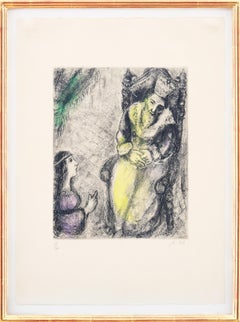
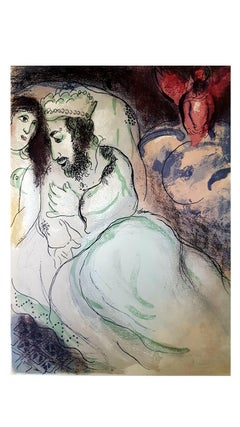
Marc Chagall - Bath-Sheba at the Feet of David - Original Handsigned Etching

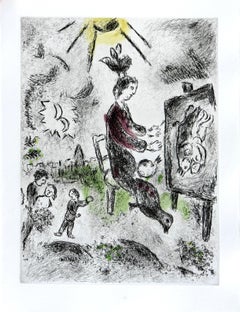
Marc Chagall - Bath-Sheba at the Feet of David - Original Handsigned Etching

By Marc Chagall

Located in Collonge Bellerive, Geneve, CH

Marc Chagall - Bath-Sheba at the Feet of David - Original Handsigned Etching 1958 Printed by Tériade Dimensions: 54 x 39 cm Handsigned and numbered handcolored Edition: 100 Reference: Cramer 30. Etching with hand-coloring, circa 1930, initialled in pencil, numbered 75/100 (there were also twenty hors-commerce copies) , published 1958 by Tériade, Paris, on Arches wove paper Marc Chagall (born in 1887) Marc Chagall was born in Belarus in 1887 and developed an early interest in art. After studying painting, in 1907 he left Russia for Paris, where he lived in an artist colony on the city’s outskirts. Fusing his own personal, dreamlike imagery with hints of the fauvism and cubism popular in France at the time, Chagall created his most lasting work—including I and the Village (1911)—some of which would be featured in the Salon des Indépendants exhibitions. After returning to Vitebsk for a visit in 1914, the outbreak of WWI trapped Chagall in Russia. He returned to France in 1923 but was forced to flee the country and Nazi persecution during WWII. Finding asylum in the U.S., Chagall became involved in set and costume design before returning to France in 1948. In his later years, he experimented with new art forms and was commissioned to produce numerous large-scale works. Chagall died in St.-Paul-de-Vence in 1985. The Village Marc Chagall was born in a small Hassidic community on the outskirts of Vitebsk, Belarus, on July 7, 1887. His father was a fishmonger, and his mother ran a small sundries shop in the village. As a child, Chagall attended the Jewish elementary school, where he studied Hebrew and the Bible, before later attending the Russian public school. He began to learn the fundamentals of drawing during this time, but perhaps more importantly, he absorbed the world around him, storing away the imagery and themes that would feature largely in most of his later work. At age 19 Chagall enrolled at a private, all-Jewish art school and began his formal education in painting, studying briefly with portrait artist Yehuda Pen. However, he left the school after several months, moving to St. Petersburg in 1907 to study at the Imperial Society for the Protection of Fine Arts. The following year, he enrolled at the Svanseva School, studying with set designer Léon Bakst, whose work had been featured in Sergei Diaghilev's Ballets Russes. This early experience would prove important to Chagall’s later career as well. Despite this formal instruction, and the widespread popularity of realism in Russia at the time, Chagall was already establishing his own personal style, which featured a more dreamlike unreality and the people, places and imagery that were close to his heart. Some examples from this period are his Window Vitebsk (1908) and My Fianceé with Black Gloves (1909), which pictured Bella Rosenfeld, to whom he had recently become engaged. The Beehive Despite his romance with Bella, in 1911 an allowance from Russian parliament member and art patron Maxim Binaver enabled Chagall to move to Paris, France. After settling briefly in the Montparnasse neighborhood, Chagall moved further afield to an artist colony known as La Ruche (“The Beehive”), where he began to work side by side with abstract painters such as Amedeo Modigliani and Fernand Léger as well as the avant-garde poet Guillaume Apollinaire. At their urging, and under the influence of the wildly popular fauvism and cubism, Chagall lightened his palette and pushed his style ever further from reality. I and the Village (1911) and Homage to Apollinaire (1912) are among his early Parisian works, widely considered to be his most successful and representative period. Though his work stood stylistically apart from his cubist contemporaries, from 1912 to 1914 Chagall exhibited several paintings at the annual Salon des Indépendants exhibition, where works by the likes of Juan Gris, Marcel Duchamp and Robert Delaunay were causing a stir in the Paris art world. Chagall’s popularity began to spread beyond La Ruche, and in May 1914 he traveled to Berlin to help organize his first solo exhibition, at Der Sturm Gallery. Chagall remained in the city until the highly acclaimed show opened that June. He then returned to Vitebsk, unaware of the fateful events to come. War, Peace and Revolution In August 1914 the outbreak of World War I precluded Chagall’s plans to return to Paris. The conflict did little to stem the flow of his creative output, however, instead merely giving him direct access to the childhood scenes so essential to his work, as seen in paintings such as Jew in Green (1914) and Over Vitebsk (1914). His paintings from this period also occasionally featured images of the war’s impact on the region, as with Wounded Soldier (1914) and Marching (1915). But despite the hardships of life during wartime, this would also prove to be a joyful period for Chagall. In July 1915 he married Bella, and she gave birth to a daughter, Ida, the following year. Their appearance in works such as Birthday (1915), Bella and Ida by the Window (1917) and several of his “Lovers” paintings give a glimpse of the island of domestic bliss that was Chagall’s amidst the chaos. To avoid military service and stay with his new family, Chagall took a position as a clerk in the Ministry of War Economy in St. Petersburg. While there he began work on his autobiography and also immersed himself in the local art scene, befriending novelist Boris Pasternak, among others. He also exhibited his work in the city and soon gained considerable recognition. That notoriety would prove important in the aftermath of the 1917 Russian Revolution when he was appointed as the Commissar of Fine Arts in Vitebsk. In his new post, Chagall undertook various projects in the region, including the 1919 founding of the Academy of the Arts. Despite these endeavors, differences among his colleagues eventually disillusioned Chagall. In 1920 he relinquished his position and moved his family to Moscow, the post-revolution capital of Russia. In Moscow, Chagall was soon commissioned to create sets and costumes for various productions at the Moscow State Yiddish Theater, where he would paint a series of murals titled Introduction to the Jewish Theater as well. In 1921, Chagall also found work as a teacher at a school for war orphans. By 1922, however, Chagall found that his art had fallen out of favor, and seeking new horizons he left Russia for good. Flight After a brief stay in Berlin, where he unsuccessfully sought to recover the work exhibited at Der Sturm before the war, Chagall moved his family to Paris in September 1923. Shortly after their arrival, he was commissioned by art dealer and publisher Ambroise Vollard to produce a series of etchings for a new edition of Nikolai Gogol's 1842 novel Dead Souls. Two years later Chagall began work on an illustrated edition of Jean de la Fontaine’s Fables, and in 1930 he created etchings for an illustrated edition of the Old Testament, for which he traveled to Palestine to conduct research. Chagall’s work during this period brought him new success as an artist and enabled him to travel throughout Europe in the 1930s. He also published his autobiography, My Life (1931), and in 1933 received a retrospective at the Kunsthalle in Basel, Switzerland. But at the same time that Chagall’s popularity was spreading, so, too, was the threat of Fascism and Nazism. Singled out during the cultural "cleansing" undertaken by the Nazis in Germany, Chagall’s work was ordered removed from museums throughout the country. Several pieces were subsequently burned, and others were featured in a 1937 exhibition of “degenerate art” held in Munich. Chagall’s angst regarding these troubling events and the persecution of Jews in general can be seen in his 1938 painting White Crucifixion. With the eruption of World War II, Chagall and his family moved to the Loire region before moving farther south to Marseilles following the invasion of France. They found a more certain refuge when, in 1941, Chagall’s name was added by the director of the Museum of Modern Art (MOMA) in New York City to a list of artists and intellectuals deemed most at risk from the Nazis’ anti-Jewish campaign. Chagall and his family would be among the more than 2,000 who received visas and escaped this way. Haunted Harbors Arriving in New York City in June 1941, Chagall discovered that he was already a well-known artist there and, despite a language barrier, soon became a part of the exiled European artist community. The following year he was commissioned by choreographer Léonide Massine to design sets and costumes for the ballet Aleko, based on Alexander Pushkin’s “The Gypsies” and set to the music of Pyotr Ilyich Tchaikovsky. But even as he settled into the safety of his temporary home, Chagall’s thoughts were frequently consumed by the fate befalling the Jews of Europe and the destruction of Russia, as paintings such as The Yellow Crucifixion...

Category

1960s Surrealist Marc Chagall Art

Materials

Etching

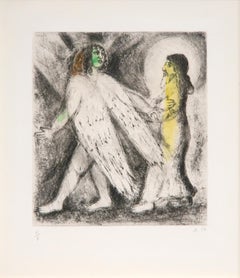
L'Homme Guide par L’Eternel (Man Guided by the Lord), pl. 97 (from Bible Series)

L'Homme Guide par L’Eternel (Man Guided by the Lord), pl. 97 (from Bible Series)

By Marc Chagall

Located in Palm Desert, CA

In 'L'Homme Guidé par l’Éternel’ (Plate 97), Chagall depicts a figure moving through space, guided by divine light and presence. The etching captures the spiritual journey of man dir...

Category

Mid-20th Century Modern Marc Chagall Art

Materials

Paper, Etching

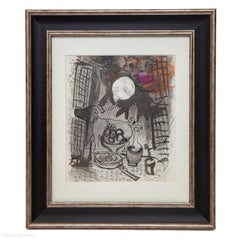
Marc Chagall Still Life with Fruits 1957 Original Lithograph Mourlot 205

Marc Chagall Still Life with Fruits 1957 Original Lithograph Mourlot 205

By Marc Chagall

Located in Eversholt, Bedfordshire

Surrealist composition with a dog, figure, cockerel floating above the still life In a cream mount, visible sheet length 19.50cm, height 22.50cm Within a black and silvered moulded ...

Category

1950s Modern Marc Chagall Art

Materials

Lithograph

Marc Chagall - Hommage à Julien Cain - Original Lithograph

Marc Chagall - Hommage à Julien Cain - Original Lithograph

By Marc Chagall

Located in Collonge Bellerive, Geneve, CH

Marc Chagall - Original Lithograph Frontispiece for André Dunoyer de Segonzac, and Julien Cain. "Humanisme Actif: Mélanges d'Art et de Littérature Offerts à Julien Cain." Paris: Herm...

Category

1960s Surrealist Marc Chagall Art

Materials

Lithograph

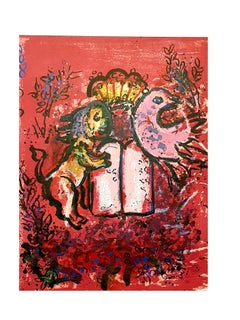
Marc Chagall - The Tables of the Law - Original Lithograph

Marc Chagall - The Tables of the Law - Original Lithograph

By Marc Chagall

Located in Collonge Bellerive, Geneve, CH

Marc Chagall The Tables of the Law Lithograph from Vitraux pour Jerusalem 1962 Printed by Mourlot Dimensions: 32.5 x 24.5 cm Publisher: André Sauret, Monte-Carlo Reference: Mourlo...

Category

1960s Surrealist Marc Chagall Art

Materials

Lithograph

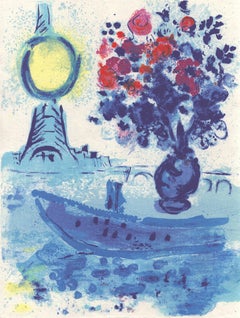
Marc Chagall -- Bateau Mouche au bouquet

Marc Chagall -- Bateau Mouche au bouquet

By Marc Chagall

Located in BRUCE, ACT

Marc Chagall Bateau Mouche au bouquet, 1961 Original Lithograph Unnumbered of the edition of 180 Sheet Size: 39 * 30 cm Unsigned Reference Mourlot 352

Category

1960s Marc Chagall Art

Materials

Lithograph

Marc Chagall - The Bible - Ahasuerus Sends Vasthi Away  - Original Lithograph

Marc Chagall - The Bible - Ahasuerus Sends Vasthi Away - Original Lithograph

By Marc Chagall

Located in Collonge Bellerive, Geneve, CH

Marc Chagall, Original Lithograh depicting an instant of the Bible. Technique: Original lithograph in colours (Mourlot no. 234) On the reverse: another black and white original litho...

Category

1960s Modern Marc Chagall Art

Materials

Lithograph

Lithograph Book Cover

Lithograph Book Cover

By Marc Chagall

Located in London, GB

Original lithograph by Marc Chagall, printed during the artist's lifetime directly from Chagall's own lithographic stones.

Category

Mid-20th Century Marc Chagall Art

Materials

Lithograph

Marc Chagall - The Bible - Original Lithograph

Marc Chagall - The Bible - Original Lithograph

By Marc Chagall

Located in Collonge Bellerive, Geneve, CH

Marc Chagall, Original Lithograph depicting an instant of the Bible. Technique: Original lithograph in colours Year: 1956 Sizes: 35,5 x 26 cm / 14" x 10.2" (sheet) Published by: Éditions de la Revue Verve, Tériade, Paris Printed by: Atelier Mourlot, Paris Documentation / References: Mourlot, F., Chagall Lithograph [II] 1957-1962, A. Sauret, Monte Carlo 1963, nos. 234 and 257 Marc Chagall (born in 1887) Marc Chagall was born in Belarus in 1887 and developed an early interest in art. After studying painting, in 1907 he left Russia for Paris, where he lived in an artist colony on the city’s outskirts. Fusing his own personal, dreamlike imagery with hints of the fauvism and cubism popular in France at the time, Chagall created his most lasting work—including I and the Village (1911)—some of which would be featured in the Salon des Indépendants exhibitions. After returning to Vitebsk for a visit in 1914, the outbreak of WWI trapped Chagall in Russia. He returned to France in 1923 but was forced to flee the country and Nazi persecution during WWII. Finding asylum in the U.S., Chagall became involved in set and costume design before returning to France in 1948. In his later years, he experimented with new art forms and was commissioned to produce numerous large-scale works. Chagall died in St.-Paul-de-Vence in 1985. The Village Marc Chagall was born in a small Hassidic community on the outskirts of Vitebsk, Belarus, on July 7, 1887. His father was a fishmonger, and his mother ran a small sundries shop in the village. As a child, Chagall attended the Jewish elementary school, where he studied Hebrew and the Bible, before later attending the Russian public school. He began to learn the fundamentals of drawing during this time, but perhaps more importantly, he absorbed the world around him, storing away the imagery and themes that would feature largely in most of his later work. At age 19 Chagall enrolled at a private, all-Jewish art school and began his formal education in painting, studying briefly with portrait artist Yehuda Pen. However, he left the school after several months, moving to St. Petersburg in 1907 to study at the Imperial Society for the Protection of Fine Arts. The following year, he enrolled at the Svanseva School, studying with set designer Léon Bakst, whose work had been featured in Sergei Diaghilev's Ballets Russes. This early experience would prove important to Chagall’s later career as well. Despite this formal instruction, and the widespread popularity of realism in Russia at the time, Chagall was already establishing his own personal style, which featured a more dreamlike unreality and the people, places and imagery that were close to his heart. Some examples from this period are his Window Vitebsk (1908) and My Fianceé with Black Gloves (1909), which pictured Bella Rosenfeld, to whom he had recently become engaged. The Beehive Despite his romance with Bella, in 1911 an allowance from Russian parliament member and art patron Maxim Binaver enabled Chagall to move to Paris, France. After settling briefly in the Montparnasse neighborhood, Chagall moved further afield to an artist colony known as La Ruche (“The Beehive”), where he began to work side by side with abstract painters such as Amedeo Modigliani and Fernand Léger as well as the avant-garde poet Guillaume Apollinaire. At their urging, and under the influence of the wildly popular fauvism and cubism, Chagall lightened his palette and pushed his style ever further from reality. I and the Village (1911) and Homage to Apollinaire (1912) are among his early Parisian works, widely considered to be his most successful and representative period. Though his work stood stylistically apart from his cubist contemporaries, from 1912 to 1914 Chagall exhibited several paintings at the annual Salon des Indépendants exhibition, where works by the likes of Juan Gris, Marcel Duchamp and Robert Delaunay were causing a stir in the Paris art world. Chagall’s popularity began to spread beyond La Ruche, and in May 1914 he traveled to Berlin to help organize his first solo exhibition, at Der Sturm Gallery. Chagall remained in the city until the highly acclaimed show opened that June. He then returned to Vitebsk, unaware of the fateful events to come. War, Peace and Revolution In August 1914 the outbreak of World War I precluded Chagall’s plans to return to Paris. The conflict did little to stem the flow of his creative output, however, instead merely giving him direct access to the childhood scenes so essential to his work, as seen in paintings such as Jew in Green (1914) and Over Vitebsk (1914). His paintings from this period also occasionally featured images of the war’s impact on the region, as with Wounded Soldier (1914) and Marching (1915). But despite the hardships of life during wartime, this would also prove to be a joyful period for Chagall. In July 1915 he married Bella, and she gave birth to a daughter, Ida, the following year. Their appearance in works such as Birthday (1915), Bella and Ida by the Window (1917) and several of his “Lovers” paintings give a glimpse of the island of domestic bliss that was Chagall’s amidst the chaos. To avoid military service and stay with his new family, Chagall took a position as a clerk in the Ministry of War Economy in St. Petersburg. While there he began work on his autobiography and also immersed himself in the local art scene, befriending novelist Boris Pasternak, among others. He also exhibited his work in the city and soon gained considerable recognition. That notoriety would prove important in the aftermath of the 1917 Russian Revolution when he was appointed as the Commissar of Fine Arts in Vitebsk. In his new post, Chagall undertook various projects in the region, including the 1919 founding of the Academy of the Arts. Despite these endeavors, differences among his colleagues eventually disillusioned Chagall. In 1920 he relinquished his position and moved his family to Moscow, the post-revolution capital of Russia. In Moscow, Chagall was soon commissioned to create sets and costumes for various productions at the Moscow State Yiddish Theater, where he would paint a series of murals titled Introduction to the Jewish Theater as well. In 1921, Chagall also found work as a teacher at a school for war orphans. By 1922, however, Chagall found that his art had fallen out of favor, and seeking new horizons he left Russia for good. Flight After a brief stay in Berlin, where he unsuccessfully sought to recover the work exhibited at Der Sturm before the war, Chagall moved his family to Paris in September 1923. Shortly after their arrival, he was commissioned by art dealer and publisher Ambroise Vollard to produce a series of etchings for a new edition of Nikolai Gogol's 1842 novel Dead Souls. Two years later Chagall began work on an illustrated edition of Jean de la Fontaine’s Fables, and in 1930 he created etchings for an illustrated edition of the Old Testament, for which he traveled to Palestine to conduct research. Chagall’s work during this period brought him new success as an artist and enabled him to travel throughout Europe in the 1930s. He also published his autobiography, My Life (1931), and in 1933 received a retrospective at the Kunsthalle in Basel, Switzerland. But at the same time that Chagall’s popularity was spreading, so, too, was the threat of Fascism and Nazism. Singled out during the cultural "cleansing" undertaken by the Nazis in Germany, Chagall’s work was ordered removed from museums throughout the country. Several pieces were subsequently burned, and others were featured in a 1937 exhibition of “degenerate art” held in Munich. Chagall’s angst regarding these troubling events and the persecution of Jews in general can be seen in his 1938 painting White Crucifixion. With the eruption of World War II, Chagall and his family moved to the Loire region before moving farther south to Marseilles following the invasion of France. They found a more certain refuge when, in 1941, Chagall’s name was added by the director of the Museum of Modern Art (MOMA) in New York City to a list of artists and intellectuals deemed most at risk from the Nazis’ anti-Jewish campaign. Chagall and his family would be among the more than 2,000 who received visas and escaped this way. Haunted Harbors Arriving in New York City in June 1941, Chagall discovered that he was already a well-known artist there and, despite a language barrier, soon became a part of the exiled European artist community. The following year he was commissioned by choreographer Léonide Massine to design sets and costumes for the ballet Aleko, based on Alexander Pushkin’s “The Gypsies” and set to the music of Pyotr Ilyich Tchaikovsky. But even as he settled into the safety of his temporary home, Chagall’s thoughts were frequently consumed by the fate befalling the Jews of Europe and the destruction of Russia, as paintings such as The Yellow Crucifixion...

Category

1950s Modern Marc Chagall Art
Materials

Lithograph

Marc Chagall - The Bible - Original Lithograph

Marc Chagall - The Bible - Original Lithograph

By Marc Chagall

Located in Collonge Bellerive, Geneve, CH

Marc Chagall, Original Lithograph depicting an instant of the Bible. Technique: Original lithograph in colours Year: 1956 Sizes: 35,5 x 26 cm / 14" x 10.2" (...

Category

1950s Modern Marc Chagall Art

Materials

Lithograph

"The Tempest"- plate 858 - by Marc Chagall, 1975

"The Tempest"- plate 858 - by Marc Chagall, 1975

By Marc Chagall

Located in New York, NY

Artist: Marc Chagall Medium: Original Lithograph, 1975 Dimensions: 19.75 x 13 in, 50.2 x 33 cm Arches Paper - Excellent Condition A This is an original lithograph by Marc Chagall...

Category

2010s Marc Chagall Art

Materials

Lithograph

Chapter 5 from Les Ames Mortes, Impressionist Etching by Marc Chagall

Chapter 5 from Les Ames Mortes, Impressionist Etching by Marc Chagall

By Marc Chagall

Located in Long Island City, NY

Marc Chagall, Russian (1887 - 1985) - Chapter 5 from Les Ames Mortes, Year: 1948, Medium: Etching on Arches, Image Size: 5 x 8 inches, Size: 15 x 11.25 in. (38.1 x 28.58 cm), Refer...

Category

1940s Impressionist Marc Chagall Art

Materials

Etching

Les Ames Mortes Vignette Plate 10, Surrealist Etching by Marc Chagall

Les Ames Mortes Vignette Plate 10, Surrealist Etching by Marc Chagall

By Marc Chagall

Located in Long Island City, NY

Marc Chagall, Russian (1887 - 1985) - Les Ames Mortes Vignette Plate 10, Year: 1948, Medium: Etching on Arches, Image Size: 9.25 x 7.25 inches, Size: 15 x 11 in. (38.1 x 27.94 cm),...

Category

1940s Surrealist Marc Chagall Art

Materials

Etching

Les Ames Mortes Vignette Plate 9, Surrealist Etching by Marc Chagall

Les Ames Mortes Vignette Plate 9, Surrealist Etching by Marc Chagall

By Marc Chagall

Located in Long Island City, NY

Marc Chagall, Russian (1887 - 1985) - Les Ames Mortes Vignette Plate 9, Year: 1948, Medium: Etching on Arches, Image Size: 9.25 x 7.25 inches, Size: 15 x 11 in. (38.1 x 27.94 cm), ...

Category

1940s Surrealist Marc Chagall Art

Materials

Etching

Les Ames Mortes Vignette Plate 6, Etching by Marc Chagall

Les Ames Mortes Vignette Plate 6, Etching by Marc Chagall

By Marc Chagall

Located in Long Island City, NY

Marc Chagall, Russian (1887 - 1985) - Les Ames Mortes Vignette Plate 6, Year: 1948, Medium: Etching on Arches, Image Size: 9.25 x 7.25 inches, Size: 15 x 11 in. (38.1 x 27.94 cm), P...

Category

1940s Modern Marc Chagall Art

Materials

Etching

Poesie De Mots Inconnus (Ex-Libris), Etching with Aquatint by Marc Chagall

Poesie De Mots Inconnus (Ex-Libris), Etching with Aquatint by Marc Chagall

By Marc Chagall

Located in Long Island City, NY

Marc Chagall, Russian (1887 - 1985) - Poesie De Mots Inconnus (Ex-Libris), Year: 1949, Medium: Etching with Aquatint, Edition: 158, Image Size: 5 x 3.25 inches, Size: 13 x 10 in. (3...

Category

1940s Modern Marc Chagall Art

Materials

Etching, Aquatint

La Visite par la Fenetre, From Maternite - Modern Etching by Marc Chagall

La Visite par la Fenetre, From Maternite - Modern Etching by Marc Chagall

By Marc Chagall

Located in Long Island City, NY

Marc Chagall, Russian (1887 - 1985) - La Visite par la Fenetre, From Maternite, Year: 1926, Medium: Etching with drypoint and aquatint on Van Gelder Zonen laid paper, Edition: 960, ...

Category

1920s Modern Marc Chagall Art

Materials

Drypoint, Etching

Le Violoniste, Etching by Marc Chagall

Le Violoniste, Etching by Marc Chagall

By Marc Chagall

Located in Long Island City, NY

Marc Chagall, Russian (1887 - 1985) - Le Violoniste, Year: 1931, Medium: Etching, Edition: 565, Image Size: 8 x 6 inches, Size: 13.25 x 8.75 in. (33.66 x 22.23 cm), Printer: Louis F...

Category

1930s Modern Marc Chagall Art

Materials

Etching

Marc Chagall - The Bible - Sarah And Abimelech - Original Lithograph

Marc Chagall - The Bible - Sarah And Abimelech - Original Lithograph

By Marc Chagall

Located in Collonge Bellerive, Geneve, CH

Marc Chagall, Original Lithograh depicting an instant of the Bible. Technique: Original lithograph in colours (Mourlot no. 234) On the reverse: another black and white original litho...

Category

1960s Modern Marc Chagall Art

Materials

Lithograph

Marc Chagall - Woman Angel - Original Lithograph

Marc Chagall - Woman Angel - Original Lithograph

By Marc Chagall

Located in Collonge Bellerive, Geneve, CH

Marc Chagall, Original Lithograph depicting an instant of the Bible. Technique: Original lithograph in colours Year: 1956 Sizes: 35,5 x 26 cm / 14" x 10.2" (sheet) Published by: Édit...

Category

1950s Modern Marc Chagall Art

Materials

Lithograph

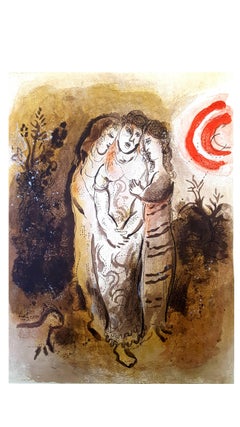
Marc Chagall - The Bible - Naomi and her daughters-in-law - Original Lithograph

Marc Chagall - The Bible - Naomi and her daughters-in-law - Original Lithograph

By Marc Chagall

Located in Collonge Bellerive, Geneve, CH

Marc Chagall, Original Lithograh depicting an instant of the Bible. Technique: Original lithograph in colours (Mourlot no. 234) On the reverse: another black and white original litho...

Category

1960s Modern Marc Chagall Art

Materials

Lithograph

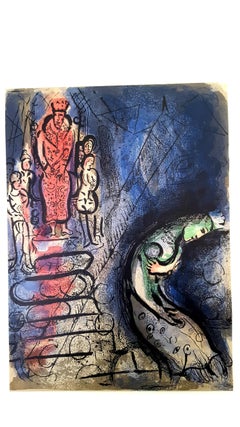
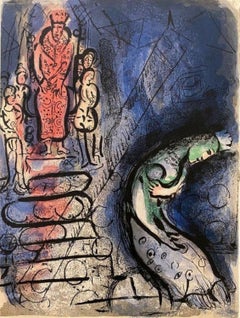
Ahasuerus sends Vasthi away

Ahasuerus sends Vasthi away

By Marc Chagall

Located in Paris, FR

Lithograph, 1960 Unsigned lithograph from the book "Drawings for the Bible" composed of 24 color lithographs Publisher : Verve (Paris) Printer : Mourlot (Paris) Catalog : Mourlot 251...

Category

1960s Abstract Marc Chagall Art

Materials

Lithograph

Ruth at Booz's feet

Ruth at Booz's feet

By Marc Chagall

Located in Paris, FR

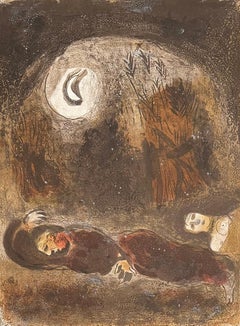
Lithograph, 1960 Unsigned lithograph from the book "Drawings for the Bible" composed of 24 color lithographs Publisher : Verve (Paris) Printer : Mourlot (Paris) Catalog : Mourlot 248...

Category

1960s Abstract Marc Chagall Art

Materials

Lithograph

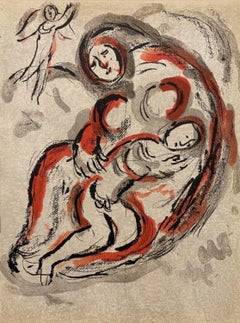
Agar in the desert

Agar in the desert

By Marc Chagall

Located in Paris, FR

Lithograph, 1960 Unsigned lithograph from the book "Drawings for the Bible" composed of 24 color lithographs Publisher : Verve (Paris) Printer : Mourlot (Paris) Catalog : Mourlot 241...

Category

1960s Abstract Marc Chagall Art

Materials

Lithograph

L'Apparation au Cirque

L'Apparation au Cirque

By Marc Chagall

Located in London, GB

Original lithograph by Marc Chagall, printed during the artist's lifetime directly from Chagall's own lithographic stones.

Category

Mid-20th Century Marc Chagall Art

Materials

Lithograph

Marc Chagall - The Bible - Original Lithograph

Marc Chagall - The Bible - Original Lithograph

By Marc Chagall

Located in Collonge Bellerive, Geneve, CH

Marc Chagall, Original Lithograph depicting an instant of the Bible. Technique: Original lithograph in colours Year: 1956 Sizes: 35,5 x 26 cm / 14" x 10.2" (sheet) Published by: Éditions de la Revue Verve, Tériade, Paris Printed by: Atelier Mourlot, Paris Documentation / References: Mourlot, F., Chagall Lithograph [II] 1957-1962, A. Sauret, Monte Carlo 1963, nos. 234 and 257 Marc Chagall (born in 1887) Marc Chagall was born in Belarus in 1887 and developed an early interest in art. After studying painting, in 1907 he left Russia for Paris, where he lived in an artist colony on the city’s outskirts. Fusing his own personal, dreamlike imagery with hints of the fauvism and cubism popular in France at the time, Chagall created his most lasting work—including I and the Village (1911)—some of which would be featured in the Salon des Indépendants exhibitions. After returning to Vitebsk for a visit in 1914, the outbreak of WWI trapped Chagall in Russia. He returned to France in 1923 but was forced to flee the country and Nazi persecution during WWII. Finding asylum in the U.S., Chagall became involved in set and costume design before returning to France in 1948. In his later years, he experimented with new art forms and was commissioned to produce numerous large-scale works. Chagall died in St.-Paul-de-Vence in 1985. The Village Marc Chagall was born in a small Hassidic community on the outskirts of Vitebsk, Belarus, on July 7, 1887. His father was a fishmonger, and his mother ran a small sundries shop in the village. As a child, Chagall attended the Jewish elementary school, where he studied Hebrew and the Bible, before later attending the Russian public school. He began to learn the fundamentals of drawing during this time, but perhaps more importantly, he absorbed the world around him, storing away the imagery and themes that would feature largely in most of his later work. At age 19 Chagall enrolled at a private, all-Jewish art school and began his formal education in painting, studying briefly with portrait artist Yehuda Pen. However, he left the school after several months, moving to St. Petersburg in 1907 to study at the Imperial Society for the Protection of Fine Arts. The following year, he enrolled at the Svanseva School, studying with set designer Léon Bakst, whose work had been featured in Sergei Diaghilev's Ballets Russes. This early experience would prove important to Chagall’s later career as well. Despite this formal instruction, and the widespread popularity of realism in Russia at the time, Chagall was already establishing his own personal style, which featured a more dreamlike unreality and the people, places and imagery that were close to his heart. Some examples from this period are his Window Vitebsk (1908) and My Fianceé with Black Gloves (1909), which pictured Bella Rosenfeld, to whom he had recently become engaged. The Beehive Despite his romance with Bella, in 1911 an allowance from Russian parliament member and art patron Maxim Binaver enabled Chagall to move to Paris, France. After settling briefly in the Montparnasse neighborhood, Chagall moved further afield to an artist colony known as La Ruche (“The Beehive”), where he began to work side by side with abstract painters such as Amedeo Modigliani and Fernand Léger as well as the avant-garde poet Guillaume Apollinaire. At their urging, and under the influence of the wildly popular fauvism and cubism, Chagall lightened his palette and pushed his style ever further from reality. I and the Village (1911) and Homage to Apollinaire (1912) are among his early Parisian works, widely considered to be his most successful and representative period. Though his work stood stylistically apart from his cubist contemporaries, from 1912 to 1914 Chagall exhibited several paintings at the annual Salon des Indépendants exhibition, where works by the likes of Juan Gris, Marcel Duchamp and Robert Delaunay were causing a stir in the Paris art world. Chagall’s popularity began to spread beyond La Ruche, and in May 1914 he traveled to Berlin to help organize his first solo exhibition, at Der Sturm Gallery. Chagall remained in the city until the highly acclaimed show opened that June. He then returned to Vitebsk, unaware of the fateful events to come. War, Peace and Revolution In August 1914 the outbreak of World War I precluded Chagall’s plans to return to Paris. The conflict did little to stem the flow of his creative output, however, instead merely giving him direct access to the childhood scenes so essential to his work, as seen in paintings such as Jew in Green (1914) and Over Vitebsk (1914). His paintings from this period also occasionally featured images of the war’s impact on the region, as with Wounded Soldier (1914) and Marching (1915). But despite the hardships of life during wartime, this would also prove to be a joyful period for Chagall. In July 1915 he married Bella, and she gave birth to a daughter, Ida, the following year. Their appearance in works such as Birthday (1915), Bella and Ida by the Window (1917) and several of his “Lovers” paintings give a glimpse of the island of domestic bliss that was Chagall’s amidst the chaos. To avoid military service and stay with his new family, Chagall took a position as a clerk in the Ministry of War Economy in St. Petersburg. While there he began work on his autobiography and also immersed himself in the local art scene, befriending novelist Boris Pasternak, among others. He also exhibited his work in the city and soon gained considerable recognition. That notoriety would prove important in the aftermath of the 1917 Russian Revolution when he was appointed as the Commissar of Fine Arts in Vitebsk. In his new post, Chagall undertook various projects in the region, including the 1919 founding of the Academy of the Arts. Despite these endeavors, differences among his colleagues eventually disillusioned Chagall. In 1920 he relinquished his position and moved his family to Moscow, the post-revolution capital of Russia. In Moscow, Chagall was soon commissioned to create sets and costumes for various productions at the Moscow State Yiddish Theater, where he would paint a series of murals titled Introduction to the Jewish Theater as well. In 1921, Chagall also found work as a teacher at a school for war orphans. By 1922, however, Chagall found that his art had fallen out of favor, and seeking new horizons he left Russia for good. Flight After a brief stay in Berlin, where he unsuccessfully sought to recover the work exhibited at Der Sturm before the war, Chagall moved his family to Paris in September 1923. Shortly after their arrival, he was commissioned by art dealer and publisher Ambroise Vollard to produce a series of etchings for a new edition of Nikolai Gogol's 1842 novel Dead Souls. Two years later Chagall began work on an illustrated edition of Jean de la Fontaine’s Fables, and in 1930 he created etchings for an illustrated edition of the Old Testament, for which he traveled to Palestine to conduct research. Chagall’s work during this period brought him new success as an artist and enabled him to travel throughout Europe in the 1930s. He also published his autobiography, My Life (1931), and in 1933 received a retrospective at the Kunsthalle in Basel, Switzerland. But at the same time that Chagall’s popularity was spreading, so, too, was the threat of Fascism and Nazism. Singled out during the cultural "cleansing" undertaken by the Nazis in Germany, Chagall’s work was ordered removed from museums throughout the country. Several pieces were subsequently burned, and others were featured in a 1937 exhibition of “degenerate art” held in Munich. Chagall’s angst regarding these troubling events and the persecution of Jews in general can be seen in his 1938 painting White Crucifixion. With the eruption of World War II, Chagall and his family moved to the Loire region before moving farther south to Marseilles following the invasion of France. They found a more certain refuge when, in 1941, Chagall’s name was added by the director of the Museum of Modern Art (MOMA) in New York City to a list of artists and intellectuals deemed most at risk from the Nazis’ anti-Jewish campaign. Chagall and his family would be among the more than 2,000 who received visas and escaped this way. Haunted Harbors Arriving in New York City in June 1941, Chagall discovered that he was already a well-known artist there and, despite a language barrier, soon became a part of the exiled European artist community. The following year he was commissioned by choreographer Léonide Massine to design sets and costumes for the ballet Aleko, based on Alexander Pushkin’s “The Gypsies” and set to the music of Pyotr Ilyich Tchaikovsky. But even as he settled into the safety of his temporary home, Chagall’s thoughts were frequently consumed by the fate befalling the Jews of Europe and the destruction of Russia, as paintings such as The Yellow Crucifixion...

Category

1950s Modern Marc Chagall Art
Materials

Lithograph

Tamar belle-fille de Juda

Tamar belle-fille de Juda

By Marc Chagall

Located in Paris, FR

Original lithograph by Marc Chagall from The Bible of 1960 Tamar belle-fille de Juda Unsigned 35 x 26 cm Excellent condition

Category

1960s Surrealist Marc Chagall Art

Materials

Lithograph

Ruth aux pieds de Booz

Ruth aux pieds de Booz

By Marc Chagall

Located in Paris, FR

Original lithograph by Marc Chagall from The Bible of 1960 Ruth aux pieds de Booz Unsigned 35 x 26 cm Excellent condition

Category

1960s Surrealist Marc Chagall Art

Materials

Lithograph

Assuérus chasse Vasthi

Assuérus chasse Vasthi

By Marc Chagall

Located in Paris, FR

Original lithograph by Marc Chagall from The Bible of 1960 "Assuérus chasse Vasthi" Unsigned 35 x 26 cm Excellent condition

Category

1960s Surrealist Marc Chagall Art

Materials

Lithograph

Marc Chagall Femme à l’oiseau

Marc Chagall Femme à l’oiseau

By Marc Chagall

Located in Saint-Didier, Provence-Alpes-Côte d'Azur

Marc Chagall Femme à l’oiseau Issue of the portfolio Twelve contemporaries Éditions d'art du Lion . Paris 1959 Published in 1000 copies Signature in the board 900 euros

Category

1950s Marc Chagall Art

Materials

Paper

Jacob's Blessing (La Bénédiction de Jacob)

Jacob's Blessing (La Bénédiction de Jacob)

By Marc Chagall

Located in Toronto, Ontario

Marc Chagall (1887–1985) was one of the most celebrated artists of the 20th century, renowned for his distinctive fusion of modernism, folklore, and Jewish cultural motifs. Chagall’...

Category

1970s Surrealist Marc Chagall Art

Materials

Lithograph

La Souris Metamorphosée en Fille (The Mouse Transformed into a Girl)

La Souris Metamorphosée en Fille (The Mouse Transformed into a Girl)

By Marc Chagall

Located in OPOLE, PL

Marc Chagall (1887-1985) - La Souris Metamorphosée en Fille (The Mouse Transformed into a Girl) Etching from 1952. Edition of 85. Enhanced with watercolour by the artist. Dimensi...

Category

1950s Modern Marc Chagall Art
Materials

Etching

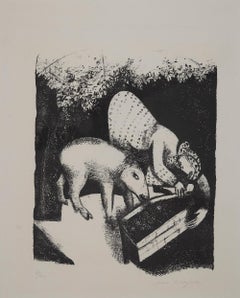
Poèmes, Planche XX, Original Woodcut, Modern, 1968

Poèmes, Planche XX, Original Woodcut, Modern, 1968

By Marc Chagall

Located in OPOLE, PL

Marc Chagall (1887-1985) - Poèmes, Planche XX Woodcut print from 1968. An unnumbered and unsigned copy from a limited edition of 238. Dimensions of sheet: 32.5 x 25 cm Dimensions...

Category

1960s Surrealist Marc Chagall Art
Materials

Woodcut

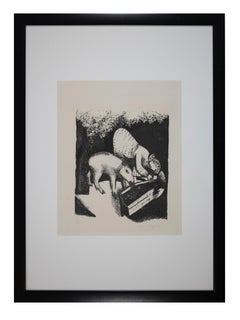
Poèmes, Planche II, Original Woodcut, Modern, 1968, Framed

Poèmes, Planche II, Original Woodcut, Modern, 1968, Framed

By Marc Chagall

Located in OPOLE, PL

Marc Chagall (1887-1985) - Poèmes, Planche II Woodcut print from 1968. An unnumbered and unsigned copy from a limited edition of 238. Dimensions of sheet: 32.5 x 25 cm Dimensions...

Category

1960s Surrealist Marc Chagall Art
Materials

Woodcut

Le Sept Péchés Capitaux, Original Etching, Modern, 1925, Excellent

Le Sept Péchés Capitaux, Original Etching, Modern, 1925, Excellent

By Marc Chagall

Located in OPOLE, PL

Marc Chagall (1887-1985) - Le Sept Péchés Capitaux Etching from 1925. Edition of 300 proofs. Dimensions of work: 25 x 19.5 cm. Publisher: Tériade, Paris. Reference: Kornfeld 47....

Category

1920s Symbolist Marc Chagall Art

Materials

Etching

Le Sept Péchés Capitaux, Original Etching, Modern, 1925, Excellent

Le Sept Péchés Capitaux, Original Etching, Modern, 1925, Excellent

By Marc Chagall

Located in OPOLE, PL

Marc Chagall (1887-1985) - Le Sept Péchés Capitaux Etching from 1925. Edition of 300 proofs. Dimensions of work: 25 x 19.5 cm. Publisher: Tériade, Paris. Reference: Kornfeld 47....

Category

1920s Symbolist Marc Chagall Art

Materials

Etching

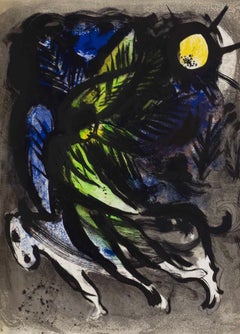
La Fortune et le Jeune Enfant, Original Etching, Modern, 1952, Excellent

La Fortune et le Jeune Enfant, Original Etching, Modern, 1952, Excellent

By Marc Chagall

Located in OPOLE, PL

Marc Chagall (1887-1985) - La Fortune et le Jeune Enfant Etching from 1952. Edition of 85. Enhanced with watercolour by the artist. Dimensions of work: 39 x 30 cm. Reference: Cr...

Category

1950s Symbolist Marc Chagall Art
Materials

Lithograph

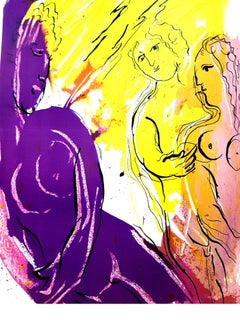
Offre

Offre

By Marc Chagall

Located in London, GB

Original lithograph by Marc Chagall, printed during the artist's lifetime directly from Chagall's own lithographic stones.

Category

Mid-20th Century Marc Chagall Art
Materials

Lithograph

Devant le Tableu

Devant le Tableu

By Marc Chagall

Located in London, GB

Original lithograph by Marc Chagall, printed during the artist's lifetime directly from Chagall's own lithographic stones.

Category

Mid-20th Century Marc Chagall Art

Materials

Lithograph

Marc Chagall “Cantique de David Sorlier 272”

Marc Chagall “Cantique de David Sorlier 272”

By Marc Chagall

Located in Los Angeles, CA

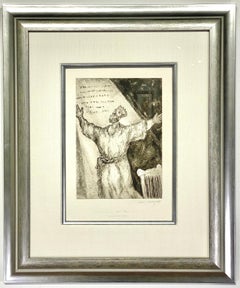
MARC CHAGALL (1887-1985) 1 Illustrationen aus “La Bible”, Probedrucke “Cantique de David Sorlier 272” 1 Sheet of etching, 1931-1939, Each c. 44-44, 5xc. 30, 5-33, 5 cm Signature:...

Category

1930s Marc Chagall Art
Materials

Etching

Marc Chagall art for sale on 1stDibs.

Find a wide variety of authentic Marc Chagall art available for sale on 1stDibs. If you’re browsing the collection of art to introduce a pop of color in a neutral corner of your living room or bedroom, you can find work that includes elements of orange, blue, yellow and other colors. You can also browse by medium to find art by Marc Chagall in lithograph and more. Much of the original work by this artist or collective was created during the 20th century and is mostly associated with the Surrealist style. Not every interior allows for large Marc Chagall art, so small editions measuring 5 inches across are available. Customers who are interested in this artist might also find the work of Salvador Dalí, Leonor Fini, and André Masson. Marc Chagall art prices can differ depending upon medium, time period and other attributes. On 1stDibs, the price for these items starts at $75 and tops out at $1,450,000, while the average work can sell for $1,229.

Questions About Marc Chagall Art
  • 1stDibs ExpertMarch 26, 2024
    Marc Chagall’s body of work is quite big. Over the course of his 75-year career, Chagall created approximately 10,000 pieces, including prints, paintings, book illustrations, stained glass windows and more.

    The Russian-French modernist worked in nearly every artistic medium, and Chagall’s vibrant and densely colorful prints are known around the world. Characterized by a bold color palette and whimsical imagery, his works are often narrative, depicting small-village scenes and quotidian moments of peasant life, as in his late painting The Flight into Egypt from 1980.

    On 1stDibs, find a selection of Marc Chagall art.
  • 1stDibs ExpertMarch 22, 2022
    Yes, Marc Chagall used oil paint to produce many of his paintings. He also worked with gouaches and watercolors. Not just a painter, Chagall made stained glass windows, illustrations, prints, ceramics and other types of works throughout his life. Find a collection of Marc Chagall art on 1stDibs.
  • 1stDibs ExpertMarch 22, 2022
    Yes, Marc Chagall migrated to the United States. The Jewish artist fled Europe during World War II, moving to New York City in 1941. He settled in France in 1947 and lived there until he died in 1985. On 1stDibs, shop a range of Marc Chagall art.
  • 1stDibs ExpertMarch 22, 2022
    Many artists and things inspired Marc Chagall. Historians believe that his Jewish heritage and his hometown of Liozna, Belarus, served as sources of inspiration throughout his life. His work also displays the influence of surrealist, cubist, symbolist and fauve artists. On 1stDibs, shop a variety of Marc Chagall art.
  • 1stDibs ExpertMarch 26, 2024
    Marc Chagall used a variety of materials in his art. The Russian-French modernist worked in nearly every artistic medium. Influenced by Symbolism, Fauvism, Cubism and Surrealism, Chagall developed his own distinctive style, combining avant-garde techniques and motifs with elements drawn from Eastern European Jewish folk art.

    Chagall produced magnificent stained-glass windows for structures in France, Israel, Germany and the United States. Additionally, his lively paintings of Paris are revered all over the world. Chagall had created etchings of Russian life during the 1920s but would explore printmaking later more deeply, during the 1950s, when he sought guidance from veteran lithographer Charles Sorlier, who became a friend and collaborator.

    Find authentic Marc Chagall art on 1stDibs.
  • 1stDibs ExpertMarch 22, 2022
    Marc Chagall lived many places over the course of his life. He was born in Liozna, Belarus, on July 7, 1887. When he began working as an artist, he lived and worked in Saint Petersburg, Russia; Paris, France; and Berlin, Germany. During World War II, he relocated to the U.S. and then returned to Paris where he primarily resided until his death in 1985. On 1stDibs, find a variety of Marc Chagall art.
  • 1stDibs ExpertMarch 26, 2024
    Marc Chagall is famous for his art. He is one of the best known artists of the 20th century.

    Chagall produced magnificent stained-glass windows for structures in France, Israel, Germany and the United States, and his lively paintings of Paris are revered all over the world. The Russian-French modernist worked in nearly every artistic medium. Influenced by Symbolism, Fauvism, Cubism and Surrealism, Chagall developed his own distinctive style, combining avant-garde techniques and motifs with elements drawn from Eastern European Jewish folk art.

    Find authentic Marc Chagall prints and paintings on 1stDibs.
  • 1stDibs ExpertMarch 22, 2022
    Marc Chagall was a painter, illustrator, glass artisan, print maker and set designer who made a lasting impact on modern art. He was born on July 7, 1887, in Liozna, Belarus, and died on March 28, 1985, in Saint Paul de Vence, France. On 1stDibs, shop a selection of Marc Chagall art.
  • 1stDibs ExpertMarch 22, 2022
    Marc Chagall was born in Liozna, Belarus on July 7, 1887. He went on to become one of the most influential artists of the 20th century, creating works that drew from the movements of Cubism, Surrealism and Fauvism. On 1stDibs, find a selection of Marc Chagall art.
  • 1stDibs ExpertMarch 22, 2022
    Marc Chagall was born on July 7, 1887, in Liozna, Belarus. He was an influential artist who worked in a variety of mediums, including paint, stained glass and illustrations. Chagall died on March 28, 1985, in Saint Paul de Vence, France. On 1stDibs, find a collection of Marc Chagall art.
  • 1stDibs ExpertMarch 22, 2022
    To pronounce Marc Chagall, say "Mark Shu-GALL." The artist's real name was Moishe Shagal. Although the artist changed his name, he referenced his heritage in many works by including fish to represent his father who worked as a herring merchant. Shop a variety of Marc Chagall art on 1stDibs.
  • 1stDibs ExpertFebruary 7, 2024
    Marc Chagall painted around 10,000 works during the course of his 75-year career. The Russian-French modernist worked in nearly every artistic medium. Influenced by Symbolism, Fauvism, Cubism and Surrealism, he developed his own distinctive style, combining avant-garde techniques and motifs with elements drawn from Eastern European Jewish folk art. On 1stDibs, find a selection of Marc Chagall art.
  • 1stDibs ExpertMarch 26, 2024
    Yes, Marc Chagall worked in the Expressionist style, but he is associated with a range of modes and was inspired by various styles.

    Chagall's lithographs as well as his other prints and paintings widely influenced the fantastic imagery of Surrealism and other movements of the 20th century. Known for his dreamlike creations inspired by folk art, Chagall drew on the colors and forms introduced by Cubism and Fauvism for a distinctive style all his own.

    Expressionist artists experimented in paintings and prints with skewed perspectives, abstraction and unconventional, bright colors to portray how isolating and anxious the world felt rather than how it appeared. You can certainly detect the trademark bright colors and dramatic, exaggerated brushstrokes of Expressionism reflected in Chagall’s works such as his Vision of Paris and I and the Village.

    Find a selection of Marc Chagall art on 1stDibs.
  • 1stDibs ExpertMarch 26, 2024
    To collect Marc Chagall art, seek out works from well known and respected sources. When it comes to making an investment of any kind, it’s important to conduct research and only work with reputable sellers. You can shop the collections of art dealers, auction houses and trusted online platforms to find authentic Marc Chagall paintings, prints and other works.

    There are many reasons to collect art. A meaningful collection of art should help a residence feel more like itself. Buy art that speaks to you. Take your time when you’re shopping for art, and choose works that will resonate with you.

    Shop Marc Chagall art on 1stDibs.
  • 1stDibs ExpertOctober 15, 2024
    To tell if a Chagall print is real, experts recommend having a certified appraiser or experienced art dealer evaluate your piece. Fewer than 5% of Chagall's prints are signed and numbered, and counterfeiters have taken advantage of this and flooded the market with many convincing replicas. As a result, it can be very difficult to authenticate an original Chagall without experience and training. On 1stDibs, find a collection of Marc Chagall art.
  • 1stDibs ExpertApril 5, 2022
    One of Marc Chagall’s most known works is entitled I and the Village. His style mixes bold colors in both the cubism and fauvism style. Shop a selection of Marc Chagall’s pieces from some of the world’s top art dealers on 1stDibs.
  • 1stDibs ExpertMarch 26, 2024
    Yes, Marc Chagall personally signed some of his bookplates. Other bookplate illustrations created by the artist bear a reproduction of his signature. Many of the signed versions come from the collections of notable historical figures, including Nicholas II, the last Russian czar. Find signed Marc Chagall lithographs on 1stDibs.
  • 1stDibs ExpertSeptember 28, 2021
    A Marc Chagall painting is likely worth anywhere between $50,000 to $70,000 according to current estimates. Marc Chagall is a Russian-French artist of Belarusian Jewish origin who is credited to be among the pioneering modernists. Adept in several styles and techniques, Chagall was best-known for creating stain-glass, tapestries and murals apart from paintings. On 1stDibs, find a variety of Marc Chagall paintings.