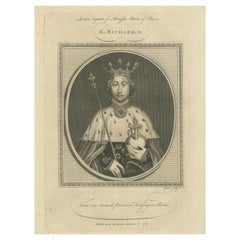
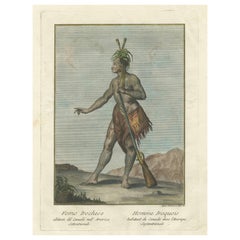
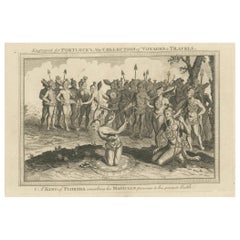
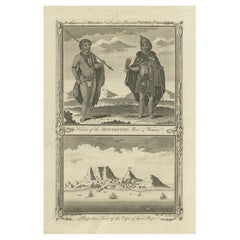
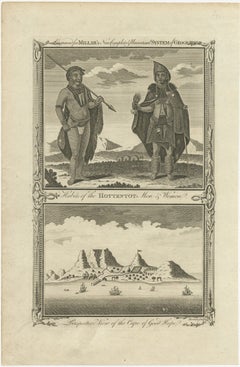
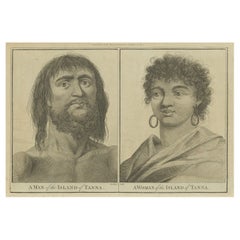
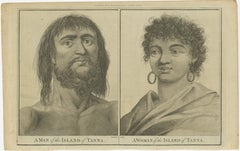
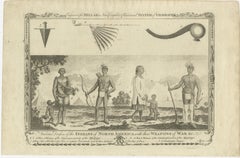
The engraving features two individual portraits side by side, labeled as inhabitants of the island of Tanna, which is part of Vanuatu in the South Pacific.
On the left is "A MAN of the Island of TANNA." He is depicted with a serious, almost stern expression, looking slightly to the side. His facial features are marked by a prominent beard and mustache, and his hair appears long and wavy. This detailed portrayal suggests an effort to capture the unique physical characteristics and possibly the demeanor of the man.
On the right is "A WOMAN of the Island of TANNA." She is shown in a three-quarter view with a gentle expression, looking directly at the viewer. Her hair is styled in tight curls, she wears large hoop earrings, and her clothing drapes softly over her shoulders, indicating a level of adornment and style.
The portraits likely aimed to depict the natural appearance and attire of the people from Tanna as accurately as possible for European audiences of the time. These works often sought to provide a detailed record of the diverse cultures encountered during exploration voyages.
The style of the engraving and the reference to Captain Cook's voyages suggest that it comes from the late 18th century, likely in the period following Cook's final voyage, which ended in 1779. The engravings of Pacific peoples associated with Cook's voyages were often published in the various accounts that proliferated after his travels, as there was a keen interest in the newly contacted peoples of the Pacific.
The text on the engraving says it was "Accurately Engraved for Anderson's Large Folio Edition of the Whole of Capt'n. Cook's Voyages &c. Complete." This indicates that the engraving was made for a specific publication by Anderson, compiling Captain Cook's voyages. George William Anderson is known for his compilation titled "A New, Authentic, and Complete Collection of Voyages Round the World," which was published initially in the 1780s. This collection often included large folio engravings such as this one.
Given this information, we can reasonably estimate that this engraving would have been published sometime in the 1780s. However, without specific publication data, it is not possible to provide an exact year. Such details would typically be found in a library catalog...
Category
Antique 1780s Wall Decorations