1920s Art

to
986
2,835
861
590
324
333
Overall Width
to
Overall Height
to
7,750
21,948
164,773
229,556
2,032
2,309
4,988
6,550
5,891
15,114
20,714
26,006
18,742
14,125
5,533
1,159
476
414
398
363
123
53
36
27
6
3
2
3,102
1,635
59
3,034
1,592
1,181
1,163
1,017
695
494
339
294
244
201
190
186
185
177
176
157
154
115
109
1,640
1,112
992
923
721
169
131
65
41
41
1,589
779
2,901
1,882
Period: 1920s
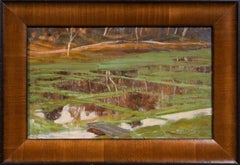
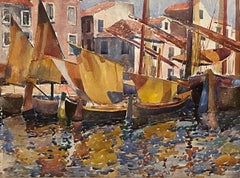
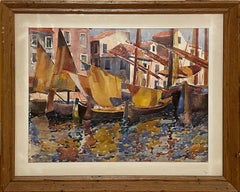
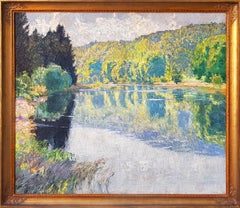
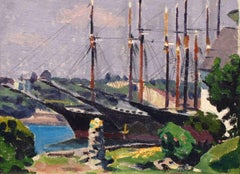
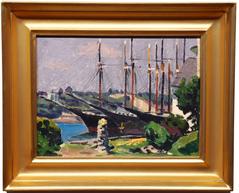
Oil on canvas Impressionist The Three Masts, Van Beek

Oil on canvas Impressionist The Three Masts, Van Beek

Located in Valladolid, ES

A beautiful oil on canvas by the Dutch painter, born in Amsterdam, Bernard Van Beek. An artist who had not attended any academy. He belonged to the Kortenhoef School, which in turn ...

Category

Impressionist 1920s Art

Materials

Canvas

The Weaving - Original Lithograph by F. Bac - 1922

The Weaving - Original Lithograph by F. Bac - 1922

Located in Roma, IT

The Weaving is an original modern artwork realized by Ferdinand Bac (1859 - 1952) in 1922. Original Lithograph on ivory paper. Perfect conditions. The Weaving is an very beautiful Liberty Style lithograph realized by the French artist Ferdinand Bac in the Second decade of the XX Century. The work depicts Penelope with the maids who sing and play ancient instruments. The background is characterized by a very calm sea and a cliff, in the central part we see the shaft of a column full of leaves and curtains. This work has been realized the French artist Ferdinand Bac (1859 - 1952). Ferdinand-Sigismond Bach, known as Ferdinand Bac was a French cartoonist, artist and writer, son of an illegitimate nephew of the Emperor Napoleon. As a young man, he mixed in the fashionable world of Paris of the Belle Époque, and was known for his caricatures, which appeared in popular journals. He also traveled widely in Europe and the Mediterranean. In his fifties, he began a career as a landscape gardener. He attended Adolphe Thiers, Gambetta, Richard Wagner, Victor Hugo, Taine, Villiers de L'Isle-Adam, Paul Verlaine, Maurice Barrès, Barbey d'Aurevilly, Alphonse Daudet, Guy de Maupassant, Verdi, Gounod, Pierre de Nolhac, and many more other famous people of the time. He established himself as one of the first cartoonists and caricaturists of his time, as famous as Albert Robida...

Category

Art Nouveau 1920s Art

Materials

Lithograph

Antique French Modern Paris School Still Life Framed Surreal Oil Painting

Antique French Modern Paris School Still Life Framed Surreal Oil Painting

Located in Buffalo, NY

Finely painted modernist still life oil painting with a view of the Eiffel Tower and a rotary phone. Oil on canvas. Framed. Measuring 20 by 23 inches overall and 15.25 by 18.25 paint...

Category

Surrealist 1920s Art

Materials

Canvas, Oil

Life-size Plaster Statue of The Callipygian Venus or Aphrodite  1920'

Life-size Plaster Statue of The Callipygian Venus or Aphrodite 1920'

Located in Rome, IT

Italian life-size plaster sculpture , figure of the Callipygian Venus, after the antique Roman marble statue. Aphrodite Kallipygos, or Callipygian Venus literally means “Venus of ...

Category

Academic 1920s Art

Materials

Plaster

Rainy Embankment (1929) - Silver Gelatin Fibre Print

Rainy Embankment (1929) - Silver Gelatin Fibre Print

Located in London, GB

Fair Fun (1938) - Silver Gelatin Fibre Print (Photo by Fox Photos/Getty Images) August 1929: A man standing alone on a rain-drenched pavement on the River Thames Embankment, London...

Category

Modern 1920s Art

Materials

Black and White, Silver Gelatin

Art Deco Portrait of a Young Blonde

Art Deco Portrait of a Young Blonde

By Franc Root McCreery

Located in Buffalo, NY

A beautiful pastel portrait by American female modern artist Franc Root McCreery Franc Root McCreery (1888-1957) Born: Dodge City, Kansas, US Franc Root M...

Category

Art Deco 1920s Art

Materials

Paper, Pastel

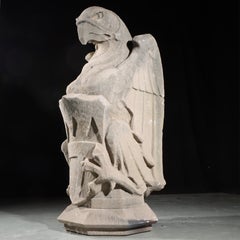
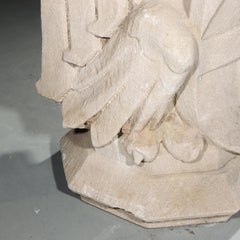
Heraldic Lion Guardian; full body gargoyle/grotesque beast with shield

Heraldic Lion Guardian; full body gargoyle/grotesque beast with shield

Located in Indianapolis, IN

This gothic style architectural segment of a building facade located ion Harlem, NYC, was carved 1924-1926 by William Bradley & Son Cut Stone Contractors. In 2020, each limestone scu...

Category

Gothic 1920s Art

Materials

Limestone

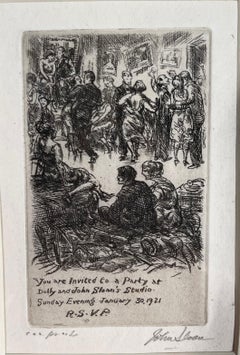
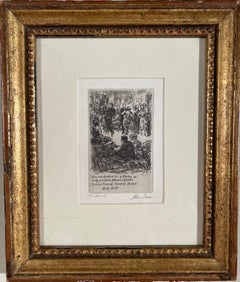
INVITATION TO STUDIO PARTY

INVITATION TO STUDIO PARTY

By John Sloan

Located in Portland, ME

Sloan, John. INVITATION TO STUDIO PARTY. Morse 200. Etching, 1921. Edition of 100 of which only 75 were printed. Signed in penci land inscribed "100 proofs." 3 3/4 x 2 3/8 inches, 96...

Category

1920s Art

Materials

Etching

Thatched cottage in Pont Audemer

Thatched cottage in Pont Audemer

Located in LE HAVRE, FR

SAUTIN René (1881-1968) (1881-1968) Thatched cottage in Pont-Audemer, 1927 Oil on thick cardboard Dimensions of the painting: 60 x 73 cm Signed and dated 1927 lower right FREE f...

Category

Realist 1920s Art

Materials

Oil

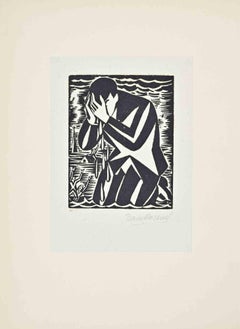
Ecce Homo VII
Ecce Homo VII

Ecce Homo VII

By Werner Drewes

Located in Fairlawn, OH

Ecce Homo VII Woodcut, 1921 Signed, titled, and dated in pencil by the artist One of only three known impressions Created while the artist was studying at the Bauhaus in Weimar, Germany. Extreme rarity-One of three know impressions Note: In 1921 Drewes went to the Bauhaus in Weimar, where, after completing the compulsory preliminary course with Johannes Itten, he continued to study with Paul Klee, Oskar Schlemmer and Georg Muche and initially went to the wall painting workshop. He then traveled extensively through Europe, North America and Asia. After returning to Germany in 1927, he went back to the Bauhaus, this time to his new location in Dessau, where he studied in the classes of László Moholy-Nagy and Wassily Kandinsky. He was one of the first artists to introduce the groundbreaking concepts of the Bauhaus School in the United States through his painting, printmaking, and teaching. Condition: Excellent Missing small voids in the upper margin from removal of the original hinges. Image size: 9 7/8 x 8 3/16 inches Reference: Rose 30 Provenance: From the estate of Drewes's teacher at the Bauhaus. During the pasot WW2 the professor lived in East Germany. WERNER DREWES 1899-1985 Werner Drewes initially studied architecture before enrolling, in 1921-22, at the Bauhaus in Weimar under Klee, Kandinsky, Itten and Feininger. For four years - 1923 to 1927 - he travelled the world with his bride, before completing his Bauhaus training in Dessau in 1929. He immigrated to the United States in 1930, documenting that move to New York through series of woodcuts. In 1936/37 he was an active founder of the American Abstract Artists and participated in the Federal Arts Project in New York before moving on to a teaching career at Washington University in St. Louis. As an artist for over sixty five years, he employed various media from drawing and watercolor, through woodcut and etching, to painting and collage. Translating an early interest in subjective cubistic forms, his work evolved into nonobjective abstraction. He was creative until the day of his death. Courtesy: Toby C. Moss Werner Drewes (1899–1985) was a painter, printmaker, and art teacher. Considered to be one of the founding fathers of American abstraction, he was one of the first artists to introduce concepts of the Bauhaus school within the United States. His mature style encompassed both nonobjective and figurative work and the emotional content of this work was consistently more expressive than formal. Drewes was as highly regarded for his printmaking as for his painting. In his role as teacher as well as artist he was largely responsible for bringing the Bauhaus aesthetic to America. Early life and education Drewes was born in 1899 to Georg Drewes, a Lutheran pastor, and Martha Schaefer Drewes. The family lived in the village of Canig within Lower Lusatia, Germany. From age eight to eighteen he attended the Saldria Gymnasium, a boarding school in Brandenburg an der Havel. There, he showed talent both for painting and woodblock printing. Graduating from Saldria in 1917, he was drafted by the German army and served in France from then until the close of the war. About this period of his life he is reported to have said that the horrors of life at the front were only made tolerable by his sketchbook, a copy of Goethe's Faust and a volume of Nietzsche. For a decade following the close of the war he studied, made paintings and prints, and traveled widely. His friend, Herwarth Walden, helped shape his appreciation for expressionist literature and art. Walden produced the quarterly magazine, Der Sturm and ran a gallery of contemporary art, Galerie Der Sturm, from which, in 1919, Drewes purchased an expressionist painting by William Wauer titled Blutrausch (Bloodlust). In the same year he made the acquaintance of Heinrich Vogeler and participated in Vogeler's socialist utopian artists' commune, Barkenhoff, at Worpswede, Lower Saxony. In 1919 Drewes also enrolled at the Königlich Technischen Hochschule Charlottenburg to study architecture and the following year he studied the same subject at the Technischen Hochschule Stuttgart. Preferring art over architecture, he then enrolled in Stuttgart's school of applied arts (Kunstgewerbeschule) where he studied life drawing and learned to work with colored glass. At this time he joined a group of artists and architects associated with the newly formed Merz Akademie, a college of design, art, and media in Stuttgart. In 1921 his friendship with a French artist, Sébastien Laurent, led him to begin studies in Weimar at Bauhaus, then a new school which taught an integrated approach to the fine and applied arts. His instructors were Johannes Itten and Lyonel Feininger, whose paintings were expressionist and abstract, and Paul Klee, who taught bookbinding, stained glass, and murals. While at Bauhaus Drewes produced a portfolio of ten woodblock prints entitled "Ecce Homo." In 1923 and 1924 he studied art during travels throughout Italy, Spain, the United States, and Central America and in 1926 he traveled to San Francisco, Japan, and Korea, thence taking the Trans-Siberian railway to Manchuria, Moscow, and Warsaw. He later said the El Grecos he saw proved to be most influential in his work. While traveling, he exhibited: (1) etchings in Madrid (1923) and Montevideo (1924), oils and etchings in Buenos Aires and St. Louis (1925), and (3) etchings in San Francisco (1926). He paid his way by the sales these exhibits produced and by taking commissions to paint portraits. While in San Francisco he set up a shop from which he sold prints he had made in Spain and South America. After his return to Germany in 1927 he resumed study at Bauhaus, which had been forced to relocate in Dessau, Saxony-Anhalt. His instructors at that time were László Moholy-Nagy (metal work), Wassily Kandinsky, and (painting), and Lyonel Feininger (prints). At this time he also worked and exhibited in Frankfurt. With the rise of Nazism abstract artists found it increasingly difficult to sell their work and, in 1930, Drewes, finding the political pressure unbearable, emigrated to the United States. There, despite the world economic crisis, Drewes was able to earn a living as a professional artist. Mature style After Drewes moved to New York, Kandinsky, who was both friend and mentor, continued to exert a strong influence over his style. Later in life he said he had a hard time getting away from Kandinsky's influence as he developed his own style. In time he was able to bring a more emotional approach to his work and to base it, more than Kandinsky did, on natural forms. In 1930 Drewes had a solo exhibition at the 135th Street Branch of the New York Public Library and a two-person show at the S.P.R. Penthouse Gallery...

Category

Expressionist 1920s Art

Materials

Woodcut

Rare 1923 Cubist Reuven Rubin Woodcut Woodblock Kabbalah Print Israeli Judaica

Rare 1923 Cubist Reuven Rubin Woodcut Woodblock Kabbalah Print Israeli Judaica

By Reuven Rubin

Located in Surfside, FL

This is from the original first edition 1923 printing. there was a much later edition done after these originals. These are individually hand signed in pencil by artist as issued. This listing is for the one print. the other documentation is included here for provenance and is not included in this listing. The various images inspired by the Jewish Mysticism and rabbis and mystics of jerusalem and Kabbalah is holy, dramatic and optimistic Rubin succeeded to evoke the spirit of life in Israel in those early days. They are done in a modern art style influenced by German Expressionism, particularly, Ernst Barlach, Ernst Ludwig Kirchner, and Franz Marc, as introduced to Israel by Jakob Steinhardt, Hermann Struck and Joseph Budko. Reuven Rubin 1893 -1974 was a Romanian-born Israeli painter and Israel's first ambassador to Romania. Rubin Zelicovich (later Reuven Rubin) was born in Galati to a poor Romanian Jewish Hasidic family. He was the eighth of 13 children. In 1912, he left for Ottoman-ruled Palestine to study art at Bezalel Academy of Art and Design in Jerusalem. Finding himself at odds with the artistic views of the Academy's teachers, he left for Paris, France, in 1913 to pursue his studies at the École Nationale Supérieure des Beaux-Arts. He was of the well known Jewish artists in Paris along with Marc Chagall and Chaim Soutine, At the outbreak of World War I, he was returned to Romania, where he spent the war years. In 1921, he traveled to the United States with his friend and fellow artist, Arthur Kolnik. In New York City, the two met artist Alfred Stieglitz, who was instrumental in organizing their first American show at the Anderson Gallery. Following the exhibition, in 1922, they both returned to Europe. In 1923, Rubin emigrated to Mandate Palestine. Rubin met his wife, Esther, in 1928, aboard a passenger ship to Palestine on his return from a show in New York. She was a Bronx girl who had won a trip to Palestine in a Young Judaea competition. He died in 1974. Part of the early generation of artists in Israel, Joseph Zaritsky, Arieh Lubin, Reuven Rubin, Sionah Tagger, Pinchas Litvinovsky, Mordecai Ardon, Yitzhak Katz, and Baruch Agadati; These painters depicted the country’s landscapes in the 1920s rebelled against the Bezalel school of Boris Schatz. They sought current styles in Europe that would help portray their own country’s landscape, in keeping with the spirit of the time. Rubin’s Cezannesque landscapes from the 1920s were defined by both a modern and a naive style, portraying the landscape and inhabitants of Israel in a sensitive fashion. His landscape paintings in particular paid special detail to a spiritual, translucent light. His early work bore the influences of Futurism, Vorticism, Cubism and Surrealism. In Palestine, he became one of the founders of the new Eretz-Yisrael style. Recurring themes in his work were the bible, the prophet, the biblical landscape, folklore and folk art, people, including Yemenite, Hasidic Jews and Arabs. Many of his paintings are sun-bathed depictions of Jerusalem and the Galilee. Rubin might have been influenced by the work of Henri Rousseau whose naice style combined with Eastern nuances, as well as with the neo-Byzantine art to which Rubin had been exposed in his native Romania. In accordance with his integrative style, he signed his works with his first name in Hebrew and his surname in Roman letters. In 1924, he was the first artist to hold a solo exhibition at the Tower of David, in Jerusalem (later exhibited in Tel Aviv at Gymnasia Herzliya). That year he was elected chairman of the Association of Painters and Sculptors of Palestine. From the 1930s onwards, Rubin designed backdrops for Habima Theater, the Ohel Theater and other theaters. His biography, published in 1969, is titled My Life - My Art. He died in Tel Aviv in October 1974, after having bequeathed his home on 14 Bialik Street and a core collection of his paintings to the city of Tel Aviv. The Rubin Museum opened in 1983. The director and curator of the museum is his daughter-in-law, Carmela Rubin. Rubin's paintings are now increasingly sought after. At a Sotheby's auction in New York in 2007, his work accounted for six of the ten top lots. Along with Yaacov Agam and Menashe Kadishman he is among Israel's best known artists internationally. Education 1912 Bezalel Academy of Arts and Design, Jerusalem 1913-14 École des Beaux Arts, Paris and Académie Colarossi, Paris Select Group Exhibitions Eged - Palestine Painters Group Eged - Palestine Painters Group, Allenby Street, Tel Aviv 1929 Artists: Chana Orloff, Abraham Melnikoff, Rubin, Reuven Nahum Gutman, Sionah Tagger,Arieh Allweil, Jewish Artists Association, Levant Fair, Tel Aviv, 1929 Artists: Ludwig Blum,Eliyahu Sigad, Shmuel Ovadyahu, Itzhak Frenel Frenkel,Ozer Shabat, Menahem Shemi...

Category

Abstract 1920s Art

Materials

Woodcut

The Vanquished
The Vanquished

The Vanquished

Located in PARIS, FR

The Vanquished by Alfredo PINA (1887-1966) A bronze sculpture with a dark brown patina signed on the base "A. Pina" old edition cast France circa 1925 height 29 cm width 20 cm d...

Category

French School 1920s Art

Materials

Bronze

American Impressionist Young Black Man Nicely Framed Oil Painting Portrait

American Impressionist Young Black Man Nicely Framed Oil Painting Portrait

Located in Buffalo, NY

Antique American oil painting portrait. Oil on board. Framed. Measuring: 22 by 28 inches overall, and 16 by 24 painting alone. Unsigned. Excellent condition, ready to hang and enjoy.

Category

Impressionist 1920s Art

Materials

Oil

Black Magic

Black Magic

By Gerald Geerlings

Located in New York, NY

Gerald Geerlings (1897-1998), Black Magic, etching and aquatint, 1929, signed in pencil lower right, titled and annotated (New York, 1928) lower left margi...

Category

American Impressionist 1920s Art
Materials

Etching

DeVilbiss Purfume Art Deco Poster by George Petty for the A.C. Schultz Company

DeVilbiss Purfume Art Deco Poster by George Petty for the A.C. Schultz Company

Located in New York, NY

This beautiful Art Deco poster was realized by the esteemed American Artist George Petty for the A.C. Schultz Company in 1926. The work is an advertisement for DeVilbiss Perfume, which depicts a "Petty Girl" (as they came to be known) in the center of the composition floating in a pentagonal black color block. With short cropped silvery white hair and red lipstick, the female figure in center (suggestive of a stylized flapper) squeezes the atomizer of her perfume bottle misting herself in fragrance. Skyscraper style geometric forms suggesting elaborately faceted gemstones- in hues of rose, lavender, orange sapphire and yellow diamond- explode around her, suggesting the stage design for the set of the iconic film "Metropolis". The top of the composition features a bronze color block reading "DeVilbiss Perfume sprays" and in scrolling Deco lettering text reads “A drop of perfume bursting into myriad atoms of fragrance makes the use of perfume an added delight” near the bottom of the piece. Additionally, there is a solid black color block with crystalline black forms emanating outwards at the base of the composition, as well as a geometric abstract form on the right side of the piece imbuing it with a distinctly modernist inflection. With its quintessentially Art Deco sensibility, this piece is sure to delight discerning collectors of the period as well as those with a distinct appreciation for unusual (and stunning) fine art pieces. its vibrant palate and clean modernist lines make this piece a winning addition to any style of interior from classic Deco to contemporary. The piece comes presented in a custom gallery frame and is in excellent vintage condition. George Petty was an American illustrator known for his series of pin-ups known as "Petty Girls" which he created for Esquire magazine. The Petty Girl were coquettish women whose legs were elongated to create idealized female forms. They were featured on magazine centerfolds, billboards, and calendars for companies such as Ridgid Tools. Born George Brown Petty IV on April 27, 1894 in Abbeville, LA, Petty received his formal training at the School of the Art Institute of Chicago under Ruth Van Sickle Ford...

Category

Art Deco 1920s Art

Materials

Lithograph

Museum Piece #2 Art Lover in Museum Exhibition

Museum Piece #2 Art Lover in Museum Exhibition

By Arnold Friedman

Located in Miami, FL

Arnold Friedman studied with Robert Henri and Kenneth Hayes Miller at the Art Students League in 1905 . Yet as he developed his style he abandoned the academic influence of his teacher. He started experimenting with materials and techniques. Friedmans intimate style recalls a variety of post-impressionist artists such as Pointillism of Pisarro, Vuillard and Nabis, and perhaps even Seurat. His thick application of paint has definitive textual impasto that was influenced by his trip to Paris in 1909. In "Museum Piece...

Category

Post-Impressionist 1920s Art

Materials

Oil, Wood Panel

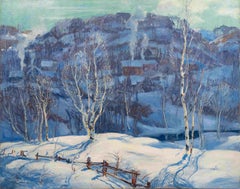
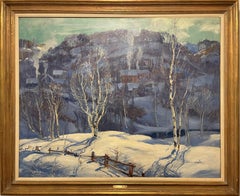
"Melting Snow"

"Melting Snow"

By Charles Morris Young

Located in Lambertville, NJ

Jim’s of Lambertville Fine Art Gallery is proud to present this piece by Charles Morris Young (1869 – 1964). Born in Gettysburg, Pennsylvania Charles Morris Young lived most of his life in Radnor. He was recognized as a pioneer in creating American Impressionist landscapes, especially snow scenes. Young is also known for his golfing, equestrian, and hunting scenes. He studied at the Pennsylvania Academy of the Fine Arts with Thomas Eakins, Robert Vonnoh, and Thomas Anschutz. In 1897, Young set off to Paris with his wife, for continued art studies at the Academie Colarossi. Living for a time in Giverny, he became acquainted with Claude Monet, recalling how in moments of frustration Monet would throw paintings...

Category

American Impressionist 1920s Art
Materials

Canvas, Oil

Heraldic boar Guardian; full body gargoyle/grotesque beast with shield

Heraldic boar Guardian; full body gargoyle/grotesque beast with shield

Located in Indianapolis, IN

This gothic style architectural segment of a building facade located ion Harlem, NYC, was carved 1924-1926 by William Bradley & Son Cut Stone Contractors. In 2020, each limestone scu...

Category

Gothic 1920s Art

Materials

Limestone

Columns of the Parthenon

Columns of the Parthenon

By Arnold Genthe

Located in Fairlawn, OH

Columns of the Parthenon vintage silver bromide print, 1929 Signed in pencil on mount: "Arnold Genthe, 1929" Illustrated: Arnold Genthe, As I Remember, Reynal & Hitchcock, NY, 1936, ...

Category

American Modern 1920s Art

Materials

Silver Gelatin

Sea Gull
Sea Gull

Sea Gull

By Henrietta Shore

Located in Santa Monica, CA

HENRIETTA SHORE (1880 -1963) SEA GULL c 1928 Lithograph, signed and titled in pencil and with the pencil cypher of printer Lynton Kistler (K). Image 7 x 6 1/8 full margins, sheet 12...

Category

American Modern 1920s Art

Materials

Lithograph

Amberley Boy, No. 2
Amberley Boy, No. 2

Amberley Boy, No. 2

By Gerald Leslie Brockhurst

Located in Fairlawn, OH

Amberley Boy, No. 2 Etching with stipple, 1928 Signed in pencil lower right (see photo) Signed in the plate in reverse (see photo) Provenance inscription in pencil verso A proof outs...

Category

English School 1920s Art

Materials

Etching

"Under the Street Lamp" Imp. Etching

"Under the Street Lamp" Imp. Etching

By Martin Lewis

Located in Houston, TX

Copperplate etching by Martin Lewis titled "Under the Street Lamp." Edition of 100. Printed on laid paper with watermark and 83 recorded impressions. McCarron catalogue raisonne #70. Signed in pencil with "imp" next to the signature. In the bottom right corner is a penciled 75 and in the top right corner is a 50. The etching is framed and was taken out of the frame for condition report and photographs. The gallery label is on the back of the matte inside the frame. Dimensions without Frame: H 15 in x W 9.5 in. Artist Biography: Martin Lewis (1881-1962) was born in Castlemaine, Victoria, Australia on 7 June 1881. He was the second of eight children and had a passion for drawing. At the age of 15, he left home and traveled in New South Wales, Australia, and in New Zealand, working as a pothole digger and a merchant seaman. He returned to Sydney and settled into a Bohemian community outside Sydney. Two of his drawings were published in the radical Sydney newspaper, The Bulletin. He studied with Julian Ashton at the Art Society's School in Sydney. Ashton, an English-born Australian artist and teacher, known for his support of the Heidelberg School and for his influential art school in Sydney. In 1900, Lewis left Australia for the United States. His first job was in San Francisco, painting stage decorations...

Category

Naturalistic 1920s Art

Materials

Etching, Laid Paper

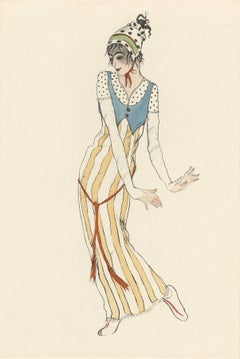
Design for Art Deco Marquetry Panels 1927 for Furniture George M Hammer London

Design for Art Deco Marquetry Panels 1927 for Furniture George M Hammer London

By Donald L. Hadden

Located in London, GB

One of a series of designs we have listed for Geo. M Hammer. To see them - and our other architectural and design-related drawings, scroll down to "More from this Seller" and below it click on "See all from this Seller" and then search. Donald L Hadden (British, 20th century) Design for a Pair of Marquetrie Panels for Geo. M Hammer with two dancing figures 23x31.5cm Watercolour signed and dated 1927 Hadden was a senior designer for Geo M Hammer, designers and retailers of school and ecclesiastical furniture. Their lift-top school desks are particularly well regarded, and always carried their brass name plate. Hammer were renowned for their interior woodwork, they were commissioned to undertake the choir stalls in Sir Basil...

Category

Modern 1920s Art

Materials

Watercolor

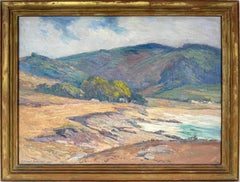
Lumier et neige fondante - Impressionist Landscape Oil by William Samuel Horton

Lumier et neige fondante - Impressionist Landscape Oil by William Samuel Horton

By William Samuel Horton

Located in Marlow, Buckinghamshire

Signed oil on canvas landscape by American impressionist painter William Samuel Horton. The piece depicts a nighttime view of Pontarlier, a commune in eastern France near the Swiss b...

Category

American Impressionist 1920s Art
Materials

Canvas, Oil

Ponte Neuf (The Old Bridge)

Ponte Neuf (The Old Bridge)

Located in Los Angeles, CA

(Note: This work is part of our exhibition Connected by Creativity: WPA Era Works from the Collection of Leata and Edward Beatty Rowan) Oil on panel, 14 ½ x 18 inches unframed, 22 x 25 ½ inches framed, inscribed “painted by David McCosh Property of Edward b. Rowan” and numbered “8” verso, this work is unsigned, but guaranteed to be by David McCosh Exhibited: The First Exhibit of the Iowa Artist...

Category

American Modern 1920s Art

Materials

Oil

N.Y. STEEL AND IRON.

N.Y. STEEL AND IRON.

By William Meyerowitz

Located in Portland, ME

Meyerowitz, William. N.Y. STEEL AND IRON. Drypoint, 1928. Edition of 40. Ttiled, numbered "2/40" and signed in pencil. 12 x 9 7/8 inches (plate), 13 1/2 x 11 inches (sheet). Inexcell...

Category

1920s Art

Materials

Drypoint

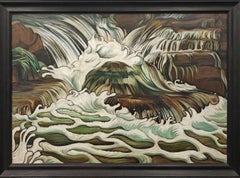
The Pleasures of the River, Regatta Boating

The Pleasures of the River, Regatta Boating

Located in New York, NY

A classic French subject that would enliven any room. Beautifully painted and the colors are restrained which make it elegant. A noted artist and a rare subject especially with the...

Category

Impressionist 1920s Art
Materials

Canvas, Oil

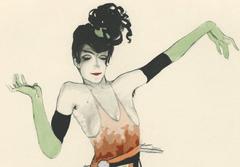
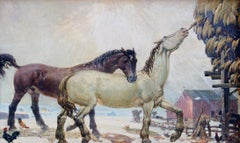
Fish and Coral Gouache by Ena Rottenberg

Fish and Coral Gouache by Ena Rottenberg

By Ena Rottenberg

Located in New York, NY

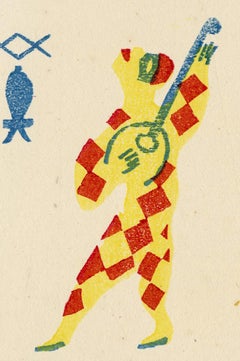
Original gouache of a fish and coral by Wiener Werkstatte artist, Ena Rottenberg. Signed with her initials on the lower right edge of the image. Likely a design for a porcelain plate...

Category

Art Deco 1920s Art
Materials

Gouache, Parchment Paper

Don Juan
Don Juan

Louis IcartDon Juan, 1928

$2,800Sale Price|20% Off

Don Juan

By Louis Icart

Located in Missouri, MO

Aquating Engraving Image Size: approx. 20 1/4 x 13 3/8 Framed Size: 28 x 20.5 inches Pencil Signed Lower Right Louis Justin Laurent Icart was born in Toulouse in 1890 and died in Paris in 1950. He lived in New York City in the 1920s, where he became known for his Art-Deco color etchings of glamourous women. He was first son of Jean and Elisabeth Icart and was officially named Louis Justin Laurent Icart. The use of his initials L.I. would be sufficient in this household. Therefore, from the moment of his birth he was dubbed 'Helli'. The Icart family lived modestly in a small brick home on rue Traversière-de-la-balance, in the culturally rich Southern French city of Toulouse, which was the home of many prominent writers and artists, the most famous being Henri de Toulouse-Lautrec. Icart entered the l'Ecole Superieure de Commerce de Toulouse in order to continue his studies for a career in business, particularly banking (his father's profession). However, he soon discovered the play writings of Victor Hugo (1802-1885), which were to change the course of his life. Icart borrowed whatever books he could find by Hugo at the Toulouse library, devouring the tales, rich in both romantic imagery and the dilemmas of the human condition. It was through Icart's love of the theater that he developed a taste for all the arts, though the urge to paint was not as yet as strong for him as the urge to act. It was not until his move to Paris in 1907 that Icart would concentrate on painting, drawing and the production of countless beautiful etchings, which have served (more than the other mediums) to indelibly preserve his name in twentieth century art history. Art Deco, a term coined at the 1925 Paris Exposition des Arts Decoratifs, had taken its grip on the Paris of the 1920s. By the late 1920s Icart, working for both publications and major fashion and design studios, had become very successful, both artistically and financially. His etchings reached their height of brilliance in this era of Art Deco, and Icart had become the symbol of the epoch. Yet, although Icart has created for us a picture of Paris and New York life in the 1920s and 1930s, he worked in his own style, derived principally from the study of eighteenth-century French masters such as Jean Antoine Watteau, François Boucher and Jean Honoré Fragonard. In Icart's drawings, one sees the Impressionists Degas...

Category

Art Deco 1920s Art
Materials

Engraving, Aquatint