1920s Art

to
623
2,503
816
608
332
348
Overall Width
to
Overall Height
to
7,536
21,338
164,357
236,733
2,104
2,319
4,650
6,398
5,828
15,269
20,898
26,213
19,112
14,121
5,350
1,030
469
420
352
238
123
51
34
26
7
3
2
2,817
1,591
54
2,733
1,435
1,038
911
905
636
376
293
291
242
205
191
189
187
177
172
153
111
109
108
1,642
1,130
933
873
755
129
64
42
41
36
1,629
768
2,543
2,094
Period: 1920s
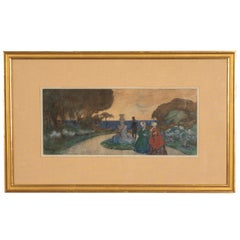
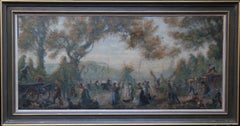
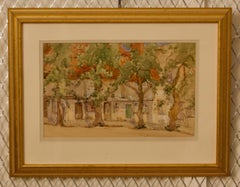
French Watercolor - Path to Autumn

French Watercolor - Path to Autumn

Located in Houston, TX

Dazzling French watercolor of fall colored foliage lining a large path, circa 1920. Signed lower right. Original artwork on paper displayed on a white mat with a gold border. Archiv...

Category

1920s Art

Materials

Paper, Watercolor

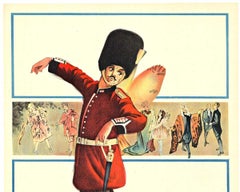
Original "Iolanthe" vintage stone lithograph vintage theater poster

Original "Iolanthe" vintage stone lithograph vintage theater poster

Located in Spokane, WA

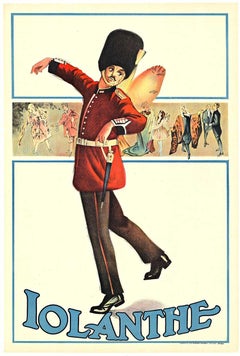
Original Iolanthe vintage theatre poster: Gilbert and Sullivan Iolante stone lithograph vintage poster. Museum linen backed. Clear, clean, bright. Grade A condition. The poster features a central image of a character dressed in a traditional British Grenadier Guard uniform, complete with a bearskin hat. The character is depicted in a whimsical pose, which aligns with the comedic and satirical nature of the operetta. Above the main figure, there are smaller illustrations of various characters from the operetta, hinting at the fantastical and fairy-tale elements of the story. The title "Iolanthe" is prominently displayed in bold, stylized lettering at the bottom. "Iolanthe, or The Peer and the Peri," is a comic opera by the famous duo W.S. Gilbert and Arthur Sullivan. The opera premiered on November 25, 1882, at the Savoy Theatre in London and is one of their most beloved works. "Iolanthe" tells the story of fairy Iolanthe, who was banished from the fairy kingdom...

Category

Art Nouveau 1920s Art
Materials

Lithograph

Vintage Silver Gelatin Photograph Jacques Lipchitz Bronze Sculpture Photo Signed

Vintage Silver Gelatin Photograph Jacques Lipchitz Bronze Sculpture Photo Signed

By Marc Vaux

Located in Surfside, FL

Marc Vaux, a figure of Montparnasse, pro­duced a trove of pho­tographs which are cur­rently held in the col­lec­tion of the Centre Pompidou in Paris, France. Marc Vaux was com­mitted equally to sup­porting artists, notably by cre­ating the Foyer des Artistes (1946-70) and, in 1951, the first Musée du Montparnasse at 10, rue de l’Arrivée. Marc Vaux was born on February 19, 1895 in Crulai, Normandy Thanks to the color mer­chant from whom he bought his plates and his pho­to­graphic equip­ment, he met the sculptor Charles Desvergnes winner of Prix the Rome and author of var­ious memo­rials who was looking for someone to pho­tographs his works. Two of Marc Vaux’s first clients were his neigh­bors of 21 Avenue du Maine- Marie Vassilieff and Maria Blanchard...

Category

Modern 1920s Art
Materials

Photographic Paper, Silver Gelatin

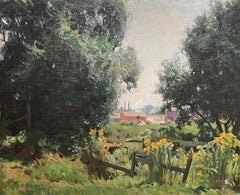
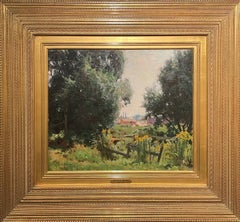
"Meadow Landscape in Summer, " Harold Dunbar, Factory Scene, Impressionism

"Meadow Landscape in Summer, " Harold Dunbar, Factory Scene, Impressionism

By Harold Dunbar

Located in New York, NY

Harold C. Dunbar (1882 - 1953) Meadow Landscape in Summer, 1929 Oil on canvas 17 1/2 x 21 inches Signed and dated lower left Harold C. Dunbar — painter, teacher, writer, and illustrator — was born in Brockton, MA on December 8, 1882. He resided in Chatham, MA and died in 1953. His work includes portraits, landscapes, street scenes, still lifes, harbors and coastal scenes. Dunbar studied with Ernest Lee Major (1864-1950) and Joseph De Camp...
Category

American Impressionist 1920s Art

Materials

Canvas, Oil

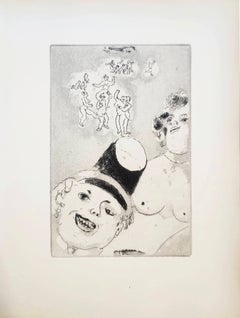
Le Sept Péchés Capitaux

Le Sept Péchés Capitaux

By Marc Chagall

Located in OPOLE, PL

Marc Chagall (1887-1985) - Le Sept Péchés Capitaux Etching from 1925. Edition of 300 proofs. Dimensions of work: 25 x 19.5 cm. Publisher: Tériade, Paris. Reference: Kornfeld 47....
Category

Symbolist 1920s Art

Materials

Etching

Le Sept Péchés Capitaux

Le Sept Péchés Capitaux

By Marc Chagall

Located in OPOLE, PL

Marc Chagall (1887-1985) - Le Sept Péchés Capitaux Etching from 1925. Edition of 300 proofs. Dimensions of work: 25 x 19.5 cm. Publisher: Tériade, Paris. Reference: Kornfeld 47....

Category

Symbolist 1920s Art

Materials

Etching

Original Rim and Rom (Musical Satrics) vintage Soviet stone lithograph poster

Original Rim and Rom (Musical Satrics) vintage Soviet stone lithograph poster

Located in Spokane, WA

Original Rim and Rom (translated: (Musical Satrics) vintage Soviet poster. Original circa 1925 Russian antique poster that is linen-backed. Printed in Leningrad. Stone lithograph, horizontal format. Year: c. 1925 edition was 1000 pieces (This is the only document copy of this poster we have ever found.) Rare horizontal Soviet bloc antique stone lithograph. Note: This is an Original Soviet stone lithograph vintage Poster, not a reprint or reproduction of any kind! Original Posters are printed in limited quantities. Most are intended for display in theaters, hold their value longer, and may be considered collectors' items in the future. It represents a fascinating period of cultural production in the USSR, where even entertainment posters utilized the innovative graphic language being developed by artists like the Stenberg Brothers. This poster is highly valuable to collectors of: Soviet propaganda and advertising art Constructivist and Russian Avant-garde design Vintage theatrical and music posters Due to Russia's stringent laws protecting cultural property, including art, historical documents, and other significant artifacts, old posters like this are incredibly rare and difficult to find or own. You are about to acquire a truly unique piece of history. This is an Original Lithograph Vintage Poster; it is not a reproduction. Worldwide, helping them with their original vintage poster collections...

Category

Constructivist 1920s Art

Materials

Lithograph

Original 1920s poster for Belga-cars, a Belgian transport company to Lourdes

Original 1920s poster for Belga-cars, a Belgian transport company to Lourdes

Located in PARIS, FR

"Belga-Cars – Lourdes, les Pyrénées vous attendent" is a striking original travel and transport poster from around 1940, capturing the spirit of European postwar tourism and pilgrima...

Category

1920s Art

Materials

Paper, Lithograph, Linen

Vase Designs
Vase Designs

Vase Designs

Located in London, London

Tiffany Vase Designs Group of Three Porcelain Vase designs. Paris, [1920’s]. Group of three original watercolour designs on paper, with marginal stamps “Planche d’aquarelle” with...

Category

Art Deco 1920s Art

Materials

Watercolor

Bullfight
Bullfight

Bullfight

By Yasuo Kuniyoshi

Located in Fairlawn, OH

Bullfight Lithograph, 1928 Signed and dated in pencil lower right (see photo) Numbered lower left (see photo) Edition: 41 (22/41) Reference: Davis L37 Printed chine applique on wove ...

Category

American Modern 1920s Art

Materials

Lithograph

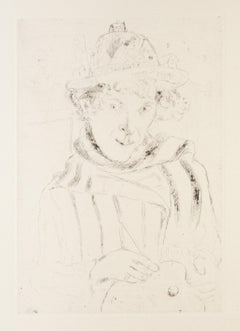
Girl's Head - Woman's Head  (Harvard)

Girl's Head - Woman's Head (Harvard)

By Elie Nadelman

Located in Fairlawn, OH

Girl's Head - Woman's Head (Harvard) Drypoint, 1920 Unsigned (as issued) From: The Drypoints of Elie Nadelman, 21 unpublished prints by the sculptor, proof from the original zinc an...

Category

American Modern 1920s Art

Materials

Drypoint

"Two-Horned Hat" by Sasha

"Two-Horned Hat" by Sasha

Located in London, GB

"Two-Horned Hat" by Sasha 5th November 1929: Lady Castlerosse modelling the medieval-style costume and wimple she will wear to the Galaxy Ball Pageant, held at London's Park Lane Ho...

Category

Modern 1920s Art

Materials

Black and White

Early 20th century oil painting figures temple horses foliage trees woman

Early 20th century oil painting figures temple horses foliage trees woman

Located in Milwaukee, WI

This painting is by an unknown Indonesian painter. The artist signed the painting "M. Kelistm" and is from Ubud, Bali. It features a large number of figures carrying a large sculptur...

Category

1920s Art

Materials

Canvas, Oil

L V Guirand de Scevola (1871-1950) Portrait of a young woman, 1928, oval pastel

L V Guirand de Scevola (1871-1950) Portrait of a young woman, 1928, oval pastel

By Lucien-Victor Guirand de Scévola

Located in Paris, FR

Lucien-Victor Guirand de Scevola (1871-1950) Portrait of a young woman Pastel on paper 38 x 28 cm (oval) Framed under glass in a vintage framing : 45 x 35 cm A label on the back "1928 Portrait de femme Etude au pastel de Guirand de Scévola" (see photographs please) Even more interestingly, we recognize the model for this portrait as Jeanne Marguerite Fournials. A painter herself (Gold Medal winner at the 1937 International Exhibition), she was a student of Guirand de Scévola. He painted her several times, including in a pastel now held in the collections of the National Museum of Modern Art. Lucien-Victor Guirand de Scévola ( 1871 – 1950) was a French painter. He was student of Fernand Cormon and Pierre Dupuis...

Category

Art Deco 1920s Art

Materials

Pastel

Teddy Piaz. Serge Lifar. Ca 1928.

Teddy Piaz. Serge Lifar. Ca 1928.

Located in New York, NY

Piaz, Teddy. Serge Lifar. Ca 1928. Exhibition poster for Russian Ballet. Original Offset. 63 x 47" unlined. Condition: Several images show imperfections. ...

Category

Art Deco 1920s Art

Materials

Offset

Floral Still Life, Oil on Canvas, A Fallen Vase with Flowers, American, 1920s

Floral Still Life, Oil on Canvas, A Fallen Vase with Flowers, American, 1920s

Located in Stamford, CT

Floral Still Life, Framed Oil on Canvas, A Fallen Vase with Flowers, American, 1920s A richly detailed still-life painting set in an ornate gilded frame, this piece captures a lush ...

Category

1920s Art

Materials

Oil

Simon Frevalles

Simon Frevalles

By Marcel Vertès

Located in New York, NY

Poster Adverting the Entertainer Simon Frevalles. 1923. Color lithograph. On Linen. An outstanding twentieth century painter, printmaker and illustrator, Marcel Vertes moved from his native Hungary to Paris during the First World War. The art of Marcel Vertes was at its peak during the vibrant and somewhat wild decade of the 1920’s. Concentrating upon scenes of Paris street life, portrayals of women and depictions of circus and cabaret acts, Vertes left a legacy of original lithographs and drawings that superbly capture the spirit of 1920’s Paris. Vertès is also responsible for the original murals in the Café Carlyle...

Category

Art Deco 1920s Art

Materials

Lithograph

WINTER WILDFOWLING
WINTER WILDFOWLING

WINTER WILDFOWLING

By Frank Benson

Located in Portland, ME

Benson, Frank. WINTER WILDFOWLING. Etching, 1927. Paff 265. Edition of 150. Signed in pencil, lowwer left. 11 7/8 x 9 7/8 inches (plate), 14 1/2 x 12 1/2 inches (sheet). Printed on W...

Category

1920s Art

Materials

Etching

Original Pompe Caruelle - water pump, vintage French antique poster

Original Pompe Caruelle - water pump, vintage French antique poster

Located in Spokane, WA

Original linen-backed fun vintage poster "POMPE CARUELLE" full lithograph from 1924. Printed by Gaillard, Paris, France. Linen baked in very fine condition, A-.. Ready to Frame. The image features a boy showing how easy the new Pomjpe Caruelle is to use, able to work it with just one hand. Above him are featured an American Indian, a Chinese man, a Man in a green hat, and an African with large earrings and a nose ring...

Category

Conceptual 1920s Art

Materials

Lithograph

W.H.D. Koerner "Silent Paths" Original Illustration

W.H.D. Koerner "Silent Paths" Original Illustration

By William Henry Dethlef Koerner

Located in San Francisco, CA

William Henry Detlef Koerner: 1878-1938. Well listed American painter and illustrator. He studied at the Art Institute of Chicago and the Art Students League in NY under Howard Pyle. He has auction results over $255,000. He is known for his Western and Indian themed paintings and illustrations for books from authors like Zane Grey...

Category

1920s Art

Materials

Mixed Media

Woman in a Fur Wrap
Woman in a Fur Wrap

Woman in a Fur Wrap

By Rudolf Bauer

Located in Fairlawn, OH

Woman in a Fur Wrap Pen and ink heightened with white, c. 1920 Signed in ink lower right (see photo) Estate stamp verso (see photo) Provenance: estate of the artist ...

Category

Art Deco 1920s Art

Materials

Ink

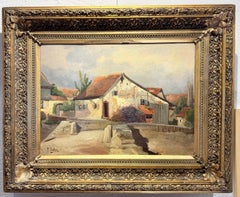
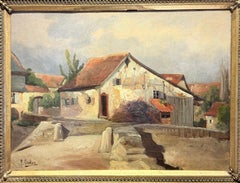
Swiss chalets (1927) - Oil on canvas 35x46 cm

Swiss chalets (1927) - Oil on canvas 35x46 cm

Located in Geneva, CH

Work signed Jeannet, artist unknown from the gallery. Dated 1927 Sold with frame, total size with frame is 44x56 cm

Category

Modern 1920s Art

Materials

Oil

Ballet und Pantomime "Harlekin", plate #10.

Ballet und Pantomime "Harlekin", plate #10.

By Walter Schnackenberg

Located in Palm Beach, FL

Walter Schnackenberg’s style changed several times during his long and successful career. Having studied in Munich, the artist traveled often to Paris where he fell under the spell of the Henri de Toulouse-Lautrec’s colorful and sensuous posters depicting theatrical and decadent subjects. Schnackenberg became a regular contributor of similar compositions to the German magazines Jugend and Simplicissimus before devoting himself to the design of stage scenery and costumes. In the artist’s theatrical work, his mastery of form, ornamentation, and Orientalism became increasingly evident. He excelled at combining fluid Art Nouveau outlines, with spiky Expressionist passages, and the postures and patterns of the mysterious East. In his later years, Schnackenberg explored the unconscious, using surreal subject matter and paler colors that plainly portrayed dreams and visions, some imbued with political connotations. His drawings, illustrations, folio prints, and posters are highly sought today for their exceedingly imaginative qualities, enchanting subject matter, and arresting use of color. SCHNACKENBERG BALLET UND PANTOMIME...

Category

Art Deco 1920s Art

Materials

Paper

Female Portrait (~60% OFF LIST PRICE - LIMITED TIME ONLY)

Female Portrait (~60% OFF LIST PRICE - LIMITED TIME ONLY)

Located in Kansas City, MO

Sara Rosa Corazon Female Portrait Archival Pigment Print on Heavy Paper 2020 16.5 x 11.5 inches Signed and dated by hand, lower right COA provided Sara Rosa Corazon, an Argentine ta...

Category

Modern 1920s Art

Materials

Archival Pigment

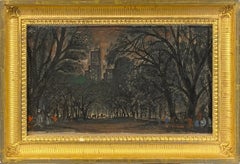
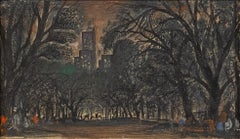
Central Park, Evening

Central Park, Evening

By Simka Simkhovitch

Located in New York, NY

Estate stamped on verso paper of backing board size 9 x 14 3/4 inches As we travel back in American art, Central Park is one of the subjects, while done - is hard to come by and very...

Category

American Impressionist 1920s Art

Materials

Mixed Media, Board

Staten Island
Staten Island

Staten Island

By Robert Hallowell

Located in Fairlawn, OH

Staten Island Watercolor on paper, c. 1928 Signed with the Estate stamp lower left Sheet size: 19 1/8 x 23 7/8 inches Titled on verso Part of small series of watercolors done of the ...

Category

American Modern 1920s Art

Materials

Watercolor

Through the Storm.
Through the Storm.

Through the Storm.

By Edmund Blampied

Located in Plano, TX

Appleby 97. 4 x 6 15/16 (sheet 8 1/8 x 10 3/8). Edition 100. A rich impression with drypoint burr and carefully wiped plate tone, printed on 'FJ Head' paper, on the full sheet with ...

Category

Modern 1920s Art

Materials

Drypoint, Etching

Ostend Horse
Ostend Horse

Ostend Horse

By Edmund Blampied

Located in Plano, TX

Ostend Horse. 1926-27. Drypoint. Appleby 125. 7 x 815/16 (sheet 9 1/8x 12 1/5). Proof B, apart from the edition 100. A rich impression with tonal wiping and drypoint burr, printed on...

Category

Modern 1920s Art

Materials

Drypoint, Etching

Coquette
Coquette

Coquette

By Victor Max Ninon

Located in Fairlawn, OH

Coquette Pochoir (silk screen) printed in colors, c. 1923-1925 Signed by the artist in pencil lower right; numbered in ink on the image, (see photo) Edition: 250 (100/250) in pencil in image (see photo) Image size: 10-1/2 x 12-3/4" The artist won a gold medal in Paris in 1925 for his porchoirs Victor Max Ninon (Vittorio Accornero de Testa, Italian, 1896-1982) Biography Vittorio Accornero de Testa was born in Casale Monferrato in 1896. He completed his first studies at the "Leardi" institute, but was forced to interrupt them due to the war events of the First World War . At 19 he was second lieutenant of the Alpine troops and in 1916 he took one of the first pilot's licenses. During the war he knows the bitterness of shooting down in air combat (for which he is decorated), but also the good fortune to stay alive, albeit with a disability. His art blossomed in the postwar period, first signing his works simply Ninon and then, probably at the suggestion of a French publisher, under the pseudonym of "Victor Max Ninon" (Victor and Max indicate strength and masculinity, Ninon boyhood) .In 1919 and 1924 he made illustrations for theGiornalino della Domenica , also together with his first wife Edina Altara , for Ardita and La Lettura . In 1923 he won the cover competition organized by the magazine El Hogar of Buenos Aires and in 1925 with his pochoirs he imposed himself in Paris at the international exhibition of modern decorative and industrial arts , obtaining a gold medal. In the same year he made two covers for the US magazine The Smart Set . In the 1920s he made numerous series of art deco style postcards for the Milanese publishing house Degami . On June 4, 1929, aGenoa embarks on the Conte Grande together with his wife Edina Altara , for New York . The two stayed in the American metropolis for a few months: in this period Accornero worked on the creation of theatrical sets and created some covers for Country Life magazine . Accornero gets awards and prizes, but the great economic crisis of the time and the nostalgia for Italy convince the two to return to their homeland, where they resume their activity as illustrators. In 1934 Accornero moved to Milan, separated amicably from his wife and continued to dedicate himself to the illustration of children's books, abandoning the pseudonym Victor Max Ninon. It illustrates about 60 books, from the fables of Andersen , Perrault and Grimm , to the tales of Poe , as well as the famous Pinocchio and Cuore published by Mondadori, Mursia, Hoepli, Martello. Several books illustrated by Accornero have been published in French, Spanish, German and English. In addition to the periodicals already mentioned, he collaborates on the first edition of the Encyclopedia of Boys , Mondadori, and with the Italian magazines Lidel , Il Secolo XX, The Italian Illustration , Fantasies of Italy , The Woman , Cordelia , For You Lady , Grace , Metropolis , La Domenica del Corriere , The Corriere dei Piccoli . In 1936 enters the world of cinema, creating sets and costumes for Wedding Vagabonde of Guido Brignone and The White Squadron of Augustus Genina . From 1935 to 1950 he also devoted himself to the theater, taking care of sets and costumes for numerous operettas, ballets and performances at the Scala in Milan and for the Milanese theaters Manzoni, Lirico and Olympia. Stages Marcello di Giordano, Nina pazza d'amore by Paisiello, I cantori di Nurimberga by Wagner, La Bohème by Puccini and other works. For this activity he is also cited in the Theater encyclopedia. In the 1940s and 1950s he wrote and illustrated six books for children for Mondadori: Tomaso (1944), Giacomino (1949), Tomaso Cacciatore (1950), Zio Stefano (1950), In Campagna che delizia! (1953), Tomaso, dear Tomaso (1955). His illustrations of Perrault's Tales published in those years by Hoepli are famous. His art in the fifties evolves towards hyperrealism . There are many personal exhibitions in Italy and abroad, including those at the Gallerie Gussoni (1959) and Bolzani (1963 and 1966) in Milan and Walcheturm (1962) in Zurich. Eminent critics praise his work, from Orio Vergani to Enrico Piceni, from Reto Roedel to De Chirico himself. On the Domenica del Corriere , the journalist, writer and painter Dino Buzzati...

Category

Art Deco 1920s Art

Materials

Stencil

The Perils of Dissipation

The Perils of Dissipation

Located in San Francisco, CA

On offer is a work which was part of a book of tonalist drawings by Granville Redmond (1871-1935). This rare pencil and charcoal drawing with white gouache accents is haunting for it...

Category

American Impressionist 1920s Art

Materials

Paper, Gouache, Graphite

En Pension.
En Pension.

En Pension.

By Edmund Blampied

Located in Plano, TX

En Pension. 1929-30. Drypoint. Appleby 142. 8 1/2 x 12 1/8 (sheet 11 1/2 x 18 5/16). Edition 100. A rich impression printed on cream wove paper with wide margins. Signed in ink. H...

Category

Modern 1920s Art

Materials

Drypoint, Etching

20th Century Oil on Canvas Italian Signed Dated Painting Portrait of Child, 1921

20th Century Oil on Canvas Italian Signed Dated Painting Portrait of Child, 1921

Located in Vicoforte, IT

Italian painting dated 1921. Framework oil on canvas, on the first canvas, depicting a portrait of a child on an armchair of good pictorial quality. Chiseled and gilded wooden frame ...

Category

1920s Art

Materials

Canvas, Oil

Ecce Homo VII
Ecce Homo VII

Ecce Homo VII

By Werner Drewes

Located in Fairlawn, OH

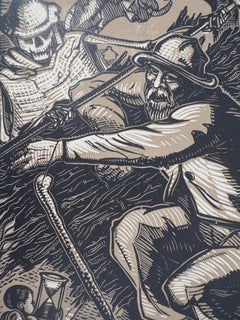
Ecce Homo VII Woodcut, 1921 Signed, titled, and dated in pencil by the artist One of only three known impressions Created while the artist was studying at the Bauhaus in Weimar, Germany. Extreme rarity-One of three know impressions Note: In 1921 Drewes went to the Bauhaus in Weimar, where, after completing the compulsory preliminary course with Johannes Itten, he continued to study with Paul Klee, Oskar Schlemmer and Georg Muche and initially went to the wall painting workshop. He then traveled extensively through Europe, North America and Asia. After returning to Germany in 1927, he went back to the Bauhaus, this time to his new location in Dessau, where he studied in the classes of László Moholy-Nagy and Wassily Kandinsky. He was one of the first artists to introduce the groundbreaking concepts of the Bauhaus School in the United States through his painting, printmaking, and teaching. Condition: Excellent Missing small voids in the upper margin from removal of the original hinges. Image size: 9 7/8 x 8 3/16 inches Reference: Rose 30 Provenance: From the estate of Drewes's teacher at the Bauhaus. During the post WW2 the professor lived in East Germany. WERNER DREWES 1899-1985 Werner Drewes initially studied architecture before enrolling, in 1921-22, at the Bauhaus in Weimar under Klee, Kandinsky, Itten and Feininger. For four years - 1923 to 1927 - he travelled the world with his bride, before completing his Bauhaus training in Dessau in 1929. He immigrated to the United States in 1930, documenting that move to New York through series of woodcuts. In 1936/37 he was an active founder of the American Abstract Artists and participated in the Federal Arts Project in New York before moving on to a teaching career at Washington University in St. Louis. As an artist for over sixty five years, he employed various media from drawing and watercolor, through woodcut and etching, to painting and collage. Translating an early interest in subjective cubistic forms, his work evolved into nonobjective abstraction. He was creative until the day of his death. Courtesy: Toby C. Moss Werner Drewes (1899–1985) was a painter, printmaker, and art teacher. Considered to be one of the founding fathers of American abstraction, he was one of the first artists to introduce concepts of the Bauhaus school within the United States. His mature style encompassed both nonobjective and figurative work and the emotional content of this work was consistently more expressive than formal. Drewes was as highly regarded for his printmaking as for his painting. In his role as teacher as well as artist he was largely responsible for bringing the Bauhaus aesthetic to America. Early life and education Drewes was born in 1899 to Georg Drewes, a Lutheran pastor, and Martha Schaefer Drewes. The family lived in the village of Canig within Lower Lusatia, Germany. From age eight to eighteen he attended the Saldria Gymnasium, a boarding school in Brandenburg an der Havel. There, he showed talent both for painting and woodblock printing. Graduating from Saldria in 1917, he was drafted by the German army and served in France from then until the close of the war. About this period of his life he is reported to have said that the horrors of life at the front were only made tolerable by his sketchbook, a copy of Goethe's Faust and a volume of Nietzsche. For a decade following the close of the war he studied, made paintings and prints, and traveled widely. His friend, Herwarth Walden, helped shape his appreciation for expressionist literature and art. Walden produced the quarterly magazine, Der Sturm and ran a gallery of contemporary art, Galerie Der Sturm, from which, in 1919, Drewes purchased an expressionist painting by William Wauer titled Blutrausch (Bloodlust). In the same year he made the acquaintance of Heinrich Vogeler and participated in Vogeler's socialist utopian artists' commune, Barkenhoff, at Worpswede, Lower Saxony. In 1919 Drewes also enrolled at the Königlich Technischen Hochschule Charlottenburg to study architecture and the following year he studied the same subject at the Technischen Hochschule Stuttgart. Preferring art over architecture, he then enrolled in Stuttgart's school of applied arts (Kunstgewerbeschule) where he studied life drawing and learned to work with colored glass. At this time he joined a group of artists and architects associated with the newly formed Merz Akademie, a college of design, art, and media in Stuttgart. In 1921 his friendship with a French artist, Sébastien Laurent, led him to begin studies in Weimar at Bauhaus, then a new school which taught an integrated approach to the fine and applied arts. His instructors were Johannes Itten and Lyonel Feininger, whose paintings were expressionist and abstract, and Paul Klee, who taught bookbinding, stained glass, and murals. While at Bauhaus Drewes produced a portfolio of ten woodblock prints entitled "Ecce Homo." In 1923 and 1924 he studied art during travels throughout Italy, Spain, the United States, and Central America and in 1926 he traveled to San Francisco, Japan, and Korea, thence taking the Trans-Siberian railway to Manchuria, Moscow, and Warsaw. He later said the El Grecos he saw proved to be most influential in his work. While traveling, he exhibited: (1) etchings in Madrid (1923) and Montevideo (1924), oils and etchings in Buenos Aires and St. Louis (1925), and (3) etchings in San Francisco (1926). He paid his way by the sales these exhibits produced and by taking commissions to paint portraits. While in San Francisco he set up a shop from which he sold prints he had made in Spain and South America. After his return to Germany in 1927 he resumed study at Bauhaus, which had been forced to relocate in Dessau, Saxony-Anhalt. His instructors at that time were László Moholy-Nagy (metal work), Wassily Kandinsky, and (painting), and Lyonel Feininger (prints). At this time he also worked and exhibited in Frankfurt. With the rise of Nazism abstract artists found it increasingly difficult to sell their work and, in 1930, Drewes, finding the political pressure unbearable, emigrated to the United States. There, despite the world economic crisis, Drewes was able to earn a living as a professional artist. Mature style After Drewes moved to New York, Kandinsky, who was both friend and mentor, continued to exert a strong influence over his style. Later in life he said he had a hard time getting away from Kandinsky's influence as he developed his own style. In time he was able to bring a more emotional approach to his work and to base it, more than Kandinsky did, on natural forms. In 1930 Drewes had a solo exhibition at the 135th Street Branch of the New York Public Library and a two-person show at the S.P.R. Penthouse Gallery...

Category

Expressionist 1920s Art

Materials

Woodcut