1920s Art

to
929
2,776
856
590
330
340
Overall Width
to
Overall Height
to
7,478
21,327
163,682
232,762
2,026
2,269
4,937
6,519
5,800
14,999
20,725
25,753
18,684
14,152
5,310
1,121
475
416
400
360
124
52
34
26
6
3
2
3,066
1,624
56
2,984
1,561
1,164
1,139
986
680
476
329
292
244
202
187
187
184
179
172
156
156
115
108
1,625
1,111
980
930
735
169
130
64
40
39
1,592
730
2,891
1,855
Period: 1920s
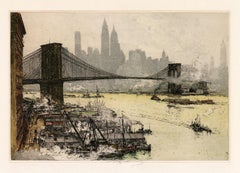
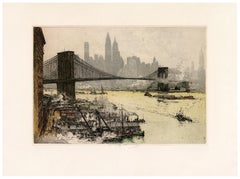
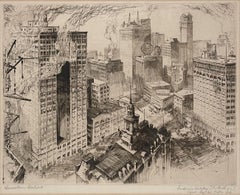
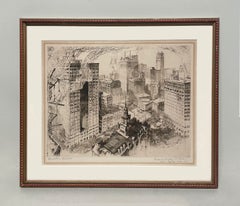
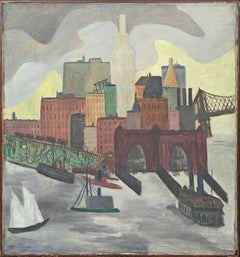
'Brooklyn Bridge' — Iconic New York City Landmark

'Brooklyn Bridge' — Iconic New York City Landmark

By Luigi Kasimir

Located in Myrtle Beach, SC

Luigi Kasimir, 'Brooklyn Bridge', color etching with aquatint, 1927, edition 100. Signed in pencil. A superb impression, with fresh colors, on heavy, cream wove paper; with margins...

Category

American Modern 1920s Art

Materials

Etching, Aquatint

“The Crow”
“The Crow”

“The Crow”

Located in Southampton, NY

Original gouache and watercolor on brown archival paper of a standing crow in profile. Signed and dated lower right. Condition is good to very good. Colors of the bird are strong a...

Category

Modern 1920s Art

Materials

Gouache, Archival Paper, Graphite

Waterfall Landscape
Waterfall Landscape

Waterfall Landscape

Located in Wilton Manors, FL

Laura Greenwood (1897-1951) Waterfall Landscape, ca. 1925 Oil on artist board, measuring 16 x 20 inches; 23 x 27 inches framed measurement. Signed lower right. Condition: the pi...

Category

Art Deco 1920s Art
Materials

Oil

Charles Ragland Bunnell Colorado Landscape Oil Painting 1926 Broadmoor Art

Charles Ragland Bunnell Colorado Landscape Oil Painting 1926 Broadmoor Art

By Charles Ragland Bunnell

Located in Denver, CO

A striking early Colorado landscape by Charles Ragland Bunnell, this 1920s oil on board painting captures the expansive plains and butte formations of the Western landscape beneath a...

Category

American Impressionist 1920s Art

Materials

Oil, Board

L'Éventail rose

L'Éventail rose

By Marie Laurencin

Located in New York, NY

A very good impression of this scarce color etching and drypoint. Fourth state (of 4). Signed and numbered 54/100 in pencil, lower margin.

Category

Cubist 1920s Art

Materials

Color, Drypoint, Etching

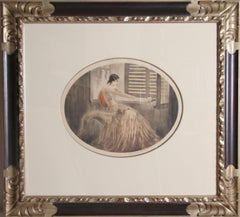
Mimi, Art Nouveau Color Etching by Louis Icart

Mimi, Art Nouveau Color Etching by Louis Icart

By Louis Icart

Located in Long Island City, NY

Louis Icart, French (1888 - 1950) - Mimi, Year: 1927, Medium: Color Etching, Signed in Pencil, Edition: 105/500, Image Size: 20.5 x 13 inches, Size: 27 in. x 19 in. (68.58 cm x ...

Category

Art Nouveau 1920s Art

Materials

Etching

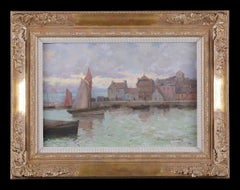
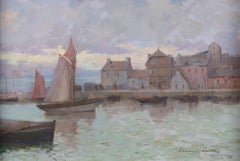
"Boston Square" Arthur Clifton Goodwin, Impressionist Boston Urban Landscape

"Boston Square" Arthur Clifton Goodwin, Impressionist Boston Urban Landscape

By Arthur Clifton Goodwin

Located in New York, NY

Arthur Clifton Goodwin Boston Square Signed lower left Oil on canvas 30 x 36 inches A painter especially known for street and waterfront scenes of Boston, Arthur Clifton Goodwin di...

Category

American Impressionist 1920s Art

Materials

Canvas, Oil

original etching
original etching

original etching

By Marie Laurencin

Located in Henderson, NV

Medium: original etching. Printed in 1926 at the atelier Lacourière on Montgolfier paper and published by Au Sans Pareil in a limited edition of 995 for "Dix filles dans un pré". Pla...

Category

1920s Art

Materials

Etching

Winter Scene, Chrudim, Czech Republic Impressionist Landscape

Winter Scene, Chrudim, Czech Republic Impressionist Landscape

Located in Beachwood, OH

Václav Radimský (Czech, 1867-1946) Winter Scene, Chrudim, 1920 Oil on board Signed lower left 23.5 x 36.25 inches Václav Jan Emanuel Radimský was a Czech impressionist painter who r...

Category

Impressionist 1920s Art

Materials

Oil

Projet de Tissus - Fauvist Flowers Watercolor & Gouache by Raoul Dufy

Projet de Tissus - Fauvist Flowers Watercolor & Gouache by Raoul Dufy

By Raoul Dufy

Located in Marlow, Buckinghamshire

Botanical watercolour and gouache on paper circa 1920 by French fauvist painter Raoul Dufy. The work depicts flowers in red, blue and green. This work was executed by Dufy as a fabric design. Dimensions: Framed: 19.5"x19.5" Unframed: 12"x12" Provenance: Private collection of works by Raoul Dufy for Bianchini Ferier Bianchini Ferrier Collection - Christie's London - July 2001 SF Fall Show Raoul Dufy was one of a family of nine children, including five sisters and a younger brother, Jean Dufy, also destined to become a painter. Their father was an accountant in the employ of a major company in Le Havre. The Dufy family was musically gifted: his father was an organist, as was his brother Léon, and his youngest brother Gaston was an accomplished flautist who later worked as a music critic in Paris. Raoul Dufy's studies were interrupted at the age of 14, when he had to contribute to the family income. He took a job with an importer of Brazilian coffee, but still found time from 1892 to attend evening courses in drawing and composition at the local college of fine arts under Charles Marie Lhullier, former teacher of Othon Friesz and Georges Braque. He spent his free time in museums, admiring the paintings of Eugène Boudin in Le Havre and The Justice of Trajan in Rouen. A municipal scholarship enabled him to leave for Paris in 1900, where he lodged initially with Othon Friesz. He was accepted by the École des Beaux-Arts, where he studied under Léon Bonnat, whose innate conservatism prompted Dufy to remark later that it was 'good to be at the Beaux-Arts providing one knew one could leave'. And leave he did, four years later, embarking with friends and fellow students on the rounds of the major Paris galleries - Ambroise Vollard, Durand-Ruel, Eugène Blot and Berheim-Jeune. For Dufy and his contemporaries, Impressionism represented a rejection of sterile academism in favour of the open-air canvases of Manet, the light and bright colours of the Impressionists, and, beyond them, the daringly innovative work of Gauguin and Van Gogh, Seurat, Cézanne, Toulouse-Lautrec and others. Dufy was an out-and-out individualist, however, and was not tempted to imitate any of these artists. He produced, between 1935 and 1937, Fée Electricité (Spirit of Electricity), the emblem for the French utilities company Electricité de France (EDF). Dufy visited the USA for the first time in 1937, as a member of the Carnegie Prize jury. In 1940, the outbreak of war (and his increasingly rheumatic condition) persuaded him to settle in Nice. When he eventually returned to Paris 10 years later, his rheumatism had become so debilitating that he immediately left for Boston to follow a course of pioneering anti-cortisone treatment. He continued working, however, spending time first in Harvard and then in New York City before moving to the drier climate of Tucson, Arizona. The cortisone treatment was by and large unsuccessful, although he did recover the use of his fingers. He returned to Paris in 1951 and decided to settle in Forcalquier, where the climate was more clement. Within a short time, however, he was wheelchair-bound. He died in Forcalquier in March 1953 and was buried in Cimiez. Between 1895 and 1898, Raoul Dufy painted watercolours of landscapes near his native Le Havre and around Honfleur and Falaise. By the turn of the century, however, he was already painting certain subjects that were to become hallmarks of his work - flag-decked Parisian cityscapes, Normandy beaches teeming with visitors, regattas and the like, including one of his better-known early works, Landing Stage at Ste-Adresse. By 1905-1906 Friesz, Braque, Matisse, Derain, Vlaminck, Van Dongen and Rouault were described collectively as Fauves (the wild beasts). What they had in common was a desire to innovate, but they felt constrained nonetheless to meet formally to set out the guiding principles of what promised to be a new 'movement'. Dufy quickly established that those principles were acceptable; moreover, he was most impressed by one particular painting by Henri Matisse ( Luxury, Calm and Voluptuousness) which, to Dufy, embodied both novelty and a sense of artistic freedom. Dufy promptly aligned himself with the Fauves. Together with Albert Marquet in particular, he spent his time travelling the Normandy coast and painting views similar...

Category

Fauvist 1920s Art

Materials

Paper, Watercolor, Gouache

“The Ballet Performance”

“The Ballet Performance”

By Jean-Louis-Marcel Cosson

Located in Southampton, NY

Exquisite, original oil on canvas painting of a ballet performance by the well known French artist, Jean-Louis-Marcel Cosson. Signed by the artist lower left. Condition is very good. Old wax reline. Solid mahogany wood frame with gold decoration. Overall framed measurements are 24.75 by 33.25 inches. Jean-Louis-Marcel Cosson was born in 1878 in Bordeaux. His first exhibition was in Paris at the Salon des Artistes Français, of which he would later become a member. He received an honourable mention at the age of 23 in 1901, and a third-place medal in 1911. He also exhibited at the Société des Beaux Arts and the Salon des Tuileries. ​ Cosson is a post-impressionist artist who developed a very distinctive style which makes him immediately recognisable among his peers. His passion was to capture a bustling Paris which was the epicentre of the Modern art world at the beginning of the twentieth century. ​ Fascinated by Edgar Degas, he almost invariably followed the themes beloved by the Impressionist Master, such as Parisian women or horse racing. But like for Degas, his most admired works remain his paintings of...

Category

Impressionist 1920s Art

Materials

Canvas, Oil

Fleurs et Papillons - Fauvist Flowers Watercolor & Gouache by Raoul Dufy

Fleurs et Papillons - Fauvist Flowers Watercolor & Gouache by Raoul Dufy

By Raoul Dufy

Located in Marlow, Buckinghamshire

Botanical watercolour and gouache on paper circa 1920 by French fauvist painter Raoul Dufy. The work depicts flowers in red and butterflies in blues, yellows, black and white. This work was executed by Dufy as a fabric design. Dimensions: Framed: 17"x27" Unframed: 10"x20" Provenance: Private collection of works by Raoul Dufy for Bianchini Ferier Bianchini Ferrier Collection - Christie's London - July 2001 SF Fall Show Raoul Dufy was one of a family of nine children, including five sisters and a younger brother, Jean Dufy, also destined to become a painter. Their father was an accountant in the employ of a major company in Le Havre. The Dufy family was musically gifted: his father was an organist, as was his brother Léon, and his youngest brother Gaston was an accomplished flautist who later worked as a music critic in Paris. Raoul Dufy's studies were interrupted at the age of 14, when he had to contribute to the family income. He took a job with an importer of Brazilian coffee, but still found time from 1892 to attend evening courses in drawing and composition at the local college of fine arts under Charles Marie Lhullier, former teacher of Othon Friesz and Georges Braque. He spent his free time in museums, admiring the paintings of Eugène Boudin in Le Havre and The Justice of Trajan in Rouen. A municipal scholarship enabled him to leave for Paris in 1900, where he lodged initially with Othon Friesz. He was accepted by the École des Beaux-Arts, where he studied under Léon Bonnat, whose innate conservatism prompted Dufy to remark later that it was 'good to be at the Beaux-Arts providing one knew one could leave'. And leave he did, four years later, embarking with friends and fellow students on the rounds of the major Paris galleries - Ambroise Vollard, Durand-Ruel, Eugène Blot and Berheim-Jeune. For Dufy and his contemporaries, Impressionism represented a rejection of sterile academism in favour of the open-air canvases of Manet, the light and bright colours of the Impressionists, and, beyond them, the daringly innovative work of Gauguin and Van Gogh, Seurat, Cézanne, Toulouse-Lautrec and others. Dufy was an out-and-out individualist, however, and was not tempted to imitate any of these artists. He produced, between 1935 and 1937, Fée Electricité (Spirit of Electricity), the emblem for the French utilities company Electricité de France (EDF). Dufy visited the USA for the first time in 1937, as a member of the Carnegie Prize jury. In 1940, the outbreak of war (and his increasingly rheumatic condition) persuaded him to settle in Nice. When he eventually returned to Paris 10 years later, his rheumatism had become so debilitating that he immediately left for Boston to follow a course of pioneering anti-cortisone treatment. He continued working, however, spending time first in Harvard and then in New York City before moving to the drier climate of Tucson, Arizona. The cortisone treatment was by and large unsuccessful, although he did recover the use of his fingers. He returned to Paris in 1951 and decided to settle in Forcalquier, where the climate was more clement. Within a short time, however, he was wheelchair-bound. He died in Forcalquier in March 1953 and was buried in Cimiez. Between 1895 and 1898, Raoul Dufy painted watercolours of landscapes near his native Le Havre and around Honfleur and Falaise. By the turn of the century, however, he was already painting certain subjects that were to become hallmarks of his work - flag-decked Parisian cityscapes, Normandy beaches teeming with visitors, regattas and the like, including one of his better-known early works, Landing Stage at Ste-Adresse. By 1905-1906 Friesz, Braque, Matisse, Derain, Vlaminck, Van Dongen and Rouault were described collectively as Fauves (the wild beasts). What they had in common was a desire to innovate, but they felt constrained nonetheless to meet formally to set out the guiding principles of what promised to be a new 'movement'. Dufy quickly established that those principles were acceptable; moreover, he was most impressed by one particular painting by Henri Matisse ( Luxury, Calm and Voluptuousness) which, to Dufy, embodied both novelty and a sense of artistic freedom. Dufy promptly aligned himself with the Fauves. Together with Albert Marquet in particular, he spent his time travelling the Normandy coast and painting views similar...

Category

Fauvist 1920s Art

Materials

Paper, Watercolor, Gouache

Whistlers Mother by Anonymous Artist Original Oil on Canvas 1924 after Whistler

Whistlers Mother by Anonymous Artist Original Oil on Canvas 1924 after Whistler

Located in Soquel, CA

Whistlers Mother by Anonymous Artist Original Oil on Canvas 1924 Nicely executed painting after James McNeil Whistler of his mother by an anonymous artist (American, 19th-20th C.) I...

Category

Post-Impressionist 1920s Art

Materials

Canvas, Oil, Stretcher Bars

Ballet und Pantomime "Maskerade", plate #9.

Ballet und Pantomime "Maskerade", plate #9.

By Walter Schnackenberg

Located in Palm Beach, FL

Walter Schnackenberg’s style changed several times during his long and successful career. Having studied in Munich, the artist traveled often to Paris where he fell under the spell of the Henri de Toulouse-Lautrec’s colorful and sensuous posters depicting theatrical and decadent subjects. Schnackenberg became a regular contributor of similar compositions to the German magazines Jugend and Simplicissimus before devoting himself to the design of stage scenery and costumes. In the artist’s theatrical work, his mastery of form, ornamentation, and Orientalism became increasingly evident. He excelled at combining fluid Art Nouveau outlines, with spiky Expressionist passages, and the postures and patterns of the mysterious East. In his later years, Schnackenberg explored the unconscious, using surreal subject matter and paler colors that plainly portrayed dreams and visions, some imbued with political connotations. His drawings, illustrations, folio prints, and posters are highly sought today for their exceedingly imaginative qualities, enchanting subject matter, and arresting use of color. SCHNACKENBERG BALLET UND PANTOMIME...

Category

Art Deco 1920s Art
Materials

Paper

Rowing Figure in an Eerie Landscape, 1929

Rowing Figure in an Eerie Landscape, 1929

Located in Stockholm, SE

Rowing Figure in an Eerie Landscape is a 1929 watercolor-and-ink illustration by Swedish artist Einar Norelius. Created for the 22nd issue of Bland tomtar och troll, the cherished an...

Category

Symbolist 1920s Art

Materials

Paper, Ink, Watercolor

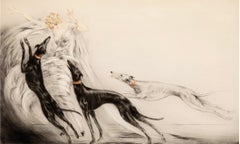
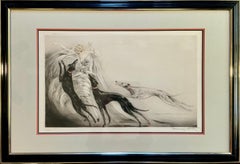
Louis Icart Art Deco Etching Coursing II, 1929

Louis Icart Art Deco Etching Coursing II, 1929

By Louis Icart

Located in Dallas, TX

Louis Icart (French, 1888-1950) Coursing II, 1929 Etching with handcoloring on paper Image: 15 x 24-7/8 inches (38.1 x 63.2 cm) (image) Ed. V/160 Framed Dimensions 27 X 39.5 Inches ...

Category

Art Deco 1920s Art
Materials

India Ink, Archival Paper

"Soubrette con pantera " Tempera cm. 15 x 19 1920 ca Siglato E.K.

"Soubrette con pantera " Tempera cm. 15 x 19 1920 ca Siglato E.K.

Located in Torino, IT

Bellissima opera siglata E.K. Cornice decò Figura di donna ,Soubrette o Circense con pantera e sullo sfondo un leone dietro le tende Classico soggetto anni 20 Deco Forse per illust...

Category

Art Deco 1920s Art
Materials

Tempera, Cardboard

La Lecture
La Lecture

La Lecture

By Henri Lebasque

Located in London, GB

Henri Lebasque French 1865 - 1937 La Lecture Oil on canvas, signed lower right Image size: 20 3/4 x 25 inches (52.7 x 63.5 cm) Original style frame Provenance: M.F. Manaut Vente Lou...

Category

Post-Impressionist 1920s Art
Materials

Canvas, Oil

Plowman, Brecksville, Ohio, Early 20th Century Farm Landscape, Cleveland School

Plowman, Brecksville, Ohio, Early 20th Century Farm Landscape, Cleveland School

By Frank Wilcox

Located in Beachwood, OH

Frank Nelson Wilcox (American, 1887–1964) Plowman, Brecksville, Ohio, c. 1922 Watercolor on paper Signed lower right 22.5 x 27.75 inches 27.75 x 34.5 inches, framed Frank Nelson Wilcox (October 3, 1887 – April 17, 1964) was a modernist American artist and a master of watercolor. Wilcox is described as the "Dean of Cleveland School painters," though some sources give this appellation to Henry Keller or Frederick Gottwald. Wilcox was born on October 3, 1887 to Frank Nelson Wilcox, Sr. and Jessie Fremont Snow Wilcox at 61 Linwood Street in Cleveland, Ohio. His father, a prominent lawyer, died at home in 1904 shortly before Wilcox' 17th birthday. His brother, lawyer and publisher Owen N. Wilcox, was president of the Gates Legal Publishing Company or The Gates Press. His sister Ruth Wilcox was a respected librarian. In 1906 Wilcox enrolled from the Cleveland School of Art under the tutelage of Henry Keller, Louis Rorimer, and Frederick Gottwald. He also attended Keller's Berlin Heights summer school from 1909. After graduating in 1910, Wilcox traveled and studied in Europe, sometimes dropping by Académie Colarossi in the evening to sketch the model or the other students at their easels, where he was influenced by French impressionism. Wilcox was influenced by Keller's innovative watercolor techniques, and from 1910 to 1916 they experimented together with impressionism and post-impressionism. Wilcox soon developed his own signature style in the American Scene or Regionalist tradition of the early 20th century. He joined the Cleveland School of Art faculty in 1913. Among his students were Lawrence Edwin Blazey, Carl Gaertner, Paul Travis, and Charles E. Burchfield. Around this time Wilcox became associated with Cowan Pottery. In 1916 Wilcox married fellow artist Florence Bard, and they spent most of their honeymoon painting in Berlin Heights with Keller. They had one daughter, Mary. In 1918 he joined the Cleveland Society of Artists, a conservative counter to the Bohemian Kokoon Arts Club, and would later serve as its president. He also began teaching night school at the John Huntington Polytechnic Institute at this time, and taught briefly at Baldwin-Wallace College. Wilcox wrote and illustrated Ohio Indian Trails in 1933, which was favorably reviewed by the New York Times in 1934. This book was edited and reprinted in 1970 by William A. McGill. McGill also edited and reprinted Wilcox' Canals of the Old Northwest in 1969. Wilcox also wrote, illustrated, and published Weather Wisdom in 1949, a limited edition (50 copies) of twenty-four serigraphs (silk screen prints) accompanied by commentary "based upon familiar weather observations commonly made by people living in the country." Wilcox displayed over 250 works at Cleveland's annual May Show. He received numerous awards, including the Penton Medal for The Omnibus, Paris (1920), Fish Tug on Lake Erie (1921), Blacksmith Shop (1922), and The Gravel Pit (1922). Other paintings include The Trailing Fog (1929), Under the Big Top (1930), and Ohio Landscape...

Category

American Modern 1920s Art
Materials

Watercolor

"Pigeon Hill, Rockport" Winthrop Duthie Turney, North Eastern American Landscape

"Pigeon Hill, Rockport" Winthrop Duthie Turney, North Eastern American Landscape

Located in New York, NY

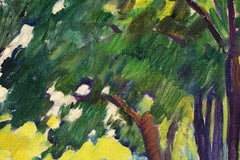
Winthrop Duthie Turney Pigeon Hill, Rockport Signed lower left Oil on canvas 20 x 24 inches Exhibited New York, National Academy of Design, Artists of America, Sixth Annual Exhibition, 1949. Winthrop Duthie Turney was born in New York City and received his education at the Art Students League. He was affiliated with the Fifteen Gallery...

Category

American Impressionist 1920s Art
Materials

Canvas, Oil

Point Lobos, California

Point Lobos, California

By William John Edmondson

Located in Fairlawn, OH

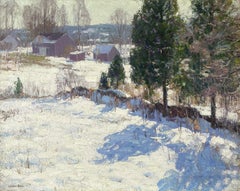
Point Lobos, California Oil on artist's board, c. 1925 Signed lower right: Wm J Edmundson (see photo) Condition: Very good condition Frame: Period McBeth Gallery style frame (see pho...

Category

American Impressionist 1920s Art
Materials

Oil

Le Liseur - Lithograph after Odilon Redon - 1923

Le Liseur - Lithograph after Odilon Redon - 1923

By Odilon Redon

Located in Roma, IT

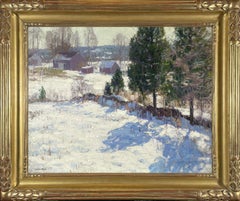
Le Liseur is a prototype reproduction realized after Odilon Redon. They belong to the suite "Odilon Redon Peintre, Dessinateur et Graveur", published by Henri Felury in 1923. Titl...

Category

Symbolist 1920s Art
Materials

Lithograph

The Young Shepherd with Pan Pipe

The Young Shepherd with Pan Pipe

Located in London, GB

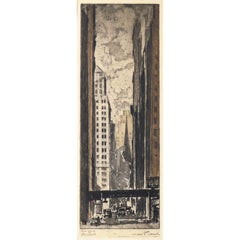
'The Young Shepherd with Pan Pipe', oil on panel, by Joseph-Marius Avy (circa 1920s). A sensuous and accomplished Arcadian study depicting a young male figure — lithe, athletic, drea...

Category

1920s Art
Materials

Oil, Wood Panel

"In Flight" (Auf der Flucht) original lithograph

"In Flight" (Auf der Flucht) original lithograph

By Alfred Kubin

Located in Henderson, NV

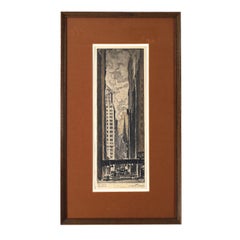
Medium: original lithograph. Printed in 1920 on smooth wove paper for the Deutsche Graphiker der Gegenwart portfolio, and published in Leipzig by Klinkhardt & Biermann in an edit...

Category

Expressionist 1920s Art
Materials

Lithograph

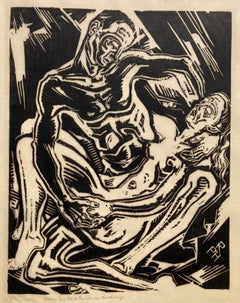
"Woman Desired by Man" original woodcut

"Woman Desired by Man" original woodcut

By Max Pechstein

Located in Henderson, NV

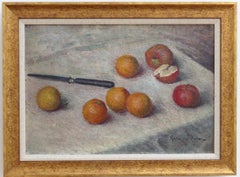
Medium: original woodcut. Printed in 1920 for the Deutsche Graphiker der Gegenwart portfolio, and published in Leipzig by Klinkhardt & Biermann in an edition of 500. Catalogue re...

Category

Expressionist 1920s Art
Materials

Woodcut

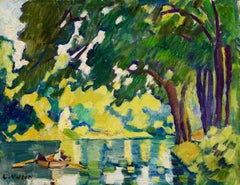
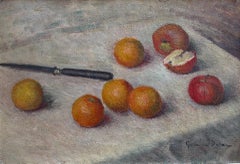
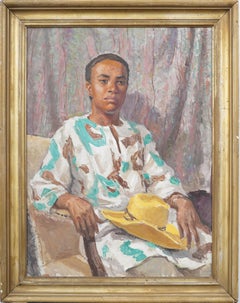
Printemps sur la Seine - Post Impressionist Landscape Oil by Robert Pinchon
Printemps sur la Seine - Post Impressionist Landscape Oil by Robert Pinchon

By Robert Antoine Pinchon

Located in Marlow, Buckinghamshire

Signed oil on canvas riverscape circa 1920 by French post impressionist painter Robert Antoine Pinchon. This very fine large example depicts a view the River Seine near to Rouen in n...

Category

Post-Impressionist 1920s Art
Materials

Canvas, Oil