1940s Art

to
1,194
2,956
1,180
1,043
410
263
Overall Width
to
Overall Height
to
7,828
21,905
164,567
227,387
2,028
2,317
4,990
6,565
5,876
15,113
20,681
25,913
18,760
14,158
5,550
2,191
430
315
215
155
117
84
78
46
20
9
2
2
3,381
2,237
155
3,022
1,467
1,168
921
899
574
392
364
359
359
280
267
264
256
223
194
164
159
147
146
2,063
1,481
1,292
1,036
712
114
114
111
57
45
1,592
953
3,784
1,899
Period: 1940s
“New Americans" 1941 WPA Exhibited Carnegie Percy Albee

“New Americans" 1941 WPA Exhibited Carnegie Percy Albee

Located in Exton, PA

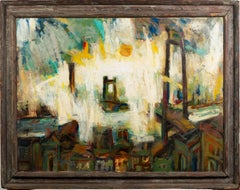
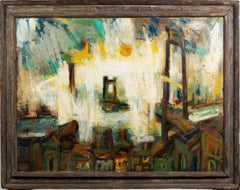
Monumental, important WPA painting signed by Percy Albee. The painting is oil canvas measuring 36" x 48". Titled verso "New Americans", this WPA painting was exhibited at the Carnegi...

Category

American Realist 1940s Art

Materials

Oil

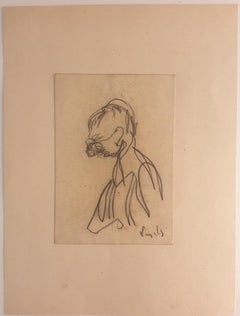
Modernist Judaica Jewish Ink Drawing Painting "New Immigrant" Off the Boat WPA

Modernist Judaica Jewish Ink Drawing Painting "New Immigrant" Off the Boat WPA

By Ben-Zion Weinman

Located in Surfside, FL

An ink drawing Judaic painting by modern artist Ben-Zion Weinman. It depicts a portrait of an old Jewish man. Coming over from Europe on a ship crossing. The work is signed "Ben-Zion". Born in 1897, Ben-Zion Weinman celebrated his European Jewish heritage in his visual works as a sculptor, painter, and printmaker. Influenced by Spinoza, Knut Hamsun, and Wladyslaw Reymont, as well as Hebrew literature, Ben-Zion wrote poetry and essays that, like his visual work, attempt to reveal the deep “connection between man and the divine, and between man and earth.” An emigrant from the Ukraine, he came to the US in 1920. He wrote fairy tales and poems in Hebrew under the name Benzion Weinman, but when he began painting he dropped his last name and hyphenated his first, saying an artist needed only one name. In 1920 he settled in America, where he found little interest in his writing. He began teaching Hebrew to support himself and then in the early 1930s returned to painting. He used his art to comment on the rise of fascism in Europe, events he felt could not be adequately explored with words. Largely self-taught, Ben-Zion visited the museums of New York City to learn his new trade. His first painting on a large scale, Friday Evening (1933, Jewish Museum, New York), depicts a Sabbath dinner table as recalled from his family home. Ben-Zion supported himself by working odd jobs until the establishment of the Works Progress Administration's Federal Art Project. Under the auspices of the wpa, Ben-Zion thrived and galleries began to show his work. In 1936, after his first one-man show at the Artists' Gallery in New York Ben-Zion was a founding member of “The Ten: An Independent Group” The Ten” a 1930’s...

Category

American Modern 1940s Art

Materials

Watercolor, Gouache

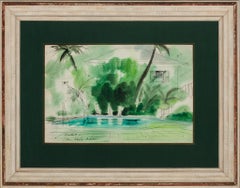
Vintage Postcard - 1940s

Vintage Postcard - 1940s

Located in Roma, IT

Vintage Postcard is a postcard realized in 1940s. Good conditions and aged. It belongs to a historical and nostalgic album including historical moments, places, families, artworks,...

Category

Modern 1940s Art

Materials

Paper, Postcard

The Golden Gate
The Golden Gate

The Golden Gate

By Adolf Arthur Dehn

Located in Fairlawn, OH

The Golden Gate Lithograph on wove paper watermarked GC, 1940 Signed in pencil by the artist (see photo) Publisher: Associated American Artists Edition: 189, unnumbered The image depicts The Golden Gate Bridge which connects San Francisco and Marin County, California References And Exhibitions: Illustrated: Adams, The Sensuous Life of Adolf Dehn, Fig. 13.17, page 324 Reference: L & O 325 AAA Index 391 Adolf Dehn, American Watercolorist and Printmaker, 1895-1968 Adolf Dehn was an artist who achieved extraordinary artistic heights, but in a very particular artistic sphere—not so much in oil painting as in watercolor and lithography. Long recognized as a master by serious print collectors, he is gradually gaining recognition as a notable and influential figure in the overall history of American art. In the 19th century, with the invention of the rotary press, which made possible enormous print runs, and the development of the popular, mass-market magazines, newspaper and magazine illustration developed into an artistic realm of its own, often surprisingly divorced from the world of museums and art exhibitions, and today remains surprisingly overlooked by most art historians. Dehn in many regards was an outgrowth of this world, although in an unusual way, since as a young man he produced most of his illustrative work not for popular magazines, such as The Saturday Evening Post, but rather for radical journals, such as The Masses or The Liberator, or artistic “little magazines” such as The Dial. This background established the foundation of his outlook, and led later to his unique and distinctive contribution to American graphic art. If there’s a distinctive quality to his work, it was his skill in introducing unusual tonal and textural effects into his work, particularly in printmaking but also in watercolor. Jackson Pollock seems to have been one of many notable artists who were influenced by his techniques. Early Years, 1895-1922 For an artist largely remembered for scenes of Vienna and Paris, Adolf Dehn’s background was a surprising one. Born in Waterville, Minnesota, on November 22, 1895, Dehn was the descendent of farmers who had emigrated from Germany and homesteaded in the region, initially in a one-room log cabin with a dirt floor. Adolf’s father, Arthur Clark Dehn, was a hunter and trapper who took pride that he had no boss but himself, and who had little use for art. Indeed, during Adolf’s boyhood the walls of his bedroom and the space under his bed were filled with the pelts of mink, muskrats and skunks that his father had killed, skinned and stretched on drying boards. It was Adolf’s mother, Emilie Haas Dehn, a faithful member of the German Lutheran Evangelical Church, who encouraged his interest in art, which became apparent early in childhood. Both parents were ardent socialists, and supporters of Eugene Debs. In many ways Dehn’s later artistic achievement was clearly a reaction against the grinding rural poverty of his childhood. After graduating from high school in 1914 at the age of 19—an age not unusual in farming communities at the time, where school attendance was often irregular—Dehn attended the Minneapolis School of Art from 1914 to 1917, whose character followed strongly reflected that of its director, Munich-trained Robert Kohler, an artistic conservative but a social radical. There Dehn joined a group of students who went on to nationally significant careers, including Wanda Gag (later author of best-selling children’s books); John Flanagan (a sculptor notable for his use of direct carving) Harry Gottlieb (a notable social realist and member of the Woodstock Art Colony), Elizabeth Olds (a printmaker and administrator for the WPA), Arnold Blanch (landscape, still-life and figure painter, and member of the Woodstock group), Lucille Lunquist, later Lucille Blanch (also a gifted painter and founder of the Woodstock art colony), and Johan Egilrud (who stayed in Minneapolis and became a journalist and poet). Adolf became particularly close to Wanda Gag (1893-1946), with whom he established an intense but platonic relationship. Two years older than he, Gag was the daughter of a Bohemian artist and decorator, Anton Gag, who had died in 1908. After her husband died, Wanda’s mother, Lizzi Gag, became a helpless invalid, so Wanda was entrusted with the task of raising and financially supporting her six younger siblings. This endowed her with toughness and an independent streak, but nonetheless, when she met Dehn, Wanda was Victorian and conventional in her artistic taste and social values. Dehn was more socially radical, and introduced her to radical ideas about politics and free love, as well as to socialist publications such as The Masses and The Appeal to Reason. Never very interested in oil painting, in Minneapolis Dehn focused on caricature and illustration--often of a humorous or politically radical character. In 1917 both Dehn and Wanda won scholarships to attend the Art Students League, and consequently, in the fall of that year both moved to New York. Dehn’s art education, however, ended in the summer of 1918, shortly after the United States entered World War I, when he was drafted to serve in the U. S. Army. Unwilling to fight, he applied for status as a conscientious objector, but was first imprisoned, then segregated in semi-imprisonment with other Pacifists, until the war ended. The abuse he suffered at this time may well explain his later withdrawal from taking political stands or making art of an overtly political nature. After his release from the army, Dehn returned to New York where he fell under the spell of the radical cartoonist Boardman Robinson and produced his first lithographs. He also finally consummated his sexual relationship with Wanda Gag. The Years in Europe: 1922-1929 In September of 1921, however, he abruptly departed for Europe, arriving in Paris and then moving on to Vienna. There in the winter of 1922 he fell in love with a Russian dancer, Mura Zipperovitch, ending his seven-year relationship with Wanda Gag. He and Mura were married in 1926. It was also in Vienna that he produced his first notable artistic work. Influenced by European artists such as Jules Pascin and Georg Grosz, Dehn began producing drawings of people in cafes, streets, and parks, which while mostly executed in his studio, were based on spontaneous life studies and have an expressive, sometimes almost childishly wandering quality of line. The mixture of sophistication and naiveté in these drawings was new to American audiences, as was the raciness of their subject matter, which often featured pleasure-seekers, prostitutes or scenes of sexual dalliance, presented with a strong element of caricature. Some of these drawings contain an element of social criticism, reminiscent of that found in the work of George Grosz, although Dehn’s work tended to focus on humorous commentary rather than savagely attacking his subjects or making a partisan political statement. Many Americans, including some who had originally been supporters of Dehn such as Boardman Robinson, were shocked by these European drawings, although George Grocz (who became a friend of the artist in this period) admired them, and recognized that Dehn could also bring a new vision to America subject matter. As he told Dehn: “You will do things in America which haven’t been done, which need to be done, which only you can do—as far at least as I know America.” A key factor in Dehn’s artistic evolution at this time was his association with Scofield Thayer...
Category

American Realist 1940s Art

Materials

Lithograph

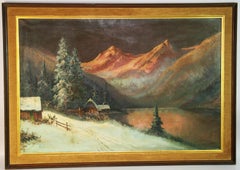
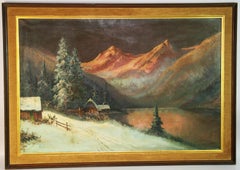
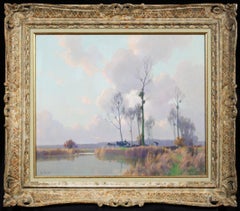
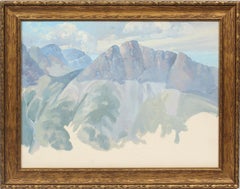
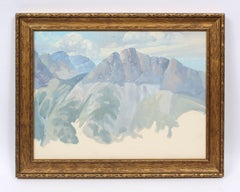
Mid Century Reflecting Mountains Norwegian Landscape

Mid Century Reflecting Mountains Norwegian Landscape

Located in Soquel, CA

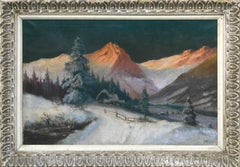
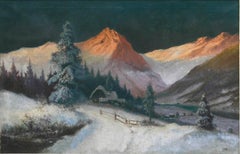
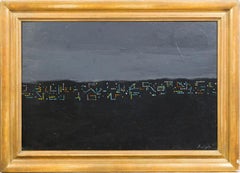
Serene mid-century landscape of mountains reflecting over a fjord in Norway by an unknown artist, Circa 1940's. Unsigned. Displayed in a rustic giltwood frame. Image, 20"H x 24"W. The Norwegian and Antarctic Fjords were carved by a massive sheet of ice...

Category

Impressionist 1940s Art

Materials

Canvas, Oil, Cardboard

Art Deco Polo Mural Study Signed by Wheeler Williams

Art Deco Polo Mural Study Signed by Wheeler Williams

By Wheeler Williams

Located in New York, NY

Wheeler Williams (American, 1897-1972) Untitled Study, 1944 (Polo Players) Pencil on paper 15 1/2 x 19 1/4 in. Signed lower right: Wheeler Williams, 1944 Artist studio label verso Inscribed on mat: Drawings for Proposed Murals: Polo Room, Hotel Plaza.... A native of Chicago, Wheeler Williams is known for his allegorical, narrative work including "Tablets to Pioneers" on the Michigan Avenue bridge in Chicago, and "Settlers of the Seaboard" in Fairmount Park in Philadelphia. He graduated with honors from Yale University in 1919 and earned a Master of Architecture degree from Harvard in 1922. He studied at the Art Institute of Chicago with sculptor Albin Polasek...

Category

Art Deco 1940s Art

Materials

Paper, Pencil

Dragon vert, Surrealist Etching by Andre Masson

Dragon vert, Surrealist Etching by Andre Masson

By André Masson

Located in Long Island City, NY

Andre Masson, French (1896 - 1987) - Dragon vert, Medium: Etching and aquatint, signed and numbered in pecnil, Edition: 14/50, Image Size: 10.5 x 8 inches, Size: 16.25 x 13 in. (41....

Category

Surrealist 1940s Art

Materials

Etching, Aquatint

Giant Aphid

Giant Aphid

By (after) Paul Klee

Located in Henderson, NV

Medium: collotype (after the lithograph). Printed in 1947 and published by The Museum of Modern Art in an edition of 2000 for a scarce Paul Klee portfolio. Image size: 9 1/2 x 5 1/4 ...

Category

1940s Art

Materials

Photogravure

At the Window

At the Window

By (after) Paul Klee

Located in Henderson, NV

Medium: collotype (after the lithograph). Printed in 1947 and published by The Museum of Modern Art in an edition of 2000 for a scarce Paul Klee portfolio. Image size: 5 1/4 x 4 inch...

Category

1940s Art

Materials

Photogravure

Saint George

Saint George

By (after) Paul Klee

Located in Henderson, NV

Medium: collotype (after the lithograph). Printed in 1947 and published by The Museum of Modern Art in an edition of 2000 for a scarce Paul Klee portfolio. Image size: 4 1/4 x 6 1/4 ...

Category

1940s Art

Materials

Photogravure

Comedy of Birds

Comedy of Birds

By (after) Paul Klee

Located in Henderson, NV

Medium: collotype (after the lithograph). Printed in 1947 and published by The Museum of Modern Art in an edition of 2000 for a scarce Paul Klee portfolio. Image size: 9 1/2 x 5 1/4 ...

Category

1940s Art

Materials

Photogravure

River View

River View

By (after) Paul Klee

Located in Henderson, NV

Medium: collotype (after the lithograph). Printed in 1947 and published by The Museum of Modern Art in an edition of 2000 for a scarce Paul Klee portfolio. Image size: 6 3/4 x 9 1/2 ...

Category

1940s Art

Materials

Photogravure

Railroad Station

Railroad Station

By (after) Paul Klee

Located in Henderson, NV

Medium: collotype (after the etching). Printed in 1947 and published by The Museum of Modern Art in an edition of 2000 for a scarce Paul Klee portfolio. Image size: 5 3/4 x 7 3/4 inc...

Category

1940s Art

Materials

Photogravure

Little World

Little World

By (after) Paul Klee

Located in Henderson, NV

Medium: collotype (after the etching). Printed in 1947 and published by The Museum of Modern Art in an edition of 2000 for a scarce Paul Klee portfolio. Image size: 5 1/2 x 3 3/4 inc...

Category

1940s Art

Materials

Photogravure

Garden of Passion

Garden of Passion

By (after) Paul Klee

Located in Henderson, NV

Medium: collotype (after the etching). Printed in 1947 and published by The Museum of Modern Art in an edition of 2000 for a scarce Paul Klee portfolio. Image size: 3 1/2 x 5 1/2 inc...

Category

1940s Art

Materials

Photogravure

Pergola

Pergola

By (after) Paul Klee

Located in Henderson, NV

Medium: collotype (after the etching). Printed in 1947 and published by The Museum of Modern Art in an edition of 2000 for a scarce Paul Klee portfolio. Image size: 3 3/4 x 5 inches ...

Category

1940s Art

Materials

Photogravure

Two Figures

Two Figures

By (after) Paul Klee

Located in Henderson, NV

Medium: collotype (after the etching). Printed in 1947 and published by The Museum of Modern Art in an edition of 2000 for a scarce Paul Klee portfolio. Image size: 4 3/4 x 4 3/4 inc...

Category

1940s Art

Materials

Photogravure

Little Castle in the Air

Little Castle in the Air

By (after) Paul Klee

Located in Henderson, NV

Medium: collotype (after the etching). Printed in 1947 and published by The Museum of Modern Art in an edition of 2000 for a scarce Paul Klee portfolio. Image size: 3 1/2 x 8 1/4 inc...

Category

1940s Art

Materials

Photogravure

L'Homme approximatif

L'Homme approximatif

By (after) Paul Klee

Located in Henderson, NV

Medium: collotype (after the etching). Printed in 1947 and published by The Museum of Modern Art in an edition of 2000 for a scarce Paul Klee portfolio. Image size: 7 x 5 3/8 inches ...

Category

1940s Art

Materials

Photogravure

Veillee Sepulchrale; Verso: Study of two figures in a landscape

Veillee Sepulchrale; Verso: Study of two figures in a landscape

By Eugene Berman

Located in Fairlawn, OH

Veillee Sepulchrale Verso: Study of two figures in a landscape Pen and ink on rose colored Canson watermark paper, 1944 Signed in ink with the artist's initials lower center (see photo) Dated 1944 lower center; Titled in ink upper left corner (see photo) Provenance: Swann Galleries, 2010, realized $900. John Popplestone (1928-2013), Akron, OH collector, noted psychologist and author Berman brothers (painters) From Wikipedia, the free encyclopedia Jump to navigationJump to search This article is about the painters. For the American songwriters/producers, see Berman Brothers (producers). Eugene Berman in Italy in the 1960s Eugène Berman (Russian: Евгений Густавович Берман; 4 November 1899, Saint Petersburg, Russia – 14 December 1972, Rome) and his brother Leonid Berman...

Category

Surrealist 1940s Art

Materials

Ink, Pen

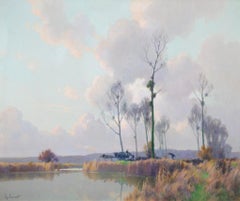
"Monterey Bay" Impressionist Landscape by Elmer Stanhope

"Monterey Bay" Impressionist Landscape by Elmer Stanhope

Located in San Francisco, CA

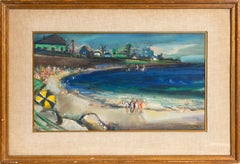
Beautiful 1940's impressionist landscape by Elmer Stanhope (1907-1956) Titled "Monterey Bay" Oil on canvas The canvas measures 24" x 30", while the frame measures 30" x 36"

Category

Impressionist 1940s Art

Materials

Oil

Paris - Lithograph by Orfeo Tamburi - 1946

Paris - Lithograph by Orfeo Tamburi - 1946

By Orfeo Tamburi

Located in Roma, IT

Paris is a beautiful artwork realized by Orfeo Tamburi in 1946. Lithograph on paper. Good conditions. The artwork represents a view of the french city Paris with confident strokes...

Category

Modern 1940s Art

Materials

Lithograph

Gravestone Leap-Frog

Gravestone Leap-Frog

By Bert Hardy

Located in London, GB

A young boy from the Gorbals area of Glasgow playing leap-frog over gravestones. Children play in the graveyard because they have no gardens or playgrounds. Original Publication: Pic...

Category

Modern 1940s Art

Materials

Silver Gelatin

Tauromaquia - Plate 12

Tauromaquia - Plate 12

Located in Henderson, NV

Medium: heliogravure (after the etching from Goya's Tauromaquia series). Printed in 1947 in a limited edition of 500 on Guarro laid paper, and published in Barcelona by Ediciones Ome...

Category

1940s Art

Materials

Photogravure

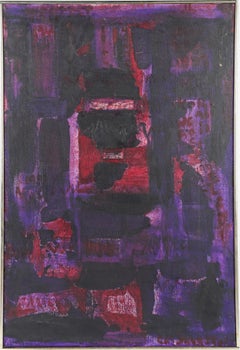
Conflict, 1941 gouache by John Von Wicht

Conflict, 1941 gouache by John Von Wicht

By John von Wicht

Located in Hudson, NY

Conflict (1941) Gouache on paper 20" x 12" 27 ½" x 19 ¼" x 1 ½" framed Signed "V. Wicht" lower right. An important work from the artist's "Force" series, which were executed in hom...

Category

Abstract 1940s Art

Materials

Paper, Gouache

Das Mondgespenst / The ghost of the moon

Das Mondgespenst / The ghost of the moon

Located in Wien, 9

Franz Rogler (1921 -1994) studied wood and stone sculpture with Wilhelm Gösser at the Graz School of Applied Arts and attended the master class for painting with Rudolf Szyszkowitz. During his studies he was drafted for military service and, together with fellow artist Hans Fronius, was deployed as a war painter in Austria, Germany, Italy, the former Yugoslavia, Greece and Russia. During this time he completed studies at the Academy in Zagreb and organised exhibitions in Austria. In 1944 he deserted and managed to escape to Switzerland, where he settled in Basel after his internment and came into contact with the Swiss Surrealists of "Group 33" and with the artists Hans Arp, Max Ernst and Meret Oppenheim through his friend Regula Weilenmann. After the end of the war, he studied at the Basel Art School with Walter Bodmer and Heinrich Müller, which introduced him to Constructivist art. In 1947 Rogler returned to Graz and became a member of the Graz Secession. From 1948 to 1950 he studied at the Vienna Academy with Albert Paris Gütersloh, before returning to Graz as a freelance artist in 1950. In 1953 he received the Art Prize of the City of Graz and his works were published in the first issue of the "Surrealist Publications" edited by Edgar Jené and Paul Celan...

Category

Surrealist 1940s Art

Materials

Paper, India Ink

Mid-Century Winter Sunrise Landscape

Mid-Century Winter Sunrise Landscape

By Genevieve Idell Booth Clibborn

Located in Soquel, CA

Beautiful mid-century winter landscape of the sun rising over a forest stream covered in fresh snow by Genevieve Clibborn (American, 1892-1982). Presented in a rustic ornate, faux wood frame. Image, 12"H x 16"W. Genevieve Idell Booth Clibborn was born in Washington on January 6, 1896. She lived most of her life in Salinas, California (East of the Monterey Peninsula). She painted and exhibited widely in that area. An award-winning artist, she was primarily self-taught and was known for her tree studies. She was a member of the Santa Cruz Art League. She was also a famous evangelist who preached at revivals in the United States, Canada and Australia. Her husband was William Booth-Clibborn, grandson of the founder of the Salvation Army...

Category

American Impressionist 1940s Art

Materials

Canvas, Oil, Cardboard

Gauguin, The God (Te atua), Gauguin (after)

Gauguin, The God (Te atua), Gauguin (after)

By Paul Gauguin

Located in Southampton, NY

Woodcut on vélin Utopian paper. Unsigned and unnumbered, as issued. Good Condition. Notes: From the folio, Gauguin, A portfolio of 12 color woodblocks, Paul Gauguin, French, 1848-19...
Category

Post-Impressionist 1940s Art

Materials

Woodcut

Model - Pencil Drawing by Eugène Berman - 1944

Model - Pencil Drawing by Eugène Berman - 1944

By Eugene Berman

Located in Roma, IT

Drawing on paper, 1944. Dimensions: 43 x 35 cm Hand signed. This artwork is shipped from Italy. Under existing legislation, any artwork in Italy created over 70 years ago by an arti...
Category

Modern 1940s Art

Materials

Pencil

Le Singe - Etching by Pablo Picasso - 1940s

Le Singe - Etching by Pablo Picasso - 1940s

By Pablo Picasso

Located in Roma, IT

Etching, aquatint and drypoint. Not Signed and not Numbered as issued. Edition of 226 pieces. Belongs to the Suite "Histoire Naturelle de Buffon" (plate p. 86). Printed by Lacourièr...

Category

Cubist 1940s Art

Materials

Paper, Etching, Drypoint, Aquatint

Les Deux Anges

Les Deux Anges

By Marie Laurencin

Located in New York, NY

A very good impression of this lithograph with strong colors. Second state (of 2). Signed and numbered 19/160 in pencil, lower left.

Category

Cubist 1940s Art

Materials

Color, Lithograph

Suburb (in Winter)

Suburb (in Winter)

Located in Los Angeles, CA

This painting is part of our exhibition Charles Goeller: A Wistful Loneliness. Oil on canvas, 20 x 15 inches, Signed lower right Exhibited: 1) Portrai...

Category

American Modern 1940s Art

Materials

Oil

Woman with a White Horse

Woman with a White Horse

By David Burliuk

Located in Saratoga Springs, NY

Signed lower right and dated 1948 David Burliuk’s vibrant depiction of a Ukrainian countryside captures a moment of quiet resilience and rural harmony. A woman, adorned in a red ker...

Category

Post-Impressionist 1940s Art

Materials

Oil, Board