Woodcut Prints and Multiples

to
497
3,207
491
321
158
239
Overall Width
to
Overall Height
to
2,036
533
228
212
197
98
55
45
42
32
9
4
1
1
170
135
57
53
51
62
658
3,163
539
28
112
430
291
153
206
363
133
157
102
33
3,111
1,193
93
2,315
1,203
900
804
612
463
455
386
349
293
271
269
238
218
208
181
168
151
135
108
4,766
36,298
20,259
18,252
10,629
407
2,131
2,446
1,868
Medium: Woodcut
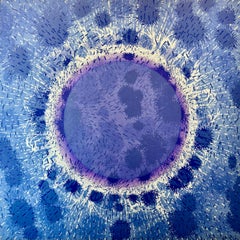
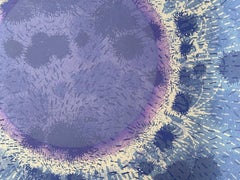
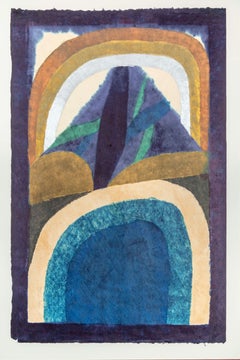
Burst Variation 156 - Abstract Woodcut Print Circle Pattern Blue, 2025

Burst Variation 156 - Abstract Woodcut Print Circle Pattern Blue, 2025

By Eve Stockton

Located in Kent, CT

This woodcut print on paper is composed of a central, circular shape in violet on a blue patterned background. The monotype brings to mind the tradition of Japanese printing while be...

Category

2010s Contemporary Woodcut Prints and Multiples

Materials

Archival Ink, Archival Paper, Monotype, Woodcut

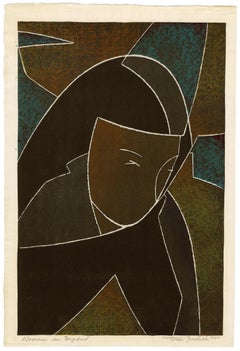
'Woman In Bagdad' — 1950s Japanese Sôsaku-hanga Signed Woodblock Print

'Woman In Bagdad' — 1950s Japanese Sôsaku-hanga Signed Woodblock Print

Located in Myrtle Beach, SC

Toshi Yoshida, 'Woman In Bagdad', color woodblock print, 1954, edition not stated. Signed, dated, and titled, in pencil. A fine, richly-inked impression, with fresh colors, on cream-wove Japan paper; the full sheet with margins (1/2 to 7/8 inch); minor toning in the margins, otherwise in excellent condition. Self-carved, self-printed. Archivally sleeved, unmatted. Image size 14 13/16 x 9 7/8 inches; sheet size 16 1/4 x 11 inches (oban tate-e). Exhibited: 'Color in Relief: Wood Block Prints from Origins to Abstraction', Georgetown University Library, 2016. Literature: Oliver Statler, Modern Japanese Prints: An Art Reborn, 1959, pp.168-169; Eugene M. Skibbe, Yoshida Toshi 1911-1999: Diversity, Change, and Continuity in the Yoshida Art Tradition, Andon 53, Society for Japanese Arts, 1996, pp. 5-14; Kendall H. Brown, Yoshida Toshi: The Nature of Tranquility, in, A Japanese Legacy: Four Generations of Yoshida Family Artists, The Minneapolis Institute of Arts, 2002, pp. 72-80; p. 91, no. 55 Exhibition: Japan & Beyond: The Yoshida Family Legacy in Japanese Woodblock Prints, curated by Kendall Brown and Quyen Le, The Ruth and Sherman Lee Institute for Japanese Art, Hanford, CA. February 3, 2004 - March 27, 2004. Collections: Art Institute of Chicago, Clark Center for Japanese Art and Culture, Minneapolis Institute of Art, University of California Merced, University of Oregon (The Lavenberg Collection of Japanese Prints). ABOUT THE ARTIST Yoshida Toshi (1911-1995) began training at the age of 14 under his father, Yoshida Hiroshi, one of the most acclaimed artists of the Japanese 20th-century printmaking revival movement shin-hanga (’new prints’ created in the traditional collaborative system of Japanese printmaking). He studied from 1932 to 1935 at the Taiheiyo-Gakai (Pacific Painting Association), co-founded by his father. Before the Pacific War, Toshi traveled widely with his father in Asia, Europe, Egypt, and the United States. Later he continued his worldwide travels, especially in Mexico, the United States, Canada, and Africa. Following his father’s death in 1950, Toshi began his very personal exploration of abstraction, joining the sôsaku-hanga movement (’creative prints’ wherein the artist is creator, carver, and printer). During this richly creative period (1954 to 1973), Toshi created over three hundred nonobjective designs. In the early 1960s, Toshi returned to large-scale figurative work, concentrating on scenes of African wildlife in its natural habitat, and in 1984 he published the first of many illustrated children's books on African wildlife (Dobutsu Ehon Shirizu), which he continued to produce until the early 1990s. In 1966 he published a book with the artist Yuki Rei...

Category

1960s Abstract Woodcut Prints and Multiples

Materials

Woodcut

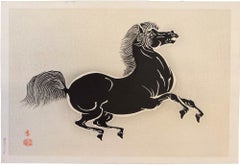
Black Horse
Black Horse

Black Horse

By Tokuriki Tomikichiro

Located in Middletown, NY

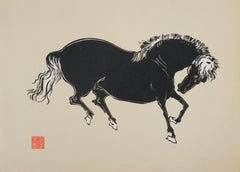
circa 1950. Woodblock print in black and gray ink on Japon laid paper, 10 1/4 x 15 3/4 inches (260 x 398 mm), full margins. With the artist's embossed chop mark in red ink in the l...

Category

Mid-20th Century Edo Woodcut Prints and Multiples

Materials

Handmade Paper, Woodcut

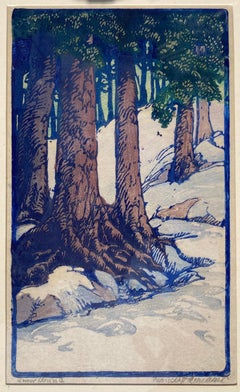
San Jacinto Color Woodcut Print, American Impressionist, Circa 1926

San Jacinto Color Woodcut Print, American Impressionist, Circa 1926

By Frances H. Gearhart

Located in Santa Monica, CA

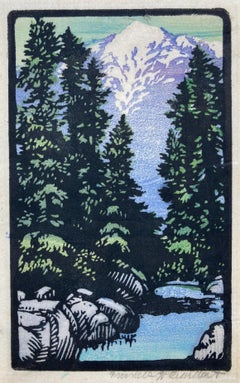
FRANCES H. GEARHART (1869-1958) (Mt.) SAN JACINTO c. 1926 Color block print. Signed in pencil. Unknown edition but uncommon. Image 6 5/8 x 4 1/8 inches. On Gearhart's typical fibrous japan paper. Sheet 10 ½ x 5 7/8 inches. Generally fresh with her usual pinholes along right margin for printing, slight bit of discoloration in the margins Provenance: Whitmore - Print Corner, Hingham MA. Their Gearhart inventory no. They were Gearhart's principal East coast dealer in the 30's. Obtained from the Whitmore Collection’s grandson in 1995. Old Print Shop...

Category

1920s American Impressionist Woodcut Prints and Multiples

Materials

Woodcut

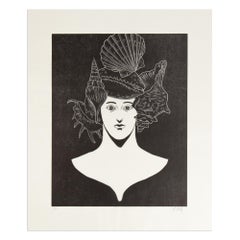
'Venus'  — German Expressionism

'Venus' — German Expressionism

By Karl Michel

Located in Myrtle Beach, SC

Karl Michel, 'Venus, Ex Libris - Hanns U. Herta Heeren', woodcut, 1923, edition not stated but small. Signed, dated, and numbered 'op.154' in pencil. Signed in the block, lower left. A fine impression, on cream Japan paper, with full margins (15/16 to 2 11/16 inches), in good condition. Printed by the artist. Matted to museum standards (unframed). . Translation: Venus Ex Libris for Hanns and Herta Heeren. Image size 5 15/16 x 4 inches (156 x 102 mm); sheet size 9 5/8 x 6 inches (245 x 152 mm). ABOUT THE ARTIST Karl Michel (1889-1984) was a noted graphic designer and expressionist printmaker during Germany's pre-Nazi Weimar Republic (1919-1933). Michel’s work was the subject of a feature article in the influential German graphic design magazine Das Plakat (The Poster) in 1920. An anti-war advocate, Michel created a suite of 12 wood engravings depicting his impressions of the humanitarian toll of WWII entitled ‘Humanitas’ (Humanity). The German publishing house Greifenverlag published the series in a reduced folio of unsigned prints. Michel’s graphic work is held in the permanent collections of the Auckland War Memorial Museum (New Zealand), Frederikshavn Kunstmuseum & Exlibrissamling (Denmark), Museum of Applied Arts (Budapest), The Robert Gore Rifkind Center for German Expressionist Studies at the Los Angeles County Museum of Art, and the German Expressionism...

Category

1920s Expressionist Woodcut Prints and Multiples

Materials

Woodcut

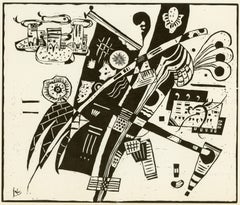
Wassily Kandinsky, Komposition, from XXe siecle, 1939

Wassily Kandinsky, Komposition, from XXe siecle, 1939

By Wassily Kandinsky

Located in Southampton, NY

This exquisite woodcut by Wassily Kandinsky (1866–1944), titled Komposition (Composition), from the album XXe siecle, Chroniques du jour, 13 rue Valette (5e), Directeur G. di San Laz...

Category

1930s Modern Woodcut Prints and Multiples

Materials

Woodcut

Wood Cut on Rice Paper "The Cicada Shell (Utsusemi)" by Gekko Ogata

Wood Cut on Rice Paper "The Cicada Shell (Utsusemi)" by Gekko Ogata

Located in Soquel, CA

Wood Cut on Rice Paper "The Cicada Shell (Utsusemi)" by Gekko Ogata Woodcut is a striking 1892 woodblock print by Meiji-era master Ogata Gekko (Japanese, 1859–1920). It references T...

Category

Late 19th Century Impressionist Woodcut Prints and Multiples

Materials

Printer's Ink, Rice Paper, Woodcut

"House Cleaning in Preparation for the New Year" - Japanese Woodblock on Paper

"House Cleaning in Preparation for the New Year" - Japanese Woodblock on Paper

By Kitagawa Utamaro 1

Located in Soquel, CA

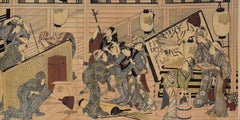
"House Cleaning in Preparation for the New Year" - Japanese Woodblock on Paper House cleaning scene by Kitagawa Utamaro (Japanese, 1753-1806). This print was originally published around 1796-1799, with this example being a later reprint. The full scene is five sheets - there are two more sheets to the right that show more members of the house. However, it is these three sheets that contain the majority of the action - a maid sweeping at a mouse, a lady fainting, and a painting moved aside to allow for cleaning. Presented in a new black mat. Mat size: 24"H x 38"W Paper size: 17.75"H x 33"W Print Impression: 14.63"H x 29.5"W Utamaro Kitagawa...

Category

18th Century Edo Woodcut Prints and Multiples

Materials

Rice Paper, Woodcut

Blue Hydrangea
Blue Hydrangea

Blue Hydrangea

By Elyse Ashe Lord

Located in Middletown, NY

A lively image by a female artist who was part of a vibrant generation of British printmakers who were pushing the boundaries of color and technique during the early 20th century. N...

Category

Early 20th Century English School Woodcut Prints and Multiples

Materials

Gouache, Handmade Paper, Drypoint, Woodcut

Graceland Mansion
Graceland Mansion

Graceland Mansion

By Jennifer Bartlett

Located in Houston, TX

Jennifer Bartlett Graceland Mansions, 1978-79 Drypoint, aquatint, silkscreen, woodcut, and lithograph on J. Green Cold Press paper and Rives BFK paper 24 x 120 inches, unframed Ed...

Category

20th Century Modern Woodcut Prints and Multiples

Materials

Etching, Lithograph, Screen, Woodcut, Drypoint, Aquatint

KYOTO (B)
KYOTO (B)

KYOTO (B)

By Kiyoshi Saitō

Located in Santa Monica, CA

KIYOSHI SAITO (Japanese 1907 - 1997) KYOTO (B) 1966 Color woodcut, signed, titled, dated and no. 5/100 in pencil. Edition 100. Image 14 3/4 x 20 5/8 inches. Full margins with deckle...

Category

1960s Modern Woodcut Prints and Multiples

Materials

Woodcut, Color

Poèmes, Planche IX, Original Woodcut, 1968, Japon Paper

Poèmes, Planche IX, Original Woodcut, 1968, Japon Paper

By Marc Chagall

Located in OPOLE, PL

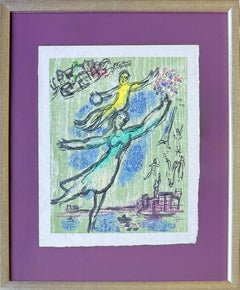
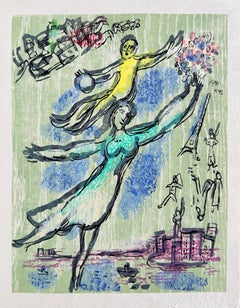
Marc Chagall (1887-1985) - Poèmes, Planche IX Woodcut print from 1968. An unnumbered and unsigned impression from the total edition of 238; this impression is on Japon paper, one o...

Category

1960s Modern Woodcut Prints and Multiples

Materials

Woodcut

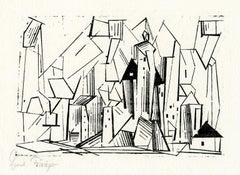
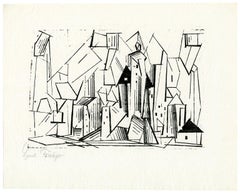
'Die Architektur' (Architecture) — Bauhaus Modernism

'Die Architektur' (Architecture) — Bauhaus Modernism

By Lyonel Feininger

Located in Myrtle Beach, SC

Lyonel Feininger, 'Die Architektur' (Architecture), also 'Stadtbild' (Cityscape), woodcut, edition proofs only in 1920; 50 in 1921. Prasse W 232. Signed in pencil. A fine, black impression, on off-white Japan, with full margins (1 1/4 to 2 1/8 inches), in excellent condition. Matted to museum standards, unframed. Image size 6 x 8 7/8 inches (152 x 229 mm); sheet size 9 1/2 x 11 7/8 inches (241 x 302 mm). No. 11 of the portfolio 'Zwolf Holzschnitte von Lyonel Feininger', 1921. Provenance: Peter Deitsch collection; exhibited Weimar Museum, 1968. Impressions of this work are in the permanent collection of: Busch-Reisinger Museum (Cambridge, Mass.), Bauhaus-Archiv (Germany), Hamburger Kunsthalie (Germany), Pfaizische Landesgewerbeanstalt (Germany), Kaiser Wilhelm Museum (Germany), Staatliche Graphische Sammlung (Germany), Philadelphia Museum of Art. ABOUT THE ARTIST Lyonel Feininger was born in New York City into a musical family—his father was a violinist and composer, his mother was a singer and pianist. He studied violin with his father, and by the age of 12, he was performing in public, but he also drew incessantly, most notably the steamboats and sailing ships on the Hudson and East Rivers, and the landscape around Sharon, Conn., where he spent time on a farm owned by a family friend. At the age of 16 he left New York to study music and art in Germany, from where his parents emigrated. Drawn more to the visual arts, he attended schools in Hamburg, Berlin, and Paris from 1887 to 1892. After completing his studies, Feininger began his artistic career as a cartoonist and illustrator, his originality leading him to great success. In 1906, after working for a dozen years in Germany, he was offered a job as a cartoonist at the Chicago Tribune, the largest circulation newspaper in the Midwest. He worked there for a year, inventing what became the standard design for the comic strip: in the words of John Carlin, “an overall pattern. . . that allowed the page to be read both as a series of elements one after the other, like language and as a group of juxtaposed images, like visual art.” His originality did not end there: he went on to become one of the great abstract painters. Like Kandinsky, music was his model, but Kandinsky only knew music from the outside—as a listener (inspired initially by Wagner, then by Schoenberg)—while Feininger knew it from the inside. He lived in Paris from 1906 to 1908, during which time he met and was influenced by the work of progressive painters Robert Delaunay and Jules Pascin, as well as that of Paul Cezanne and Vincent van Gogh. He began painting full-time, developing his distinctive Iyrical style based on Cubist and Expressionist idioms and a concern for the emotive qualities of light and color. He exhibited with the Der Blaue Reiter group in 1913, and in 1917, he had his first solo exhibition at Galerie Der Sturm in Berlin. One year after his solo exhibition, in 1918, Feininger began making woodcuts. He became enamored with the medium, producing an impressive 117 in his first year of exploring the printmaking medium. In 1919 at the invitation of the architect Walter Gropius, he was appointed the first master at the newly formed Staatliches Bauhaus in Weimar. His woodcut of a cathedral...

Category

1920s Bauhaus Woodcut Prints and Multiples

Materials

Woodcut

Elegant Amusements of Eastern Genji - Japanese Triptych Woodblock Print on Paper

Elegant Amusements of Eastern Genji - Japanese Triptych Woodblock Print on Paper

By Utagawa Kunisada (Toyokuni III)

Located in Soquel, CA

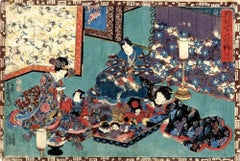
Elegant Amusements of Eastern Genji - Japanese Triptych Woodblock Print on Paper Dynamic woodblock print with several elegantly dressed figures by Utag...

Category

1850s Edo Woodcut Prints and Multiples

Materials

Paper, Ink, Woodcut

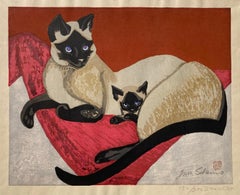
TWO SIAMESE CATS
TWO SIAMESE CATS

TWO SIAMESE CATS

By Junichiro Sekino

Located in Santa Monica, CA

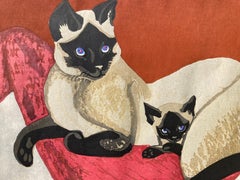
JUN'ICHIRO SEKINO (1914-1988) TWO SIAMESE CATS Japanese Woodblock Print, c. 1960, 1st edition, pencil signed, titled and numbered 90/200 with red Sekino pub...

Category

1960s Modern Woodcut Prints and Multiples

Materials

Woodcut

Japanese Print, Koi Carp - Signed Woodcut

Japanese Print, Koi Carp - Signed Woodcut

By Mokuchu URUSHIBARA

Located in Paris, IDF

Mokuchu URUSHIBARA Koi Carp, c. 1930 Woodcut after on an ink drawing Signed with the artist's stamp On paper 30 x 24 cm (c. 11.81 x 9.44 in) INFORMATION : Engraving published by Mo...

Category

1930s Modern Woodcut Prints and Multiples

Materials

Woodcut

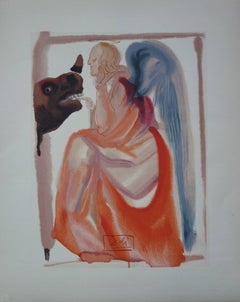
Cerberus - Woodcut print - 1963

Cerberus - Woodcut print - 1963

By Salvador Dalí­

Located in Roma, IT

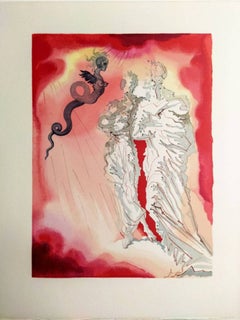
Cerberus - Hell  plate 6 is a woodcut print realized in 1963 for a series illustrating the Medieval poem of the "Divine Comedy" by Dante Alighieri. Good conditions. Limited editio...

Category

1960s Surrealist Woodcut Prints and Multiples

Materials

Woodcut

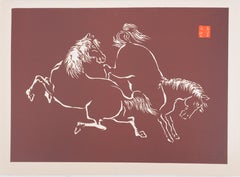
Japanese Print, Pair of horses playing (red) - Signed Woodcut

Japanese Print, Pair of horses playing (red) - Signed Woodcut

By Mokuchu URUSHIBARA

Located in Paris, IDF

Mokuchu URUSHIBARA Pair of horses playing (red), c. 1930 Woodcut after on an ink drawing Signed with the artist's stamp On paper 28 x 39 cm (c. 11.02 x 15.35 in) INFORMATION : Engr...

Category

1930s Modern Woodcut Prints and Multiples

Materials

Woodcut

Tolosa (Toulouse); Leaf LXXI from Hartmann Schedel's Nuremberg Chronicle

Tolosa (Toulouse); Leaf LXXI from Hartmann Schedel's Nuremberg Chronicle

Located in Middletown, NY

Woodcut on laid paper, 8 3/8 x 9 1/8 inches (212 x 233 mm), the full sheet. In excellent condition with text and portraits of Empedocles, Sapho, Zeuxis and others on the verso, as is...

Category

15th Century and Earlier Old Masters Woodcut Prints and Multiples

Materials

Ink, Handmade Paper, Laid Paper, Woodcut

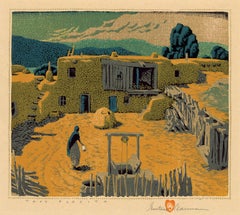
'Taos Placita' — American Southwest Regionalist Masterwork

'Taos Placita' — American Southwest Regionalist Masterwork

By Gustave Baumann

Located in Myrtle Beach, SC

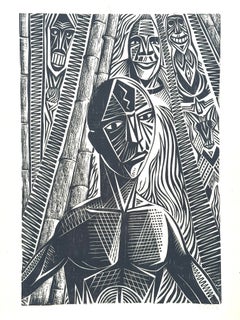
Gustave Baumann, 'Taos Placita', color woodcut, 1947, edition 125. Baumann 132. Signed, titled, and numbered '20-125' in pencil; with the artist’s Hand-in-Heart chop. A superb, richly-inked impression, with fresh colors, on fibrous oatmeal wove paper; the full sheet with margins (2 to 3 1/8 inches); slight rippling at the left sheet edge, in excellent condition. Matted to museum standards, unframed. Image size 9 5/8 x 11 1/4 inches (244 x 286 mm); sheet size 13 1/4 x 17 inches (337 x 432 mm). Collections: Harwood Museum of Art, New Mexico Museum of Art, Phoenix Art Museum, Scottsdale Art Museum, Wichita Art Museum. ABOUT THE ARTIST Gustave Baumann (1881-1971) was a renowned printmaker and a leading figure of the American color woodcut revival whose exquisite craftsmanship and vibrant imagery captured the essence of the Southwest. "A brilliant printmaker, Baumann brought to the medium a full mastery of the craft of woodworking that he acquired from his father, a German cabinetmaker. This craftsmanship was coupled with a strong artistic training that resulted in the handsome objects we see in the exhibition today. After discovering New Mexico in 1918, Baumann began to explore in his woodblock prints of this period the light. color, and architectural forms of that landscape. His prints of this period are among the most beautiful and poetic images of the American West." —Lewis I. Sharp, Director, Denver Art Museum Baumann, the son of a craftsman, immigrated to the United States from Germany with his family when he was ten, settling in Chicago. From 1897 to 1904, he studied in the evenings at the Art Institute of Chicago, working in a commercial printmaking shop during the day. In 1905, he returned to Germany to attend the Kunstwerbe Schule in Munich, where he decided on a career in printmaking. He returned to Chicago in 1906 and worked for a few years as a graphic designer of labels. Baumann made his first prints in 1909 and exhibited them at the Art Institute of Chicago the following year. In 1910, he moved to the artists’ colony in Nashville, Indiana, where he explored the creative and commercial possibilities of a career as a printmaker. In 1915, he exhibited his color woodcuts at the Panama-Pacific International Exposition in San Francisco, winning the gold medal. Among Baumann’s ongoing commercial activities was his work for the Packard Motor Car Company from 1914 to 1920 where he produced designs, illustrations, and color woodcuts until 1923. In 1919, Baumann’s printmaking work dominated the important exhibition of American color woodcuts at the Detroit Institute of Arts. Twenty-six of his prints were included, far more than the works of any other artist. A set of his blocks, a preparatory drawing, and seven progressive proofs complemented the exhibition. That same year, Baumann worked in New York and, over the summer, in Provincetown, Massachusetts. His airy images of Cape Cod employed soft, pastel colors and occasionally showed the influence of the white-line woodcut technique. Many of his Chicago artist friends had traveled to the southwest, and Baumann became intrigued by their paintings, souvenirs, and stories of an exotic place named Taos, New Mexico. In the summer of 1918, he spent the summer in Taos sketching and painting before visiting Santa Fe. Paul Walter, the director of the Museum of New Mexico, offered him a studio in the museum's basement. Inspired by the rugged beauty of the Southwest—the vibrant colors and dramatic landscapes of the region became a central theme in his work, influencing his artistic style and subject matter for the remainder of his career. Later in the decade, he traveled to the West Coast and made prints of California landscape. Baumann's prints became synonymous with the Southwest, capturing the spirit of its place in America's identity with a unique sense of authenticity and reverence. His iconic images of desert vistas, pueblo villages, and indigenous cultures served as visual tributes to the region's rich cultural heritage, earning him a dedicated following among collectors and curators alike. A true craftsman and artist, Baumann completed every step of the printmaking process himself, cutting each block, mixing the inks, and printing every impression on the handmade paper he selected. His dedication to true craftsmanship and his commitment to preserving the integrity of his artistic vision earned him widespread acclaim and recognition within the art world. About the vibrant colors he produced, Baumann stated, “A knowledge of color needs to be acquired since they don’t all behave the same way when ground or mixed...careful chemistry goes into the making of colors, with meticulous testing for permanence. While complicated formulae evolve new colors, those derived from Earth and metal bases are still the most reliable.” In the 1930s, Baumann became interested in puppet theater. He designed and carved his own marionettes and established a little traveling company. From 1943 to 1945, the artist carved an altarpiece for the Episcopal Church of the Holy Faith in Santa Fe. In 1952, a retrospective exhibition of his prints was mounted at the New Mexico Museum of Fine Arts. Throughout his prolific career, Baumann executed nearly four hundred color woodcuts. Baumann’s woodcuts...

Category

1940s American Modern Woodcut Prints and Multiples
Materials

Woodcut

Jose Luis Cuevas original artist proof signed woodcut Ghosts of downtown V paper

Jose Luis Cuevas original artist proof signed woodcut Ghosts of downtown V paper

By José Luis Cuevas

Located in Miami, FL

Jose Luis Cuevas (Mexico, 1934-2017) Artist Proof 'Fantasmas del Centro Histórico V', 2004 woodcut on paper Guarro Biblos 250g. 20.9 x 16 in. (53 x 40.5 cm.) Edition of 60 Unframed I...

Category

Early 2000s Contemporary Woodcut Prints and Multiples

Materials

Paper, Woodcut, Ink

"Woman Desired by Man" original woodcut

"Woman Desired by Man" original woodcut

By Max Pechstein

Located in Henderson, NV

Medium: original woodcut. Printed in 1920 for the Deutsche Graphiker der Gegenwart portfolio, and published in Leipzig by Klinkhardt & Biermann in an edition of 500. Catalogue re...

Category

1920s Expressionist Woodcut Prints and Multiples

Materials

Woodcut

First Snow at Kitano Shrine — Sosaku Hanga Japanese Woodblock, Kyoto

First Snow at Kitano Shrine — Sosaku Hanga Japanese Woodblock, Kyoto

Located in Myrtle Beach, SC

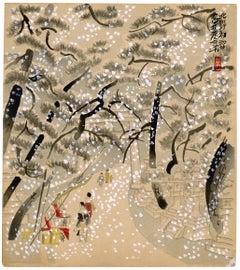
Kamei Tobei, 'First Snow of the Year at Kitano (Kitano Hatsu Yuki)', color woodblock print, c. 1930s. Signed Kamei Tobei in black ink, with the artist red seal Eiichi (the artist’s g...

Category

1930s Showa Woodcut Prints and Multiples

Materials

Woodcut

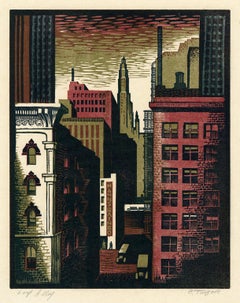
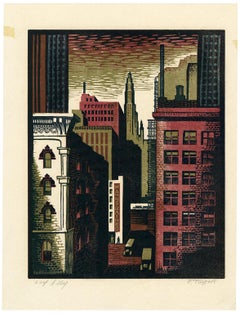
'Lot Cleaning, Los Angeles' — 1930s Modernism

'Lot Cleaning, Los Angeles' — 1930s Modernism

By Paul Landacre

Located in Myrtle Beach, SC

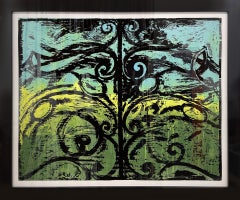
'Lot Cleaning, Los Angeles', wood engraving, edition 60, Zeitlin & Ver Brugge 69. Signed, titled and numbered '51/60' in pencil. A brilliant, black impression, on Kitakata Japan pape...

Category

1930s American Modern Woodcut Prints and Multiples
Materials

Woodcut

Shunga - Woodcut by Katsukawa Schuncho - Mid-18th Century

Shunga - Woodcut by Katsukawa Schuncho - Mid-18th Century

By Katsukawa Shunshō

Located in Roma, IT

Shunga is an original modern artwork realized by Katsukawa Schuncho (1726 – 1793) in the half of the 18th Century. Erotic scene from the series "Koshuko zue juni ko". A courtesan with a customer under a kimono stand...

Category

Mid-18th Century Modern Woodcut Prints and Multiples
Materials

Woodcut, Paper

Composition - Woodcut by Luigi Spacal - 1970s

Composition - Woodcut by Luigi Spacal - 1970s

By Luigi Spacal

Located in Roma, IT

Composition is a contemporary artwork realized by Luigi Spacal (Trieste, 1907 - Trieste, 2000) in the 1970s. Original Colored woodcut print on cardboard. Image Dimensions: 18 x 14 cm Good conditions. Lojze Spacal...

Category

1970s Abstract Woodcut Prints and Multiples

Materials

Woodcut

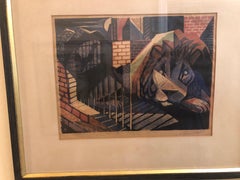
Japanese Print, White-billed Pie - Signed Woodcut

Japanese Print, White-billed Pie - Signed Woodcut

By Mokuchu URUSHIBARA

Located in Paris, IDF

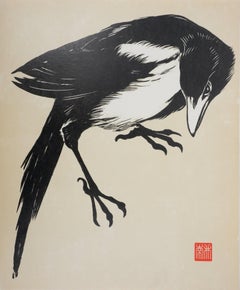
Mokuchu URUSHIBARA White-billed Pie, c. 1930 Woodcut after on an ink drawing Signed with the artist's stamp On paper 32 x 26.5 cm (c. 12.59 x 10.23 in) INFORMATION : Engraving pub...

Category

1930s Modern Woodcut Prints and Multiples
Materials

Woodcut

(Untitled), from the series Pictures of ladies' etiquette

(Untitled), from the series Pictures of ladies' etiquette

By Yoshu Chikanobu

Located in Middletown, NY

Tokyo: c1893. Wooblock tryptich printed in colors on hand laid mulberry paper, 14 3/4 x 29 inches (375 x 737 mm), the full sheet. Meiji period. In very good condition with extensive...

Category

Late 19th Century Woodcut Prints and Multiples

Materials

Handmade Paper, Woodcut

Big Seascape XII Left - Ocean Waves Woodcut Print Blue, 2015

Big Seascape XII Left - Ocean Waves Woodcut Print Blue, 2015

By Eve Stockton

Located in Kent, CT

This contemporary woodcut print on paper evokes the peacefulness of ocean waves depicted in bright, cerulean blue and vibrant cobalt. The woodcut print brings to mind the tradition o...

Category

2010s Contemporary Woodcut Prints and Multiples

Materials

Archival Ink, Archival Paper, Woodcut

'Peking - Paifang Gate' — Mid-Century Watanabe Color Woodcut

'Peking - Paifang Gate' — Mid-Century Watanabe Color Woodcut

By Cyrus Le Roy Baldridge

Located in Myrtle Beach, SC

Cyrus Le Roy Baldridge, 'Peking '25', woodblock print, published 1926. Signed, titled, dated, and annotated 'No 124' in pencil. A fine impression, with fresh, undiminished colors; the full sheet, in excellent condition. Watanabe 6 mm seal, lower right, indicating an impression printed between 1945 and 1957. Archivally sleeved, unmatted. Image size 9 5/8 x 14 5/16 inches; sheet size 10 7/16 x 15 3/8 inches. ABOUT THE IMAGE A 'paifang', also known as a 'pailou', is a traditional style of Chinese architectural arch or gateway structure. It has been theorized that the paifang gate architecture was influenced by Buddhist torana temple gates. Paifang are designed with traditional Chinese architectural motifs including multi-tiered roofs, prominent supporting posts, and gracefully arched openings. This is an unusual ukiyo-e or 'floating world' woodcut published by Watanabe Shozaburo, Tokyo, in that the subject is of an early 20th-century scene in Peking, China. ABOUT THE ARTIST Cyrus Leroy Baldridge...

Category

1920s Showa Woodcut Prints and Multiples

Materials

Woodcut

Japanese Print, Horse Bowing - Signed Woodcut

Japanese Print, Horse Bowing - Signed Woodcut

By Mokuchu URUSHIBARA

Located in Paris, IDF

Mokuchu URUSHIBARA Horse bowing, c. 1930 Woodcut after on an ink drawing Signed with the artist's stamp On paper 26 x 35 cm (c. 10.2 x 13.7 in) INFORMATION : Engraving published by...

Category

1930s Modern Woodcut Prints and Multiples

Materials

Woodcut

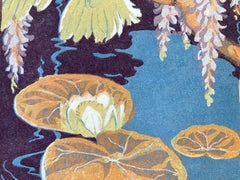
Winter Trees — Sōsaku Hanga Japanese Woodblock Print

Winter Trees — Sōsaku Hanga Japanese Woodblock Print

Located in Myrtle Beach, SC

Hajime Namiki, 'Tree Scene 159', color woodcut, edition 200, 2022. Signed in pencil and with the artist’s red seal. Titled, numbered '37/200' and dated, in pencil. A very fine impres...

Category

21st Century and Contemporary Contemporary Woodcut Prints and Multiples
Materials

Woodcut

SNOWBOUND

SNOWBOUND

By Frances H. Gearhart

Located in Santa Monica, CA

FRANCES H. GEARHART (1869-1958) SNOWBOUND c.1928 Color block print, Signed and titled in pencil. 11 x 6 ½” sheet c. 14 x 9” Laid down on backing board. The usual slight browning a...

Category

1920s American Impressionist Woodcut Prints and Multiples
Materials

Color, Linocut, Woodcut

Find Original Woodcut Prints for Your Home

Original woodcut prints and other types of fine art prints can help enhance any room in your home while supporting your effort to tie an interior design together.
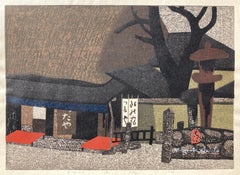
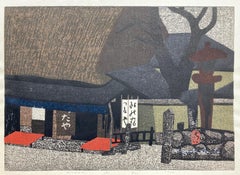
Woodcut is a type of relief print that is made by carving a block of wood with a knife or gouge. The surface is then inked with a roller and pressed onto paper. Unlike with intaglio techniques, the section of the surface that has not been incised is what appears in the print. 
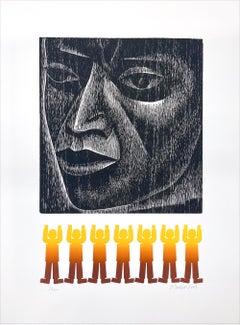
Woodcut printmaking is one of the oldest printing techniques, first used in 9th-century China, mastered by Albrecht Dürer during the Northern Renaissance and famously associated with the ukiyo-e artists of 17th- and 18th-century Japan. (For concision, power and delight, it’s hard to beat a Japanese woodblock print, the product of an artistic tradition that is aging very well indeed.)  

Elsewhere, German Expressionists like Emil Nolde and Ernst Ludwig Kirchner embraced the medium for its bold, graphic power in the 1920s, and artists continue to use it today.

OK, so what is the difference between a woodcut print and an intaglio print?

“[Intaglio] is the opposite of relief printing — woodcut, linoleum cut, letterpress, and rubber or metal stamping,” says Rhea Fontaine of Paulson Fontaine Press. “With relief printing, the raised areas of the printing surface are inked and printed, while the areas that have been cut away do not pick up the ink. Often these prints are made by hand.”

Find original woodcut prints by Katsushika Hokusai, Suzuki Harunobu, M.C. Escher, Mino Maccari and many other artists on 1stDibs.