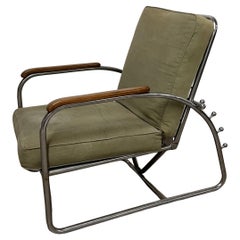
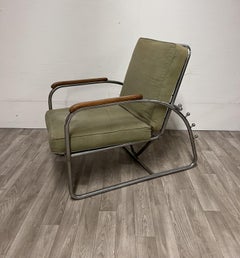
Bauhaus Style Reclining Chair
Located in Red Lion, PA
Bahaus Style Chair reclines in 4 different angles and fully extends to 50"
Category
Vintage 1960s Side Chairs
Materials
Chrome
Bauhaus Style Reclining Chair
Located in Red Lion, PA
Bahaus Style Chair reclines in 4 different angles and fully extends to 50"
Chrome
$9,800
H 30 in W 24 in D 27 in
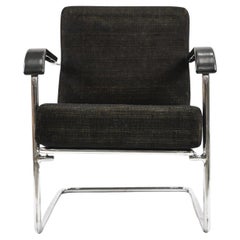
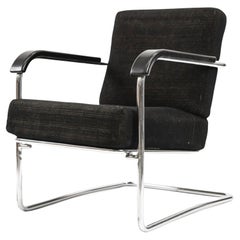
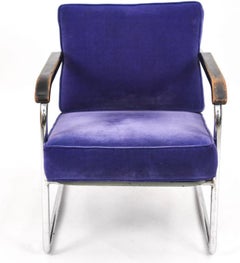
Werner Max Moser Embru Wohnbedarf WB21 Reclining Lounge Chair Switzerland 1935
By Werner Max Moser, Embru
Located in Brooklyn, NY
chair by Werner Max Moser. Manufactured by Embru, Zurich Switzerland. Bauhaus chrome-plated tubular
Stainless Steel

$8,400
H 26 in W 24 in D 33 in
Werner Max Moser Embru Wohnbedarf WM1 Reclining Lounge Chair Switzerland 1939
By Embru, Werner Max Moser
Located in Brooklyn, NY
chair by Werner Max Moser. Manufactured by Embru Wohnbedarf, Zurich Switzerland. Bauhaus chrome-plated
Stainless Steel
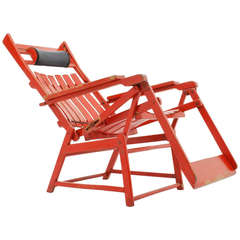
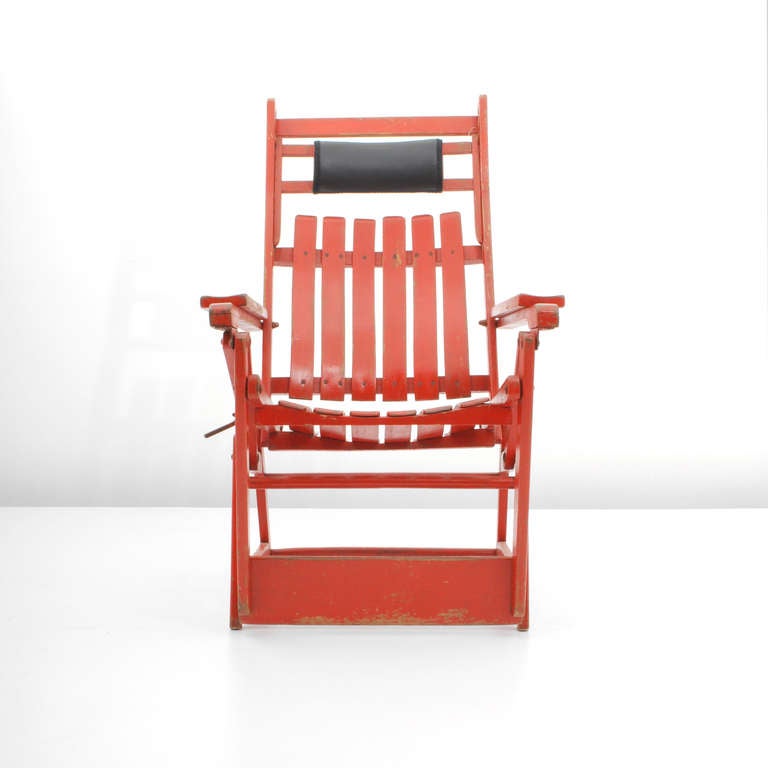
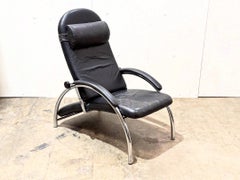
Eckart Muthesius "Siesta" Red Reclining Deck Chair
By Eckart Muthesius
Located in West Palm Beach, FL
Rare Reclining “Siesta” Deck Chair With Adjustable Headrest and Footrest By Architect and Interior
Metal
Sold
H 34 in W 26 in D 36 in
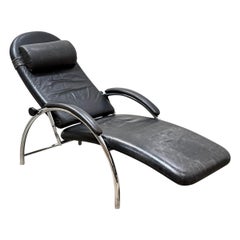
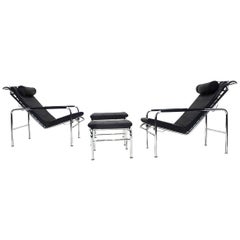
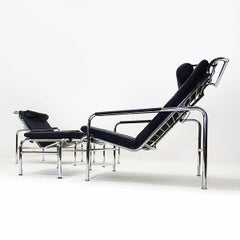
Optima Reclining Lounge Chair by Ingmar + Knut Relling - Black Leather + Chrome
By Westnofa Furniture, Ingmar Relling, Knut Relling
Located in Decatur, GA
Seldom seen vintage Bauhaus style reclining lounge chair/chaise by father + son designers, Ingmar
Steel, Chrome
Sold
H 32.29 in W 22.84 in D 43.31 in
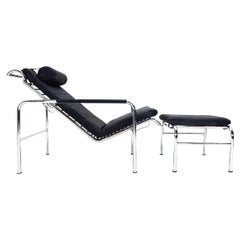
Black Leather and Chrome Gabriele Mucchi Genni Reclining Chairs and Ottomans
By Gabriele Mucchi
Located in Highclere, Newbury
An outstanding pair of black leather and chrome Genni reclining lounge chairs with matching
Chrome
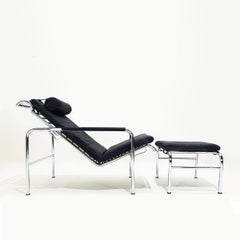
Sold
H 32.29 in W 22.84 in D 43.31 in
Black Leather and Chrome Gabriele Mucchi Genni Reclining Chair and Ottoman
By Gabriele Mucchi
Located in Highclere, Newbury
An outstanding black leather and chrome Genni reclining lounge chair with matching ottoman
Chrome
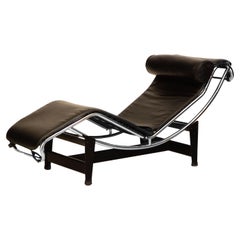
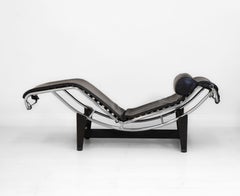
Sold
H 22.84 in W 21.26 in D 63.78 in
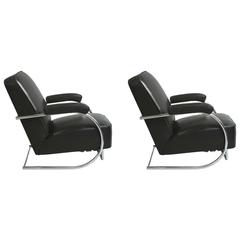
Vintage 1980s LC4 Leather & Chrome Le Corbusier Style Chaise Lounge Recliner
By Le Corbusier, Pierre Jeanneret, Charlotte Perriand Cassina
Located in Norwich, GB
Vintage LC4 Le Corbusier style black leather & chrome chaise longue. circa 1980. After the original, designed in 1929 by Charlotte Perriand and Le Corbusier. The chaise adjusts on t...
Chrome
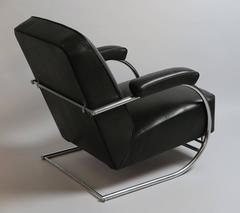
Anton Lorenz Reclining Lounge Chair, 1930s
By Anton Lorenz
Located in Bern, CH
1930s, attributed to Anton Lorenz, reupholstered in smooth black leather, support frame for the reclined
Chrome
$28,800Sale Price|25% Off
H 28 in W 28 in D 30 in
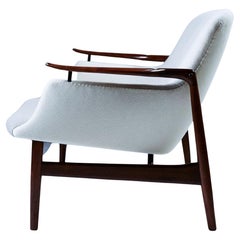
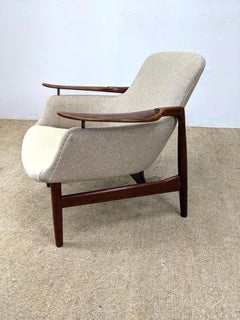
Finn Juhl NV-53, Original Rosewood Lounge Chair, Niels Vodder, Denmark, 1953
By Finn Juhl, Niels Vodder
Located in Brooklyn, NY
Finn Juhl NV-53, Original Rosewood Lounge Chair, Niels Vodder, Denmark, 1946 Finn Juhl originally designed the 53-series for master joiner Niels Vodder. It was introduced at the Cope...
Brass
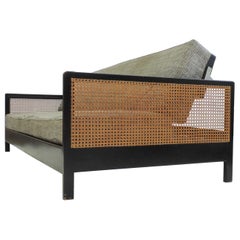
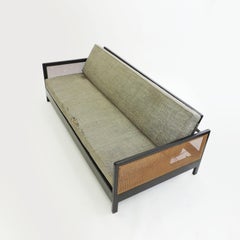
Werner Max Moser Sofa for Wohnbedarf, Switzerland, 1930s
By Werner Max Moser, Wohnbedarf
Located in Milan, IT
Rare Architect Werner Max Moser sofa for Wohnbedarf, Switzerland, 1930s.
Metal
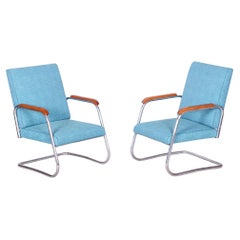
$4,052 / set
H 32.68 in W 23.23 in D 27.17 in
Restored Bauhaus Pair of Armchairs, Karel E. Ort, Hynek Gottwald, Czech, 1930s
By Hynek Gottwald, Karel Ort
Located in Brandys nad Labem, Středočeský kraj
Restored Bauhaus Pair of Armchairs. Designer: Karel E. Ort Maker: Hynek Gottwald Source: Czechia (Czehoslovakia) Period: 1930-1939 Material: Chrome-plated Steel, Fabric Newly profe...
Steel, Chrome
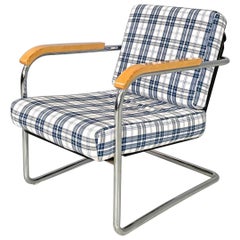
$2,337
H 26.78 in W 23.23 in D 31.5 in
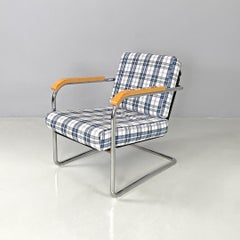
Swiss blue tartan and white armchair 1435 by Werner Max Moser for Embru, 2000s
By Embru, Werner Max Moser
Located in MIlano, IT
Swiss blue tartan and white armchair 1435 by Werner Max Moser for Embru, 2000s Armchair mod. 1435 with a rectangular base. The seat and backrest are composed of two padded cushions c...
Metal
$2,067
H 25.99 in W 23.23 in D 30.32 in
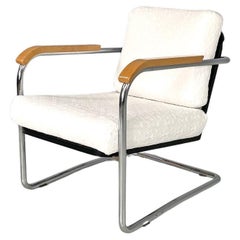
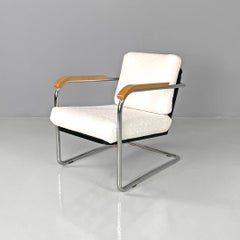
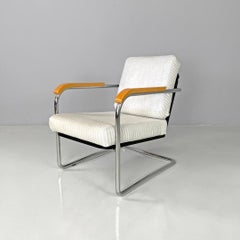
Swiss white fabric and metal armchair 1435 by Werner Max Moser for Embru, 2000s
By Werner Max Moser, Embru
Located in MIlano, IT
Swiss white fabric and metal armchair 1435 by Werner Max Moser for Embru, 2000s Armchair mod. 1435 with a rectangular base. The seat and backrest are composed of two padded cushions ...
Metal
$2,584
H 27.56 in W 23.23 in D 31.5 in
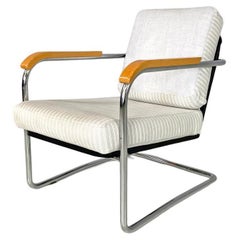
Swiss striped light blue armchair 1435 by Werner Max Moser for Embru, 2000s
By Werner Max Moser, Embru
Located in MIlano, IT
Swiss striped light blue armchair 1435 by Werner Max Moser for Embru, 2000s Armchair mod. 1435 with a rectangular base. The seat and backrest are made up of two padded cushions cover...
Metal
The Bauhaus was a progressive German art and design school founded by the architect Walter Gropius that operated from 1919 to 1933. Authentic Bauhaus furniture — sofas, dining chairs, tables and more — and the school’s followers married industrial and natural materials in simple, geometric forms. The goal of the Bauhaus was to erase the distinction between art and craft while embracing the use of new technologies and materials.
ORIGINS OF BAUHAUS FURNITURE DESIGN
CHARACTERISTICS OF BAUHAUS FURNITURE DESIGN
BAUHAUS FURNITURE DESIGNERS YOU SHOULD KNOW
AUTHENTIC BAUHAUS FURNITURE ON 1STDIBS
The name Bauhaus is derived from the German verb bauen, “to build.” Under the school’s innovative curriculum, students were taught the fine arts, such as painting and sculpture, as well as practical skills like carpentry and metalworking.
The school moved from Weimar in 1925 to the city of Dessau, where it enjoyed its heyday under Gropius, then Hannes Meyer and Ludwig Mies van der Rohe. The period from 1932 to 1933 when it operated in Berlin under Mies was its final chapter. Despite its brief existence, the Bauhaus has had an enduring impact on art and design in the United States and elsewhere, and is regarded by many as the 20th century’s chief crucible of modernism.
The faculty roster at the Bauhaus reads like a who’s who of modernist creative genius — it included such artists as Paul Klee, Wassily Kandinsky and László Moholy-Nagy along with architects and designers like Mies and Marcel Breuer, who became known for his muscular brutalist-style concrete buildings in the postwar years. In 1925, while he was head of the Bauhaus carpentry workshop, Breuer gave form to his signature innovation: the use of lightweight tubular-steel frames for chairs, side tables and sofas — a technique soon adopted by Mies and others. Breuer’s Cesca chair was the first-ever tubular steel frame chair with a caned seat to be mass produced, while the inspiration for his legendary Wassily chair, a timeless design and part of the collection crafted to furnish the Dessau school, was the bike he rode around campus.
Bauhaus design style reflects the tenets by which these creators worked: simplicity, clarity and function. They disdained superfluous ornament in favor of precise construction. Seating pieces such as side chairs, armchairs or club chairs for example, were made with tubular metal or molded plywood frames, and upholstery was made from leather or cane. Above all, designs in the Bauhaus style offer aesthetic flexibility. They can be the elements of a wholly spare, minimalist space, the quiet foundation of an environment in which color and pattern come from one’s own collection of art and artifacts.
Today, from textiles to typefaces, architecture, furniture and decorative objects for the home, Bauhaus creations continue to have an outsize influence on modern design.
Find a collection of authentic Bauhaus furniture on 1stDibs.
With entire areas of our homes reserved for “sitting rooms,” the value of quality antique and vintage seating cannot be overstated.
Fortunately, the design of side chairs, armchairs and other lounge furniture — since what were, quite literally, the early perches of our ancestors — has evolved considerably.
Among the earliest standard seating furniture were stools. Egyptian stools, for example, designed for one person with no seat back, were x-shaped and typically folded to be tucked away. These rudimentary chairs informed the design of Greek and Roman stools, all of which were a long way from Sori Yanagi's Butterfly stool or Alvar Aalto's Stool 60. In the 18th century and earlier, seats with backs and armrests were largely reserved for high nobility.
The seating of today is more inclusive but the style and placement of chairs can still make a statement. Antique desk chairs and armchairs designed in the style of Louis XV, which eventually included painted furniture and were often made of rare woods, feature prominently curved legs as well as Chinese themes and varied ornaments. Much like the thrones of fairy tales and the regency, elegant lounges crafted in the Louis XV style convey wealth and prestige. In the kitchen, the dining chair placed at the head of the table is typically reserved for the head of the household or a revered guest.
Of course, with luxurious vintage or antique furnishings, every chair can seem like the best seat in the house. Whether your preference is stretching out on a plush sofa, such as the Serpentine, designed by Vladimir Kagan, or cozying up in a vintage wingback chair, there is likely to be a comfy classic or contemporary gem for you on 1stDibs.
With respect to the latest obsessions in design, cane seating has been cropping up everywhere, from sleek armchairs to lounge chairs, while bouclé fabric, a staple of modern furniture design, can be seen in mid-century modern, Scandinavian modern and Hollywood Regency furniture styles.
Admirers of the sophisticated craftsmanship and dark woods frequently associated with mid-century modern seating can find timeless furnishings in our expansive collection of lounge chairs, dining chairs and other items — whether they’re vintage editions or alluring official reproductions of iconic designs from the likes of Hans Wegner or from Charles and Ray Eames. Shop our inventory of Egg chairs, designed in 1958 by Arne Jacobsen, the Florence Knoll lounge chair and more.
No matter your style, the collection of unique chairs, sofas and other seating on 1stDibs is surely worthy of a standing ovation.