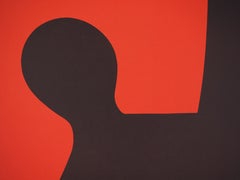
Find the exact calder 1969 you’re shopping for in the variety available on 1stDibs. You can easily find an example made in the
Abstract style, while we also have 63
Abstract versions to choose from as well. You’re likely to find the perfect calder 1969 among the distinctive items we have available, which includes versions made as long ago as the 20th Century as well as those made as recently as the 20th Century. When looking for the right calder 1969 for your space, you can search on 1stDibs by color — popular works were created in bold and neutral palettes with elements of
gray,
beige,
white and
brown. There have been many interesting calder 1969 examples over the years, but those made by
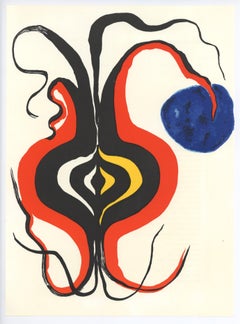
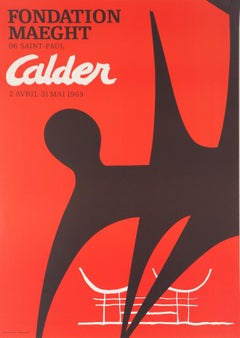
Alexander Calder and
(after) Alexander Calder are often thought to be among the most thought-provoking. Artworks like these of any era or style can make for thoughtful decor in any space, but a selection from our variety of those made in
lithograph,
paper and
paint can add an especially memorable touch.
The American sculptor Alexander Calder is known as the father of the mobile, a moving artwork composed of delicately balanced sculptural forms suspended from the ceiling.
Because Calder's parents, both artists themselves, did not want him to suffer the hardships of trying to make a living in art, they encouraged the young Calder to study mechanical engineering at the Stevens Institute of Technology, in Hoboken, New Jersey. He worked a number of jobs, including as a hydraulic engineer and draftsman for the New York Edison Company, before deciding to pursue an artistic career. He never abandoned his engineering background, however, applying his understanding of gears and moving parts in all his artworks, from mechanical toys like the Cirque Calder (1931) and his revered prints to his free-standing abstract sculptures, called stabiles.
In 1926, Calder moved to Paris and established a studio in the Montparnasse quarter. He began creating the many parts of his famous miniature circus from found materials, such as wire, string, cloth, rubber and cork. Designed to be transportable, Cirque grew to fill five suitcases over the years. Always interested in putting forms in motion, Calder also pioneered a new art form called wire sculptures, which he described as “drawings in space.” Like his famous mobiles, the wire sculptures were suspended so that they turned with any movement of the air, presenting different forms when viewed from different angles.
In the 1950s, Calder returned to his roots in mechanical engineering, creating monumental abstract sculptures that verged on the architectural. He worked from loose gestural drawings like this preparatory sketch for his Man Stabile, from 1966. Throughout his career, he also worked as a set designer for the theater, as well as an illustrator and printmaker, producing vibrant, whimsical drawings for books and journals.
Find original Alexander Calder art today on 1stDibs.
Decorating with fine art prints — whether they’re figurative prints, abstract prints or another variety — has always been a practical way of bringing a space to life as well as bringing works by an artist you love into your home.
Pursued in the 1960s and ’70s, largely by Pop artists drawn to its associations with mass production, advertising, packaging and seriality, as well as those challenging the primacy of the Abstract Expressionist brushstroke, printmaking was embraced in the 1980s by painters and conceptual artists ranging from David Salle and Elizabeth Murray to Adrian Piper and Sherrie Levine.
Printmaking is the transfer of an image from one surface to another. An artist takes a material like stone, metal, wood or wax, carves, incises, draws or otherwise marks it with an image, inks or paints it and then transfers the image to a piece of paper or other material.
Fine art prints are frequently confused with their more commercial counterparts. After all, our closest connection to the printed image is through mass-produced newspapers, magazines and books, and many people don’t realize that even though prints are editions, they start with an original image created by an artist with the intent of reproducing it in a small batch. Fine art prints are created in strictly limited editions — 20 or 30 or maybe 50 — and are always based on an image created specifically to be made into an edition.
Many people think of revered Dutch artist Rembrandt as a painter but may not know that he was a printmaker as well. His prints have been preserved in time along with the work of other celebrated printmakers such as Pablo Picasso, Salvador Dalí and Andy Warhol. These fine art prints are still highly sought after by collectors.
“It’s another tool in the artist’s toolbox, just like painting or sculpture or anything else that an artist uses in the service of mark making or expressing him- or herself,” says International Fine Print Dealers Association (IFPDA) vice president Betsy Senior, of New York’s Betsy Senior Fine Art, Inc.
Because artist’s editions tend to be more affordable and available than his or her unique works, they’re more accessible and can be a great opportunity to bring a variety of colors, textures and shapes into a space.
For tight corners, select small fine art prints as opposed to the oversized bold piece you’ll hang as a focal point in the dining area. But be careful not to choose something that is too big for your space. And feel free to lean into it if need be — not every work needs picture-hanging hooks. Leaning a larger fine art print against the wall behind a bookcase can add a stylish installation-type dynamic to your living room. (Read more about how to arrange wall art here.)
Find fine art prints for sale on 1stDibs today.