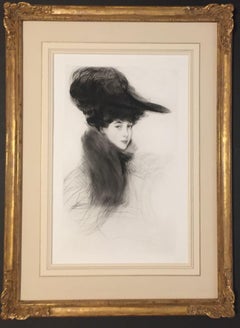
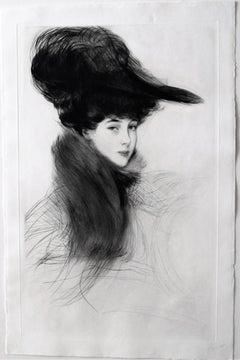
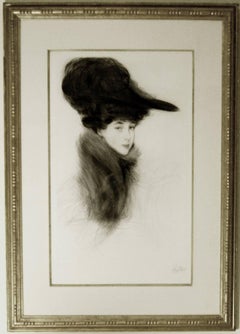
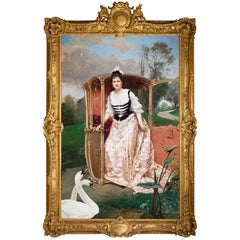
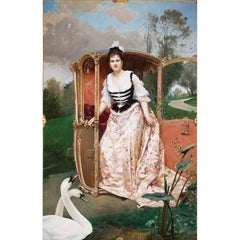
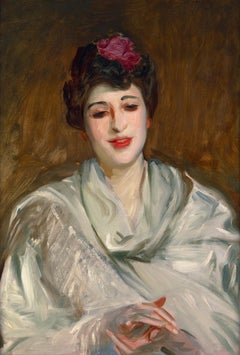
Rich impression with dramatic drypoint burr and tone no other artist epitomizes the whole atmosphere of elegance and hedonistic pleasure which pervaded Paris society at the first decade of the century as does Helleu. A close friend of Proust and the inspiration for one of the principal characters in La Recherche du Temps Perdu, Helleu’s whole life style echoed the incomparable elegance and flow of his drawing, the sheer style of his art, and his eye for the poses of the beautiful women who were his friends and his patrons. During the 1870’s, Helleu had come to know the painters of Impressionism and also artists Sargent and Whistler who became his special friends and inspiration. By the early 1880’s, he had already developed the quality of expressive sweeping line, which is the essence of his drawing, but in 1885 he was encouraged by Tissot to try working on prints in drypoint. At this time, Tissot had decided, after the death of his lover and model Kathleen Newton, to travel to the Holy Land on an artistic pilgrimage. Having decided he would no longer engrave, he gave Helleu his diamond stylus…a literal and figurative “passing of the baton”. It was in the incision and texture of drypoint that his art was to reach one of its greatest peaks. He had an innate feel for the balance between a lightly curving stroke and the deeply cut highly tonal burr of the strongest drypoint. Around the turn of the century he started to combine drypoint with multi-inking in colors, the areas of color restricted to such touches as the bows on the hats, the hair color or the red of the lips. The plate was drawn at a single sitting, and then the color inks were brushed onto it. The results are some of the most splendid and decorative of all Belle Époque prints.
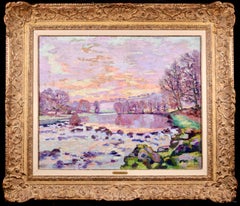
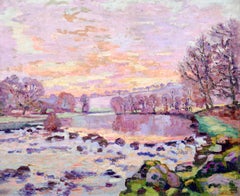
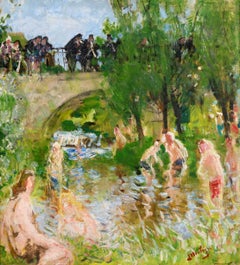
Emerging in 19th-century France, Impressionist art embraced loose brushwork and plein-air painting to respond to the movement of daily life. Although the pioneers of the Impressionist movement — Claude Monet, Edgar Degas, Paul Cézanne, Berthe Morisot, Camille Pissarro, and Pierre-Auguste Renoir — are now household names, their work was a radical break with an art scene led and shaped by academic traditions for around two centuries. These academies had oversight of a curriculum that emphasized formal drawing, painting and sculpting techniques and historical themes.
The French Impressionists were influenced by a group of artists known as the Barbizon School, who painted what they witnessed in nature. The rejection of pieces by these artists and the later Impressionists from the salons culminated in a watershed 1874 exhibition in Paris that was staged outside of the juried systems. After a work of Monet’s was derided by a critic as an unfinished “impression,” the term was taken as a celebration of their shared interest in capturing fleeting moments as subject matter, whether the shifting weather on rural landscapes or the frenzy of an urban crowd. Rather than the exacting realism of the academic tradition, Impressionist paintings, sculptures, prints and drawings represented how an artist saw a world in motion.
Many Impressionist painters were inspired by the perspectives in imported Japanese prints alongside these shifts in European painting — Édouard Manet drew on ukiyo-e woodblock prints and depicted Japanese design in his Portrait of Émile Zola, for example. American artists such as Mary Cassatt and William Merritt Chase, who studied abroad, were impacted by the work of the French artists, and by the late 19th century American Impressionism had its own distinct aesthetics with painters responding to the rapid modernization of cities through quickly created works that were vivid with color and light.
Find a collection of authentic Impressionist art on 1stDibs.
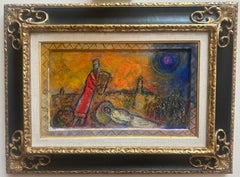
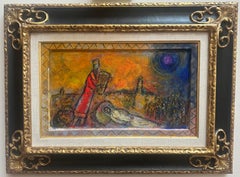
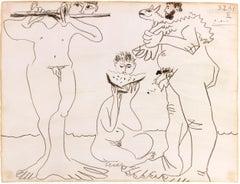
Bring energy and an array of welcome colors and textures into your space by decorating with figurative fine-art prints and works on paper.
Figurative art stands in contrast to abstract art, which is more expressive than representational. The oldest-known work of figurative art is a figurative painting — specifically, a rock painting of an animal made over 40,000 years ago in Borneo. This remnant of a remote past has long faded, but its depiction of a cattle-like creature in elegant ocher markings endures.
Since then, figurative art has evolved significantly as it continues to represent the world, including a breadth of works on paper, including printmaking. This includes woodcuts, which are a type of relief print with perennial popularity among collectors. The artist carves into a block and applies ink to the raised surface, which is then pressed onto paper. There are also planographic prints, which use metal plates, stones or other flat surfaces as their base. The artist will often draw on the surface with grease crayon and then apply ink to those markings. Lithographs are a common version of planographic prints.
Figurative art printmaking was especially popular during the height of the Pop art movement, and this kind of work can be seen in artist Andy Warhol’s extensive use of photographic silkscreen printing. Everyday objects, logos and scenes were given a unique twist, whether in the style of a comic strip or in the use of neon colors.
Explore an impressive collection of figurative art prints for sale on 1stDibs and read about how to arrange your wall art.