

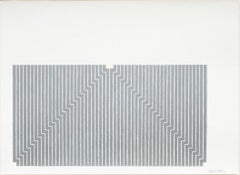
Del Mar, from Race Track Series
By Frank Stella
Located in Miami, FL
Del Mar, from Race Track Series 1972 Screenprint 20 1/4 x 80 in.
Category
1970s Minimalist Abstract Prints
Materials
Screen
Del Mar, from Race Track Series
By Frank Stella
Located in Miami, FL
Del Mar, from Race Track Series 1972 Screenprint 20 1/4 x 80 in.
Screen

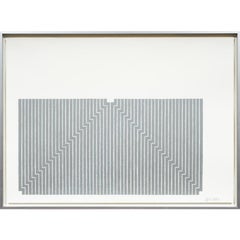
Frank Stella 'Del Mar' Screenprint 1972
By Frank Stella
Located in Miami, FL
Frank Stella 'Del Mar' from Race Track screenprint in colors, on Gemini Rag board, 1972, signed and dated in pencil, numbered 53/75 (there were also nine artist's proofs), published ...
Screen
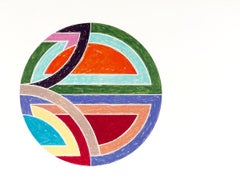
Sinjerli Variation I
By Frank Stella
Located in New York, NY
From the artist's Sinjerli Variations series created in 1977, this original print by Frank Stella was created as a lithograph and screenprint in colors on Arches paper. Hand-signed i...
Lithograph, Screen
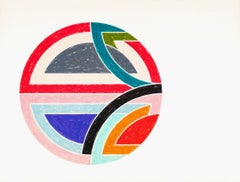

Sinjerli Variation Ia
By Frank Stella
Located in New York, NY
From the artist's Sinjerli Variations series created in 1977, Frank Stella created this original print as a lithograph and screenprint in colors on Arches paper. Hand-signed in penci...
Lithograph, Screen


$35,000
H 38.5 in W 38 in
Polar Co-ordinates Variant Ia, from Polar Co-ordinates for Ronnie Peterson
By Frank Stella
Located in Palo Alto, CA
Frank Stella Polar Co-ordinates Variant Ia, from Polar Co-ordinates for Ronnie Peterson, 1980 is a print that is from the Polar Coordinates for Ronnie Peterson series. Using the titl...
Lithograph, Screen


Op Art Shaped Canvas Painting Circa 1960s
By Frank Stella
Located in Peabody, MA
A colorful shaped op-art canvas, ca. 1960s, in the manner of Frank Stella, Al Loving, Paul Reed, etc.
Paint


Fortin de las Flores
By Frank Stella
Located in Toronto, Ontario
Frank Stella's work references many of the key developments or movements in post-war American art; Op Art, hard-edge abstraction, conceptual art, and Minimalism. His iconic concentri...
Lithograph
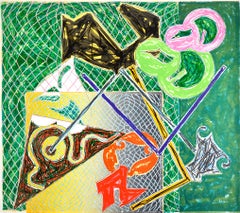
Shards V
By Frank Stella
Located in New York, NY
Lithograph and screenprint on Arches cover, Signed and dated
Lithograph
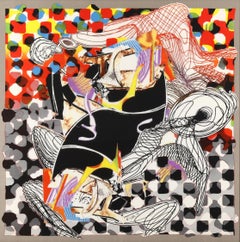
The Whale Watch
By Frank Stella
Located in New York, NY
A remarkably printed work of art, created by Frank Stella in collaboration with master-printer, Ken Tyler of Tyler Graphics Limited, The Whale Watch is a beautifully colored screenpr...
Screen, Silk
Nemrik, from The Near East Series
By Frank Stella
Located in Palo Alto, CA
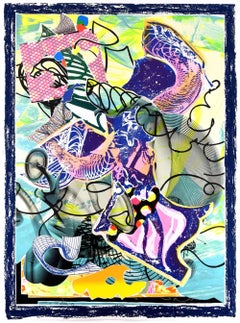
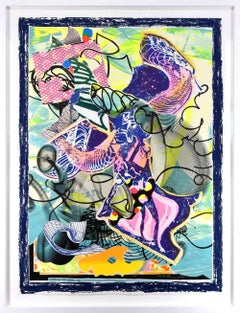
Frank Stella Nemrik, from the Near East Series, 1999 is a chaotically vibrant work that encapsulates Stella’s abstract style so poignantly. Using a mix of bright, neon colors, Stella...
Handmade Paper, Etching, Screen, Engraving, Lithograph, Stencil
$15,200Sale Price|20% Off
H 16.25 in W 28.875 in
Frank Stella Black Adder 1968 Signed Serigraph Edition of 100
By Frank Stella
Located in Minneapolis, MN
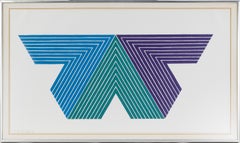
Artist: Frank Stella Title: Black Adder Medium: Serigraph on Paper Year: 1968 Sheet Size: 16.25" x 28.875" Frame Size: 16.75" x 31.5" Edition: TP VI (trail proof 6) outside of the st...
Paper, Screen
$2,800
H 38 in W 23 in
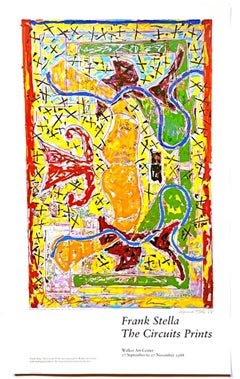
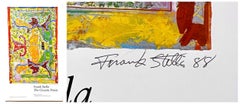
Limited Edition Walker Art Center exhibition print, Hand Signed by Frank Stella
By Frank Stella
Located in New York, NY
Frank Stella Frank Stella The Circuit Prints (Hand Signed), 1988 Color offset lithograph poster (hand signed by Frank Stella) Signed and dated 88 in ink by Frank Stella directly unde...
Lithograph, Offset
$55,000
H 53.1 in W 52.4 in
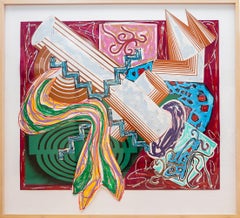
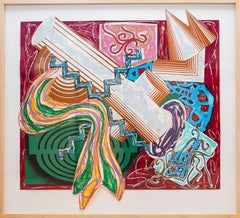
FRANK STELLA Then Came a Stick and Beat the Dog, El Lissitzky's Had Gadya 1984
By Frank Stella
Located in Rancho Santa Fe, CA
Frank Stella's 1984 print "Then Came a Stick and Beat the Dog, Illustrations After El Lissitzky's Had Gadya" shows the artist's maximalist approach to abstraction and his interest in...
Paper, Mixed Media, Lithograph, Linocut, Screen
$12,500
H 16 in W 22 in
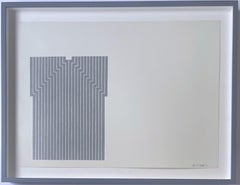
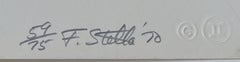
Frank Stella, Luis Miguel Dominguin, print from Aluminum Series, Signed/N Framed
By Frank Stella
Located in New York, NY
Elegantly framed and ready to hang! Frank Stella Luis Miguel Dominguin, from the Aluminum Series Lithograph and silkscreen in gray and silver on Special Arjomari paper Signed, dated...
Lithograph, Screen
Going Abroad (From The Waves II Series)
By Frank Stella
Located in Palo Alto, CA
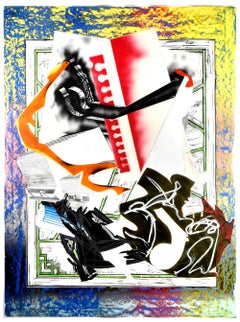
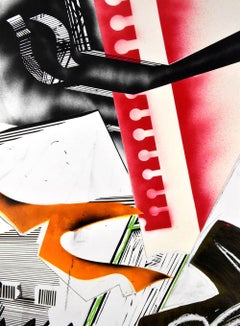
Frank Stella’s Going Abroad (From The Waves Series), 1989 recalls the post-painterly abstraction that has become a hallmark of Stella’s style. This screenprint demonstrates the artis...
Lithograph, Linocut, Screen
$8,000
H 17 in W 23.25 in D 1 in
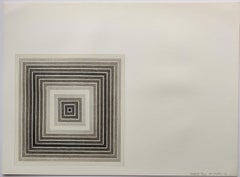
Frank Stella 'Union Pacific' from Aluminum Series, Limited Edition, Signed Print
By Frank Stella
Located in San Rafael, CA
Frank Stella (American, 1936-2024) 'Union Pacific' (from the Aluminum Series), 1970 Lithograph and screenprint in metallic silver on Special Arjomari paper Edition 33/75 (there were ...
Lithograph

$6,900
H 16.15 in W 21.89 in
Frank Stella -- Sharpesville, from Multicolored Squares I
By Frank Stella
Located in BRUCE, ACT
Frank Stella Sharpesville, from Multicolored Squares I, 1972 Lithograph Hang signed and numbered A.P. 3 /20 lower right Image size: 26.1 x 26.1 cm Sheet size: 41 x 55.6 cm Published...
Lithograph
$400,000
H 99 in W 132 in D 10 in
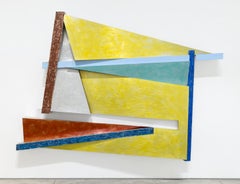
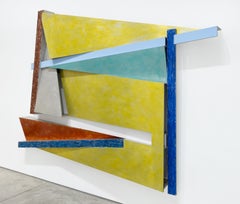
Tijuca #10 - High Relief Aluminum Abstract Painting, 1978
By Frank Stella
Located in Palm Desert, CA
'Tijuca #10' (1978) is an exceptional large-scale relief painting that marks a pivotal moment in Frank Stella’s evolution from Minimalist restraint to the bold, three-dimensional max...
Metal
Frank Stella was one of the central figures in postwar American art. A proponent of minimalism and non-representational abstraction, Stella was a painter, printmaker and sculptor.
A native of Massachusetts, Stella attended Phillips Academy in Andover and earned a BA from Princeton, where he studied art and color theory with Josef Albers and Hans Hofmann. Stella frequented New York galleries as a student and was intrigued by the work of Jackson Pollock and Franz Kline, both of whom were at the height of their creative powers in the late 1950s.
After moving to New York in 1958, Stella gravitated toward the geometric abstraction and restrained painting style of Barnett Newman and Jasper Johns.
Johns’s flat, graphic images of common objects such as targets and flags prompt viewers to question the essential nature of representation and whether these pictures are really paintings or simply new iterations of the items themselves. Stella pushed Johns’s reasoning further, considering paintings on canvas as objects in their own right, like sculptures, rather than representations. This led him to reject certain formal conventions, eschewing sketches and often using nontraditional materials, like house paint.
In 1959, Stella created his “Black Paintings,” series, in which bands of black paint are separated by thin, precise stripes of bare canvas. At a time when contemporary painting was all about wild gestures, thick paint and formal abandon, these pieces created a sensation. That same year, Stella's work was included in the exhibition "Sixteen Americans" at the Museum of Modern Art in New York, and he joined the roster of artists represented by Leo Castelli Gallery. In 1960, he began introducing color into his work and using unconventionally shaped canvases to complement his compositions.
In his “Eccentric Polygon” series, from 1965 and ‘66, Stella embraces asymmetry and bold color, creating forms delineated by painted fields and by the edges of the canvas. This series was followed by the 1967–70 “Protractor” series, characterized by colorful circles and arcs. Named after the ancient cities whose circular plans Stella had noticed while traveling in the Middle East during the 1960s, these works usually comprised several canvases set flush against one another so that the geometric figures in each section came together in a larger, more complex whole.
Also in the mid-1960s, Stella started exploring printmaking, initially working with Kenneth Tyler, of Gemini G.E.L., and later installing printing equipment in his own studio. In 1968, he created the “V” series of lithographs, which included the print Quathlamba I. Following a solo exhibition at the Museum of Modern Art in 1970, Stella began working in three dimensions, adding relief elements to paintings, which could almost be considered wall-mounted sculptures.
Stella’s 1970–73 “Polish Village” series was inspired by documentary photos and architectural drawings of Polish synagogues that had been destroyed by Nazis during World War II. The resulting works — composed primarily of paint and cloth on plywood — are more rugged and less polished than his previous series.
Herman Melville's Moby Dick was Stella's muse for a series of three- dimensional works he created in the 1980s in which waveforms, architectural elements and Platonic solids play a prominent role. During this period, Stella embraced a new, exuberant style that is exemplified in "La Scienza della Fiacca."
In 1997, the artist oversaw the creation of the Stella Project, a 5,000-square-foot work inside the Moores Opera House at the University of Houston. A large free-standing sculpture by Stella stands outside the National Gallery of Art in Washington, D.C.
Stella’s work is in the collections of numerous important museums around the world, including New York’s Museum of Modern Art and Metropolitan Museum of Art; the Menil Collection, in Houston; the Hirshhorn Museum and Sculpture Garden, in Washington, D.C.; and the San Francisco Museum of Modern Art. He was awarded the National Medal of Arts by President Obama in 2009, and was given the Lifetime Achievement Award in Contemporary Sculpture by the International Sculpture Center in 2011.
Find original Frank Stella art for sale on 1stDibs.
Decorating with fine art prints — whether they’re figurative prints, abstract prints or another variety — has always been a practical way of bringing a space to life as well as bringing works by an artist you love into your home.
Pursued in the 1960s and ’70s, largely by Pop artists drawn to its associations with mass production, advertising, packaging and seriality, as well as those challenging the primacy of the Abstract Expressionist brushstroke, printmaking was embraced in the 1980s by painters and conceptual artists ranging from David Salle and Elizabeth Murray to Adrian Piper and Sherrie Levine.
Printmaking is the transfer of an image from one surface to another. An artist takes a material like stone, metal, wood or wax, carves, incises, draws or otherwise marks it with an image, inks or paints it and then transfers the image to a piece of paper or other material.
Fine art prints are frequently confused with their more commercial counterparts. After all, our closest connection to the printed image is through mass-produced newspapers, magazines and books, and many people don’t realize that even though prints are editions, they start with an original image created by an artist with the intent of reproducing it in a small batch. Fine art prints are created in strictly limited editions — 20 or 30 or maybe 50 — and are always based on an image created specifically to be made into an edition.
Many people think of revered Dutch artist Rembrandt as a painter but may not know that he was a printmaker as well. His prints have been preserved in time along with the work of other celebrated printmakers such as Pablo Picasso, Salvador Dalí and Andy Warhol. These fine art prints are still highly sought after by collectors.
“It’s another tool in the artist’s toolbox, just like painting or sculpture or anything else that an artist uses in the service of mark making or expressing him- or herself,” says International Fine Print Dealers Association (IFPDA) vice president Betsy Senior, of New York’s Betsy Senior Fine Art, Inc.
Because artist’s editions tend to be more affordable and available than his or her unique works, they’re more accessible and can be a great opportunity to bring a variety of colors, textures and shapes into a space.
For tight corners, select small fine art prints as opposed to the oversized bold piece you’ll hang as a focal point in the dining area. But be careful not to choose something that is too big for your space. And feel free to lean into it if need be — not every work needs picture-hanging hooks. Leaning a larger fine art print against the wall behind a bookcase can add a stylish installation-type dynamic to your living room. (Read more about how to arrange wall art here.)
Find fine art prints for sale on 1stDibs today.