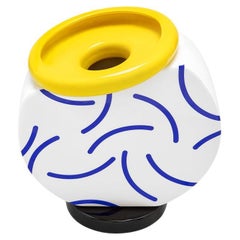
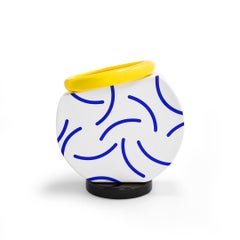
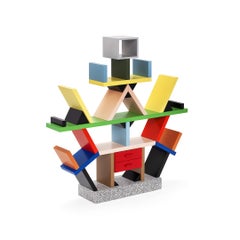
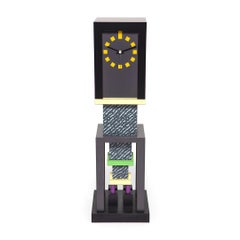
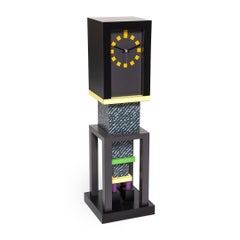
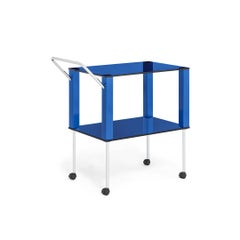
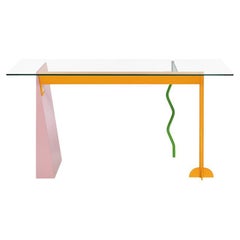
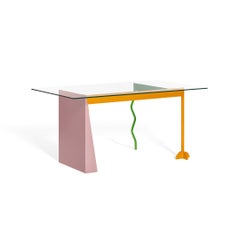
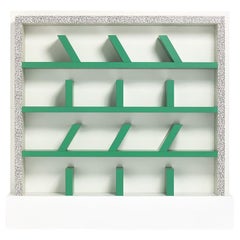
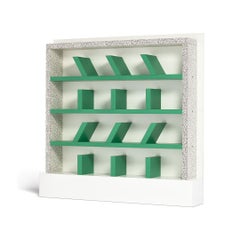
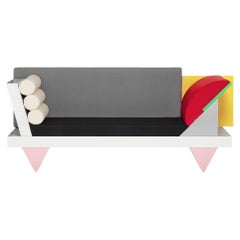
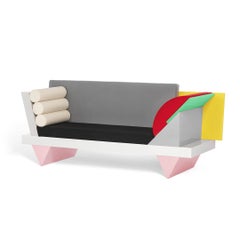
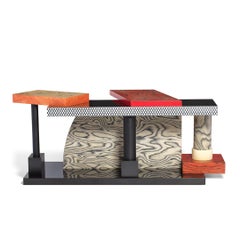
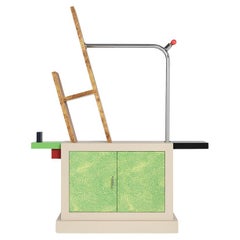
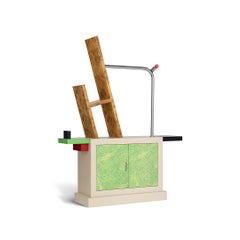
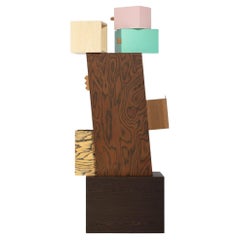
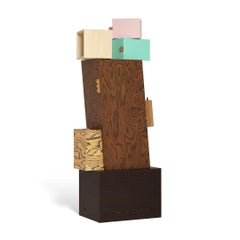
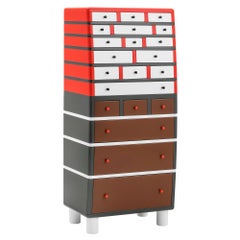
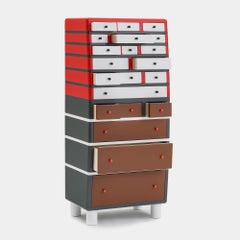
To many people, postmodern design is synonymous with the Memphis Group. This Italian collaborative created the most radical and attention-getting designs of the period, upending most of the accepted standards of how furniture should look. Today, the Memphis Milano brand, which is managed by Alberto Bianchi Albrici, still produces designs created by the group between 1981 and 1988.
The Memphis story begins in 1980, when Ettore Sottsass, then a beacon of Italian postmodernism, tapped a coterie of younger designers to develop a collection for the Milan Furniture Fair the next year, determined that all the new furniture they were then seeing was boring. Their mission: Boldly reject the stark minimalism of the 1970s and shatter the rules of form and function. (Sottsass’s Ultrafragola mirror, designed in 1970, embodied many of what would become the collective’s postmodern ideals.)
The group decided to design, produce and market their own collection, one that wouldn’t be restricted by concerns like functionality and so-called good taste. Its debut, at Milan’s 1981 Salone del Mobile, drew thousands of viewers and caused a major stir in design circles.
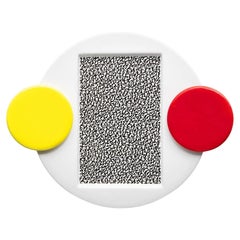
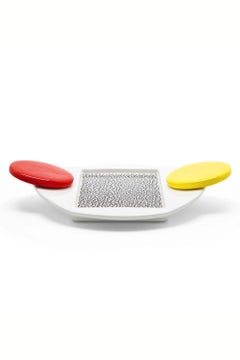
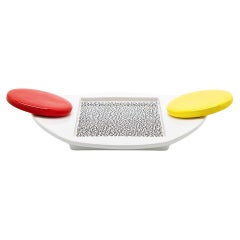
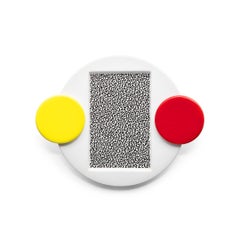
So as a record of Bob Dylan’s “Stuck Inside of Mobile” played on repeat, they took their name from the song, devised their marketing strategy and plotted the postmodern look that would come to define the decade of excess — primary colors, blown-up proportions, playful nods to Art Deco and Pop art. A high-low mix of materials also helped define Memphis, as evidenced by Javier Mariscal’s pastel serving trays, which feature laminate veneer — a material previously used only in kitchens — as well as Shiro Kuramata’s Nara and Kyoto tables made from colored glass-infused terrazzo.
An image of Sottsass posing with his collaborators in a conversation pit shaped like a boxing ring appeared in magazines all over the world, and Karl Lagerfield furnished his Monte Carlo penthouse entirely in Memphis furniture. Meanwhile, members like Andrea Branzi, Aldo Cibic, Michele de Lucchi, Nathalie du Pasquier, Kuramata, Paola Navone, Peter Shire, George Sowden, Sottsass and his wife, journalist Barbara Radice, went on to enjoy fruitful careers.
Some people think of the Milan-based collective as the design equivalent to Patrick Nagel’s kitschy screenprints, but for others Memphis represents what made the early 1980s so great: freedom of expression, dizzying patterns and off-the-wall colors.
Eventually, the Reagan era gave way to cool 1990s minimalism, and Memphis fell out of fashion. Sottsass left the group in 1985, and by 1987, it had disbanded. Yet decades later, Memphis is back and can be traced to today’s most exciting designers.
“As someone who was born in the 1980s, Memphis at times feels like the grown-up, artsy version of the toys I used to play with,” says Shaun Kasperbauer, cofounder of the Brooklyn studio Souda. “It feels a little nostalgic, but at the same time it seems like an aesthetic that’s perfectly suited to an internet age — loud, colorful and utilizing forms that are graphic and often a little unexpected.”
Find a collection of Memphis Milano seating, tables, decorative objects and other furniture on 1stDibs.
Your dining room table is a place where stories are shared and personalities shine — why not treat yourself and your guests to the finest antique and vintage glass, silver, ceramics and serveware for your meals?
Just like the people who sit around your table, your serveware has its own stories and will help you create new memories with your friends and loved ones. From ceramic pottery to glass vases, set your table with serving pieces that add even more personality, color and texture to your dining experience.
Invite serveware from around the world to join your table settings. For special occasions, dress up your plates with a striking Imari charger from 19th-century Japan or incorporate Richard Ginori’s Italian porcelain plates into your dining experience. Celebrate the English ritual of afternoon tea with a Japanese tea set and an antique Victorian kettle. No matter how big or small your dining area is, there is room for the stories of many cultures and varied histories, and there are plenty of ways to add pizzazz to your meals.
Add different textures and colors to your table with dinner plates and pitchers of ceramic and silver or a porcelain lidded tureen, a serving dish with side handles that is often used for soups. Although porcelain and ceramic are both made in a kiln, porcelain is made with more refined clay and is more durable than ceramic because it is denser. The latter is ideal for statement pieces — your tall mid-century modern ceramic vase is a guaranteed conversation starter. And while your earthenware or stoneware is maybe better suited to everyday lunches as opposed to the fine bone china you’ve reserved for a holiday meal, handcrafted studio pottery coffee mugs can still be a rich expression of your personal style.
“My motto is ‘Have fun with it,’” says author and celebrated hostess Stephanie Booth Shafran. “It’s yin and yang, high and low, Crate & Barrel with Christofle silver. I like to mix it up — sometimes in the dining room, sometimes on the kitchen banquette, sometimes in the loggia. It transports your guests and makes them feel more comfortable and relaxed.”
Introduce elegance at supper with silver, such as a platter from celebrated Massachusetts silversmith manufacturer Reed and Barton or a regal copper-finish flatware set designed by International Silver Company, another New England company that was incorporated in Meriden, Connecticut, in 1898. By then, Meriden had already earned the nickname “Silver City” for its position as a major hub of silver manufacturing.
At the bar, try a vintage wine cooler to keep bottles cool before serving or an Art Deco decanter and whiskey set for after-dinner drinks — there are many possibilities and no wrong answers for tableware, barware and serveware. Explore an expansive collection of antique and vintage glass, ceramics, silver and serveware today on 1stDibs.