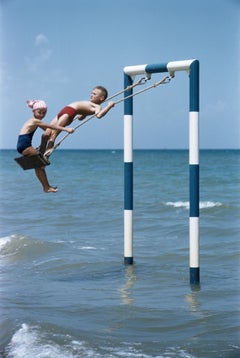
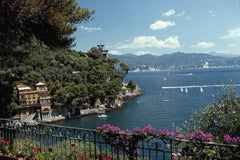
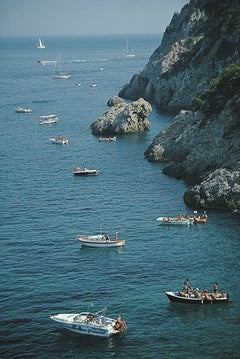
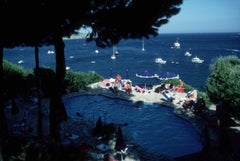
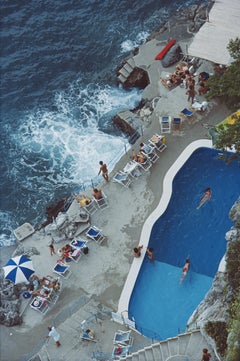
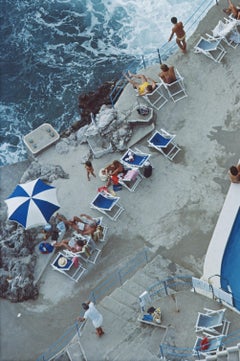
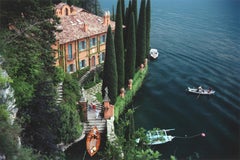
Find the exact slim aarons italian riviera you’re shopping for in the variety available on 1stDibs. Finding the perfect slim aarons italian riviera may mean sifting through those created during different time periods — you can find an early version that dates to the 20th Century and a newer variation that were made as recently as the 20th Century. If you’re looking to add a slim aarons italian riviera to create new energy in an otherwise neutral space in your home, you can find a work on 1stDibs that features elements of
black,
gray,
purple,
brown and more. These artworks were handmade with extraordinary care, with artists most often working in
digital print,
lambda print and
laser print.
American photographer Slim Aarons captured the 20th century’s international jet set — U.S. socialites, European royalty, Hollywood stars — at play in sun-kissed locales like Monaco, Saint-Tropez and Palm Beach, as well as other luxurious settings around the globe.
Committed to eschewing makeup and artificial lighting, Aarons created images that are at once candid and polished, combining the relaxed posture of his subjects, who trusted him to document their lives, with the visual sharpness of a seasoned art director. Having gotten his start taking pictures for the U.S. military magazine Yank during World War II, he contributed over the course of his career to Life, Town and Country and Holiday magazines and published several books.
Aarons was born in Manhattan in 1916. He joined the army at 18, shooting military maneuvers at West Point before serving as a combat photographer, for which he was awarded a Purple Heart. After the war, he moved to California and began snapping socialites and movie stars.
In the 1950s, Aarons opened a bureau for Life magazine in Rome, where he took pictures capturing the postwar scene. He was always able to win the trust of his elite subjects, who saw him as close to a peer, rather than a paparazzo.
In a 2002 interview with The Independent, Aarons remarked, ''I knew everyone. They would invite me to one of their parties because they knew I wouldn't hurt them. I was one of them.'' This access allowed him to document the rich and famous with their guard down, reading newspapers and magazines, talking on the phone, relaxing by the pool, and chatting with friends. The 1957 photograph The Kings of Hollywood, for example, which won him wide acclaim, shows Clark Gable, Van Heflin, Gary Cooper and Jimmy Stewart laughing together as they celebrate New Year’s Eve.
Many of Aarons’s best-known images involve games and sports. In the 1972 Poolside Backgammon, two young women play the board game of the title against the backdrop of a majestic Acapulco estate. In 1958’s Cannes Watersports, a couple attempts to glide across the Golfe de la Napoule on Jet Skis, one expertly and one hanging on for dear life. And in Penthouse Pool, shot in Athens in 1961, a young woman wearing a yellow bathing cap smiles coyly at the camera, surrounded by friends and brightly colored seat cushions, with the Acropolis faintly visible in the background.
Among Aarons’s books are 1974’s A Wonderful Time: An Intimate Portrait of the Good Life, and its 2003 sequel, Once Upon a Time. His final book, A Place in the Sun, was published in 2005, one year before his death.
Find a collection of vintage Slim Aarons photography on 1stDibs.
The first decades of the 20th century were a period of artistic upheaval, with modern art movements including Cubism, Surrealism, Futurism and Dadaism questioning centuries of traditional views of what art should be. Using abstraction, experimental forms and interdisciplinary techniques, painters, sculptors, photographers, printmakers and performance artists all pushed the boundaries of creative expression.
Major exhibitions, like the 1913 Armory Show in New York City — also known as the “International Exhibition of Modern Art,” in which works like the radically angular Nude Descending a Staircase by Marcel Duchamp caused a sensation — challenged the perspective of viewers and critics and heralded the arrival of modern art in the United States. But the movement’s revolutionary spirit took shape in the 19th century.
The Industrial Revolution, which ushered in new technology and cultural conditions across the world, transformed art from something mostly commissioned by the wealthy or the church to work that responded to personal experiences. The Impressionist style emerged in 1860s France with artists like Claude Monet, Paul Cézanne and Edgar Degas quickly painting works that captured moments of light and urban life. Around the same time in England, the Pre-Raphaelites, like Edward Burne-Jones and Dante Gabriel Rossetti, borrowed from late medieval and early Renaissance art to imbue their art with symbolism and modern ideas of beauty.
Emerging from this disruption of the artistic status quo, modern art went further in rejecting conventions and embracing innovation. The bold legacy of leading modern artists Georges Braque, Pablo Picasso, Frida Kahlo, Salvador Dalí, Henri Matisse, Joan Miró, Marc Chagall, Piet Mondrian and many others continues to inform visual culture today.
Find a collection of modern paintings, sculptures, prints and other fine art on 1stDibs.
Since the introduction of photography in the 19th century, it has been used to show the earth’s diverse landscapes. Modern and contemporary landscape photography continues to capture scenes of landscapes from around the world while becoming much more exploratory.
Historically, artists have played a key role in landscape preservation. Early 20th-century landscape photography provided a powerful argument for the establishment of the U.S. National Park Service a century ago, and iconic national park shots by Ansel Adams and Eliot Porter captured the public’s imagination and fueled conservation efforts.
The world of landscape photography has grown far more experimental in the last several decades, bolstered by innovative techniques and creative talents. Abstract landscape photography is often a thought-provoking exploration of bold, bleeding colors. To understand just how abstract these images can be, look no further than Jean-François Rauzier's outstanding landscape compositions.
A simpler style is offered by minimalist landscape photography and its subdued tones. These pieces tend to imbue their surroundings with a sense of serenity, making them an excellent addition to bedrooms and quiet living rooms. And like any other works of art that you’ve brought into your home, there are many ways to arrange photography in a space. Small areas, for example, are ideal for displaying more petite pieces. These can also be positioned in a cluster as a gallery wall. You can stand framed landscape photography on an easel, a mantelpiece, floating shelves or on the floor leaning against a wall.
Browse exquisite landscape photography on 1stDibs today and find an eye-catching image to complement any home or collection.